
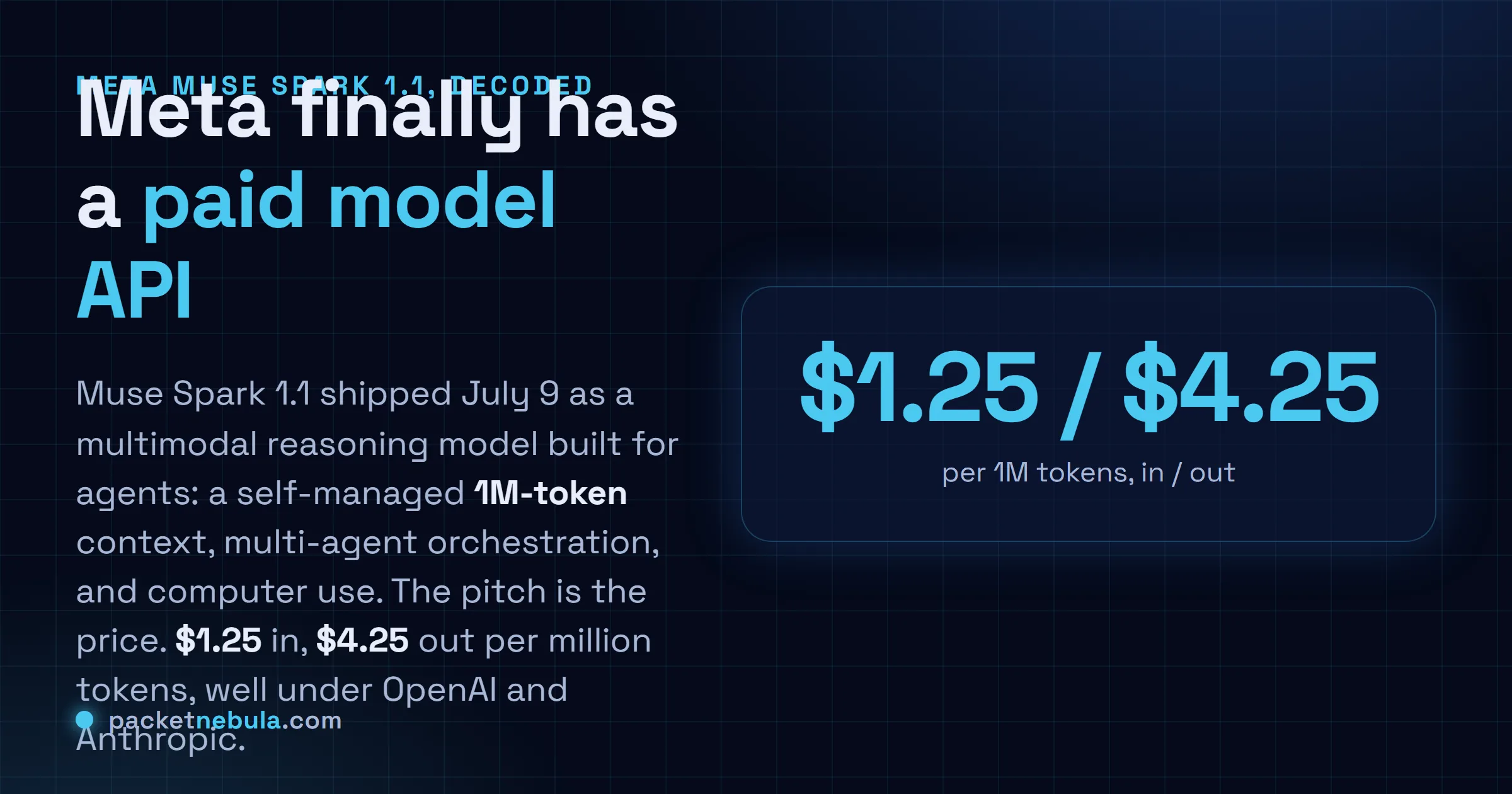
Meta spent years as the lab that gave its weights away, so watching it stand up a paid API is a small plot twist. On July 9 it shipped Muse Spark 1.1, and here's the one-liner we'd give a teammate: it's a multimodal reasoning model built for agents. A 1M-token context it manages itself. Multi-agent orchestration, plus computer use across apps. The hook isn't a benchmark, though. It's the invoice. $1.25 per million input tokens and $4.25 output, which lands well under OpenAI and Anthropic for the same rough tier. Meta's own numbers put it top of the tool-use charts, past Claude Opus 4.8 there, while it trails on the hard long-horizon coding test. So the real question isn't whether Meta can ship a frontier-ish model. It clearly can. It's whether the price makes the gaps worth living with, and whether you can even get at it yet.
The short answer
Muse Spark 1.1 landed July 9 as Meta’s first paid model API: a multimodal agentic model with a self-managed 1M-token context, multi-agent orchestration and computer use. It tops Meta’s tool-use benchmarks and beats Opus 4.8 there, but trails GPT-5.5 on long-horizon coding. The price is the pitch. The catch, for most of us: the developer API is a US-only preview at launch.
The pitch is the price
Meta building a paid model API at all is the story under the story. This is the company whose whole AI identity was open weights you could download and run yourself. Muse Spark 1.1 keeps a free consumer face, it runs in Thinking mode inside the Meta AI app and on meta.ai, but the new thing is a metered endpoint you pay for by the token. Joel Kaplan, Meta’s policy chief, framed it as “high intelligence at one of the best price points in the market,” which is marketing, sure, but the numbers back the price part.
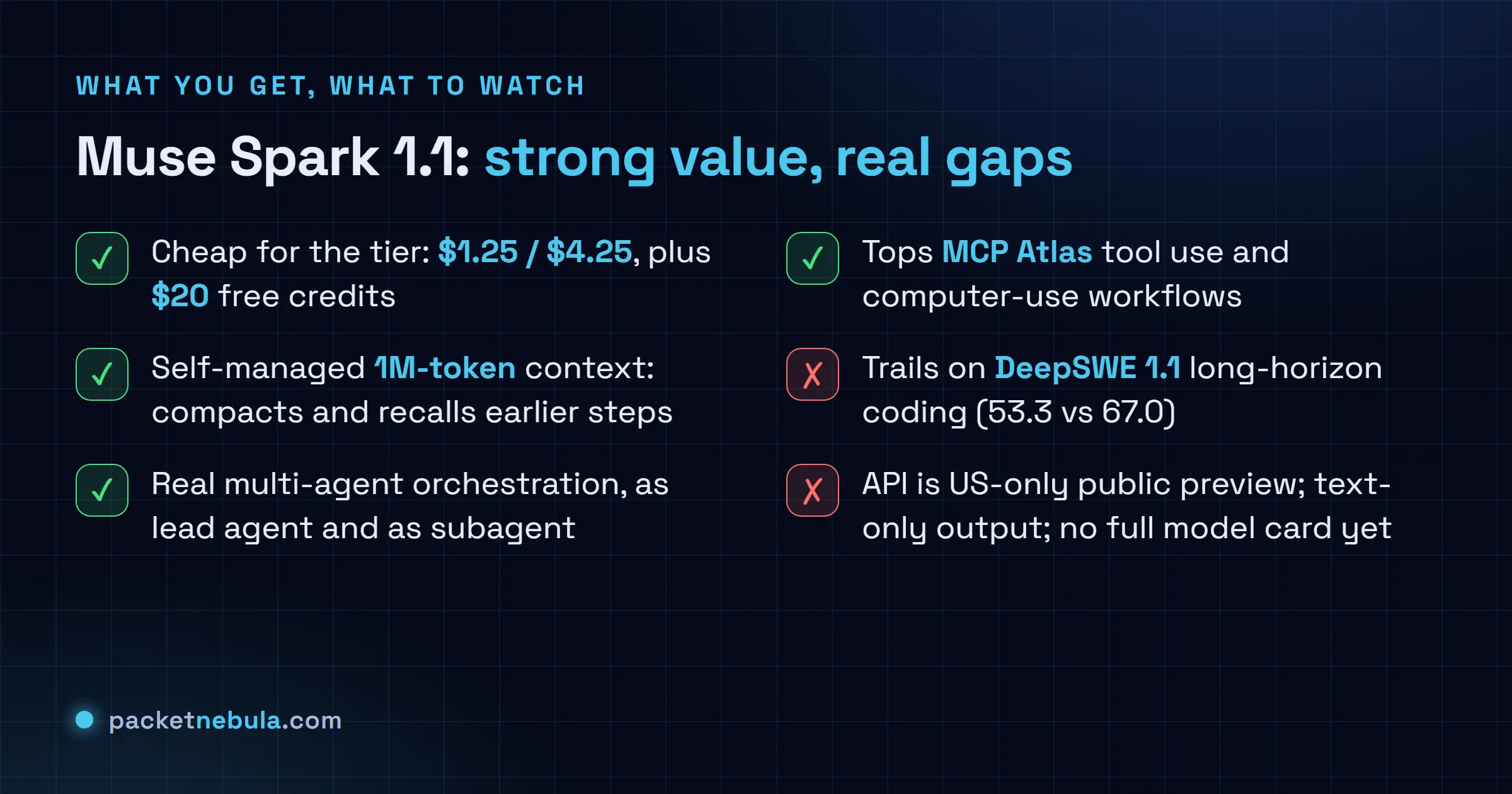
$1.25 per million input tokens. $4.25 output. For a model pitched at agent work, that sits comfortably under the frontier offerings from OpenAI and Anthropic, and Meta throws in $20 of free credits to get you in the door. It is not the absolute cheapest thing on the market. It is cheap for what it claims to be, which is a different and more interesting position.
What “agentic” actually means here
Every model calls itself agentic now, so the word has gone soft. Muse Spark 1.1 attaches some concrete things to it. First, that context window. A million tokens is not new on its own, plenty of models quote big numbers. What Meta claims is that the model actively manages the window: it recalls actions from early in a run and compacts the history so the important steps survive instead of scrolling off the top. For a long agent loop, that management is the part that usually breaks.
Second, orchestration. Muse Spark 1.1 is trained to run as a lead agent that plans and delegates across parallel subagents, and also to be a subagent itself, one that does a defined job and knows when to escalate. And computer use: it works across multiple apps with data changing under it, choosing between writing a script to automate something and just driving the interface directly.
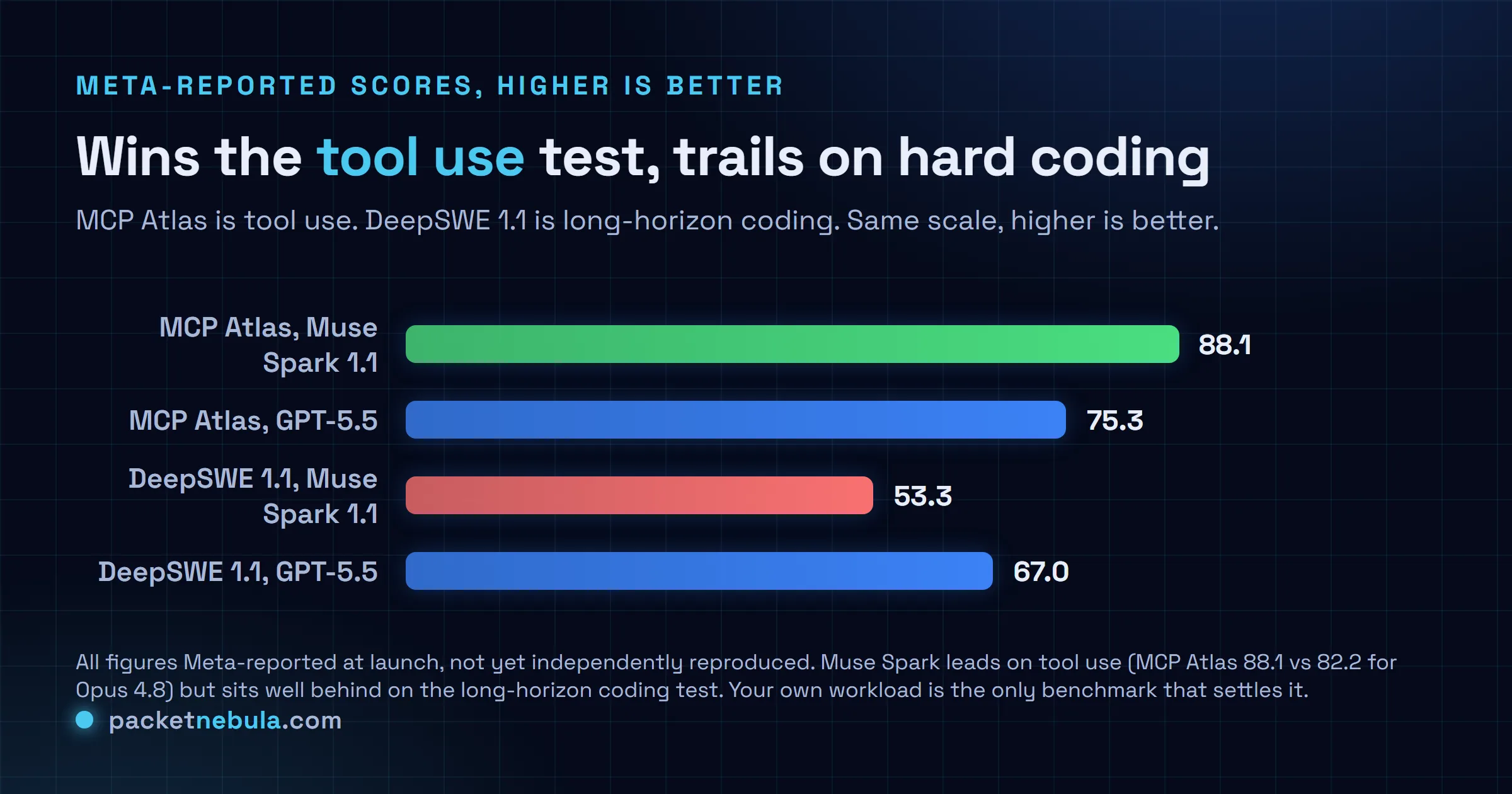
On paper that lines up with where its benchmarks are strong. Meta reports 88.1 on MCP Atlas, its tool-use test, against 82.2 for Claude Opus 4.8 and 75.3 for GPT-5.5. Tool use is exactly what an orchestration model needs to nail, so the shape of the results at least matches the pitch.
Image: Meta. Official Muse Spark 1.1 launch artwork.
Where it trails, and the catch
Now the honest column. On DeepSWE 1.1, the long-horizon coding test that measures resolving real, multi-step issues, Muse Spark 1.1 scores 53.3 against GPT-5.5’s 67.0. That is a real gap, not rounding. So the model that tops the tool-use chart sits well down the field on the hardest sustained coding. Read together, the picture is a model that’s excellent at driving tools and agents, and merely okay when the code change itself is deep and sprawling.
Two more things temper the excitement. The benchmarks are Meta-reported, run at launch, and nobody outside has reproduced them yet. Treat them as a starting claim, not a verdict. And the practical blocker: the developer API shipped as a public preview for US developers. If you’re building from Europe or most of the rest of the world, the paid endpoint may not be open to you yet, whatever the price says. The free consumer app is wider, but you can’t build a product on the chat window.
Output is text only, too. Image and audio go in, only text comes back, so this is not the model for generating media. And there’s no full model card at launch, which is a bit rich for a company that built its reputation on openness.
So should you switch?
If you run agents at volume and you’re in the US, Muse Spark 1.1 is worth an afternoon on your own workload, because the combination it offers, cheap tokens plus genuine tool-use and orchestration strength, is rare and the price makes the experiment cheap. Just don’t take the coding claims on faith. Run it on the messy, multi-file task you actually care about before you move anything real onto it.
If your bottleneck is the hardest coding, the deep sprawling change, the numbers still point elsewhere for now. The cheaper end of the field is getting crowded fast, and Meta just walked in from a direction nobody was watching. We wrote up the other budget disruptor, xAI’s coding-first model, in xAI Grok 4.5 is here, and if you’re weighing the Anthropic side on price versus power, our Sonnet 5 vs Opus 4.8 breakdown covers that trade. The pattern across all of them is the same: the interesting pressure on the frontier is coming from underneath, on price.
Sources: Meta’s Muse Spark 1.1 announcement on the Meta AI blog, plus pricing, benchmark and availability reporting from DataCamp, PPC Land and Crypto Briefing, July 9 to 13 2026. All benchmark figures are Meta-reported and not yet independently reproduced; pricing, regional availability and context limits may change.
Update, 7 October 2026. Muse Spark 1.3 shipped on 2 September at the same price. See Meta's pricing and rate limits page and the LLM API pricing tracker.
Frequently asked questions
How much does Muse Spark 1.1 cost?
Through the Meta Model API it is $1.25 per million input tokens and $4.25 per million output. New sign-ups get $20 in free credits before pay-as-you-go kicks in. Meta positions that above GPT-5 mini and Claude Haiku 4.5 on price, but below Claude Sonnet 4.8, so it is a mid-tier rate for a model aimed at agent work.
Is Muse Spark 1.1 good at coding?
It depends which coding. On tool use and computer-use tasks it leads: Meta reports 88.1 on MCP Atlas against 82.2 for Claude Opus 4.8. On the long-horizon coding test DeepSWE 1.1 it scores 53.3, behind GPT-5.5's 67.0. So it is strong at driving tools and agents, weaker on sprawling multi-step code changes. All those numbers are Meta-reported and not yet independently reproduced.
What does the 1M-token context actually do?
Muse Spark 1.1 actively manages a context window of up to a million tokens. It remembers earlier actions, pulls back information from much earlier in a run, and compacts the history so the steps that matter for later work survive. For a long agent run that reads files, calls tools and edits code, that is the difference between staying coherent and losing the thread halfway through.
Can I use Muse Spark 1.1 in Europe?
The consumer version runs free in Thinking mode inside the Meta AI app and at meta.ai with a Meta login. The developer API, though, launched July 9 as a public preview for US developers. If you are outside the US and want to build on it, you may be waiting until Meta widens access.
What is Muse Spark 1.1 built for?
Agentic work rather than chat. It is trained to orchestrate multiple agents, acting as a lead that plans and delegates to parallel subagents, or as a subagent that does one job and reports back. It also handles computer use, picking between writing a script and clicking through an interface. Text, image and audio go in; only text comes out.


