
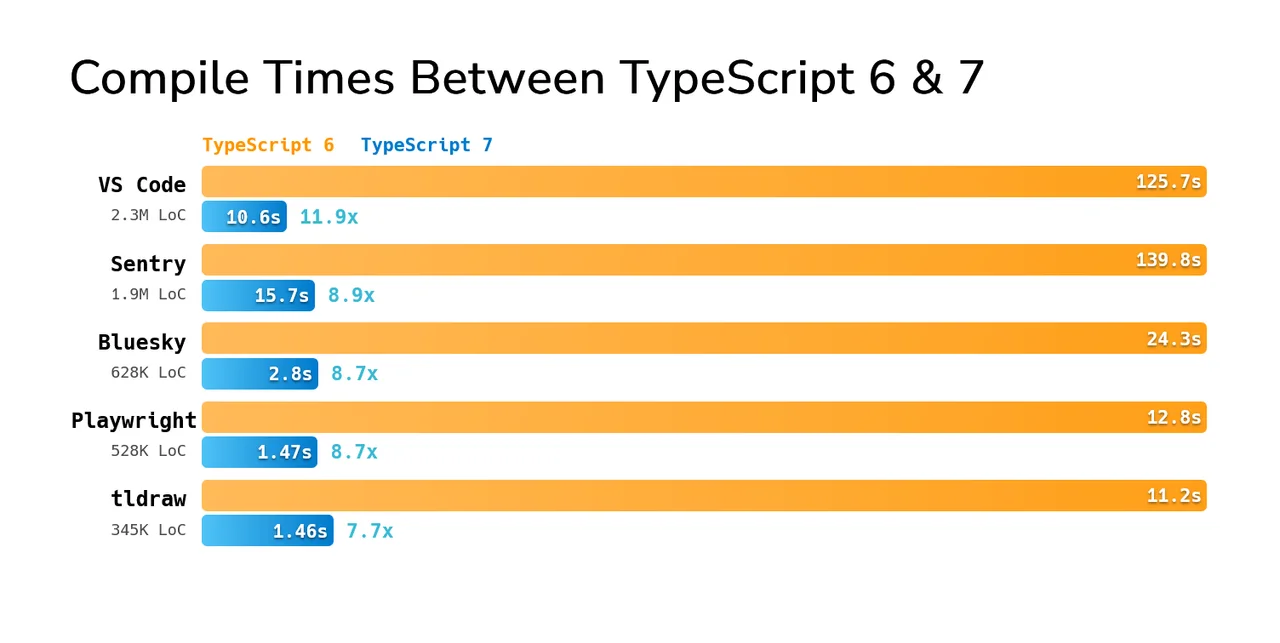
We know the pause. You save a file, the type-checker spins up, and off you go to check your phone. TypeScript 7.0, out July 8, is Microsoft's fix for exactly that: the compiler got rebuilt from scratch in Go, and on full builds it runs roughly 10 times faster than 6.0. We're talking about the VS Code codebase dropping from 125.7 seconds to 10.6. It isn't new syntax or a new type system. It keeps 6.0's type-checking almost exactly, so most projects just get quicker for free. There's a catch we'll get to, and if your stack is Astro or Svelte you'll want to read it before you upgrade. But for the plain case, running tsc over your own code, this is the biggest quality-of-life jump the language has had in years.
The short answer
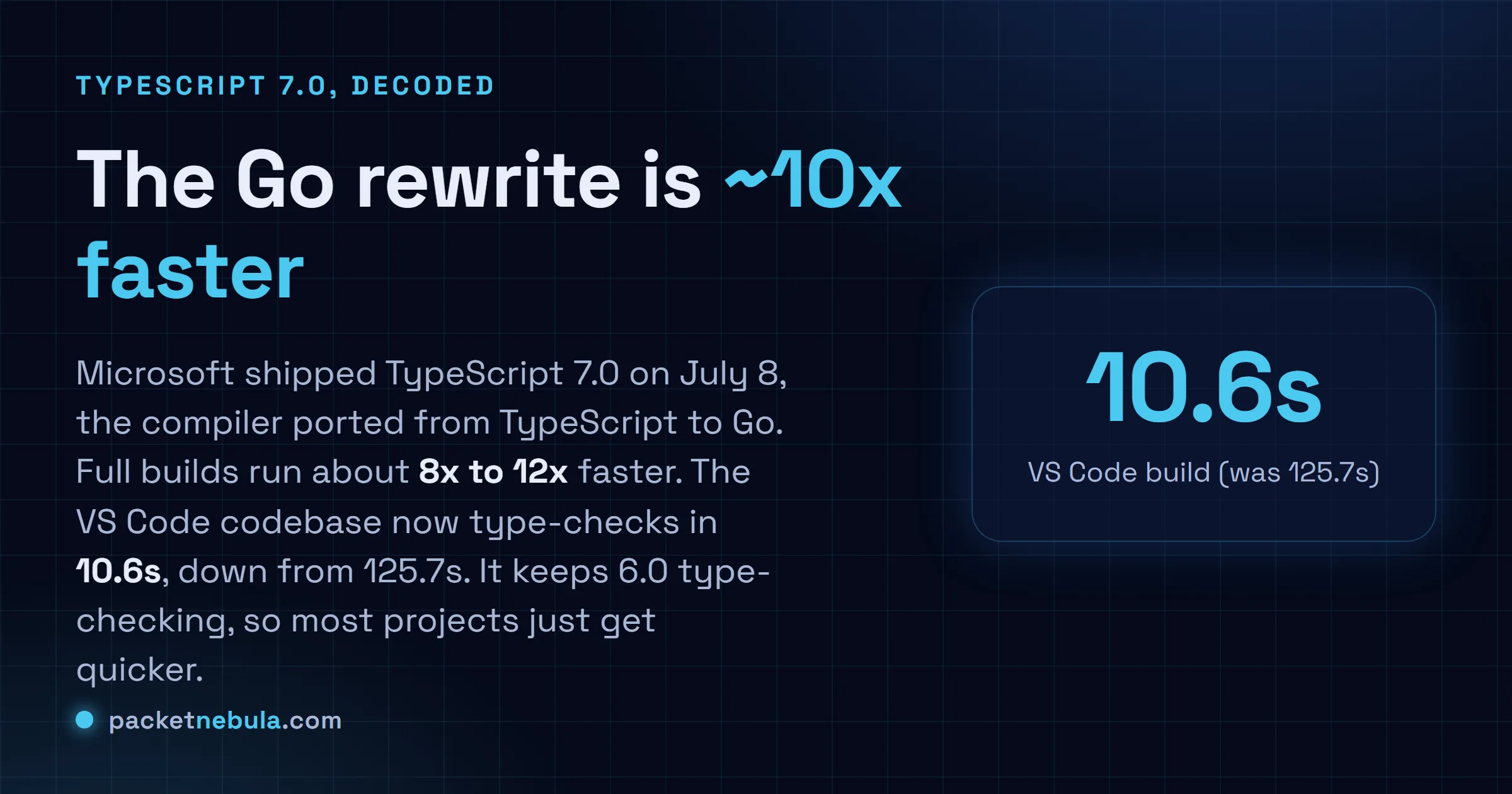
TypeScript 7.0 shipped July 8 as a full rewrite of the compiler in Go. Full builds run about 8x to 12x faster, the VS Code codebase type-checks in 10.6 seconds instead of 125.7, and it keeps 6.0’s type-checking so most projects just get quicker. The catch: no stable programmatic API yet, so Astro, Svelte and Vue tooling can’t use it for the moment.
What actually shipped
For years the TypeScript compiler was itself written in TypeScript, which meant it ran on Node, on top of V8, doing all its work on a single thread. That was fine when projects were small. It stopped being fine a while ago. So Microsoft did the drastic thing and rewrote the entire compiler in Go, and that rewrite is what 7.0 is.
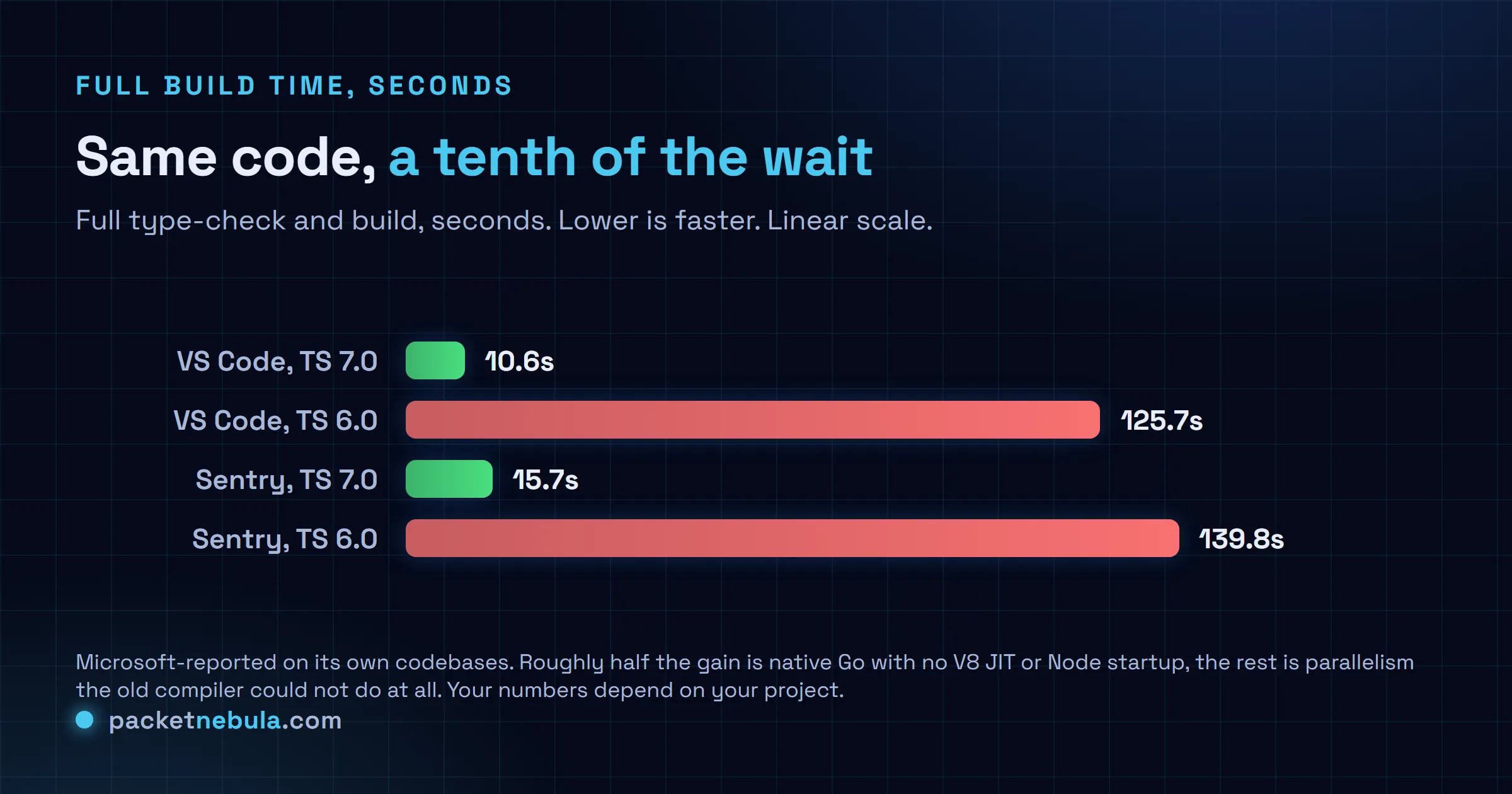
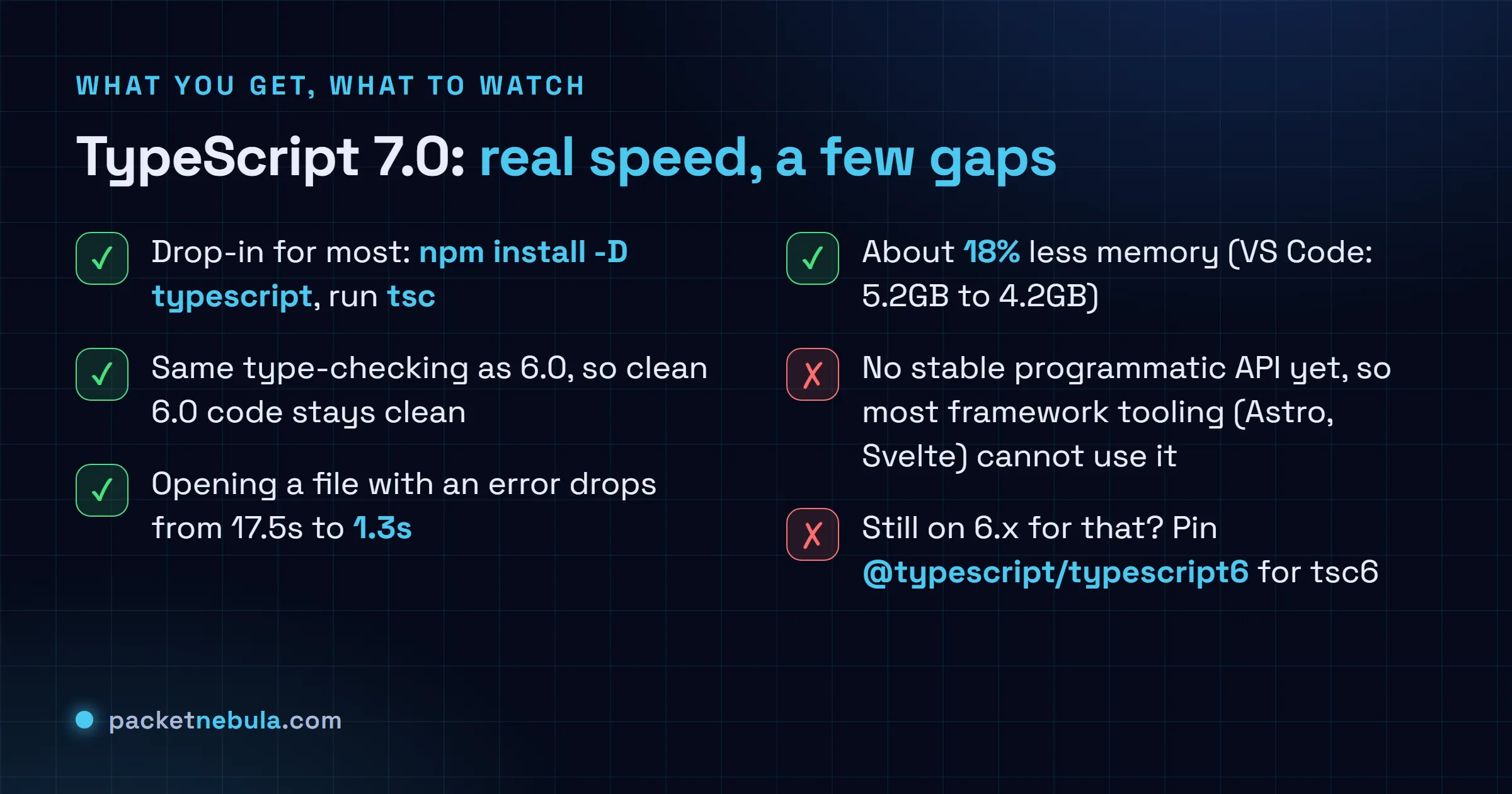
The headline is the speed. Microsoft measured its own codebases and got between 8x and 12x on full builds. VS Code, about 1.5 million lines of TypeScript, dropped from 125.7 seconds to 10.6. Sentry went from 139.8 to 15.7. The number that matters more day to day is the editor one: opening a file that has a type error in the VS Code repo used to take around 17.5 seconds before the squiggle showed up. On 7.0 it’s under 1.3. That’s the difference between waiting and not noticing.
Where the speed comes from
Two things, stacked. Go compiles to native machine code, so there’s no V8 just-in-time warmup and no Node process to spin up, and that alone is worth roughly half the gain. The rest comes from parallelism. The old single-threaded compiler couldn’t spread type-checking across cores at all. The Go one uses shared-memory multithreading, so on a modern laptop it puts your other cores to work instead of letting them idle.
Memory got better too, which surprised us a little given rewrites usually trade memory for speed. Checking VS Code went from about 5.2 GB down to 4.2, roughly 18 percent lighter. For anyone running type-checking in CI on a memory-capped runner, that’s a quiet but real win.
The catch, and it’s a real one
Here’s the part to read before you upgrade a real project. Command-line tsc is ready. The programmatic API is not. TypeScript 7.0 doesn’t yet expose a stable API for other tools to call into, and a lot of the ecosystem depends on exactly that. Anything that type-checks code living inside a component file leans on the compiler as a library, which means most framework tooling can’t use 7.0 for now.
That’s not a small footnote if you build with Astro, as this site did until September 2026. Astro’s own type-checking is one of the tools sitting on the old API today. Svelte and Vue are in the same spot. So if you build with one of those, you can adopt 7.0 for a plain tsc pass in CI, but your editor’s framework-aware checks will keep running on 6.x until that API ships. The trade-offs of building on a static generator are covered in WordPress versus a static site.
Should you switch
If you run tsc over a normal TypeScript project, plain Node or a backend or a library, the answer is easy: try it now. Run npm install -D typescript, keep using tsc, and watch your CI time fall. Because 7.0 matches 6.0’s type-checking, the odds of a surprise are low. A handful of flags behave differently, so skim the release notes, but this is about as gentle as a major version gets.
If you’re on a component framework, be more patient. Pin the old line where you need it with npm install -D typescript@npm:@typescript/typescript6, which hands you a tsc6 binary, and let the framework tooling catch up. The stable API is the thing everyone’s now waiting on.
Zoom out and this fits a pattern we keep seeing: the boring infrastructure under our tools is quietly getting rewritten in faster languages, and the payoff shows up as a feedback loop that stops interrupting you. That matters more now that so many of us have an AI agent editing our code and re-running the checker on every pass. A type-check that finishes in a second instead of two minutes changes how those agents feel to work with, the same way the newer coding models changed what they can attempt. Faster tools, faster loop. That’s the whole story here, and it’s a good one.
Sources: Microsoft’s official Announcing TypeScript 7.0 post (July 8 2026) for the build-time, memory and API figures, and The Register’s coverage of the first stable Go release. Benchmark numbers are Microsoft-reported on its own codebases and will vary by project and hardware.
Frequently asked questions
Is TypeScript 7.0 actually 10x faster?
On full builds, roughly yes. Microsoft reports 8x to 12x on its own codebases: VS Code went from 125.7 seconds to 10.6, and Sentry from 139.8 to 15.7. About half the win is native Go code with no V8 or Node startup, and about half is parallelism the old compiler could not do. Your real number depends on your project size and hardware.
Will my code break when I upgrade to TypeScript 7.0?
Probably not. TypeScript 7.0 is built to match 6.0's type-checking and command-line behaviour, so almost any code that compiles cleanly on 6.0 compiles identically on 7.0. A few flags behave differently, so read the release notes, but for most projects it is a drop-in swap.
How do I install TypeScript 7.0?
Run npm install -D typescript and use the tsc command as usual. If you need to stay on the old line for a project, pin it with npm install -D typescript@npm:@typescript/typescript6, which gives you a tsc6 binary you can run side by side.
Why can not Astro, Svelte or Vue tooling use TypeScript 7.0 yet?
Those tools lean on TypeScript's programmatic API to type-check code embedded in components, and 7.0 does not expose a stable API yet. Command-line tsc is ready, but the editor and framework integrations that call into the compiler as a library will need to wait for that API to land.
Is TypeScript really written in Go now?
Yes. Microsoft ported the whole compiler from TypeScript to Go, shipping as 7.0. Go compiles to native code and threads well, which is where the speed comes from. The language you write stays exactly the same; only the thing that checks it changed.


