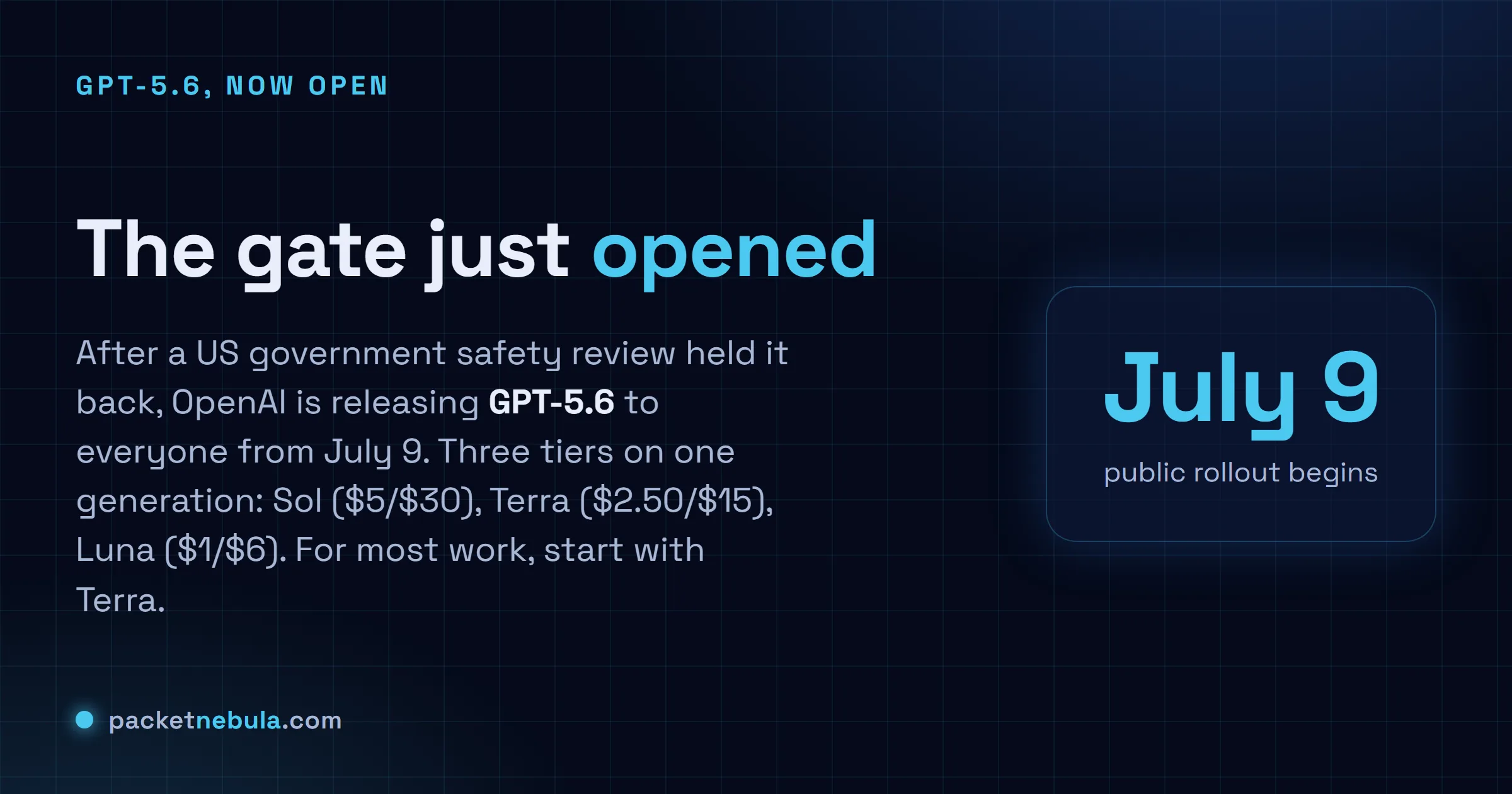
For three weeks GPT-5.6 sat behind a government gate. As of July 9 that gate is open, and OpenAI is rolling the model out to everyone. It isn't one model either. You pick Sol, Terra or Luna, three tiers riding on one generation. Sol is OpenAI's strongest model yet at $5 in and $30 out per million tokens. Terra matches last year's GPT-5.5 for half that. Luna is the cheap floor at $1 / $6. The genuinely new part isn't the tiers, we covered those back in June. It's that a US safety review under a fresh cybersecurity order held the launch, and the White House just cleared it. Here's what actually shipped today, which tier we'd reach for, and why the rollout won't land in your account all at once.
The short answer
GPT-5.6 opens to everyone from July 9, after a US government safety review held it back for weeks. It ships as three tiers on one generation: Sol ($5/$30), Terra ($2.50/$15), Luna ($1/$6). Nothing about the model changed today. What changed is access. For most work, Terra is the one to try first. Just don’t expect it in your account the same minute.
The news is access, not a new model
Let’s be clear about what happened today, because it’s easy to misread as a launch. The model is the same GPT-5.6 OpenAI previewed in June. Same tiers, same prices, same ultra subagent mode. What flipped on July 9 is that anyone can get to it. OpenAI put it plainly on X: they’re expanding preview access globally now, with all three variants going public.
Up to this week, GPT-5.6 lived behind a preview gate open to about 20 vetted partner organisations. That’s the shift. A frontier model that a handful of companies were testing is now, in stages, everyone’s to use.
Why it was stuck behind a gate
Here’s the part that’s genuinely new, and honestly the more interesting story. An AI cybersecurity order signed in early June set a rule: submit powerful models for government review 30 days before you ship them to the public. GPT-5.6 was the first big model to hit that rule head on.
So OpenAI shipped it to that small group of partners, gated behind a federal safety review. The Department of Commerce’s Center for AI Standards and Innovation ran additional testing. The administration then granted permission for the wider release, and that clearance is what unlocked today.
OpenAI wasn’t thrilled about the precedent. The company said it doesn’t believe this kind of government access process should become the long term default, but it complied to get GPT-5.6 out on a reasonable timeline. Whatever you think of that, it’s the reason a finished model sat on the shelf for three weeks.
Sol, Terra, Luna, and the price that matters

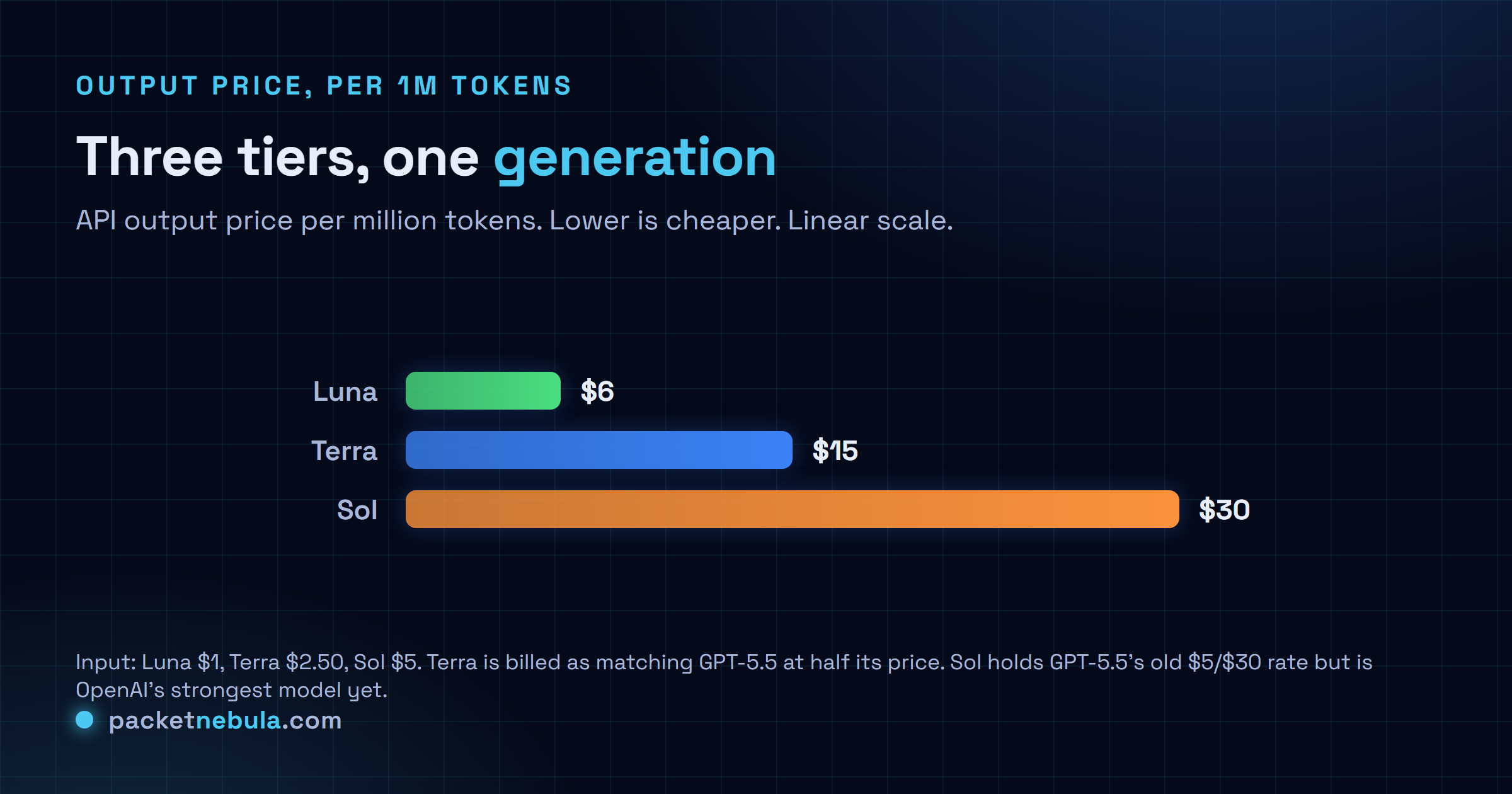
The tier system is the same one we broke down in June, so the short version. Sol is the top at $5 in and $30 out per million tokens, the exact rate GPT-5.5 used to charge, and OpenAI calls it their most powerful model yet. Terra is everyday use at $2.50 / $15, half of Sol, billed as matching GPT-5.5’s performance. Luna is the floor at $1 / $6 for high volume or simpler jobs.
Read that the right way and the top price didn’t move. What OpenAI added is a near flagship (Terra) that does most of the work for half the money. If you’re running GPT-5.5 in production today, that’s the line item worth a look first.
Which tier we’d actually reach for

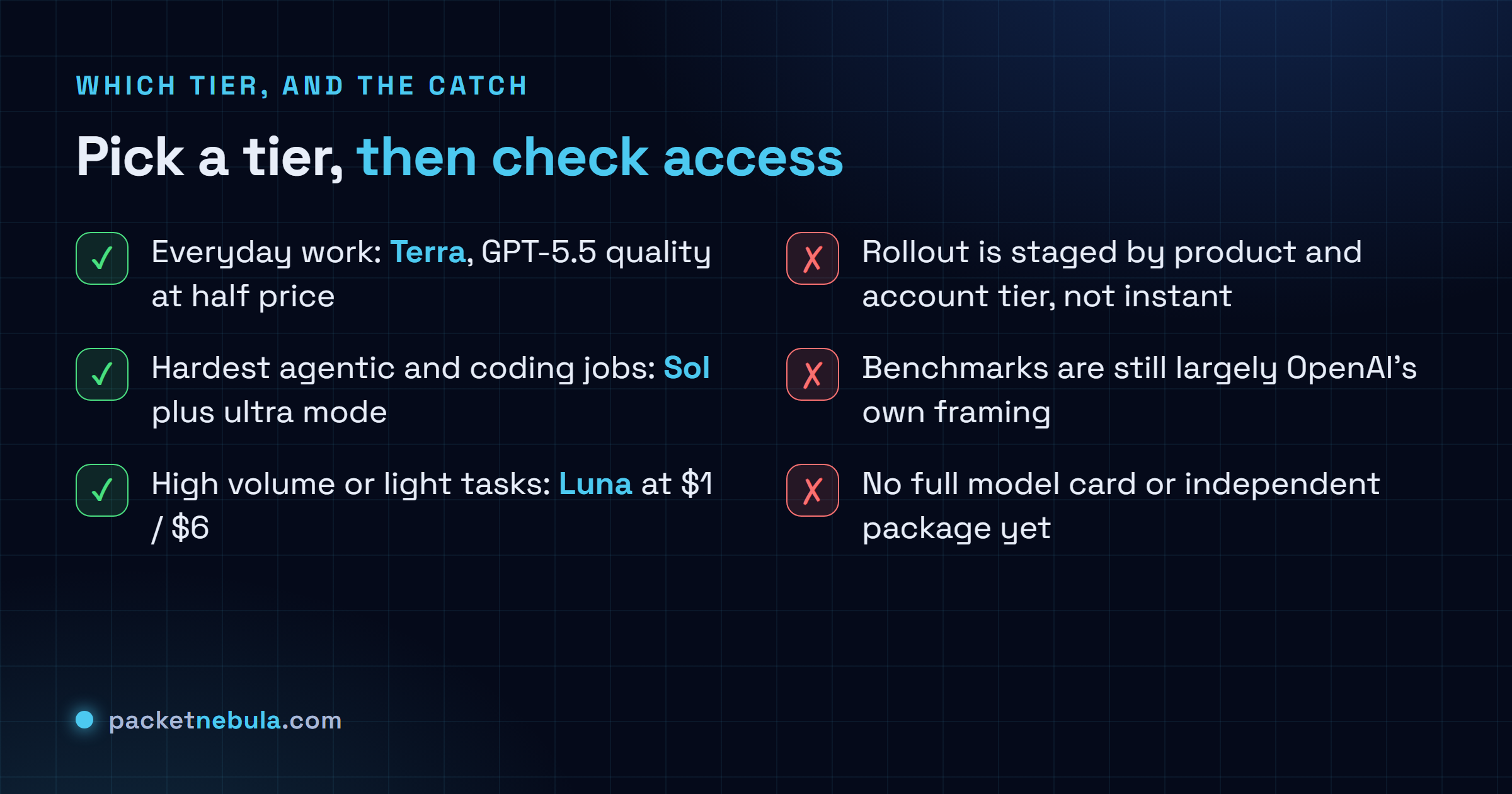
Terra, for most of it. GPT-5.5 quality at half the invoice is the easy win, and probably the reason most people will care about GPT-5.6 at all. Save Sol, with its ultra mode that spins up subagents, for the jobs where a single agent loses the thread: long agentic pipelines, gnarly coding. Luna when the task is light and volume is the whole story.
If what you actually want is a model you can run yourself, none of these qualify. They’re closed and API only. That’s a different shelf, and our look at Fable 5 versus Grok 4.5 covers where the rest of the frontier field sits right now.
The caveat: it won’t all arrive at once
One thing to plan around. OpenAI’s wording leaves room for a staged rollout across ChatGPT, Codex and the API, appearing by product and by account tier rather than all in one go. So “public on July 9” doesn’t mean “in your console at 9am.” Give it a bit.
And the benchmarks are still largely OpenAI’s own framing. There’s no full model card or independent, machine readable package yet, so the coding claims are early and partly the vendor’s. Useful to act on, worth verifying before you bet a product on it. The news today is simple though: the model most of us couldn’t touch, we now can.
Sources: OpenAI’s own July 9 announcement, reported by Engadget, Neowin and PYMNTS, July 2026. Prices and tier framing per OpenAI; benchmark claims are provisional until a full model card ships.
Frequently asked questions
When can I use GPT-5.6?
OpenAI began the public rollout on July 9, 2026, after the US government cleared a wider release. Access arrives in stages across ChatGPT, Codex and the API, and by account tier, so it may not appear in your account the moment the announcement lands. Before then it was a limited preview for roughly 20 vetted partner organisations.
What are Sol, Terra and Luna in GPT-5.6?
They are capability tiers on the same generation, not three separate models. OpenAI split the version number (5.6) from the tier so each can improve on its own schedule. Sol is the top tier at $5 input and $30 output per million tokens, Terra the mid tier at $2.50/$15, Luna the lean one at $1/$6.
Why was GPT-5.6 held back?
A US cybersecurity order signed in early June requires companies to submit powerful models for government review 30 days before a public release. The Department of Commerce's Center for AI Standards and Innovation ran extra testing on GPT-5.6, then the administration cleared it for wider distribution, which is what unlocked the July 9 launch.
Which GPT-5.6 tier should I use?
For most everyday work, Terra: OpenAI describes it as matching GPT-5.5 while costing half as much. Reach for Sol, plus its ultra subagent mode, only when you need the absolute ceiling on hard agentic or coding jobs. Luna is the pick when cost dominates and the task is light.
How much does GPT-5.6 cost?
Sol is $5 input and $30 output per million tokens, the same rate GPT-5.5 charged. Terra is exactly half at $2.50/$15. Luna is the floor at $1/$6. So the generation did not raise the top price; it added two cheaper rungs beneath it.