
• Latest
  • Trending
  • All
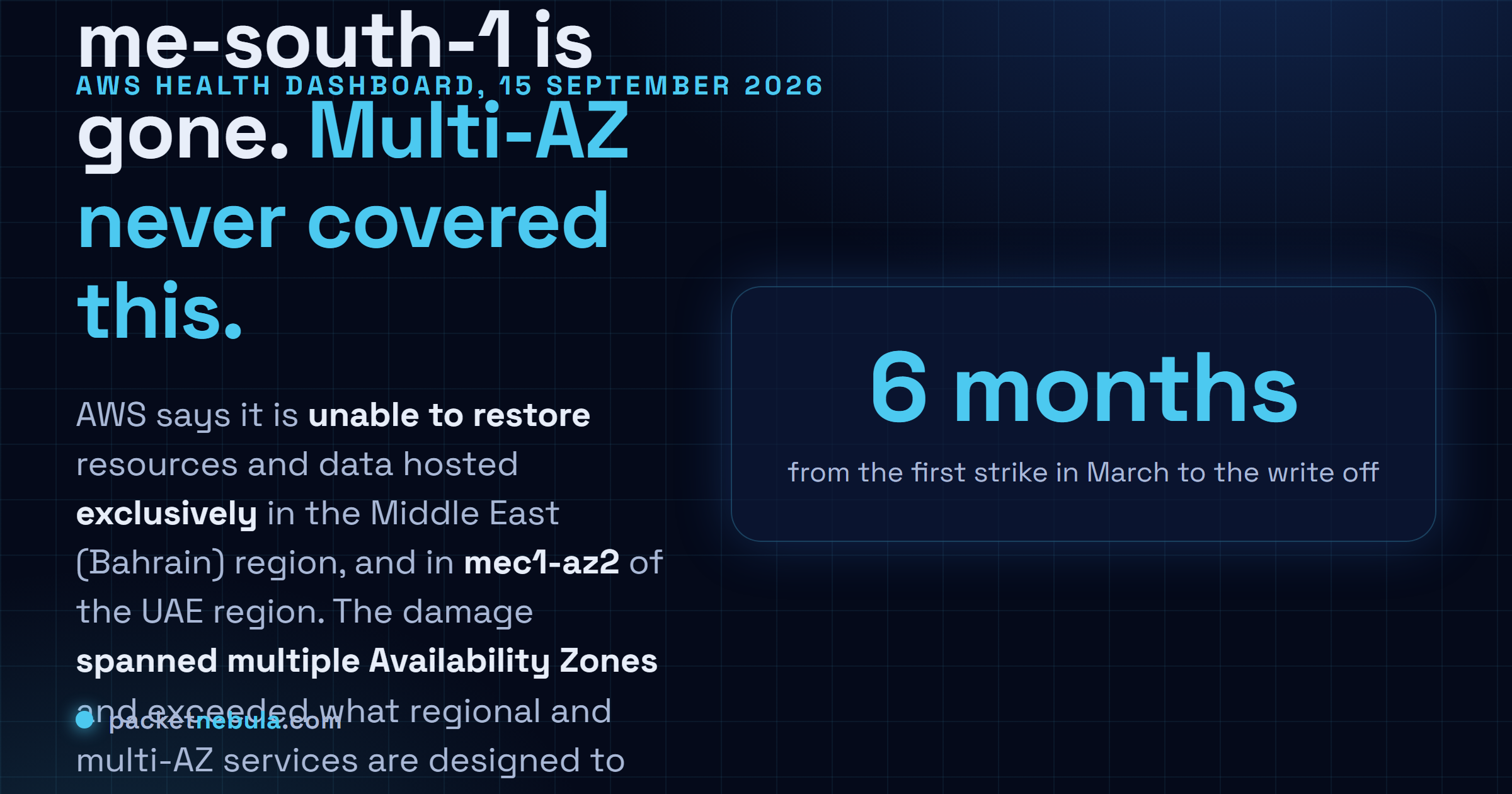
Answer card stating that on 15 September 2026 AWS said it is unable to restore access to resources and data hosted exclusively in the Middle East Bahrain region me-south-1 and in the mec1-az2 zone of the UAE region, because the damage spanned multiple Availability Zones and exceeded what multi-AZ services are designed to withstand.

AWS can’t restore me-south-1, six months after the drone strikes

17 September 2026
Answer card stating that Google released Gemini 3.8 Live and Gemini 3.8 Live Extended Thinking on 15 September 2026 at 3 dollars per million audio input tokens and 12 dollars out, that the thinking model requires asynchronous tools, and that Artificial Analysis scores it 82.6 on its Speech to Speech Quality Index.

Gemini 3.8 Live Extended Thinking rejects any tool that blocks

16 September 2026
Answer card summarising the Atria Dawn Preview release: 744B GLM-5.2 base, MIT licence, 1.5 TB BF16 and 756 GB FP8 checkpoints, 256K context, top on five of sixteen benchmark rows and trailing on SWE-bench Pro.

Atria Dawn Preview is 744B under MIT, and the BF16 weighs 1.5 TB

15 September 2026
Answer card stating that OpenAI released the Agents API in public beta on 10 September 2026 with no separate fee, billed through model tokens, tool calls and hosted sandbox time, with a choice of OpenAI hosted, self hosted or partner sandboxes, US only data residency and no Zero Data Retention support.

OpenAI’s Agents API has no fee, no ZDR and a one hour sandbox clock

14 September 2026
Answer card: Sakana Fugu Max at $2 and $6 per million tokens, Fugu Ultra v2 unchanged at $5 and $30, and Sakana saying Ultra v2 scores without Fable 5 or GPT-6 Astra in its pool.

Fugu Max costs $2 and $6 while Fugu Ultra v2 runs without Fable 5

13 September 2026
Answer card stating that DeepSeek released DeepSeek-V4.1-Flash on 10 September 2026 as a 552 billion parameter mixture of experts model with a new causal encoder decoder architecture that activates 8 billion parameters on input and 16 billion on output, with native vision, a one million token context and MIT licensed weights, that the API model name is now deepseek-flash at 0.15 dollars per million input tokens and 0.60 dollars per million output tokens off peak, and that DeepSeek announced V4 Pro would be routed to V4.1-Flash from 14 September and reversed that on 11 September.

DeepSeek V4.1-Flash arrived, and the V4 Pro retirement lasted a day

12 September 2026
Answer card stating that Cognition released SWE-2 on 10 September 2026, a coding model post-trained from Kimi K3, scoring 50.0 percent on FrontierCode 1.1 Main against 50.9 percent for Claude Fable 5.1 and 27.3 percent on Terminal-Bench 4 against 55.8 percent, available only inside Devin.

SWE-2 trails Fable 5.1 by one point, and by 28 on Terminal-Bench 4

11 September 2026
Answer card for Meta Muse, free to 100 million tokens a week then $20 a month, launched 8 September 2026 for United States adults only, running in a dedicated per user virtual machine.

Does Meta Muse do enough to earn your inbox and a card on file?

9 September 2026
Answer card stating that the public download pages for the VMware Virtual Disk Development Kit on developer.broadcom.com began returning 404 errors on 25 August 2026 with no announcement or deprecation notice, that Broadcom support tells customers the kit is no longer available for use or download, and that release lines 7.0.3.1, 8.x and 9.x are all affected.

Broadcom pulled VDDK 8.0 and 9.0, and the 404 is the only notice

8 September 2026
Answer card stating that OpenAI published its research acceleration measurements on 6 September 2026, that as of mid August 2026 its research organisation logged 3.1 agent workdays of coding agent runtime for every workday of human labour normalised to a standard eight hour day, and that OpenAI states this should not be read as a 3.1 times productivity gain because it measures runtime rather than delivered output.

OpenAI’s 3.1 agent-workdays per human day is not a 3.1x gain

7 September 2026
Answer card stating that Mullvad announced on 3 September 2026 that it is shutting down its public encrypted domain name system servers on 2 November 2026 and sponsoring the Quad9 Foundation instead, with 194.242.2.2 and its five sibling addresses all going away, and virtual private network customers unaffected.

Mullvad’s DNS servers go dark on 2 November, and Quad9 blocks no ads

5 September 2026
OpenAI announcement image for GPT-6 Astra, a spiral galaxy of white, blue and amber points of light curling around a bright core on a near black star field.

GPT-6 Astra lists at $10 and $50, 2.5x what GPT-5.6 Sol costs

6 September 2026
Google's official announcement image for the release, reading Introducing Gemini 3.8 Flash and 3.8 Flash Cyber in black type over a pale blue background with a blurred white chevron and the four colour Gemini spark below.

Gemini 3.8 Flash keeps the price and the 1 January cliff

3 September 2026
  • About
  • Contact
  • Privacy
  • Legal
Thursday, September 17, 2026
  • Login
Packet Nebula
  • Home
  • Articles
    • Security
    • Network
    • Dev
    • Sysadmin
    • SEO
    • Email & DNS
  • Tools
    • Network tools: free, fast, no signup
    • Security tools: free, fast, no signup
    • Developer tools: free, fast, no signup
    • Sysadmin tools: free, fast, no signup
    • SEO tools: free, fast, no signup
    • Email & DNS tools: free, fast, no signup
  • Download
  • About
No Result
View All Result
Packet Nebula
No Result
View All Result
Home Sysadmin

AWS can’t restore me-south-1, six months after the drone strikes

by stephane
17 September 2026
in Sysadmin
0
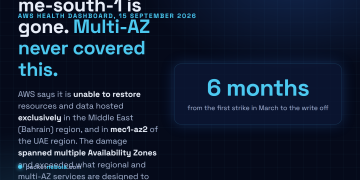
Answer card stating that on 15 September 2026 AWS said it is unable to restore access to resources and data hosted exclusively in the Middle East Bahrain region me-south-1 and in the mec1-az2 zone of the UAE region, because the damage spanned multiple Availability Zones and exceeded what multi-AZ services are designed to withstand.
491
SHARES
1.4k
VIEWS
Share on FacebookShare on Twitter

Every cloud architecture review we've sat in ends the same way. Someone asks about disaster recovery, someone else says "it's multi-AZ", and the room moves on. On 15 September 2026 AWS posted the sentence that retires that answer. Its Middle East (Bahrain) region, me-south-1, took drone strike damage across more than one Availability Zone during the Iran war, and after six months of trying, AWS says the resources and data hosted exclusively there can't be restored. Not delayed. Gone. One zone of the UAE region is written off the same way. We've read the dashboard wording, the earlier April update and the reporting from the day, because the difference between "data lost" and "data safe" here comes down to one adverb.

The short answer

AWS says the damage in Bahrain "spanned multiple Availability Zones and exceeded what our regional and multi-AZ services are designed to withstand", and that it's "unable to restore access to the resources and data hosted exclusively" in the region. In the UAE region, me-central-1, the mec1-az2 zone is written off the same way while recovery continues on mec1-az1 and mec1-az3. Customers were told to migrate in March, billing was suspended on 30 April, and the next Bahrain update isn't due until early 2027. If you kept a copy of anything in another region, you're fine. If your only copy sat in me-south-1, it isn't coming back.
me-south-1whole region unrecoverable, all three zones
mec1-az2the one UAE zone written off, two still in recovery
Early 2027when AWS says it'll say more about Bahrain
Answer card stating that on 15 September 2026 AWS said on its Health Dashboard that it is unable to restore access to resources and data hosted exclusively in the Middle East Bahrain region me-south-1, and in the mec1-az2 Availability Zone of the Middle East UAE region me-central-1, because damage from drone strikes in March and April 2026 spanned multiple Availability Zones and exceeded what its regional and multi-AZ services are designed to withstand.
The first time we've seen a hyperscaler tell customers a whole region's data is unrecoverable. The wording is careful, and it matters.

What AWS said, and how long it took

The Bahrain region opened in July 2019 with three Availability Zones. The US and Israeli offensive against Iran began on 28 February 2026, and in early March a drone strike near one of the Bahrain facilities damaged the first zone. Two data centres in the UAE region were hit directly in the same period. AWS moved fast on the advice: the Health Dashboard told customers it "strongly recommend[s]" migrating all accessible resources to other Regions and restoring anything inaccessible from remote backups. Most did, according to the September statement, before a second Bahrain zone went down in April and the region stopped being usable at all.

The 30 April update is the one people remember. The region "has suffered damage due to the conflict in the Middle East and is currently unavailable", billing suspended, restoration "expected to take several months". Then nothing on the open issues list for four and a half months. The Service History tab just showed every Bahrain service red, week after week. Honestly, we'd assumed the silence meant a slow rebuild.

It meant an assessment. On 15 September the dashboard entry changed from prolonged recovery to a conclusion, first reported by Reuters. For Bahrain, AWS is unable to restore access to resources and data hosted exclusively in the region, and it says it has "supported the remaining customers in re-establishing their operations in alternate regions". For the UAE, mec1-az2 gets the same verdict while AWS keeps working on regional resources and on the zonal ones in mec1-az1 and mec1-az3. Another UAE update is promised in the coming months. Bahrain gets one in early 2027, with no rebuild date and no reopening promise attached. AWS hasn't published how many customers lost data or how much, and we couldn't find any mention of credits beyond the billing suspension. The MTurk shutdown came with a dated FAQ. This came with a paragraph.
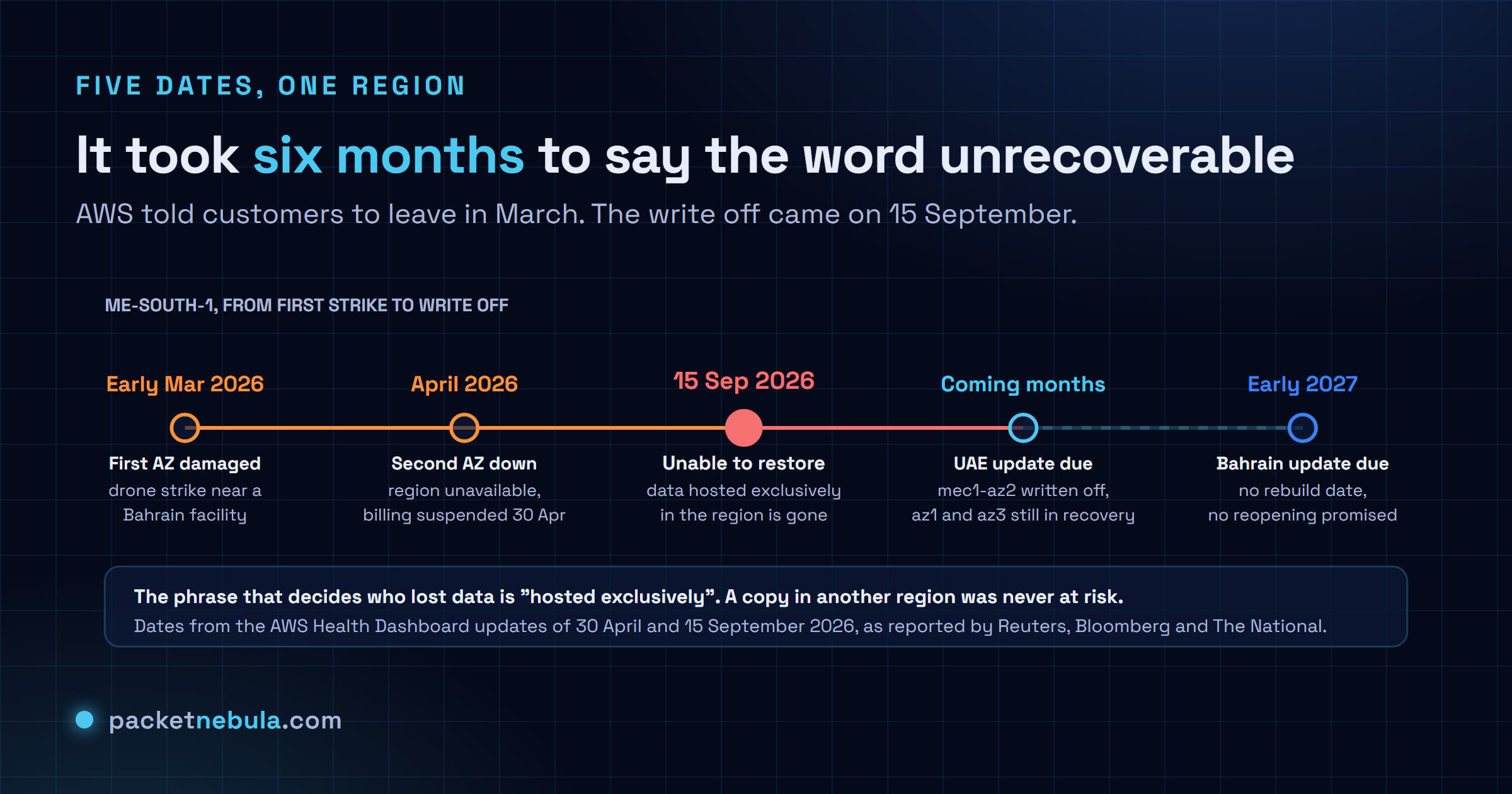
Timeline of the AWS Middle East Bahrain region loss showing the first Availability Zone damaged by a drone strike in early March 2026, a second zone disrupted in April with the region unavailable and billing suspended on 30 April, the 15 September 2026 Health Dashboard update declaring data hosted exclusively in the region unrecoverable, a further UAE update promised in the coming months with mec1-az2 written off and the other two zones still in recovery, and a Bahrain update promised for early 2027 with no rebuild or reopening date.
Six months from the first strike to the word unrecoverable. The advice to leave came in month one.

What multi-AZ was ever designed to survive

Here's the line to reread: "exceeded what our regional and multi-AZ services are designed to withstand". That isn't an admission of a design flaw. It's a description of the design. An Availability Zone is one or more data centres with its own power and networking, placed far enough from the region's other zones that a fire or a substation failure takes out one and not the rest. Far enough for a local disaster. Not far enough for a country. The whole region sits inside one small state, and a campaign that targets the facilities themselves hits all of it.

So a Multi-AZ RDS instance and an S3 bucket (which stores objects across at least three zones by default) both did exactly what they were built for, and it wasn't enough. S3's eleven nines of durability is a statement about disk failure inside a region. It has never been a promise about the region existing.

Which brings us back to the adverb. "Hosted exclusively." Cross-Region Replication on the bucket, a snapshot copied to Frankfurt, an RDS automated backup replicated to Ireland, an AWS Backup plan with a copy rule: any one of those makes the data not exclusive to me-south-1, and those customers restored and moved on in March. The ones who lost data are the ones for whom multi-AZ was the entire plan. I might be wrong about the proportion, but from what we've seen of Gulf deployments, data residency rules pushed a lot of teams to keep everything inside the country on purpose. That's a legal constraint colliding with a physical one, and it deserves its own conversation with whoever writes your residency policy.

What to check on your own account this week

None of this needs a new region or a new bill. It needs an inventory of what's exclusive. Start with S3, because that's where the irreplaceable stuff usually lives. List every bucket with the region it sits in:

AWS CLI
for b in $(aws s3api list-buckets --query 'Buckets[].Name' --output text); do echo "$b $(aws s3api get-bucket-location --bucket "$b" --query LocationConstraint --output text)"; done

Then ask each bucket that matters whether it replicates anywhere. A bucket with no rule returns a ReplicationConfigurationNotFoundError, which is the answer you're looking for, just not the one you want:

AWS CLI
aws s3api get-bucket-replication --bucket my-bucket

For EBS, the snapshot lives in the region where you took it. Copying one elsewhere is a single call, run against the destination region, and later copies of the same volume's snapshots are incremental:

AWS CLI
aws ec2 copy-snapshot --region eu-west-1 --source-region eu-west-3 --source-snapshot-id snap-0123456789abcdef0 --description "offsite copy"

RDS has cross-Region automated backup replication and cross-Region read replicas. AWS Backup plans take a copy action that targets a second region and can run on a schedule you never think about again. Whichever you pick, the test isn't "do we have backups". It's "delete the region in your head and list what's left". We ran that exercise on our own account after reading the dashboard and found one bucket of build artefacts that would've been gone. Small. Still gone.

One more practical point. Restoring a few terabytes across regions is a bandwidth problem before it's anything else, and the March migration window was measured in weeks, not days. Our data transfer calculator will tell you how long your copy takes at the throughput you actually get. Run it before you need it.

Sources

AWS, AWS Health Dashboard, updates of 30 April and 15 September 2026 (the "unable to restore access" wording, the "exceeded what our regional and multi-AZ services are designed to withstand" sentence, the mec1-az2 verdict, the billing suspension). The National, Amazon Web Services unable to restore Bahrain data network knocked out by Iran, 15 September 2026 (the 28 February start of the offensive, the two March disruptions, the April strike, the early 2027 update). Bloomberg via Insurance Journal, Amazon's AWS Facilities in Bahrain, UAE Still Not Restored From Iran War Damage, 16 September 2026 (the Reuters first report, the coming months UAE update). CircleID, AWS Says Iran Strikes Caused Permanent Customer Data Loss in Bahrain and UAE, 16 September 2026 (the 30 April timeline, the unquantified customer impact). Developing Telecoms, AWS says restoring UAE and Bahrain cloud regions will take several months, 4 May 2026 (the "strongly recommend" migration wording, the two UAE data centres hit directly, the "several months" estimate). CNBC, AWS says it can't restore service to Bahrain, UAE facilities 6 months after Iran strikes, 15 September 2026. The S3 and EBS behaviour is from the AWS documentation as read on 17 September 2026.

Frequently asked questions

Did AWS lose all customer data in the Bahrain region?

AWS says it can't restore resources and data hosted exclusively in me-south-1, meaning data that had no copy in another region. Anything replicated or backed up elsewhere was restorable, and AWS says most customers re-established operations in other regions after the March advice to migrate. The company hasn't said how many customers lost data or how much.

Is the UAE region, me-central-1, also gone?

No. One of its three zones, mec1-az2, is written off with the same "unable to restore" wording. AWS says it's still working on regional resources and on zonal resources in mec1-az1 and mec1-az3, with a further update promised in the coming months. Treat the region as degraded rather than closed until that update lands.

Doesn't multi-AZ protect against this kind of failure?

It protects against one zone failing, which is what zones are placed and powered for. AWS's own wording is that the damage spanned multiple zones and exceeded what multi-AZ services are designed to withstand. Surviving the loss of a whole region needs a copy in another region, through S3 Cross-Region Replication, snapshot copies, RDS cross-Region backups or an AWS Backup copy rule.

Will AWS rebuild or reopen the Bahrain region?

It hasn't said. The 15 September update promises a further Bahrain update in early 2027 and gives no rebuild date and no statement either way on reopening. Billing for the region has been suspended since 30 April 2026.

Tags: awsbackupsclouddisaster recoveryme-south-1newsS3
Share196Tweet123
stephane

stephane

  • Trending
  • Comments
  • Latest
Answer card: Proton Lumo 2.0 is private by policy, not by locality. Saved history is locked so even Proton cannot read it, but the prompt is decrypted on a Proton EU server to answer it, then forgotten.

Proton Lumo 2.0 review: how private is it, really?

3 September 2026
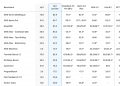
The Agentic Coding section of the official Hy4 preview benchmark appendix published by Tencent, a table comparing Hy3 and Hy4 preview against DeepSeek V4 Pro 0813, Qwen 3.8 Max, GLM 5.3, Kimi K3, GPT 5.6 Sol and Claude Opus 5 across SWE-bench Multilingual, SWE-bench Pro, DeepSWE, three SWE Atlas tasks, SWE-Marathon, Terminal-Bench 2.1, NL2Repo-Bench, CyberGym, ProgramBench, PostTrainBench and Harbor-Index.

Tencent’s 770B Hy4 tops one benchmark row in 46

3 September 2026
Answer card: Qwen 3.7 Max is API-only and cannot run locally yet; the open Qwen models (Qwen 3.6 27B, qwen3:8b to 32b) run offline via Ollama.

Qwen 3.7 local: what you can actually run offline

22 June 2026
Answer card: JWTs are not encrypted, anyone can read them; the signature proves who issued the token, not who may read it.

Are JWTs encrypted? No, and the difference will bite you

0
Answer card: a random 8 character password falls in under 2 hours offline, while 16 random characters hold for 1.4 trillion years at the same speed.

How long does it take to crack a password in 2026?

0
Answer card: three DNS records decide if your mail lands or bounces; SPF lists allowed senders, DKIM signs messages, DMARC sets the failure policy.

SPF, DKIM and DMARC explained: the records your email needs

0
Answer card stating that on 15 September 2026 AWS said it is unable to restore access to resources and data hosted exclusively in the Middle East Bahrain region me-south-1 and in the mec1-az2 zone of the UAE region, because the damage spanned multiple Availability Zones and exceeded what multi-AZ services are designed to withstand.

AWS can’t restore me-south-1, six months after the drone strikes

17 September 2026
Answer card stating that Google released Gemini 3.8 Live and Gemini 3.8 Live Extended Thinking on 15 September 2026 at 3 dollars per million audio input tokens and 12 dollars out, that the thinking model requires asynchronous tools, and that Artificial Analysis scores it 82.6 on its Speech to Speech Quality Index.

Gemini 3.8 Live Extended Thinking rejects any tool that blocks

16 September 2026
Answer card summarising the Atria Dawn Preview release: 744B GLM-5.2 base, MIT licence, 1.5 TB BF16 and 756 GB FP8 checkpoints, 256K context, top on five of sixteen benchmark rows and trailing on SWE-bench Pro.

Atria Dawn Preview is 744B under MIT, and the BF16 weighs 1.5 TB

15 September 2026
  • About
  • Contact
  • Privacy
  • Legal

Copyright © 2026 Stephane Cardon.

Welcome Back!

Login to your account below

Forgotten Password?

Retrieve your password

Please enter your username or email address to reset your password.

Log In
No Result
View All Result
  • Home
  • Articles
    • Security
    • Network
    • Dev
    • Sysadmin
    • SEO
    • Email & DNS
  • Tools
    • Network tools: free, fast, no signup
    • Security tools: free, fast, no signup
    • Developer tools: free, fast, no signup
    • Sysadmin tools: free, fast, no signup
    • SEO tools: free, fast, no signup
    • Email & DNS tools: free, fast, no signup
  • Download
  • About

Copyright © 2026 Stephane Cardon.