




Sit in a Zoox and there is nowhere to put your hands. Four seats facing each other, no wheel, no pedals, no front. On 31 July the Federal Register published the notice that lets Amazon charge you to ride in one, a two-year exemption from portions of eight federal safety standards, capped at 2,500 vehicles per twelve months. Every headline called it a first. It mostly is, though the interesting part is which first: NHTSA already did this in 2020 for Nuro, whose delivery pod was low-speed and carried nobody. The line that moved this week is passengers, at road speed, paying.
The short answer
NHTSA published a Part 555 grant on 31 July 2026 letting Zoox sell rides in a purpose-built robotaxi with no steering wheel, pedals or driver seat. Two years, 2,500 vehicles per twelve months, enhanced reporting attached. Las Vegas goes paid first. California still needs two separate state permits, and the emergency-scene behaviour that triggered a 105-vehicle recall in July is patched but not closed.
What the exemption is, in plain terms
Part 555 is the pressure valve in US vehicle regulation. Federal Motor Vehicle Safety Standards are self-certified, meaning a manufacturer asserts compliance rather than waiting for a stamp, and a vehicle that cannot comply has exactly one legal route: petition NHTSA for a temporary exemption and argue that your design is at least as safe as the rule you are breaking.
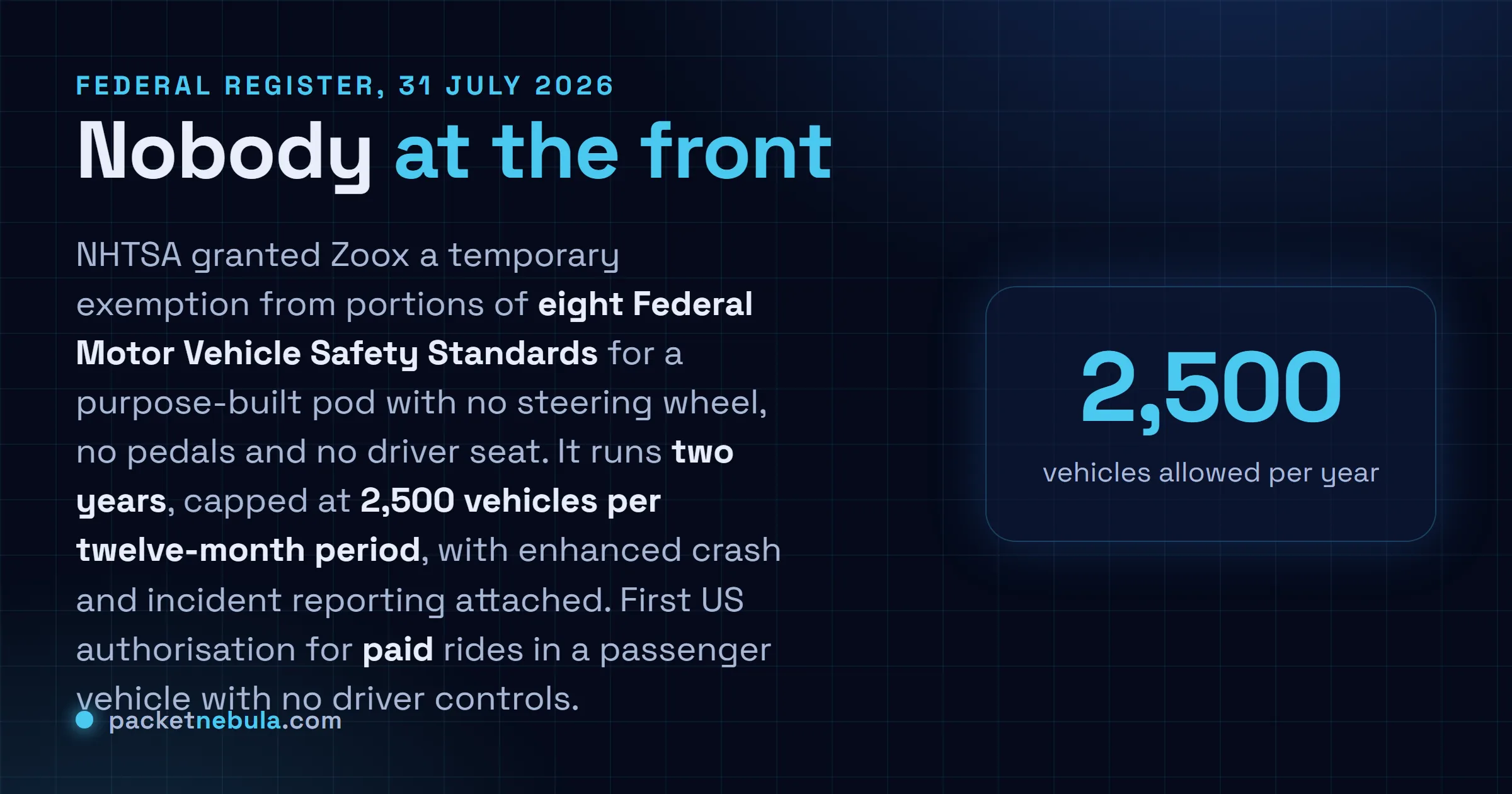
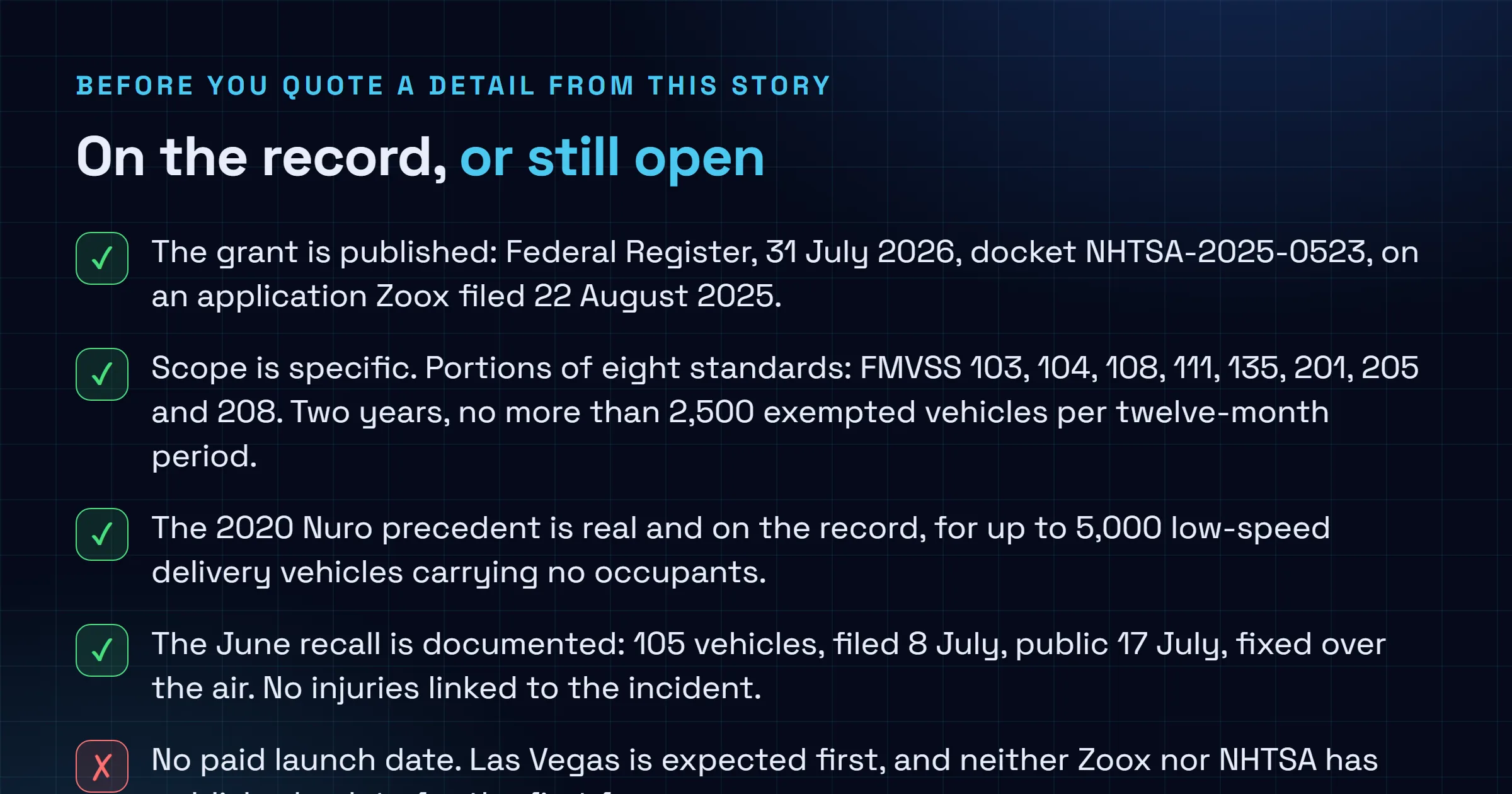
Zoox filed that petition on 22 August 2025. The grant landed in the Federal Register on 31 July 2026, docket NHTSA-2025-0523, and it does something narrower than the coverage suggested. It exempts portions of eight standards. Not eight standards wholesale.
Read the list and the logic falls out immediately:
FMVSS 103 and 104 govern windshield defrosting and wiping. 108 covers lamps and reflective devices. 111 is rear visibility. 135 is light vehicle brake systems. 201 and 208 are occupant protection in interior impact and occupant crash protection. 205 is glazing materials.
Almost every one of those rules contains a sentence that only parses if somebody is sitting at the front looking forward. Rear visibility means a rearward view for the driver. Brake standards assume a pedal with a foot on it. A bidirectional pod with four seats facing inward has no front, no rear and no driver, so the clauses do not fail so much as stop applying. NHTSA administrator Jonathan Morrison put the agency’s finding as the Zoox systems exceeding “the equivalent performance requirements” of a compliant vehicle, while saying monitoring continues.
The first that actually happened
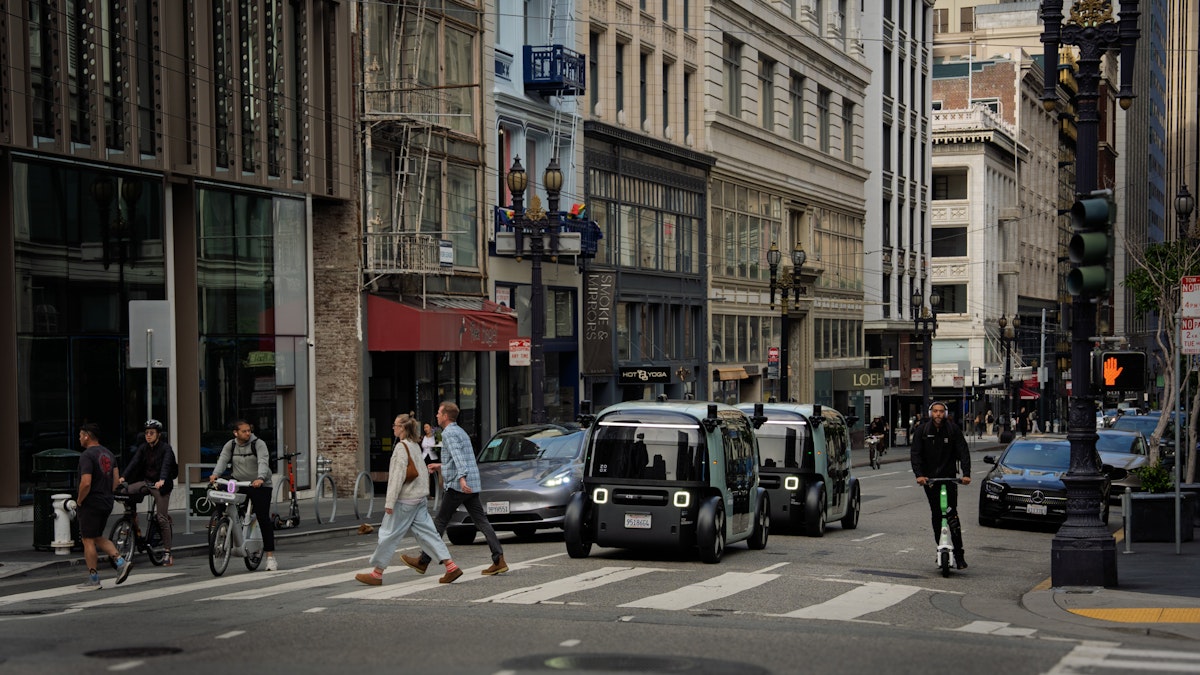
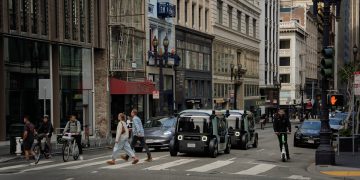
Image: Zoox, from its Part 555 exemption journal post.
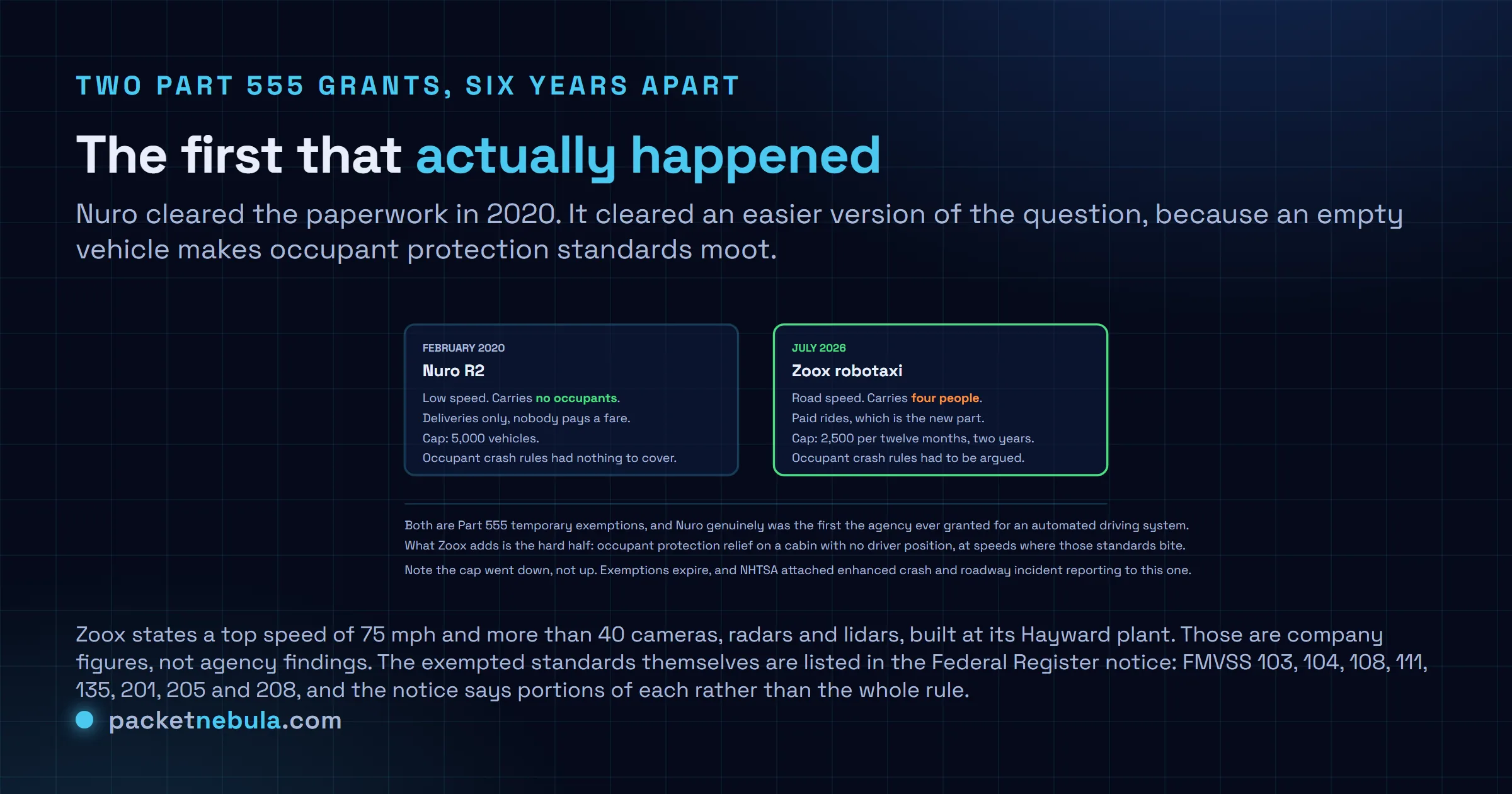
Nuro got here in February 2020. NHTSA granted it a Part 555 exemption for up to 5,000 R2 delivery vehicles, and at the time that was correctly reported as the first driverless exemption the agency had ever issued.
So why is 2026 a milestone at all?
Because the R2 made the hard question disappear. It was low-speed and it carried no people, which meant Zoox’s difficult standards, the occupant protection ones, simply had nothing to protect. Arguing that a crash standard for occupants should not apply to a vehicle that cannot hold an occupant is not a stretch. It’s a definition.
Zoox had to do the opposite. Four passengers, road speeds, and a cabin layout that a 1970s crash standard never imagined. Zoox states a top speed of 75 mph and more than 40 cameras, radars and lidars on the vehicle, built at its Hayward plant, which the company has said it is scaling toward roughly 100 robotaxis a week. Getting occupant protection relief on that is a genuinely new thing for the agency to have signed.
I’d argue the cap is the part worth watching, and hardly anyone quoted it. Nuro got 5,000 units in 2020 and Zoox got 2,500 per twelve-month period in 2026. That is not deregulation running away with itself. Part 555 has a statutory ceiling, the exemption expires, and NHTSA can pull it. Enhanced crash and roadway incident reporting came attached.
Smoke, and the thing the approval did not fix
On 20 June a Zoox robotaxi with nobody inside approached an active fire scene in Las Vegas. Heavy smoke across the road, the area not yet fully coned off. The vehicle entered the smoke, braked, tried to steer clear.
Nobody was hurt. Zoox filed a recall with NHTSA on 8 July covering 105 vehicles, public on 17 July, remedied over the air with software that handles smoke detection and recognising an emergency in low visibility.
That sequence is worth sitting with, because it’s the strongest argument in both directions at once. A recall filed within eighteen days and fixed without anyone visiting a service centre is a real advantage of a software-defined fleet. Try that with a wiring harness. But the underlying problem is not a smoke classifier. It’s that autonomous vehicles keep turning up where firefighters and police are working, and a patch teaches one fleet about one failure mode after it happened.
Honestly, I think that’s the fair criticism of the timing. The exemption is a judgement that the safety case clears the bar today, granted five weeks after a fleet-wide recall for a scenario the fleet had not anticipated. Reasonable people can read that as regulators moving with evidence, or as moving quickly. NHTSA’s own framing leaned toward removing barriers to innovation while keeping enforcement, which is a position rather than a resolution.
What changes if you are not buying a robotaxi
Most readers here run networks or ship software, so the useful part is the shape of the decision, not the vehicle.
A regulator just accepted that a software system can substitute for a mechanical control that was mandatory for fifty years, on the argument that measured performance beats prescribed hardware. That reasoning has legs well beyond cars. It’s the same argument that shows up whenever a compliance regime written around a physical artefact meets a system that does the job differently, and it lands the same way: you stop shipping the artefact and start shipping the evidence. Enhanced reporting is not a footnote in that trade, it’s the price.
The other lesson is duller and more useful. Zoox spent eleven months between filing and grant, held a demonstration-only exemption for the year before that, and still cannot charge a fare in its home state until two separate California bodies sign off. Federal approval was the headline and it was never the whole gate.
If you’re tracking how regulators are handling autonomy generally, this sits next to the FCC’s Covered List action on foreign-produced robots, which used equipment authorisation as its lever. Different agency, opposite direction, same underlying instrument: whoever controls the certificate controls the market.
Sources: the grant itself, the eight standards, the docket number, the two-year term and the 2,500-vehicle cap are in the Federal Register notice Zoox, Grant of Temporary Exemption (31 July 2026), announced alongside NHTSA’s press release on automated vehicle exemptions. Zoox published its own note as Zoox gets NHTSA Part 555 Exemption for purpose-built robotaxi. The Morrison quote, the deployment picture and the remaining California permits are reported by Al Jazeera and TechCrunch. The June incident and the 105-vehicle recall are covered by CNBC and the Las Vegas Review-Journal. The 2020 precedent is the Nuro grant of temporary exemption. Image: Zoox.
Frequently asked questions
What did NHTSA actually grant Zoox on 31 July 2026?
A temporary exemption under 49 CFR Part 555 from portions of eight Federal Motor Vehicle Safety Standards, for a purpose-built vehicle with no steering wheel, no pedals and no driver seat. It runs two years and covers no more than 2,500 exempted vehicles for each twelve-month period. Zoox filed the application on 22 August 2025, and the grant notice appeared in the Federal Register on 31 July 2026 under docket NHTSA-2025-0523.
Which eight safety standards were exempted?
FMVSS 103 windshield defrosting and defogging, 104 windshield wiping and washing, 108 lamps and reflective devices, 111 rear visibility, 135 light vehicle brake systems, 201 occupant protection in interior impact, 205 glazing materials, and 208 occupant crash protection. Note the word in the notice is portions. These are not blanket waivers, they are relief from the specific clauses that assume a human driver is sitting behind a wheel looking through a windshield.
Was this really the first exemption of its kind?
The first for a passenger-carrying vehicle that can charge fares. NHTSA granted Nuro a Part 555 exemption in February 2020, for up to 5,000 R2 delivery vehicles, but the R2 was low-speed and designed to carry no occupants at all, which made the occupant protection standards easy to argue away. Zoox is the first case where the agency accepted a no-controls design that carries people at normal road speeds. Zoox also held a demonstration-only exemption from August 2025 that did not permit paid rides.
Can Zoox charge for rides everywhere now?
No. The federal exemption removes the federal obstacle only. Las Vegas is expected first. In California, Zoox still needs driverless deployment permits from both the Public Utilities Commission and the Department of Motor Vehicles before it can charge anyone, and it currently gives free rides in San Francisco. State and local approval is a separate track from Part 555 and always was.
What is the unresolved safety issue?
Emergency scenes. On 20 June 2026 an unoccupied Zoox robotaxi in Las Vegas drove into a section of road covered by heavy smoke from an active fire, in an area not yet fully coned off, and braked while steering away. Zoox filed a recall with NHTSA on 8 July covering 105 vehicles, made public on 17 July, fixed by an over-the-air software update for smoke detection and low-visibility emergency recognition. No injuries were linked to it. The exemption arrived with the broader question of driverless vehicles interfering with emergency responders still open, which is why NHTSA attached enhanced crash and incident reporting.