
Two people who would not be named, a British infrastructure company founded in 2024, and a field in Mason County, West Virginia. That's the sourcing on the largest compute contract of the month. On 26 August Bloomberg reported that Anthropic agreed to pay Nscale roughly $45 billion over six years for about 460 megawatts at its Monarch campus, running NVIDIA Vera Rubin systems. CNBC matched it the same day. Anthropic declined to comment, Nscale has published nothing, and neither company has put a line on its newsroom. The number that matters if you're actually paying for Claude today isn't the 45. It's the date.
The short answer
Bloomberg reported on 26 August 2026 that Anthropic will pay Nscale about $45 billion over six years for roughly 460 megawatts at the Monarch campus in Mason County, West Virginia, on NVIDIA Vera Rubin systems. CNBC matched it. Neither company has confirmed anything. The site is due online at the end of 2027, so nothing about your rate limits, your prices or your regions changes because of this. What it tells you is where Anthropic thinks its capacity problem gets solved, and how late.
What was actually reported
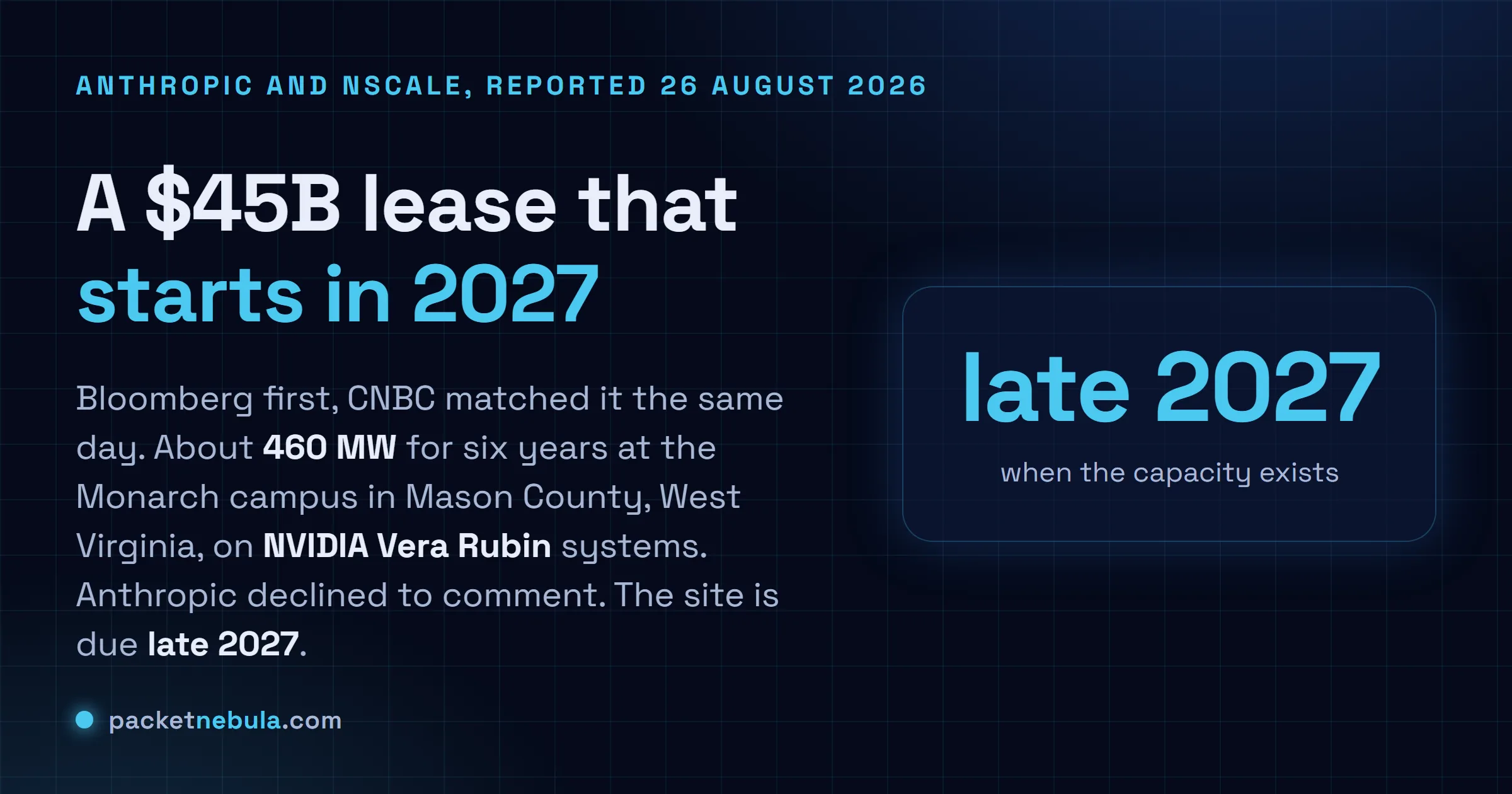
Bloomberg went first on 26 August. Anthropic agreed to pay Nscale, a British AI infrastructure company founded in 2024, roughly $45 billion across six years for compute capacity. CNBC ran its own version the same day, with the detail that the capacity is about 460 megawatts at an Nscale development in West Virginia, drawing on Nvidia’s Vera Rubin chips, expected online at the end of 2027. TechCrunch and others followed.
Anthropic declined to comment. Nscale hasn’t issued a release. So every number in the paragraph above traces back to unnamed sources at two outlets that both have good records on this beat, which is a decent place to be but is not the same as terms in a filing. We’d flag that harder if the numbers were doing something surprising. They aren’t.
Worth saying plainly: $45 billion over six years is $7.5 billion a year, from a company whose run rate reportedly passed $65 billion at the end of July. It’s a large cheque, not an implausible one.
The campus is the more interesting half
Monarch isn’t new, and Anthropic isn’t its anchor. Nscale announced the site on 16 March 2026 at GTC, on up to 2,250 acres in Mason County, with a Microsoft letter of intent for 1.35 gigawatts of Vera Rubin NVL72 capacity in phase one. Nscale puts the total power runway beyond 8 gigawatts.
Where does the power come from? Not the grid, at least not at first. Nscale is building what it calls America’s first state certified AI microgrid, running independently of the local network, with Caterpillar G3500 natural gas generator sets scaling to 2 gigawatts of generation by the first half of 2028. Grid tie-in comes later, and Nscale frames it as export capability rather than a dependency.
That’s the detail we’d actually keep. A hyperscale AI site with its own gas plant is a different risk object from one hanging off a utility. Fuel supply becomes an operational input. Local air permits become a schedule item. And the state politics get louder rather than quieter as the megawatts climb, because $80 million a year of projected state tax revenue buys a lot of patience right up until it doesn’t.
460 MW is a diversification move, not a step change
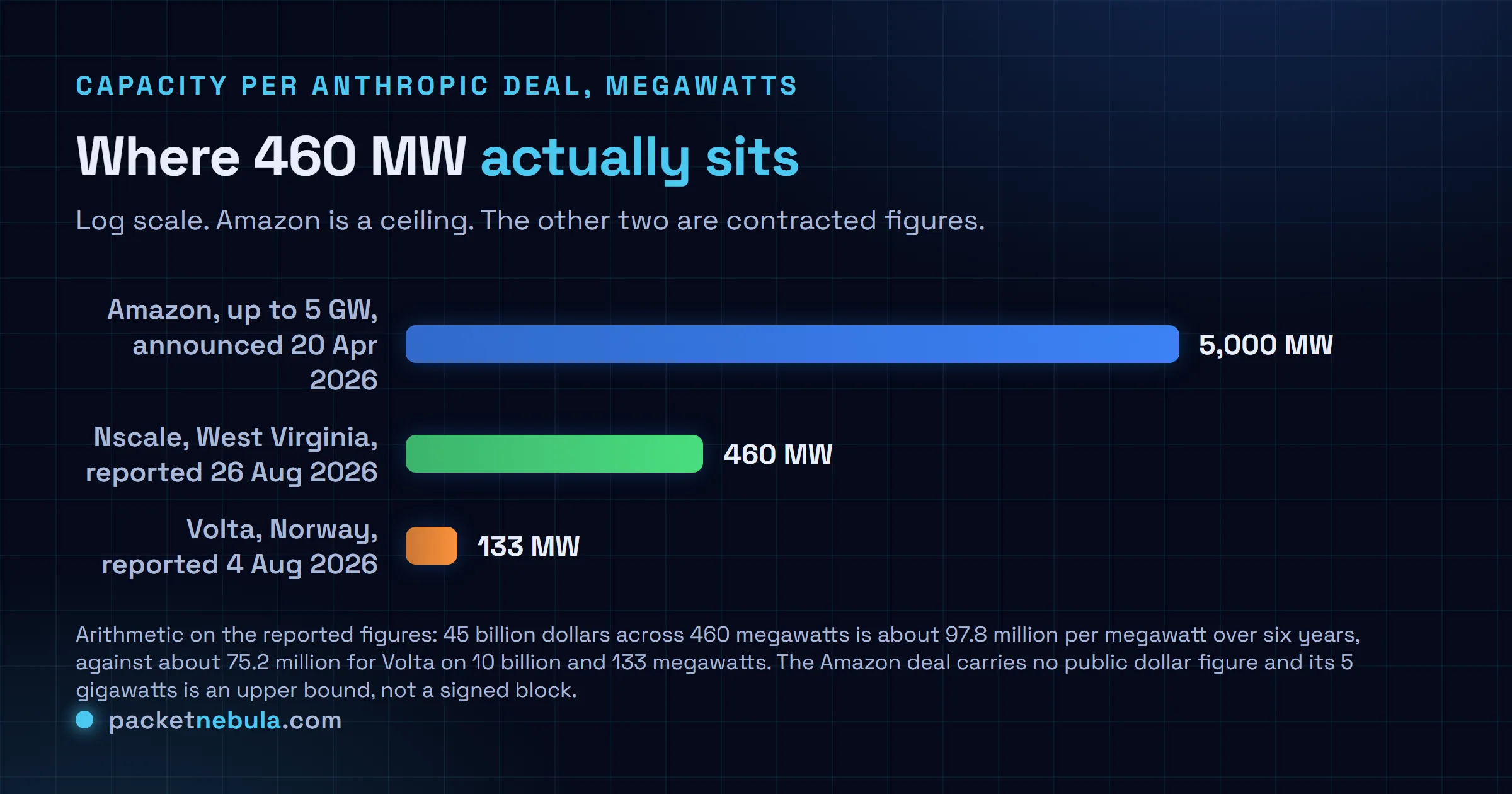
Line it up against what Anthropic already has and the size stops looking dramatic. The Amazon expansion announced on 20 April 2026 covers up to 5 gigawatts. This is 460 megawatts. Under a tenth of that ceiling, and about a third of what Microsoft signed a letter of intent for at the same campus.
Run the arithmetic on the reported numbers and you get about $97.8 million per megawatt across the six years. The Volta deal in Norway, reported on 4 August, works out around $75.2 million per megawatt on $10 billion and 133 megawatts. Roughly 30 percent apart. I wouldn’t read too much into that gap, because we have no idea what each contract actually includes, and Vera Rubin density in 2027 is not Vera Rubin density in 2026. But if someone tells you contracted compute is getting cheaper per watt, those two datapoints don’t say so.
What the deal does buy is supplier count. Volta, AMD, SpaceX, Google, Broadcom, Amazon, and the Theseus platform with Macquarie and GIC that landed on 10 August with no numbers attached at all. Nscale is one more name that isn’t AWS. For a company that filed confidentially for an IPO in June, a supply chain with seven counterparties reads better than one with two.
What it changes for you, today
Nothing. That’s not a snarky answer, it’s the whole practical takeaway.
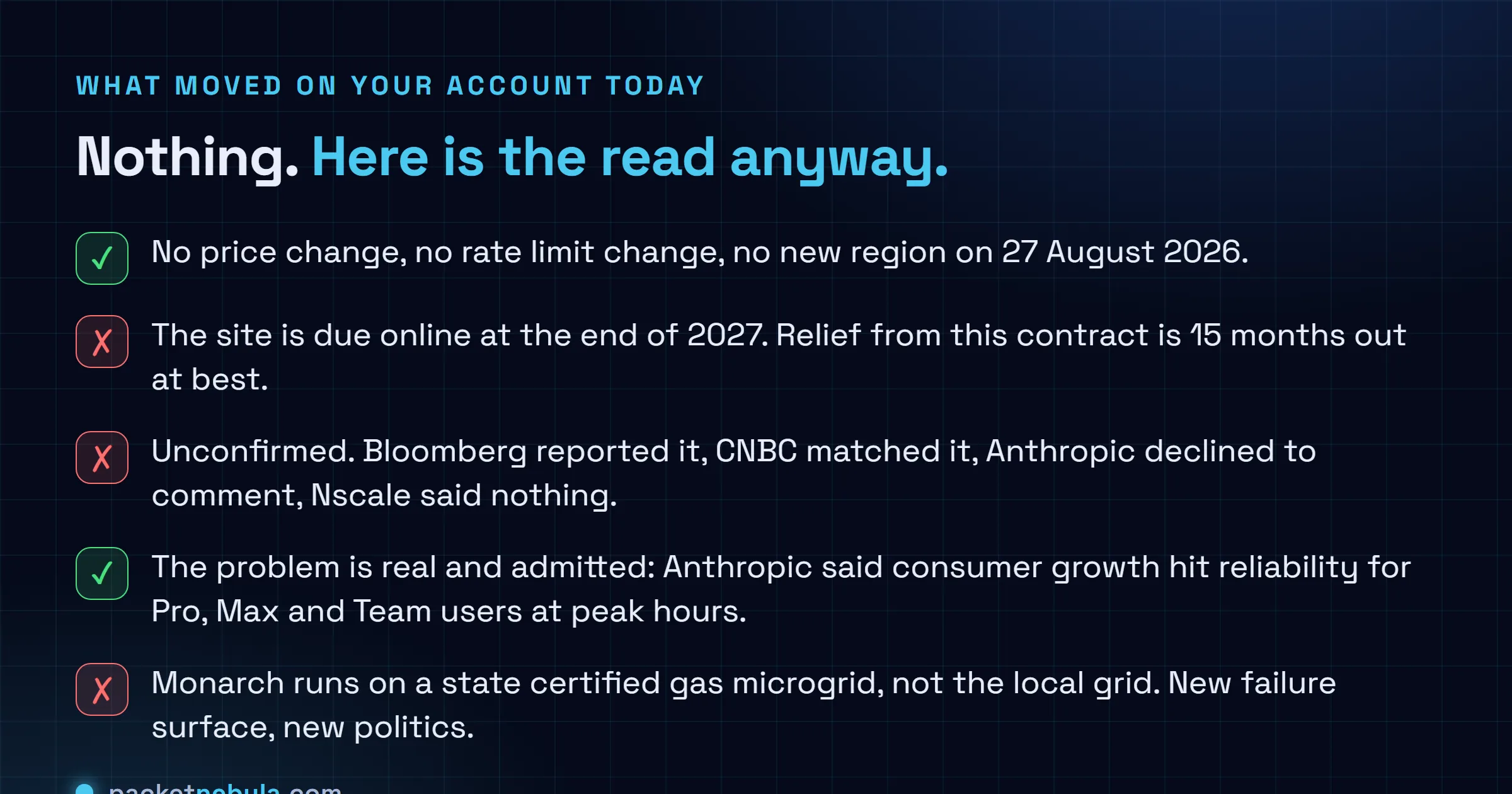
The reason to care is the shape of the answer. Anthropic put the problem in writing back in April: unprecedented consumer growth had impacted reliability and performance for free, Pro, Max and Team users, especially during peak hours. That was the company’s own language in its Amazon announcement, not a critic’s. The fixes it has bought since split into two piles. Amazon capacity that lands in months. Purpose built sites that land in years.
Monarch is firmly in the second pile. So is most of what has been announced since spring, because Vera Rubin itself is only now reaching its first named customers and a 2,250 acre campus with its own gas plant takes as long as it takes.
If you’re writing a 2027 capacity assumption into a plan, this is a reasonable input. If you’re trying to work out why your agent run stalled at 11am on a Tuesday, it isn’t one.
Sources
Bloomberg, 26 August 2026, first report of the $45 billion figure. CNBC for the 460 megawatts, the six year term, the West Virginia location and the late 2027 date. TechCrunch for the Vera Rubin detail and the run of prior Anthropic compute agreements. Campus specifications, the microgrid, the Caterpillar generation figures and the Microsoft letter of intent come from Nscale’s own Monarch announcement of 16 March 2026. The peak hour reliability quote is Anthropic’s, from its 20 April 2026 Amazon compute announcement. The Volta terms are from TechCrunch, 4 August 2026. Run rate and IPO filing details are from Forbes, 18 August 2026.
Update, 7 October 2026. The comparison with Volta divides $10 billion by 133 MW. Bitdeer's 6-K gives 121 MW of IT load (133 MW gross), so the like-for-like figure is higher. See the ledger row.
Frequently asked questions
Did Anthropic and Nscale confirm the $45 billion deal?
No. Bloomberg reported it on 26 August 2026 citing people with knowledge of the matter who asked not to be named because the details are confidential, and CNBC matched the report the same day. Anthropic declined to comment. Nscale has not published a press release about it, and there is nothing on either company newsroom as of 27 August 2026. Treat the figures as well sourced reporting rather than disclosed terms.
How much compute is 460 megawatts?
Enough electricity for roughly 345,000 US homes at any one time, by the comparison used in the coverage. In Anthropic terms it is modest: the Amazon expansion announced on 20 April 2026 covers up to 5 gigawatts, so this contract is under a tenth of that ceiling. It is also about a third of the 1.35 gigawatt first phase Microsoft signed a letter of intent for at the same campus.
When does this capacity actually come online?
The end of 2027 for the West Virginia site, which is also when Nscale said Vera Rubin deployment at Monarch begins, phased across multiple tranches. Nothing in this contract adds a single megawatt to Claude before then. If your 2026 problem is rate limits at 10am Eastern, this deal is not the fix.
What is the Monarch Compute Campus?
Nscale's flagship US site in Mason County, West Virginia, on up to 2,250 acres. Nscale announced it on 16 March 2026 alongside a Microsoft letter of intent for 1.35 gigawatts of NVIDIA Vera Rubin NVL72 capacity, with Caterpillar G3500 natural gas generator sets scaling to 2 gigawatts of generation by the first half of 2028. Nscale calls the power setup America's first state certified AI microgrid, running independently of the local grid, with a runway beyond 8 gigawatts.
Why is Anthropic signing so many of these?
Because it has said, in its own words, that growth broke things. In the 20 April 2026 Amazon announcement it wrote that unprecedented consumer growth had impacted reliability and performance for free, Pro, Max and Team users, especially during peak hours. Since then it has stacked agreements with Volta, AMD, SpaceX, Google and Broadcom, plus the Theseus platform with Macquarie and GIC. It also filed confidentially for an IPO in June 2026, which is the other reason contracted capacity keeps getting announced.


