
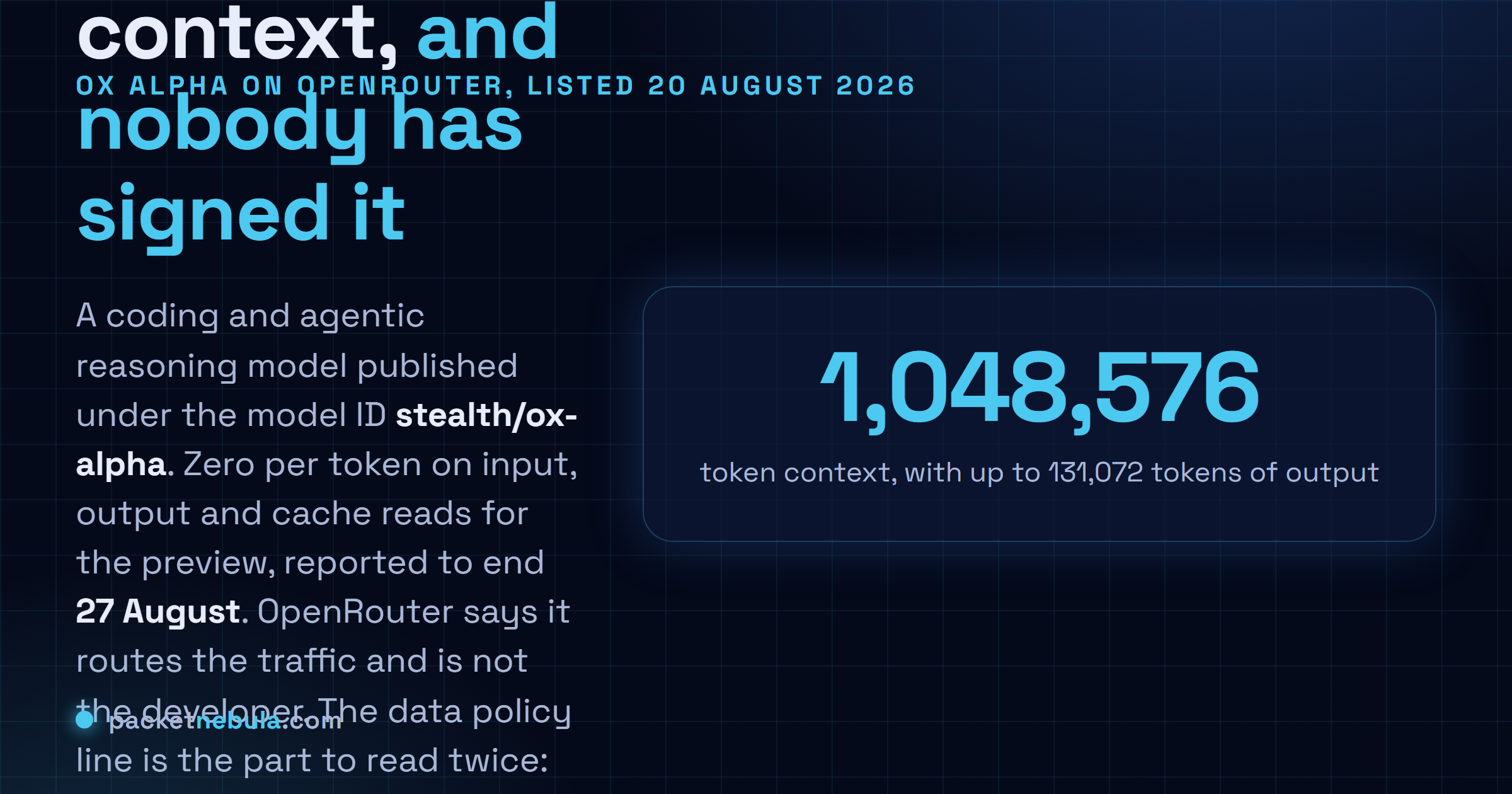
You open the OpenRouter model list, sort by price, and there it is at the top: ox-alpha, a million tokens of context, zero dollars in and zero dollars out. Free coding model, listed 20 August 2026, and no lab has put its name on it. That is the whole story and also the catch. OpenRouter is explicit that it only routes the requests, that the thing is run by a third party who chose to stay anonymous for the preview, and that prompts and completions are retained by that provider. Not used for training, the terms say. Retained, though. So the question is not whether Ox Alpha is good, because the early spot checks say it is decent. The question is what you are willing to send to an operator you cannot name.
The short answer
Ox Alpha went up on OpenRouter on 20 August as stealth/ox-alpha, a coding and agent model from an operator nobody has identified. It is genuinely capable on the early spot checks. It also retains everything you send it, under terms written by a company with no name on them. Use it on code you would happily publish.
What is actually on the listing
The documented part is short, so here it is in full.
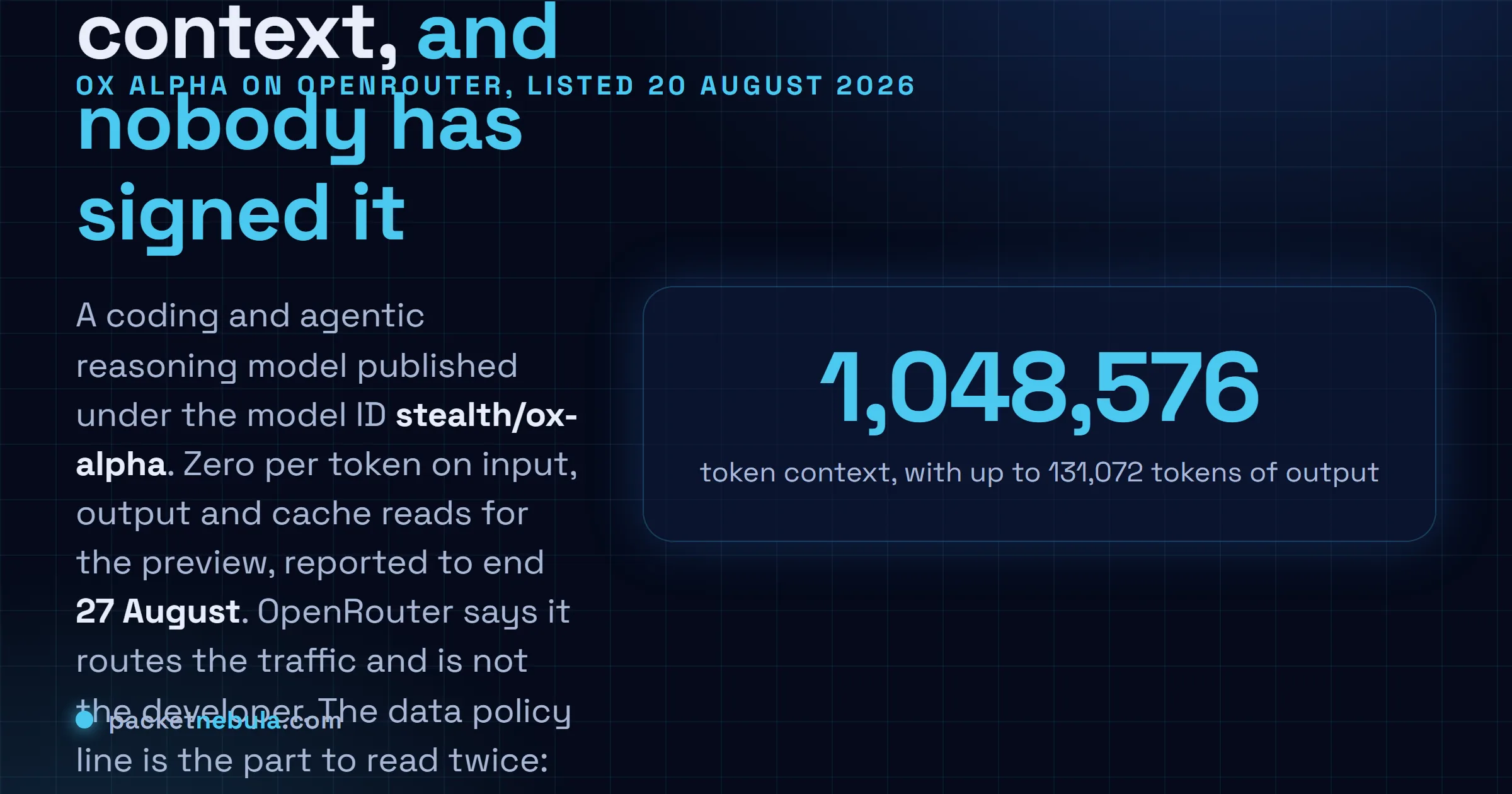
Model ID stealth/ox-alpha. Context window 1,048,576 tokens, with a ceiling of 131,072 tokens on the completion. Input accepts text, images and video. Output is text. Function calling works through the usual tools and tool_choice parameters, and JSON response formatting is supported. The description on the page pitches it at long horizon software engineering and workflows that mix text with visual context.
Pricing during the preview is zero on prompt tokens, completion tokens and cache reads. The reporting around the launch puts the free window at roughly a week from 20 August, so it closes around 27 August, and OpenCode pushed it to its users on the same free basis.
When we looked at the model page, the live stats read 6.01 seconds median latency, 23 tokens per second of throughput, and three day uptime of 99.99 percent. Twenty-three tokens a second is not fast. For a reasoning model doing agent work that is survivable, for a chat UI it would feel sluggish.
The 80 percent number, and what it is worth
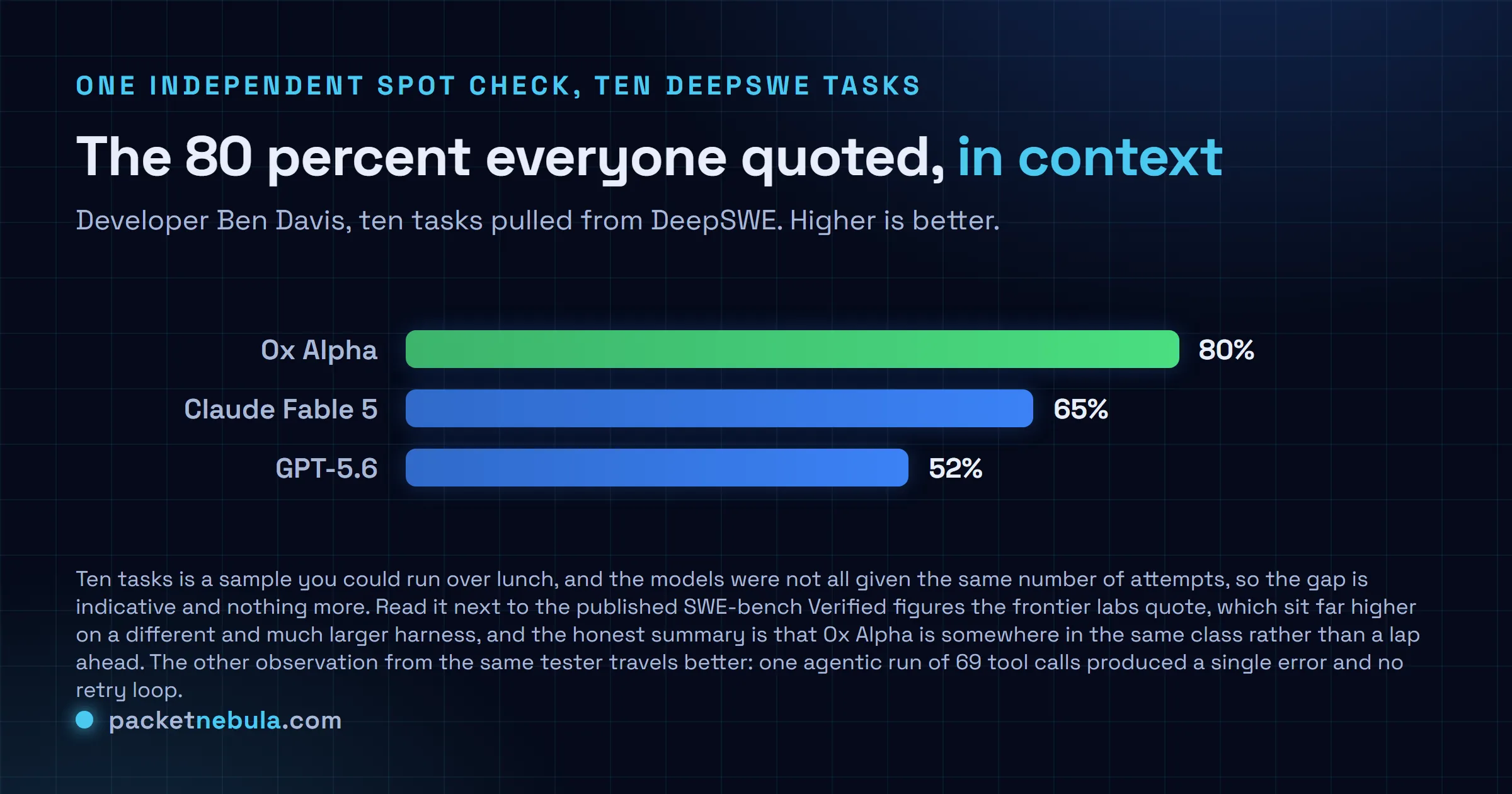
The headline everywhere is that Ox Alpha closed out DeepSWE at 80 percent, beating Claude Fable 5 at 65 and GPT-5.6 at 52. Developer Ben Davis ran that, and to his credit he described his own method plainly.
Ten tasks. Pulled from DeepSWE, not the whole suite. And the models were not all given the same number of attempts. That is a spot check, the kind of thing you do on a Thursday evening to decide whether a new model is worth a second look, and it answered that question well. It does not sit alongside the SWE-bench Verified figures the frontier labs publish, which come off a much larger harness and land far higher for everyone involved.
The detail from the same tester that impressed us more was the agent run: 69 tool calls, one error, no retry loop. Long tool chains are where cheap models fall apart, usually by looping on a failed call until the budget dies. Not looping is a real signal.
Who is running it
Nobody has said, and the guessing has been thorough.
Davis puts himself at 99 percent certainty that this is Zhipu’s GLM family, on four pieces of evidence. Video encoder token consumption matches GLM-5V-Turbo, at roughly 147 tokens per second of clip. Tokenizer counts match GLM-5.3 exactly, offset by a fixed 75 token wrapper. Audio input gets rejected the same way GLM-5V rejects it. And the output carries about 1.3 emojis per thousand characters, which lines up with the GLM and Qwen house style.
That is careful work and it is still circumstantial. Nobody at Zhipu has confirmed anything, and a tokenizer can be shared or copied. If it is GLM, the timing fits: GLM-5.3 shipped on 14 August with the weights held back, and a cloaked multimodal sibling running free for a week is exactly how you collect a week of real agent traffic before you name the thing.
There is precedent for the whole ritual. In September 2025, two models called Sonoma Sky Alpha and Sonoma Dusk Alpha sat free and anonymous on OpenRouter with a 2M context, climbed the charts, and were confirmed a few weeks later as xAI’s Grok 4 Fast in reasoning and non reasoning form. Same pattern of a leak-shaped launch, then a real name. We wrote about the gap between a confirmed launch and the leak noise around it when Kimi K3 landed, and the lesson holds here.
The line in the terms
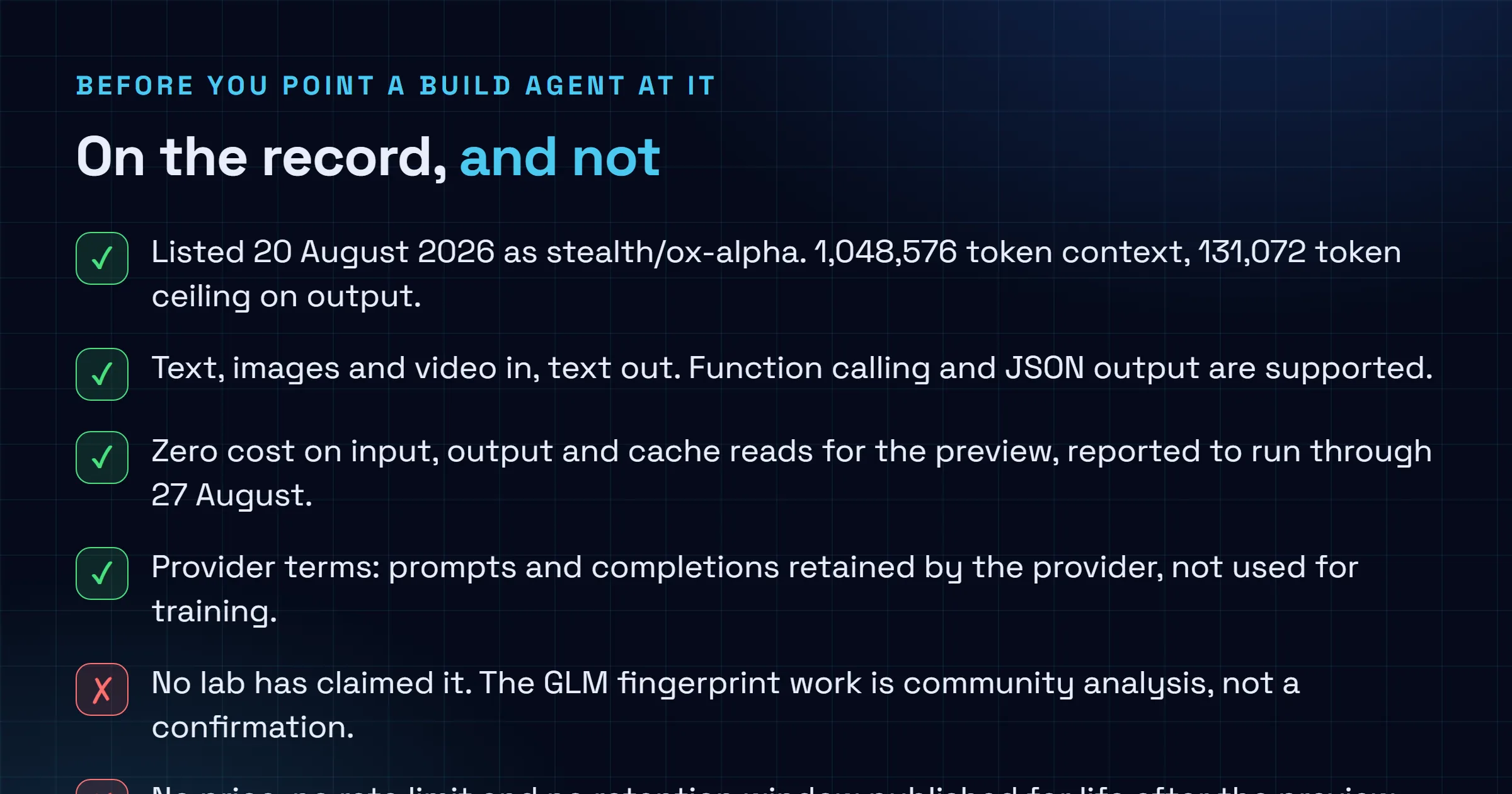
Here is the sentence, from the model page: prompts and completions for this model are retained by the provider and are not used for training.
Read both halves. Not used for training is the reassuring half, and it is also the half that is easy to promise. Retained by the provider is the operative half. Retained where, for how long, under which country’s disclosure rules, by a legal entity with what name. None of that is published, and there is no one to ask, because the point of a stealth listing is that there is no one to ask.
For open source work, a side project, a benchmark harness, a throwaway script, that is a non-issue. Free frontier-ish coding with a million tokens of context is a genuinely good deal and you should go use it before 27 August.
For your employer’s private repository, it is not a close call. Don’t.
Our own rule while these previews run: point the agent at a scratch checkout, keep credentials out of the environment it can read, and treat every token you send as public. Which, incidentally, is a reasonable default for any model endpoint whose operator you would not name in a compliance review.
What we would do this week
Try it. Give it a real task with a long tool chain, because that is the part the spot check suggested is strong and the part that would show up as weak fastest.
Then write down what you actually get, because the price is going to change. Every cloaked preview ends the same way: a name, a rate card, and a number that is not zero. If Ox Alpha is worth paying for, you want that judgement made on your own workload rather than on ten tasks somebody ran on a Thursday.
I might be wrong about the GLM attribution, incidentally. The tokenizer evidence is strong but it is the kind of strong that has been wrong before.
Sources
Model listing, pricing, context limits and data policy: Ox Alpha on OpenRouter. The ten task DeepSWE spot check and the tokenizer fingerprinting are reported in this analysis of the stealth model and in AI/TLDR’s release note. The Sonoma precedent comes from OpenRouter’s own reveal post.
Frequently asked questions
What is Ox Alpha?
A reasoning model aimed at coding and long running agent work, listed on OpenRouter on 20 August 2026 under the model ID stealth/ox-alpha. It carries a 1,048,576 token context window, returns up to 131,072 tokens, and accepts text, images and video as input. OpenRouter states that it routes requests to the model and is not its developer, owner or provider.
Who made Ox Alpha?
Nobody has said. The provider is listed as Stealth and no lab has claimed it. Community fingerprinting points at Zhipu's GLM family, based on tokenizer counts that match GLM-5.3 with a fixed offset and on video encoder behaviour that matches GLM-5V-Turbo. That is analysis by an outside tester, not a confirmation from anyone who would know.
How long is Ox Alpha free?
The listing shows zero for input, output and cache reads during the preview, and the coverage around the launch reports a window of roughly one week from 20 August, so through 27 August 2026. No price for what comes after has been published, and no rate card, quota or retention window either.
Is it safe to use Ox Alpha on work code?
We would not. The data policy on the listing says prompts and completions are retained by the provider and are not used for training. Retention by an operator whose legal identity, jurisdiction and retention period are all unpublished is a poor fit for proprietary source, customer data or anything under an NDA. Open source work and throwaway experiments are a different matter.
Did the 80 percent DeepSWE score come from a full benchmark run?
No. It came from a ten task spot check by developer Ben Davis, who reported 80 percent for Ox Alpha against 65 percent for Claude Fable 5 and 52 percent for GPT-5.6 on the same ten tasks, with the models not all given the same number of attempts. It is a useful signal and it is not a benchmark result.


