
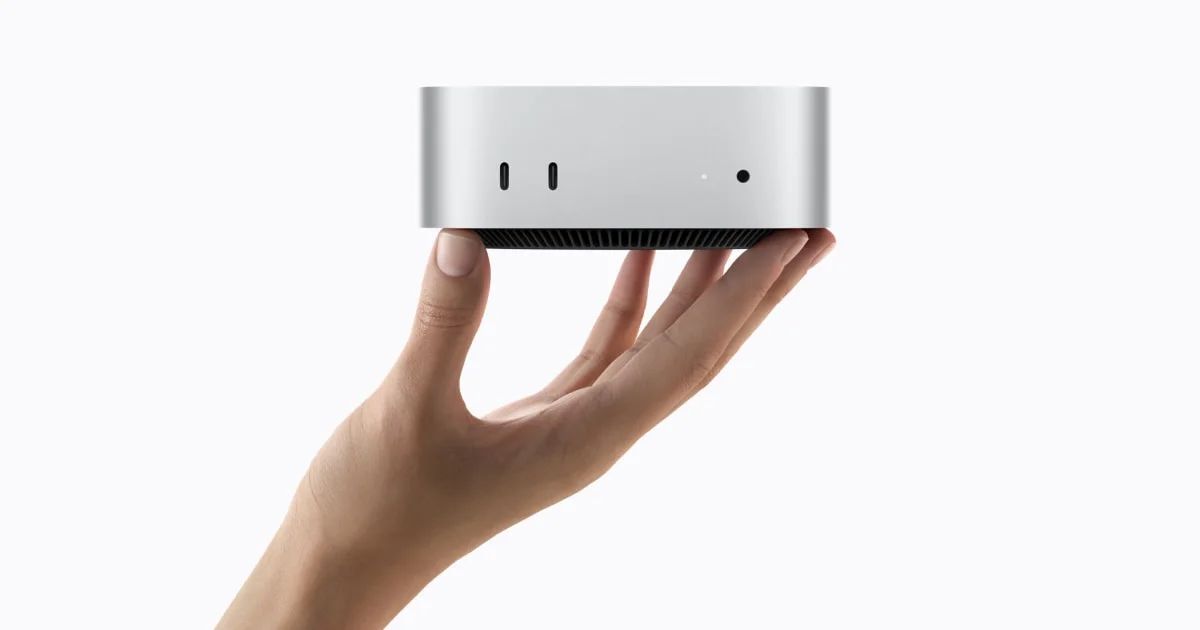
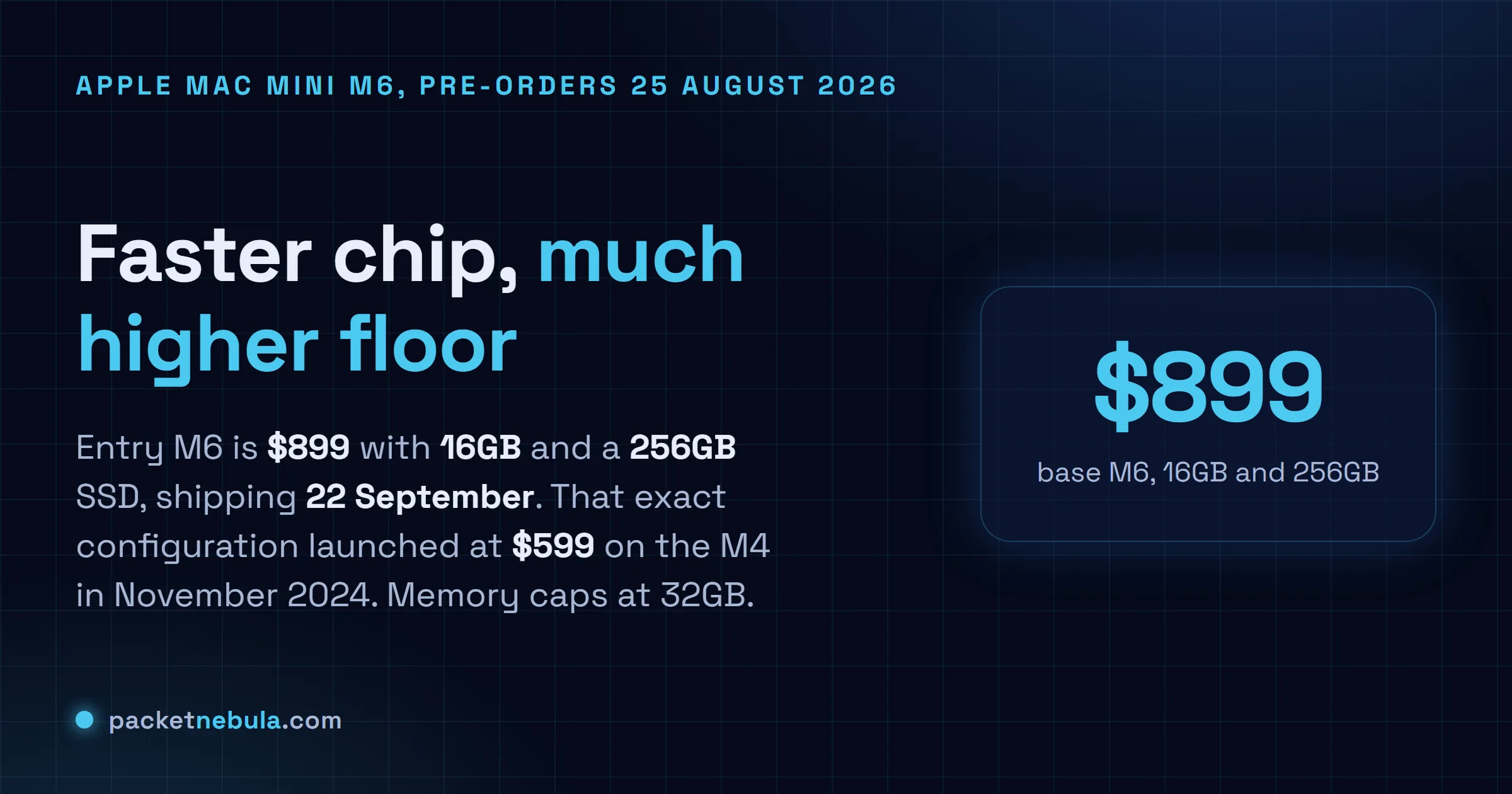
The cheap Mac is gone. Apple opened pre-orders on the M6 Mac mini on 25 August, and the entry machine now costs $899 with 16GB of unified memory and a 256GB SSD, which is the exact configuration that sat at $599 when the M4 model launched in November 2024. Same memory, same storage, three hundred dollars more. You do get real hardware for it: a 12-core CPU, a 12-core GPU with Neural Accelerators in every core, a dual 16-core Neural Engine, 170GB/s of bandwidth, and 2.5Gb Ethernet instead of gigabit. Whether that adds up depends entirely on what you were planning to put on the box, and if the answer is local models, read the memory line twice.
The short answer
Apple opened pre-orders for the M6 Mac mini on 25 August 2026, shipping 22 September. The M6 brings a 12-core CPU, a 12-core GPU with Neural Accelerators in each core, a dual 16-core Neural Engine and 170GB/s of bandwidth. Wi-Fi 7, Bluetooth 6 and 2.5Gb Ethernet across the range. The catch is the price and the memory: $899 buys the same 16GB and 256GB that cost $599 at the M4 launch, and 32GB is as far as the M6 goes. The M5 Pro at $1,699 gets 24GB standard, up to 64GB, 307GB/s and Thunderbolt 5.
What $899 actually gets you
The chip is a genuine step. M6 runs a 12-core CPU and a 12-core GPU, both up two cores from the M4, and for the first time on a Mac mini every GPU core carries a Neural Accelerator. The Neural Engine is now a dual 16-core arrangement rather than a single block, and memory bandwidth climbs to 170GB/s from the M4’s 153GB/s.
Apple’s headline claims, all measured against the M4 Mac mini: up to 40 percent faster CPU, up to 2x graphics, up to 2x storage, up to 4x on AI work. The one number with an actual application attached is LM Studio prompt processing, quoted at up to 4.8x faster than M4 and 13.5x faster than M1. Vendor benchmarks on vendor workloads. We’d wait for someone independent to run a real model before treating any of it as planning data.
Two things in the spec sheet matter more to us than any of that.
Ethernet finally moves off gigabit. Every new Mac mini ships with 2.5Gb as standard, with the 10Gb option still there at extra cost. For anyone using one of these as an always-on box next to a NAS, that’s the upgrade that changes a working day, and it’s the one Apple buried three quarters of the way down the press release. Wi-Fi 7 and Bluetooth 6 come along too, up from Wi-Fi 6E and Bluetooth 5.3.
The price line, without the spin
Here’s the sequence, and we’re keeping it to things that are on the record.
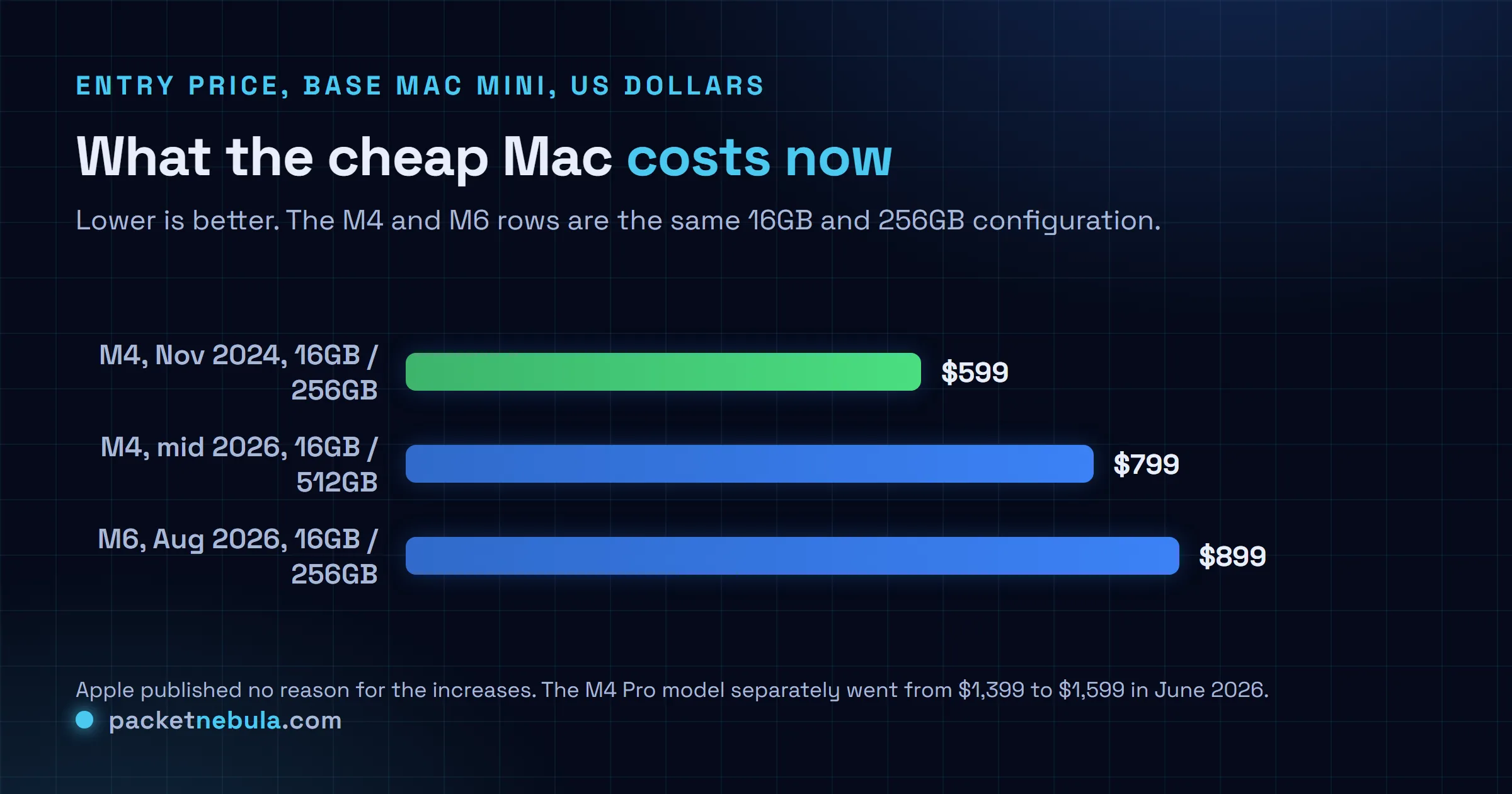
November 2024: the M4 Mac mini arrives at $599 with 16GB and a 256GB SSD. During 2026 that configuration disappears from the store, and the entry point becomes a $799 machine with a 512GB SSD. In June, the M4 Pro version goes from $1,399 to $1,599. Now the M6 puts 16GB and 256GB back on the shelf at $899.
So the like-for-like comparison is $599 to $899. Fifty percent, in under two years, on the machine whose entire reputation was being the cheap way into a Mac.
Apple gave no reason, and we’re not going to invent one on its behalf. The context everyone is pointing at is real enough: memory and NAND contract prices have been climbing hard all year as data centre buyers absorb supply, and we’ve watched the same pressure land on the MacBook Air and on Pixel pricing. Whether that fully explains a $300 move on a $599 product, I doubt. Component cost is part of it. The rest is what a company charges when the thing sells anyway.
Apple is selling this as an AI box. Read the memory line.
The press release says “always-on agentic computing” and it says it more than once. Srouji’s quote calls it an always-on agentic device. The marketing images show local models and AI agents automating daily tasks. That’s the pitch.
And then the $899 machine ships with 16GB of unified memory, configurable to 32GB, and that is the ceiling.
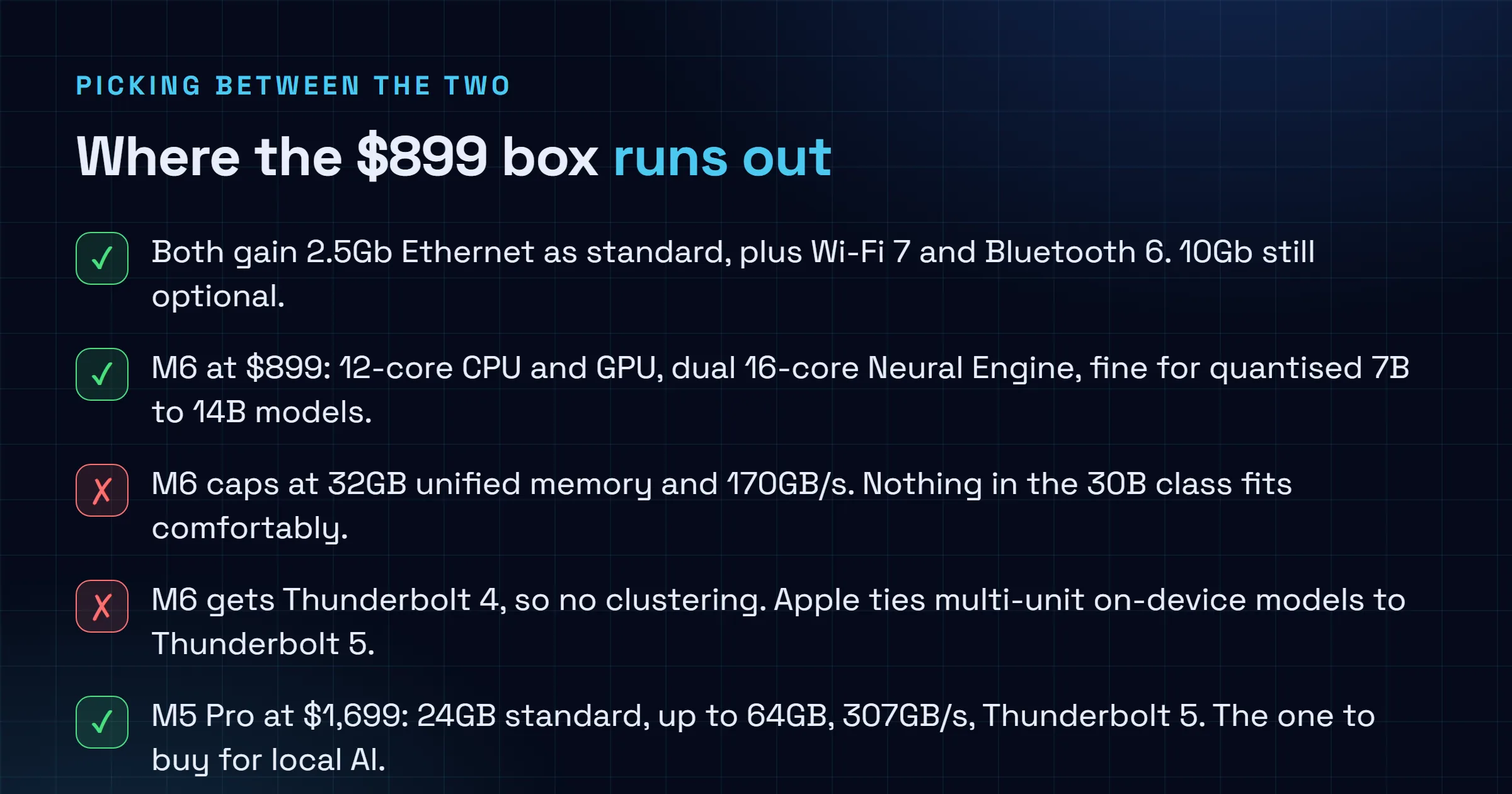
Unified memory is shared. Whatever the model loads comes out of the same pool as macOS, your browser and everything else running. On 16GB you’re comfortable with quantised weights in roughly the 7B to 14B band plus a usable context window, which genuinely covers a lot of agent work and most coding assistants. Push into the 30B class and you need 32GB, which is the M6’s maximum. Past that you’re buying the M5 Pro, which starts at 24GB, goes to 64GB, and runs 307GB/s of bandwidth against the M6’s 170.
The port split says the same thing in hardware. M6 gets three Thunderbolt 4 ports. M5 Pro gets three Thunderbolt 5. Apple explicitly states that Thunderbolt 5 is what allows clustering several Mac mini systems together to run large AI models entirely on device. That capability simply isn’t on the cheap machine, by design.
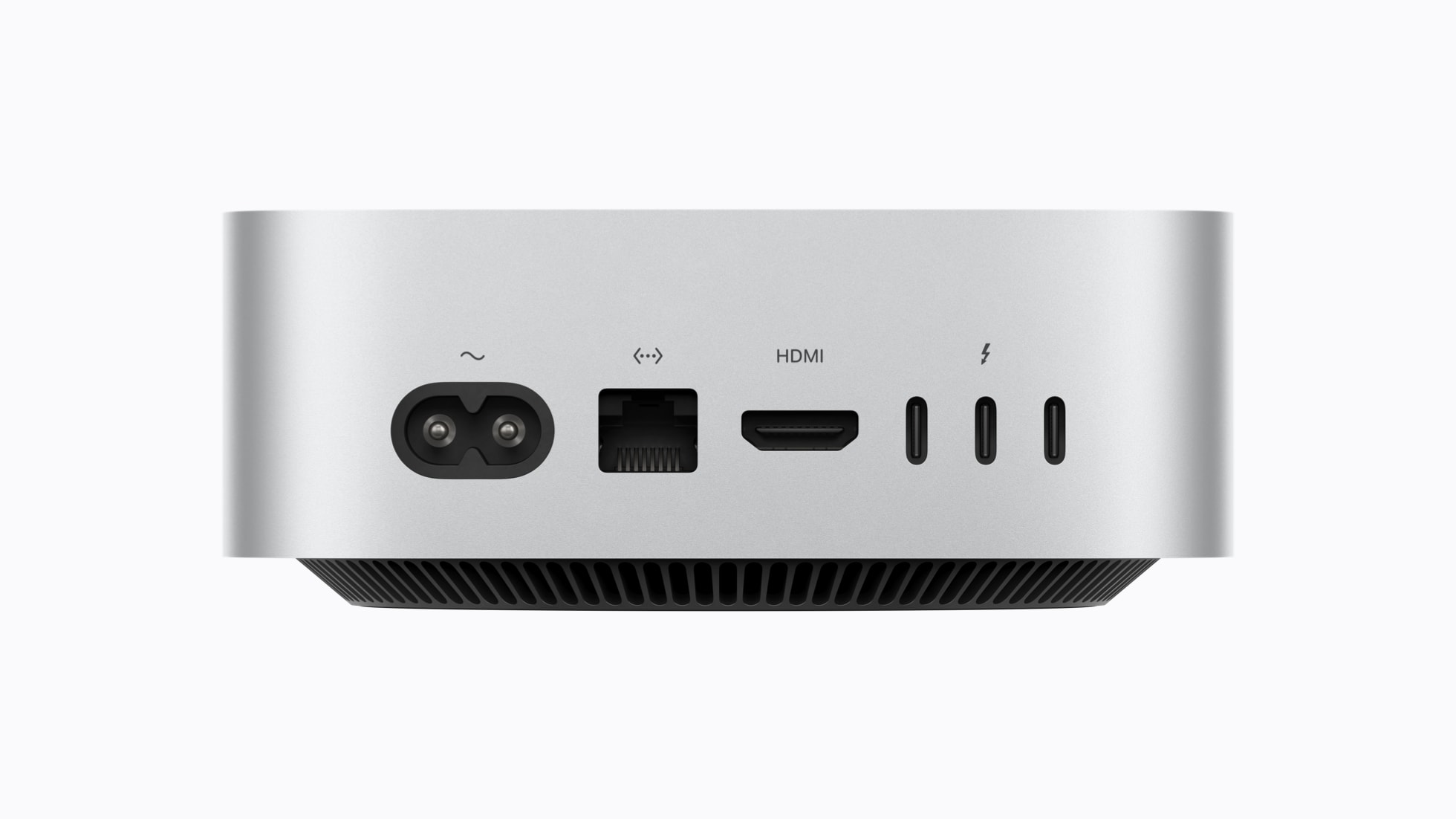
Image: Apple, from its Mac mini newsroom announcement, 25 August 2026.
I might be wrong about how much this bites. For an always-on agent chewing through an 8B model and a queue of small tasks, 16GB is fine and the extra Neural Engine will show up in latency you can feel. But the gap between the copy and the configuration is wide enough to notice.
So which one, and when
If you want a small, quiet, low-draw desktop that runs all the time and talks to a 2.5Gb switch, the M6 at $899 does that well and the chip is not the limiting factor. Buy it for what it is.
If the reason you’re looking at a Mac mini is running models locally, the $899 configuration is the wrong purchase and the 32GB upgrade only moves the wall a little. Either budget for the M5 Pro or wait, because the memory market is the thing setting these prices and nobody sensible is predicting where it lands.
Worth a note on timing: pre-orders opened 25 August in 30 countries, nothing ships until 22 September, and macOS 27 arrives as a free update in the autumn. If your workflow depends on the new Apple Intelligence and Siri work Apple keeps attaching to this launch, that’s a second date to watch, and it isn’t the one on your delivery slip. The previous generation sold out fast enough to show up on eBay above list, so if you’ve decided, decide early.
Sources
Chip specifications, the 170GB/s and 307GB/s bandwidth figures, the port breakdown, the 2.5Gb Ethernet and Wi-Fi 7 details, the Thunderbolt 5 clustering statement, the Srouji quote, the LM Studio comparisons and the pre-order and availability dates all come from Apple’s own Mac mini announcement, published 25 August 2026, including its education pricing note. Base configuration and pricing for both models, plus the discontinuation of the $599 machine, are reported by TechCrunch and MacRumors. The price history, including the mid-cycle move to a $799 entry point and the M4 Pro increase from $1,399 to $1,599 in June, is from Macworld. M4 Mac mini reference specifications are from Apple’s own tech specs page.
Frequently asked questions
How much does the M6 Mac mini cost?
The M6 model starts at $899 in the US with a 12-core CPU, 12-core GPU, 16GB of unified memory and a 256GB SSD, or $799 with education pricing. The M5 Pro model starts at $1,699, or $1,599 education, and comes with 24GB of memory and a 512GB SSD. Pre-orders opened on 25 August 2026 in 30 countries and regions, with deliveries and retail availability starting 22 September.
Why did the Mac mini go from $599 to $899?
Apple has not published a reason, and we would not quote one it did not give. What is on the record is the sequence: the M4 Mac mini launched at $599 in November 2024 with 16GB and 256GB, that configuration was dropped during 2026 leaving a $799 model with a 512GB SSD as the entry point, the M4 Pro version went from $1,399 to $1,599 in June, and the M6 now reinstates 16GB and 256GB at $899. Memory and NAND contract prices have been climbing all year on data centre demand, which is the obvious backdrop, but Apple itself stayed quiet about it.
Is 16GB enough to run local AI models on the M6 Mac mini?
For small models, yes. Unified memory is shared between the system and the model, so on a 16GB machine you realistically fit quantised models in the 7B to 14B range with room for a context window, which covers a lot of agent and coding assistant work. Anything in the 30B and up class needs the 32GB configuration at minimum, and the M6 tops out at 32GB. If you want to load bigger weights, the M5 Pro goes to 64GB with 307GB/s of bandwidth.
What is the difference in ports between the M6 and M5 Pro Mac mini?
Both have two front USB-C ports supporting USB 3, a front headphone jack, HDMI, and Ethernet at 2.5Gb with a 10Gb option. The split is on the back: three Thunderbolt 4 ports on the M6, three Thunderbolt 5 ports on the M5 Pro. Apple says Thunderbolt 5 is what lets you cluster several Mac mini systems to run large AI models entirely on device, so that capability does not exist on the $899 machine.
How much faster is the M6 Mac mini than the M4?
Apple claims up to 40 percent faster CPU, up to 2x graphics, up to 2x storage and up to 4x AI performance versus the M4 Mac mini. The most concrete figure it published is LLM prompt processing in LM Studio, quoted as up to 4.8x faster than M4 and up to 13.5x faster than M1. These are vendor numbers on vendor-chosen workloads, so treat them as a direction rather than a benchmark, and wait for independent runs before budgeting around them.


