




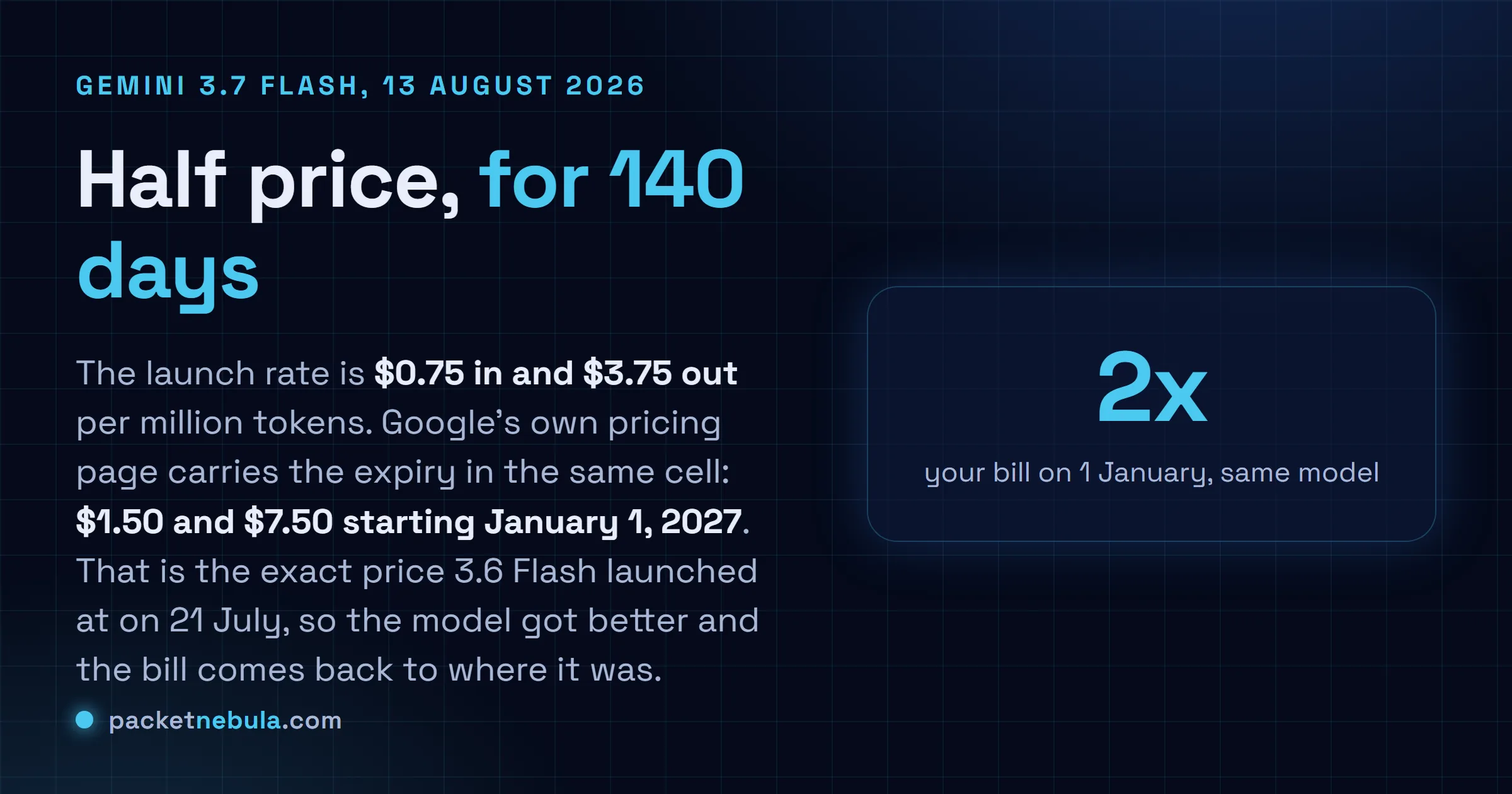
We had the Gemini pricing page open for something else, and the 3.7 Flash row carried a sentence most of today's coverage skipped. Google shipped Gemini 3.7 Flash on 13 August at $0.75 per million input tokens and $3.75 output, genuinely half what 3.6 Flash cost at launch three weeks back. The catch is printed inside the same cell: that rate runs through 31 December 2026. On 1 January it becomes $1.50 and $7.50, which is precisely what 3.6 Flash launched at. So the model got better and the invoice takes a 140 day holiday before returning to where it started.
The short answer
Gemini 3.7 Flash landed on 13 August, three weeks after 3.6 Flash, at half the price 3.6 launched with. Google’s pricing page carries the expiry in the same cell as the price: $1.50 and $7.50 from 1 January 2027, which is 3.6 Flash’s launch rate. The coding and agent scores moved a long way on Google’s own evaluations. And 3.5 Pro still has no date.
What Google shipped
 Image: Google
Gemini 3.7 Flash is a coding and agent model. Google calls it the most intelligent workhorse model it has for that work, and credits developer feedback plus algorithmic changes for turning it around in three weeks.
Three weeks. That’s the part worth sitting with. We wrote up Gemini 3.6 Flash on 21 July, and the ink isn’t dry. Google is now iterating the Flash tier faster than most teams finish an evaluation harness.
It’s live in the Gemini API through AI Studio and Android Studio, in Google Antigravity, in the Gemini Enterprise Agent Platform and the Enterprise app. Consumers get it through Spark if they pay for AI Pro or Ultra, in 160 plus countries, from today.
The price has a date attached
Here’s the bit we think matters most for anyone doing capacity planning.
The launch rate is $0.75 per million input tokens and $3.75 per million output. Google’s own blog frames it as available “through the end of the year at an introductory price”. The API pricing page is blunter, and puts the whole thing in one line: $0.75 through December 31, 2026, then $1.50 starting January 1, 2027. Output reads the same way, $3.75 then $7.50.
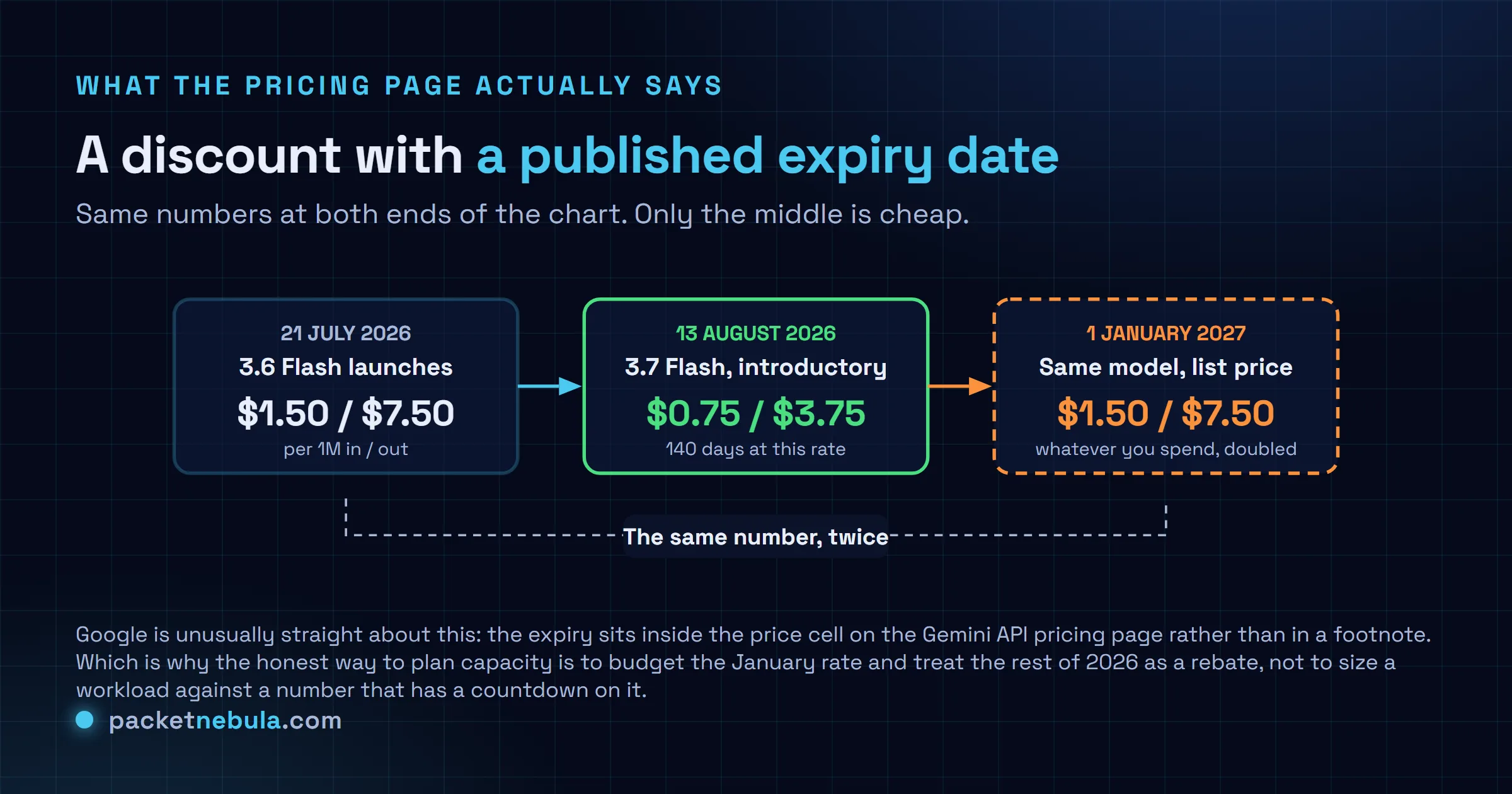
Compare that to what we recorded on 21 July, when 3.6 Flash arrived at $1.50 in and $7.50 out. Identical. So the honest description of today isn’t “Google halved the price of its Flash model”. It’s closer to “Google shipped a better Flash model, and is running a rebate on it until the new year.”
Run the arithmetic on a modest workload. A team burning 50M input and 10M output tokens a month pays $75 today. Same tokens, same model, in January: $150. Whatever number you’re looking at, double it and put that in the budget.
Honestly, I’d rather have this than the alternative. Plenty of vendors quietly reprice and let you find out on the invoice, and we caught xAI moving the cache rate under an unchanged headline price only yesterday. Google published the date. Use it.
What actually got better
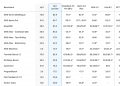
Google published a spread of evaluation numbers against 3.6 Flash, and the gains are not subtle.
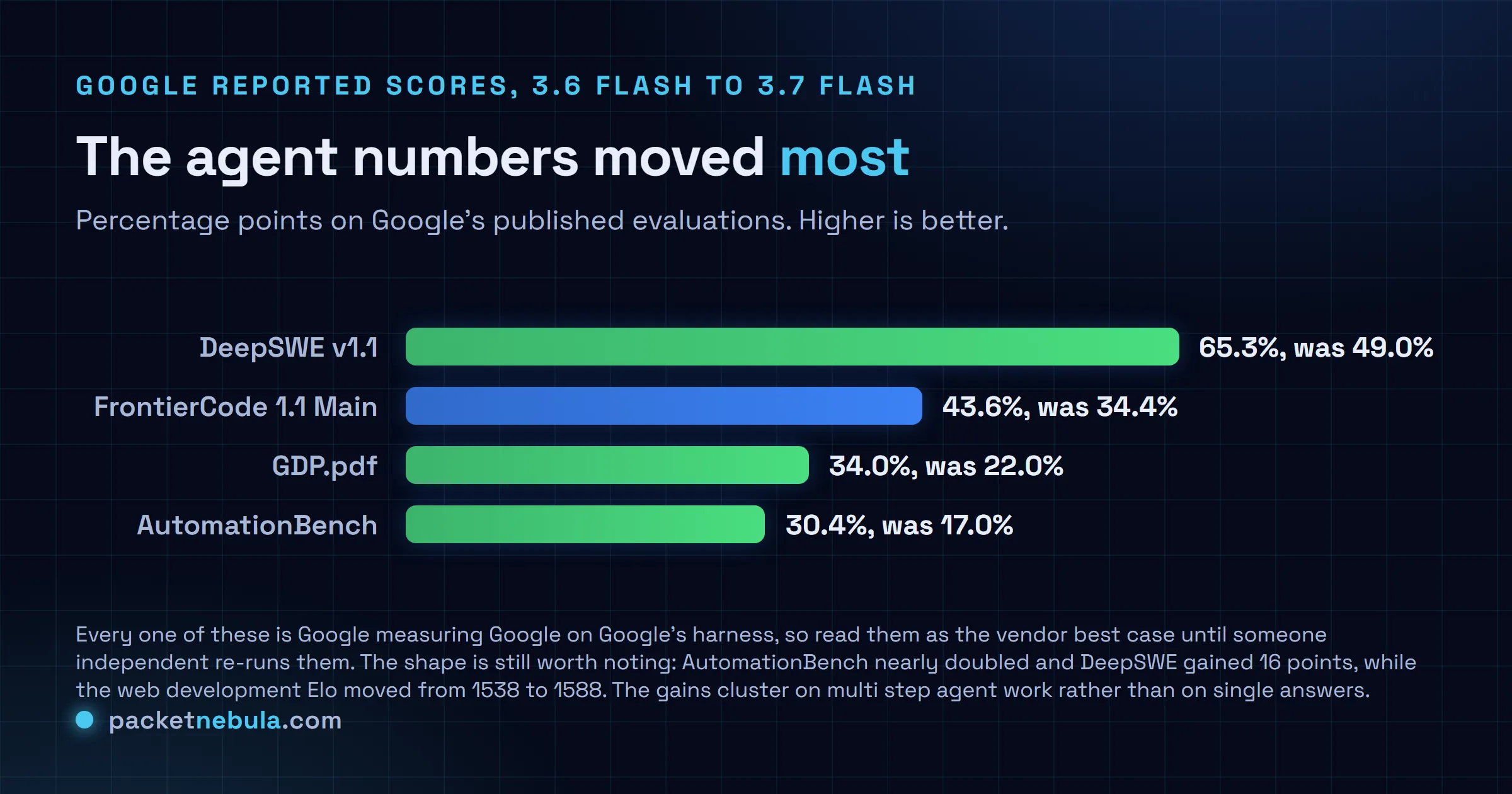
DeepSWE v1.1 went 49.0% to 65.3%. FrontierCode 1.1 Main, 34.4% to 43.6%. GDP.pdf, 22.0% to 34.0%. AutomationBench nearly doubled, 17.0% to 30.4%. WebDev Arena Elo moved from 1538 to 1588.
Look at where the big jumps sit. AutomationBench and DeepSWE are multi step work, the kind where a model has to keep going after something breaks. The web development Elo moved 50 points, which is real but ordinary. Google’s own framing matches: developers reportedly found it “better adapts to roadblocks” and follows instructions more faithfully.
All vendor numbers, though. Every one of these is Google grading Google. We’d wait for Artificial Analysis or a similar third party before treating the DeepSWE jump as settled, because a 16 point gain in three weeks on a coding benchmark is the kind of result that sometimes shrinks when someone else runs it.
And the Pro nobody has seen
Gemini 3.5 Pro is still missing. No date, again.
We covered the July slip when it happened, and the situation hasn’t moved except that Google has now shipped two Flash models in the meantime. Read that how you like. Our take: the Flash tier is where the engineering is landing, and if you’ve been holding a project open waiting for Pro, you’re waiting on something with no public schedule while a cheaper model gets meaningfully better every few weeks.
Should you move
If you’re on 3.6 Flash and your prompts are portable, testing 3.7 costs you an evaluation run. The scores went one direction and the rate is currently lower.
If you’re building something that has to survive 2027, size it at $1.50 and $7.50. That’s the real price. Anything you save between now and December is a bonus, not a plan.
Sources
Google, Introducing Gemini 3.7 Flash, 13 August 2026. Google, Gemini API pricing, consulted 13 August 2026, for the introductory rate and its 31 December expiry. 9to5Google, Gemini 3.7 Flash launches three weeks after last model. Thurrott, Google Launches Gemini 3.7 Flash Model, on the continuing absence of 3.5 Pro. The 3.6 Flash launch prices are the ones we recorded on 21 July 2026.
Frequently asked questions
How much does Gemini 3.7 Flash cost?
Seventy five cents per million input tokens and $3.75 per million output, on the paid tier. That is an introductory rate. Google's Gemini API pricing page states it applies through December 31, 2026, and that the price becomes $1.50 input and $7.50 output starting January 1, 2027. Both numbers sit in the same cell on the official page, so the expiry is not buried in a footnote.
Is Gemini 3.7 Flash cheaper than 3.6 Flash?
Right now, yes, by half against what 3.6 Flash charged when it launched on 21 July 2026, which was $1.50 in and $7.50 out. From 1 January 2027 the 3.7 Flash list price is that same $1.50 and $7.50. So the discount is real for the rest of 2026 and then the two generations meet at the same number.
Is Gemini 3.7 Flash better than 3.6 Flash?
On the evaluations Google published, clearly. DeepSWE v1.1 went from 49.0% to 65.3%, FrontierCode 1.1 Main from 34.4% to 43.6%, GDP.pdf from 22.0% to 34.0% and AutomationBench from 17.0% to 30.4%, with the WebDev Arena Elo moving 1538 to 1588. These are Google's own runs on Google's harness, so treat them as the vendor best case until independent evaluations land.
Where can I use Gemini 3.7 Flash?
Through the Gemini API in Google AI Studio and Android Studio, plus Google Antigravity, the Gemini Enterprise Agent Platform and the Gemini Enterprise app. On the consumer side it powers Gemini Spark for Google AI Pro and Ultra subscribers across more than 160 countries, live from 13 August 2026.
Has Gemini 3.5 Pro been released yet?
No. Google shipped a second Flash model in three weeks and still gave no date for 3.5 Pro, the flagship that has been in partner testing since the spring. The Flash line is now on its second release since Pro was first promised, which tells you where Google's shipping capacity is actually going.