

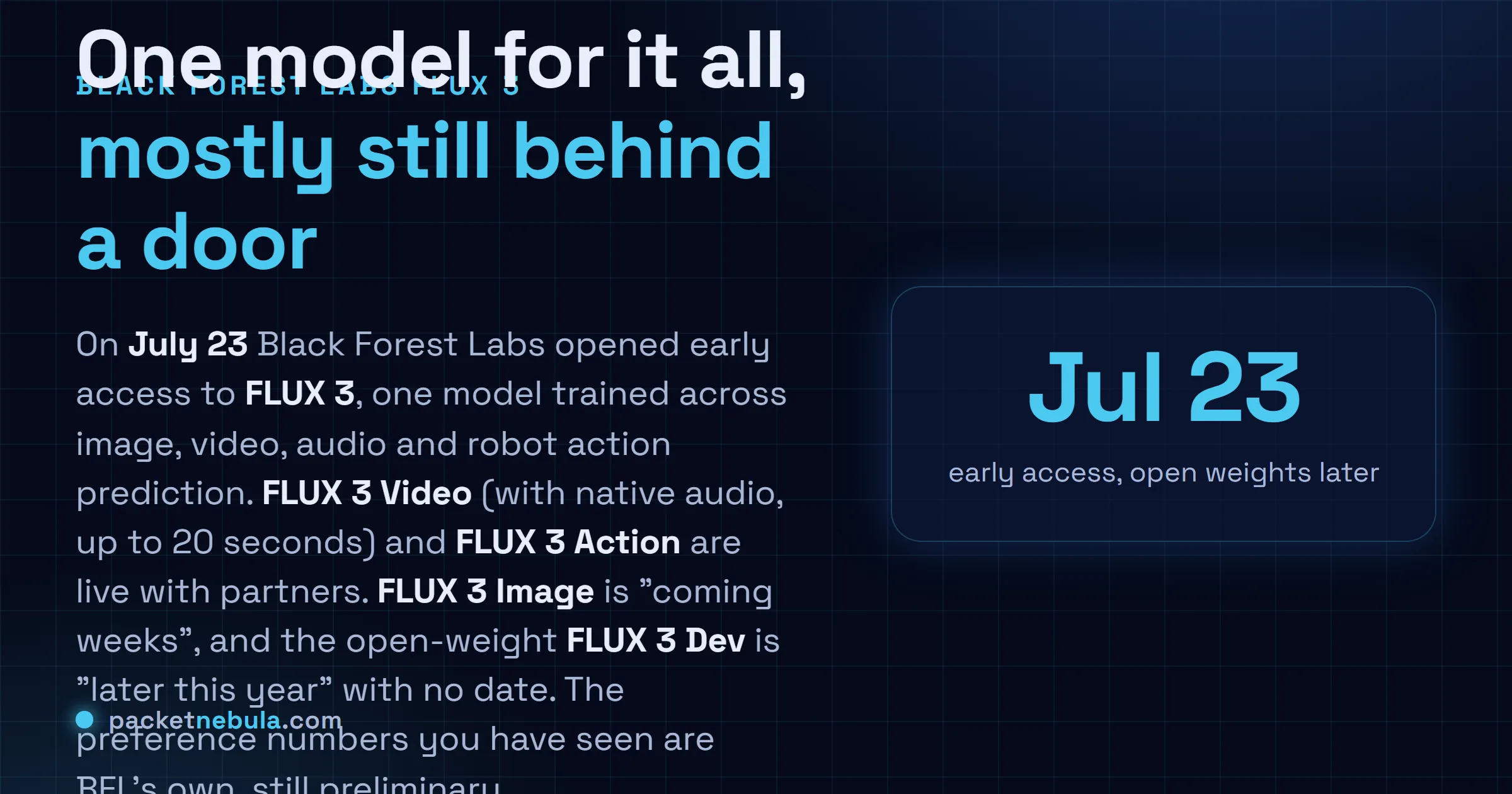
So a new model drops and the pitch is that it does everything: video, image, audio, even robot arms, all from one set of weights. That's FLUX 3, which Black Forest Labs pushed into early access on July 23. What actually shipped is narrower than the headline. FLUX 3 Video and FLUX 3 Action are live for partners, FLUX 3 Image is 'coming weeks', and FLUX 3 Dev, the open-weight version the FLUX line built its name on, is 'later this year' with no date attached. The benchmark chart everyone's reposting is BFL's own preliminary preference test, harness still in development, methodology not published. We went in to sort the model you might actually use from the numbers you're being handed.
The short answer
Black Forest Labs launched FLUX 3 on July 23, one model trained across image, video, audio and robot action prediction. FLUX 3 Video and FLUX 3 Action are in early access with partners, FLUX 3 Image is weeks out, and the open-weight FLUX 3 Dev lands later this year. The preference numbers you’re seeing are BFL’s own, and still preliminary. Here’s the line between what shipped and what’s promised.
What actually shipped
One model that tries to do the lot. That’s the real story here. Where most labs ship an image model, then a separate video model, Black Forest Labs trained FLUX 3 across image, video, audio and even robot actions in a single architecture it calls Self-Flow. CEO Robin Rombach’s line is that “each training modality strengthens the others,” so the video understanding feeds the image work and back again. Whether that pays off is the interesting question. It’s also the part nobody outside BFL can test yet.
The headline capability is video. FLUX 3 can generate clips up to 20 seconds long with native, in-sync audio, from text, an image, or an existing video. The preliminary evaluations BFL published used 10-second 720p clips. It’ll also chain shots into longer multi-shot sequences, edit images while keeping a product or material consistent across motion, and, through a variant called FLUX-mimic built with mimic robotics, predict robot actions. Audi is testing that last one on real manipulation tasks, with fine-tuning from as little as 30 minutes of robot data.
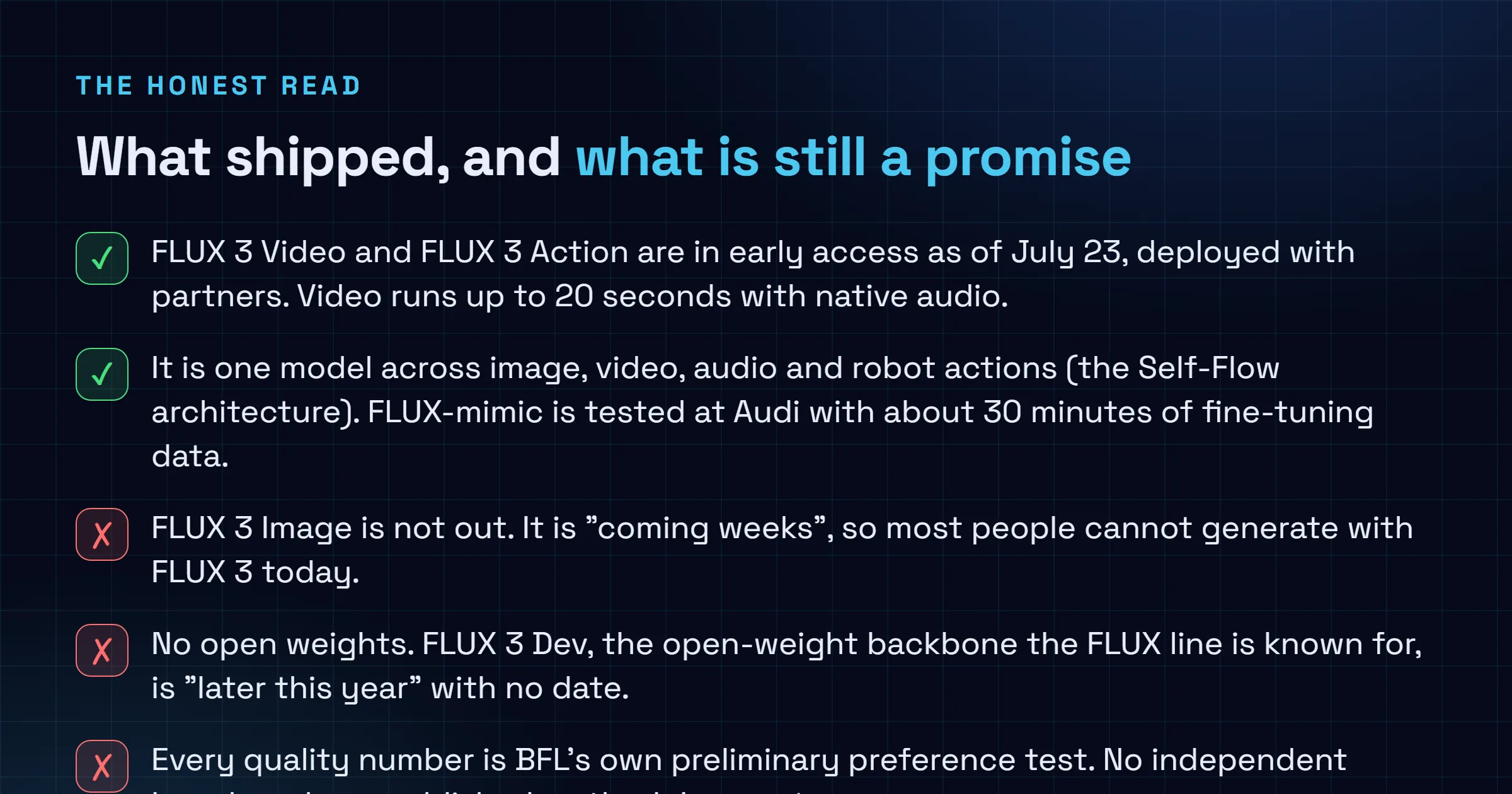
Here’s the catch that the launch posts skate over. Only two pieces are live. FLUX 3 Video and FLUX 3 Action are in early access, deployed with a handful of partners. FLUX 3 Image is “coming weeks.” So unless you’re one of those partners, you can’t put a prompt into FLUX 3 this afternoon.
The benchmark chart is theirs
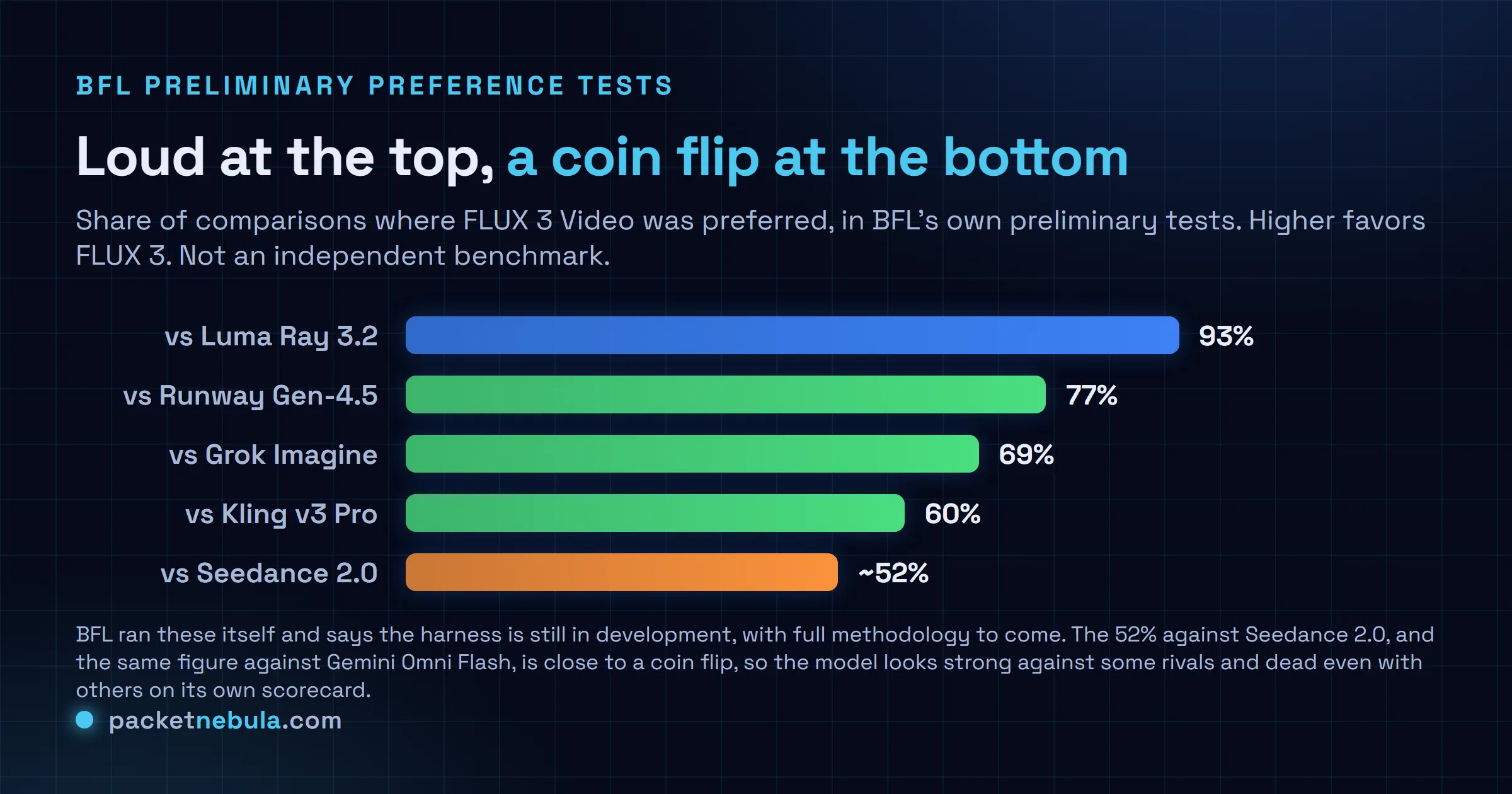
Those preference numbers are getting quoted like scores. They aren’t. This is BFL sitting FLUX 3 next to rival clips and picking which it prefers, on a harness it says out loud is “still in development.” Full benchmark results and methodology come “with broader availability,” which is to say later, from the same people who built the model.
Read the whole spread and it gets more honest. Yes, FLUX 3 was preferred over Luma Ray 3.2 in 93 percent of comparisons and Runway Gen-4.5 in 77 percent. But against Seedance 2.0 and Gemini Omni Flash it sat at roughly 52 percent. That’s not a win, that’s noise. So the model looks strong against some competitors and dead even with others, on its own scorecard, before a single outside reviewer has run it. Worth holding that thought before you repeat “beats everything.”
The open weights are the FLUX thing, and they’re not here
This is the shift that matters most. A big part of why FLUX got a following is that the FLUX.1 line shipped open weights you could pull down and run yourself. FLUX 3 launches as APIs and private weights. The open-weight backbone, FLUX 3 Dev, is promised “later this year,” no date.
So the one property that made the line special, the part you could actually own and self-host, is exactly what’s deferred on the version with the loudest claims. If you’re building on open image or video weights today, FLUX 3 doesn’t change your stack yet. It’s a preview of intent. BFL, for what it’s worth, is a serious shop here: valued around 3.25 billion dollars, more than 450 million raised, and it has actually shipped open weights before. So the odds the Dev release lands are decent. It’s just not something you can plan a release around when there’s no date on it.
The honest read
I think the architecture bet is genuinely interesting, and I’m not going to reprint a preference chart as if it were a benchmark. Both of those are true at once.
If you get early-access to FLUX 3 Video, use it, and test the 20-second-with-audio claim on your own prompts, because your prompts are the only test that counts. Just don’t wire a production pipeline to a model most of us can’t touch yet, and don’t quote “93% preferred” as a measured fact when it’s BFL grading its own homework. If you need image or video generation you can actually run or price today, the Seedream 5.0 Pro and Qwen-Image-3.0 drops from earlier this month are where the receipts are, and for the robotics angle our writeup on single-camera robot navigation is the honest state of play. When FLUX 3 Image opens, the Dev weights land, or one reproducible benchmark shows up, that’s when the claims become facts. Not before.
Sources: Black Forest Labs (bfl.ai), the official FLUX 3 announcement of July 23, 2026, for the Self-Flow architecture, the four release tiers (Video, Action, Image, Dev), the 20-second video with native audio, the FLUX-mimic robotics variant, and the preliminary preference win-rates (77% vs Runway Gen-4.5, 93% vs Luma Ray 3.2, up to 69% vs Grok Imagine, 60% vs Kling v3 Pro, about 52% vs Seedance 2.0 and Gemini Omni Flash) along with BFL’s own caveat that the results are preliminary and the harness is still in development. GlobeNewswire via The Manila Times and Crypto Briefing for the early-access availability (Video and Action now, Image in the coming weeks, open-weight FLUX 3 Dev later in 2026), the Robin Rombach quotes, the Audi robotics test with about 30 minutes of fine-tuning data, and the company context (valued around 3.25 billion dollars, more than 450 million raised). All capability and preference figures are as reported by Black Forest Labs and are not independently reproduced.
Update, 7 October 2026. FLUX 3 Action base (7B) was published on Hugging Face on 22 September under the FLUX Kommunity License v1.0, which is non-commercial. FLUX 3 Dev still has no date. See the open-weight tracker.
Frequently asked questions
Is FLUX 3 released?
Partly. On July 23, 2026, Black Forest Labs opened early access to FLUX 3 Video (with optional native audio) and FLUX 3 Action, deployed with initial partners. FLUX 3 Image is set to roll out in the coming weeks. So you cannot just sign up and generate today unless you are one of those partners.
Can I download the FLUX 3 weights?
Not yet. Black Forest Labs says it will release faster and open-weight versions of FLUX 3, including an open-weight backbone called FLUX 3 Dev, later in 2026. No date is set. The earlier FLUX.1 line shipped open weights, so this is the part longtime FLUX users are waiting on, and it is the part that is missing at launch.
What can FLUX 3 actually do?
It is one model trained across image, video, audio and action prediction in a single architecture BFL calls Self-Flow. It generates video up to 20 seconds long with in-sync audio, edits images and holds product consistency across motion, and via a variant called FLUX-mimic it predicts robot actions. Audi is testing the robotics piece.
Are the FLUX 3 benchmarks real?
They are BFL running its own preliminary preference tests, not an independent benchmark. In those tests FLUX 3 Video was preferred over Runway Gen-4.5 in 77 percent of comparisons and Luma Ray 3.2 in 93 percent, but only about 52 percent over Seedance 2.0 and Gemini Omni Flash, which is close to a coin flip. BFL says the harness is still in development and full methodology comes later.
How is FLUX 3 different from Seedream or Qwen-Image?
Seedream 5.0 Pro and Qwen-Image-3.0 are image models. FLUX 3 is a single model spanning image, video with audio, and robot actions, which is a much bigger swing. The trade is that the two image models are usable now, while FLUX 3 is early access with the open weights and the full methodology still pending.


