
Picture a warehouse robot you brief like a new hire. 'Leave the lobby, take the corridor, stop facing the second shelf.' No map uploaded, no LiDAR spinning on the roof, just one ordinary camera. That's the pitch behind Robostral Navigate, the first robotics model from Mistral, out July 7. It's an 8B vision-language model that reads a single RGB camera feed plus a natural-language instruction and decides where the robot moves next. The headline number is real: 76.6% success on R2R-CE validation-unseen, the standard test for following directions in rooms the robot never trained on, beating the best depth or multi-camera systems by 4.5 points. We went to split what actually ships here from what's still a research result with a sales form bolted on.
The short answer
Mistral’s first robotics model, Robostral Navigate, drives a robot from one ordinary camera and a plain-language instruction. No LiDAR, no depth sensor, no pre-loaded map. It posts a genuinely strong 76.6% on the R2R-CE unseen benchmark, edging out heavier depth-camera rigs. The catches: it only navigates (no grasping yet), it’s trained entirely in simulation, and you can’t download it. A sharp research result with a sales form, not a product you deploy tonight.
What Mistral actually shipped
Mistral is the French lab everyone files under “makes open-weight LLMs.” So a robotics model is a genuine swerve. On July 7 it announced Robostral Navigate, calling it its first model for embodied navigation. Not a chatbot. A thing that moves robots.
The setup is simple to describe and that’s the appeal. You give the robot a camera and a sentence. The model, 8 billion parameters, watches the RGB feed and works out where to go, either by pointing at a spot in the frame or telling the robot to displace by some amount. Then it looks again. Repeat until it’s parked facing the shelf you asked for.
What it doesn’t use is the tell. No LiDAR. No depth camera. No SLAM map of the building loaded up front. Most serious indoor navigation stacks lean on at least one of those, and they cost money and calibration. Robostral Navigate throws them out and runs on the one sensor a cheap robot already has.
The one-camera claim, and why it matters
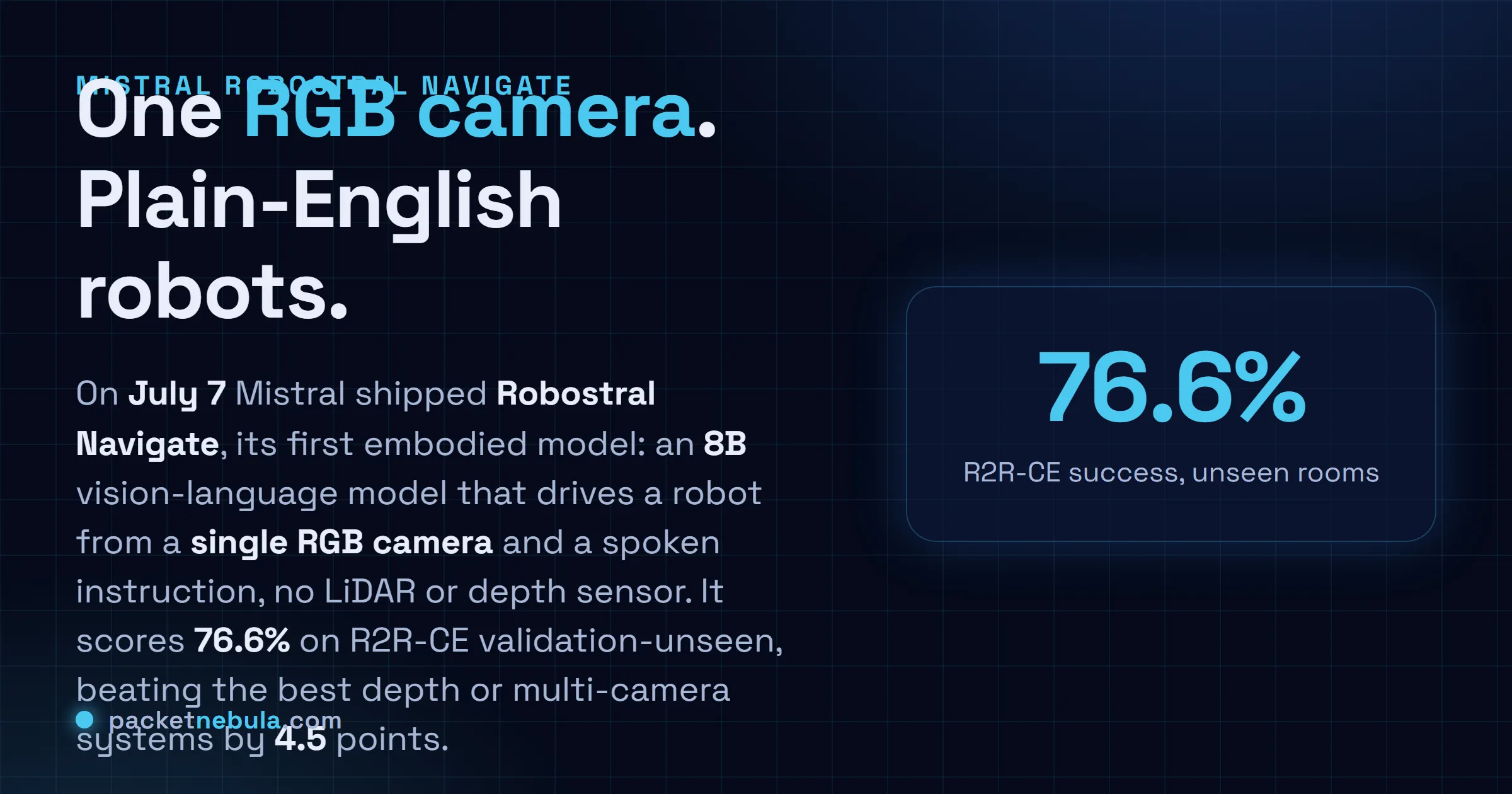
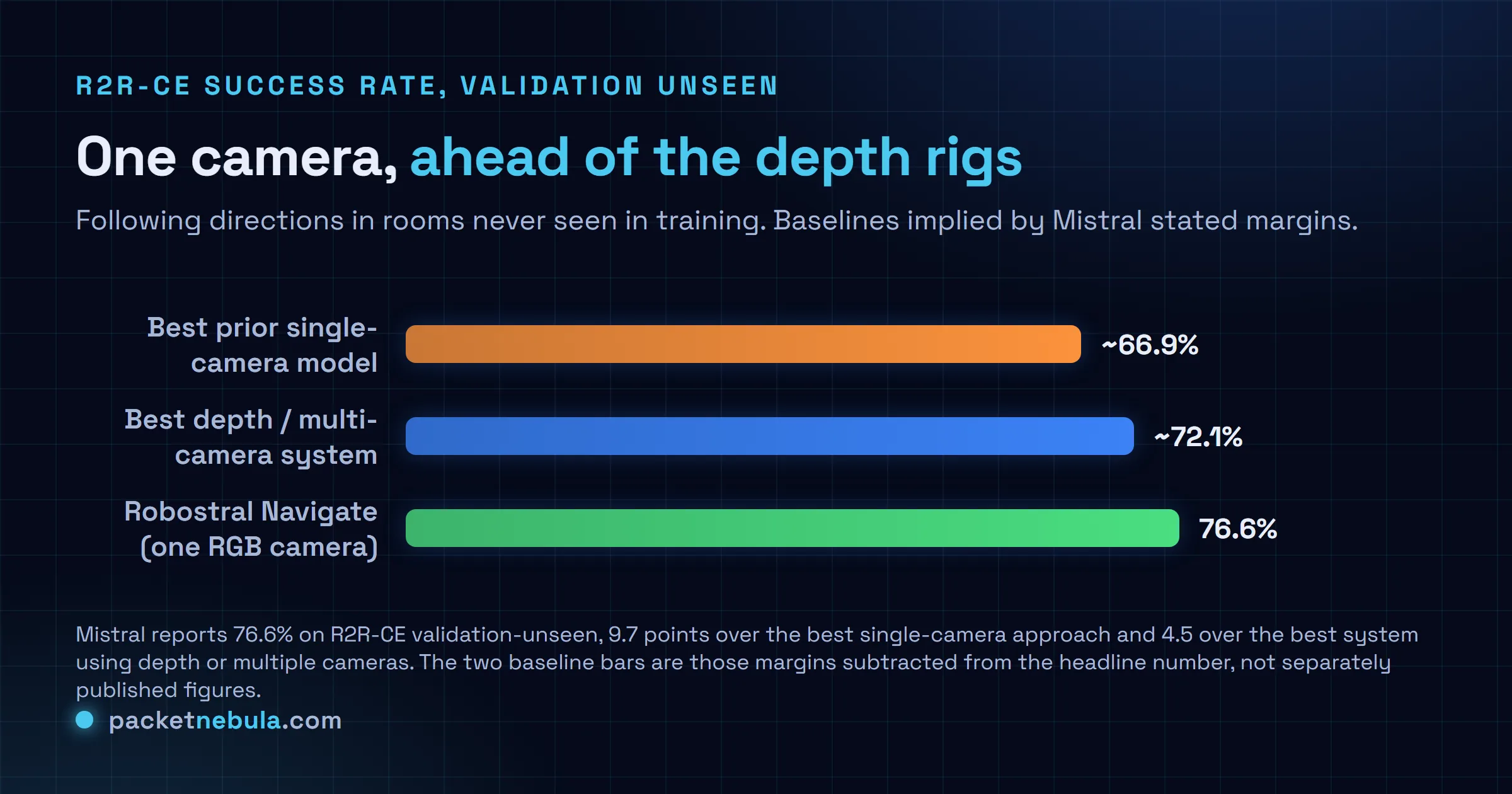
Here’s the part that made us look twice. On R2R-CE, the room-to-room benchmark where a robot follows written directions through spaces it wasn’t trained on, Robostral Navigate hits 76.6% on validation-unseen. Mistral says that’s 9.7 points clear of the best prior single-camera model, and 4.5 points ahead of the best system that uses depth or several cameras.
Read that second margin again. A single plain camera beating rigs that carry extra hardware. If it holds up outside the benchmark, that’s a real cost story, because sensors and the wiring around them are a big chunk of what makes a capable robot expensive.
How it got there is a training-efficiency trick, not just more compute. The model learned entirely in simulation, about 2.4 million trajectories across 350,000 scenes. To make that affordable, Mistral built a prefix-caching scheme with tree-based attention masking that squeezes a whole episode into one sequence, which it says cut training tokens by 22 times while keeping every learning signal. On top of that, online reinforcement learning (their CISPO algorithm) added another 3.2% success. So the number isn’t brute force. It’s a smarter pipeline.
What it can’t do yet
Now the honest column, because the demo video is smooth and it’s easy to get carried away. Robostral Navigate navigates. That’s it. It gets the robot to the right place, and then it stops. No grasping, no picking, no doing anything once it arrives. Mistral says so directly: this is “only the first step toward a unified embodied agent.” Good on them for writing it down.
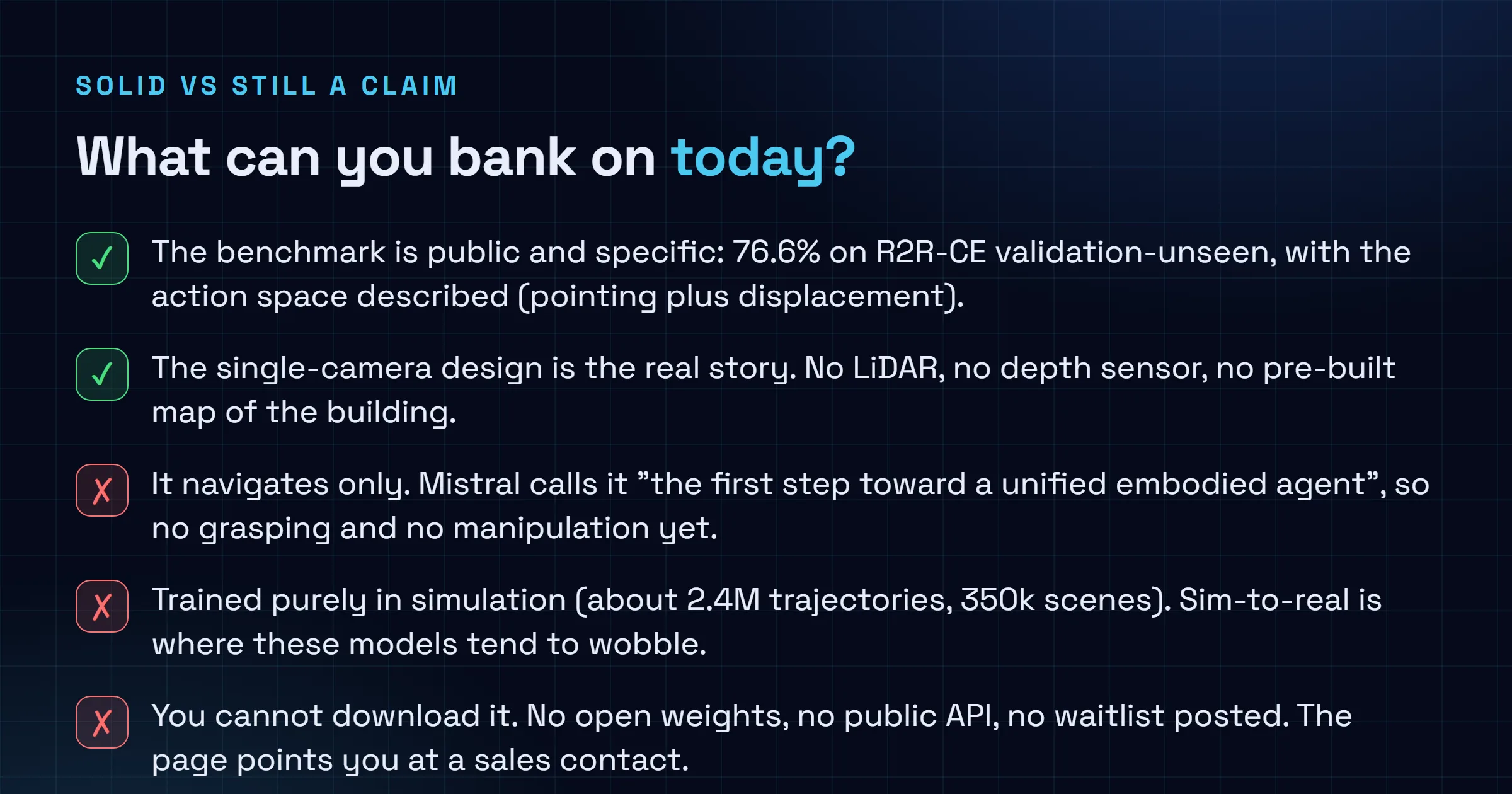
Two more caveats worth planning around. It’s trained purely in simulation, and sim-to-real is exactly where navigation models tend to wobble: real lighting, reflective floors, a pallet parked where the sim never put one. A benchmark score doesn’t tell you how it behaves in your actual stockroom. And you can’t get it. There’s no open-weight drop, no public API, no waitlist we could find. The launch page routes you to sales. For a lab whose whole brand is open weights, that’s a notable choice, and it means Robostral Navigate is a result you can read about, not code you can run.
What it changes for you
If you build or buy robots, this is a “watch the space” signal with teeth. The claim that one commodity camera can out-navigate a depth rig, if it survives contact with real floors, changes what a useful robot has to cost. Pair it with the compute side we’ve been tracking, where robot brains are getting cheaper too, like NVIDIA’s mainstream Jetson Thor modules pushing capable inference downmarket. Cheaper sensors and cheaper compute is the combination that eventually makes physical AI pencil out.
If you don’t touch robots, file it next to the humanoid funding wave as more evidence that the money and the models are both piling into embodied AI right now. Mistral shipping a navigation model at all is the data point. A year ago it was an LLM shop and nothing else.
The read we’d give: Robostral Navigate is a strong, specific research result with a genuinely interesting single-camera angle, wrapped in the usual first-version limits. It navigates, it’s sim-trained, and it’s sales-gated. Impressive on the benchmark. Check back when someone who isn’t Mistral runs it on a real robot in a real building.
Sources: the model, the benchmark numbers and the training method come from Mistral’s own announcement, “Robostral Navigate: single-camera AI navigation”, and its launch post on X (July 7, 2026). Independent coverage of the single-camera design and the R2R-CE result: MarkTechPost and PYMNTS. The two baseline bars in the chart are Mistral’s stated 9.7 and 4.5 point margins subtracted from its 76.6% headline, not separately published figures, and all performance numbers are Mistral’s own on a public benchmark.
Frequently asked questions
What is Robostral Navigate?
Robostral Navigate is Mistral's first robotics model, an 8-billion-parameter vision-language model for embodied navigation. It takes a single RGB camera feed plus a plain-language instruction and predicts where a robot should move, either by pointing at a target in the camera view or issuing a displacement command. Mistral says it runs on wheeled robots, legged ones and drones, and generalizes across robot types without a pre-built map. It was announced on July 7, 2026.
How good is it, really?
On R2R-CE (Room-to-Room in Continuous Environments), the standard instruction-following benchmark, Robostral Navigate scores 79.4% success on validation-seen and 76.6% on validation-unseen. Mistral reports that the unseen number beats the best previous single-camera approach by 9.7 points and the best system using depth or multiple cameras by 4.5 points. That last part is the interesting bit: one plain camera edging out rigs with extra sensors. The numbers are Mistral's own, from its launch writeup, but R2R-CE is a public benchmark others can rerun.
Do I need LiDAR or depth cameras to use it?
No, and that is the whole point. Robostral Navigate works from a single standard color (RGB) camera, with no depth sensor and no LiDAR. That matters for cost and for retrofit: a lot of cheap robots already have exactly one camera and nothing else. The model was trained entirely in simulation, roughly 2.4 million trajectories across 350,000 scenes, then tuned with online reinforcement learning that Mistral says added 3.2% success on top.
Can I download it or call an API?
Not as of this writing. Mistral has not posted open weights, a public API endpoint or a waitlist for Robostral Navigate. The announcement page points interested users at a sales contact rather than a download. So today it is a published result and a demo, not something you can wire into your own robot this afternoon. Treat the specs as a strong signal of where Mistral is heading, not as an SDK you can pull tonight.
What can it not do yet?
It only navigates. Robostral Navigate moves a robot to the right place, but it does not grasp, manipulate or do anything with its hands once it arrives. Mistral explicitly calls it "only the first step toward a unified embodied agent," which is honest. It is also trained purely in simulation, so real-world lighting, reflections and clutter are exactly the conditions where these models tend to slip. Navigation solved on a benchmark is not the same as a robot that reliably finds your second shelf in a messy stockroom.


