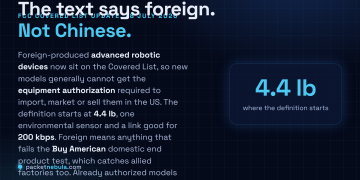





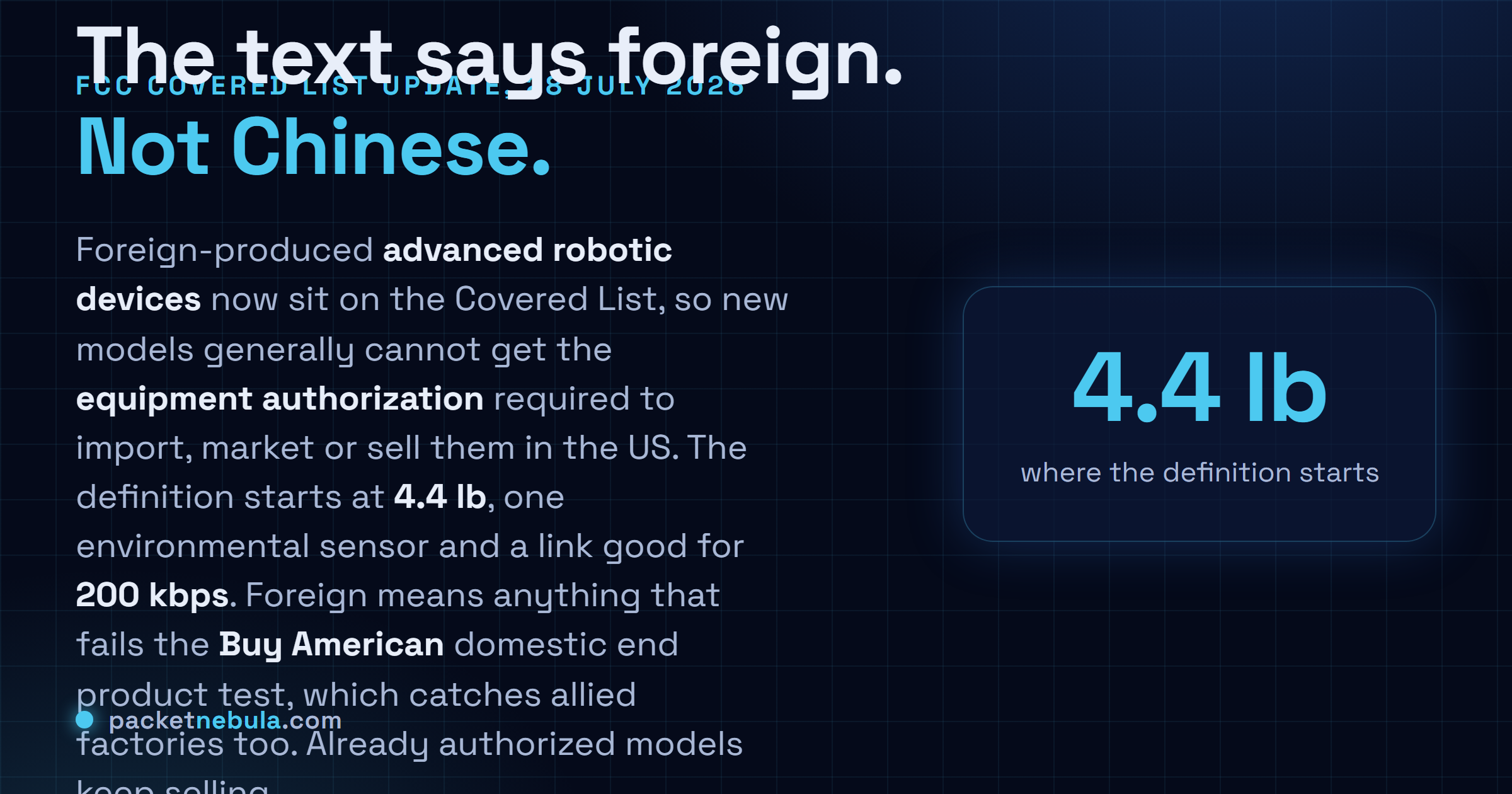
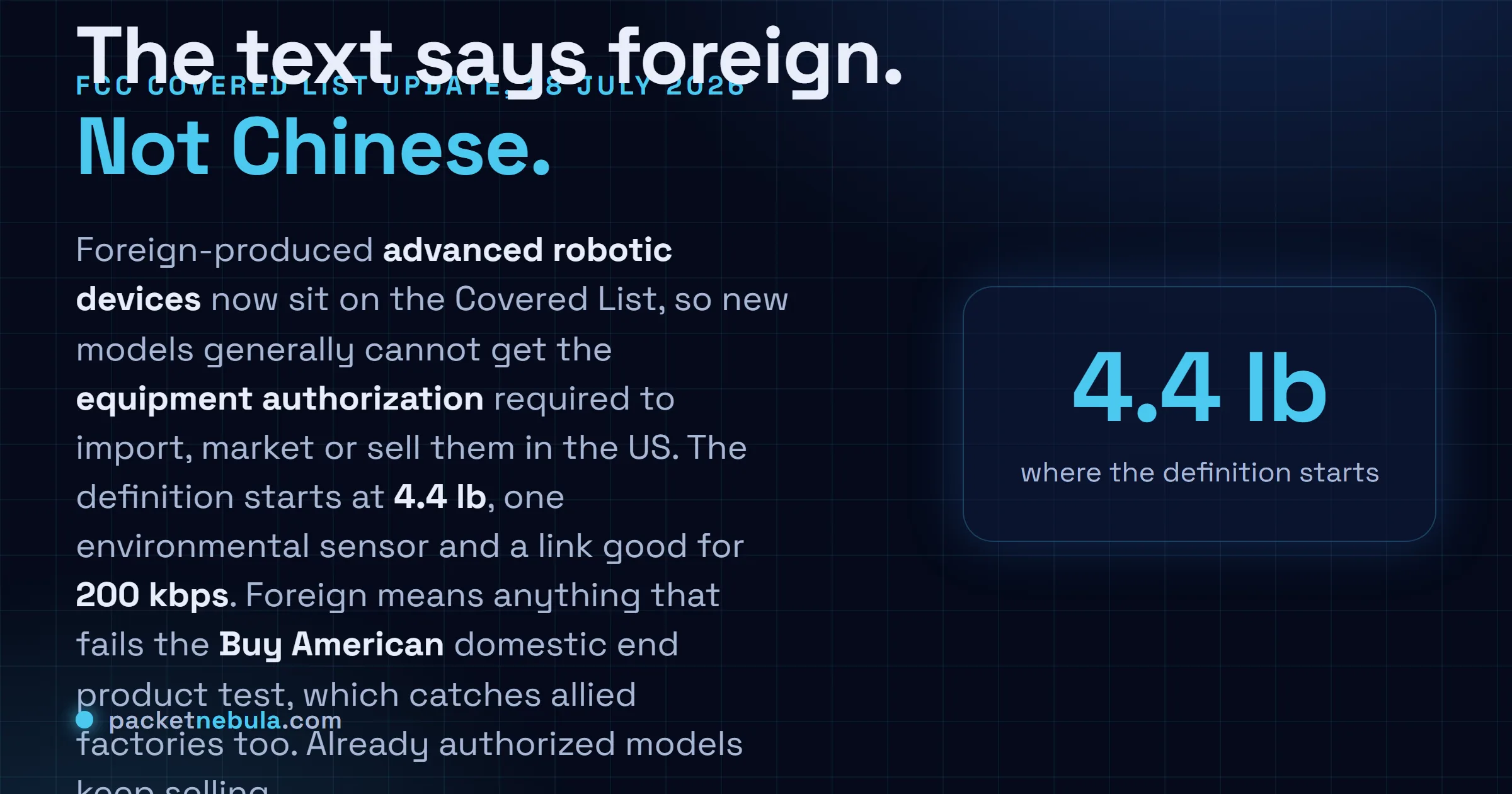
Your robot vacuum still works. Worth saying first, because the headlines this week read like the US outlawed robots, and plenty of people went and looked at their hallway. What the FCC did on 28 July was add foreign-produced advanced robotic devices to its Covered List, which stops new models getting the equipment authorization you need to import, market or sell hardware in the US. Units already bought are fine. Models already certified keep shipping. The part that didn't make the headlines is the definition: over 4.4 pounds, one environmental sensor, a network link good for 200 kbps, and software doing the steering. Read that back and count how many machines in your house qualify. Then look at the word the FCC used. It says foreign, not Chinese.
The short answer
The FCC added foreign-produced advanced robotic devices to its Covered List on 28 July 2026, so new models generally cannot receive the equipment authorization required to sell them in the US. Existing devices and already certified models are untouched. The definition is broad enough to include app-connected robot vacuums, and it says foreign rather than Chinese, which catches allied factories too.
What the FCC actually did
On 28 July the Commission added two categories to its Covered List: foreign-produced advanced robotic devices, and connected power inverters. That list is the mechanism the FCC has used for years against named telecoms vendors, and the effect is consistent. Equipment on it generally cannot receive new equipment authorizations, and without an authorization you can’t legally import, market or sell the thing in the United States.
Why does the FCC get a say over a warehouse robot? Because the robot has a radio in it. Wi-Fi, Bluetooth, cellular, take your pick. Every one of those is an intentional radiator, every intentional radiator needs certification, and certification is a chokepoint the Commission already controls. It’s an elegant piece of leverage, honestly. No new statute required.
The legal route matters here too. Under the Secure and Trusted Communications Networks Act, the FCC can only update the Covered List when national security authorities tell it to. This direction came from a White House-convened executive branch interagency body, with the Department of War and DHS involved. Chairman Brendan Carr’s framing was that the Commission is “acting in lock step with our national security agencies”, which is a fair description of a body executing someone else’s determination. The stated risks are supply chain vulnerability and the possibility of a connected machine being commandeered inside critical infrastructure.
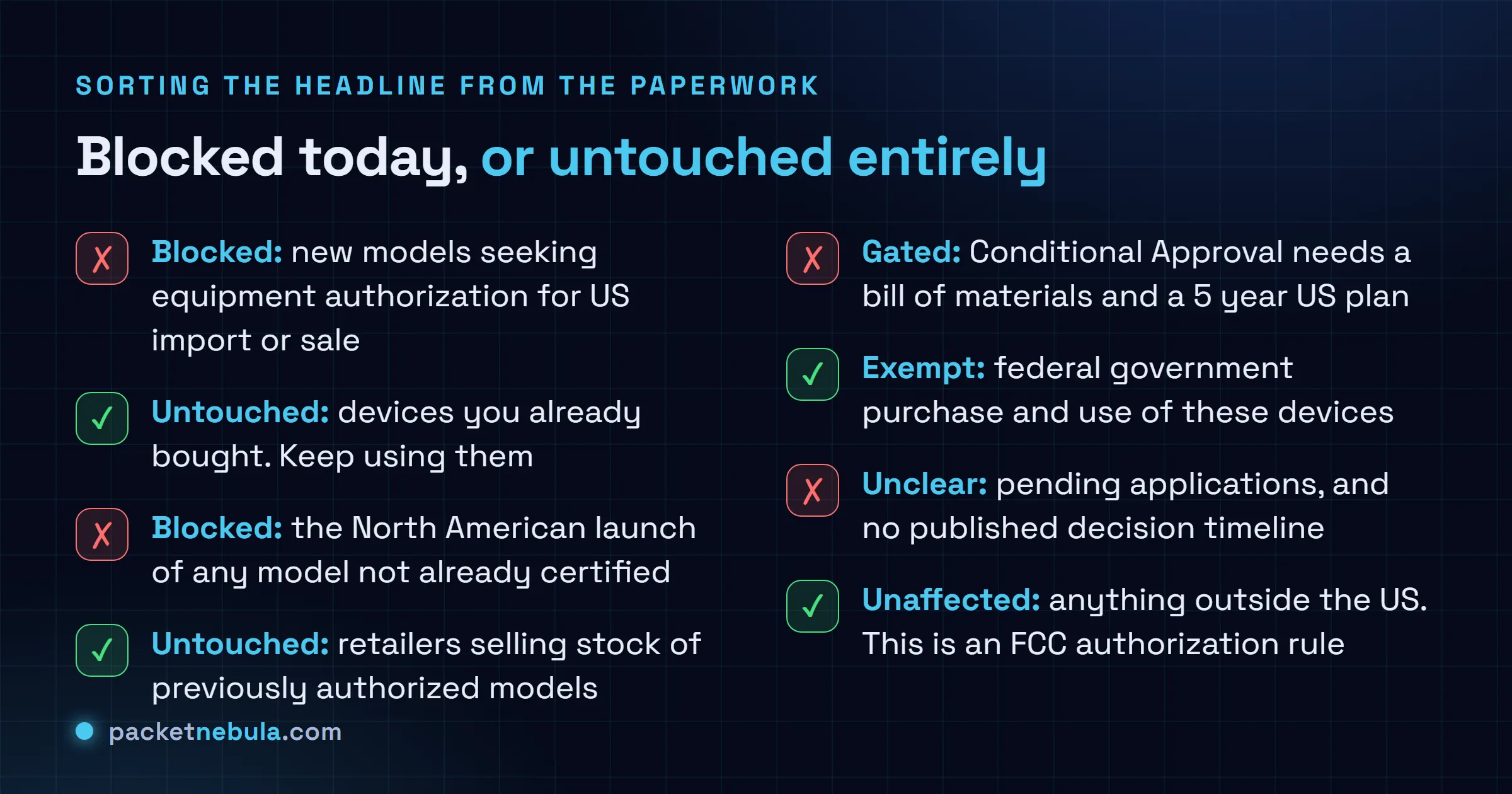
Now the part the coverage mostly skipped. The FCC’s own fact sheet is explicit about what this doesn’t do. It doesn’t affect devices people already bought. It doesn’t stop retailers selling previously authorized models. It doesn’t touch federal government purchase or use. And it doesn’t restrict any device that gets Conditional Approval from DoW or DHS. So the practical scope is narrower than “ban” suggests, and also stranger, because it applies to the next model rather than the current one.
The definition is where it gets wide
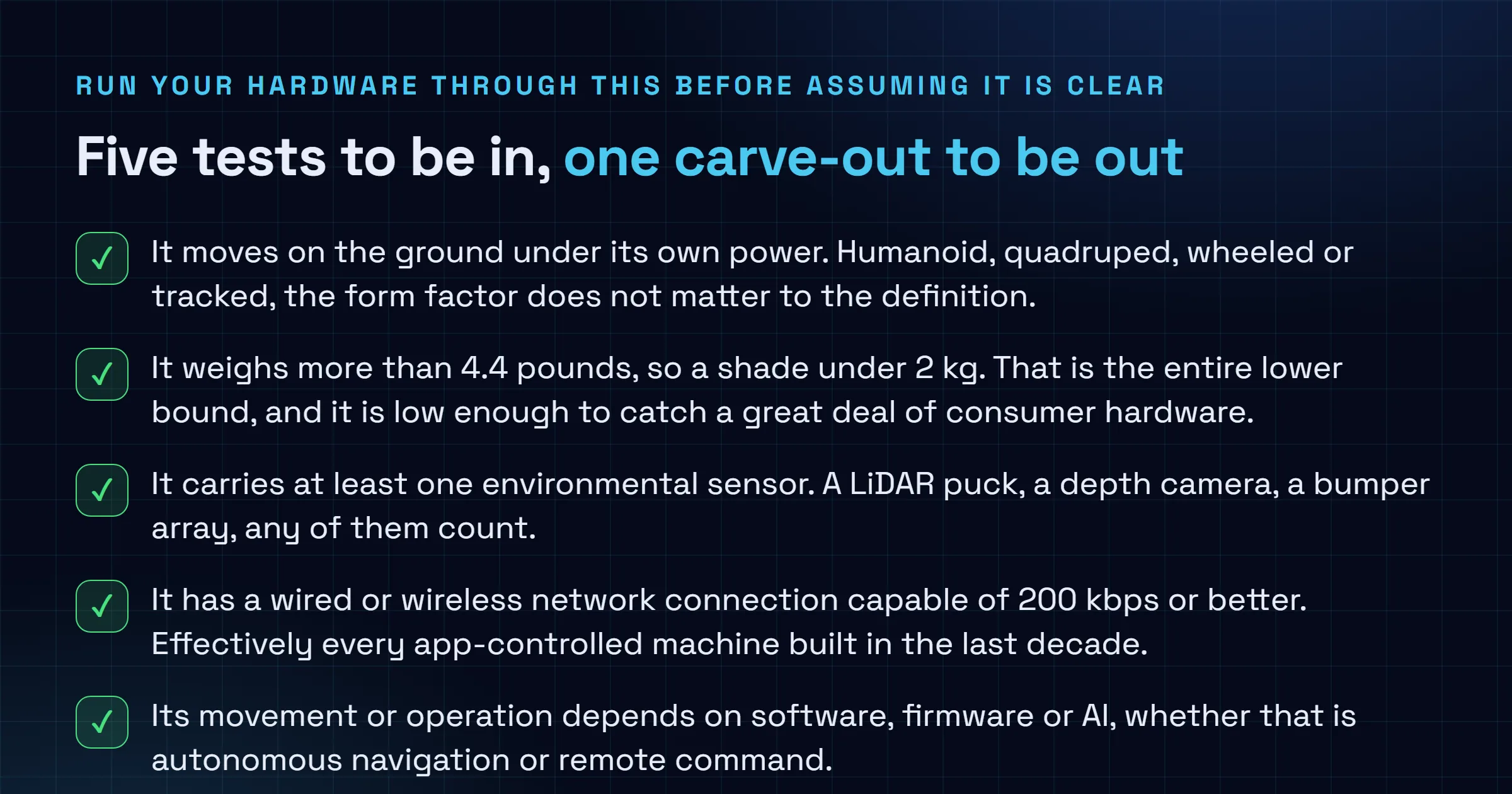
Here’s the test. A device is an advanced robotic device if it moves on the ground under software control, weighs more than 4.4 pounds, carries at least one environmental sensor, and supports a network connection capable of at least 200 kbps. Humanoid, quadruped, wheeled, tracked, the shape is irrelevant.
Four and a bit pounds. One sensor. Dial-up-plus bandwidth.
Go and weigh a mid-range robot vacuum. It’ll be somewhere north of 3 kg with the dustbin in, it has a LiDAR turret on top, it talks to an app over Wi-Fi, and it navigates itself. That’s four for four. Reporting through 29 and 30 July converged on the same conclusion, that new models from Roborock, Ecovacs and Dreame are caught by the definition, and so is iRobot, whose Roombas are built in Asia even though the company is American. Which tells you something important about how the rule is drawn: it tests where the machine was made, not whose logo is on it.
The exclusions are worth knowing because they’re specific rather than vague. Connected road vehicles, out. Rail-only equipment, out. Aircraft and drones, out, though drones have their own restrictions elsewhere. Unmanned underwater vehicles, out. Specified medical and mobility devices under FDA regulation, out. Stationary industrial robots bolted to a factory floor, out, because the definition needs mobility.
What’s left is a category that runs from a $400 vacuum to a $200,000 humanoid, all governed by the same paperwork.
Foreign is not the same word as Chinese
Every headline said China. The determination doesn’t.
Foreign-produced is defined by reference to the Buy American regulations, at 48 C.F.R. 25.101(a): if an article fails to qualify as a domestic end product, it’s foreign-produced. No country list. No named entity. A quadruped assembled in Japan or a warehouse robot built in Germany sits in exactly the same bucket as one from Shenzhen.
The robotics industry noticed immediately. AUVSI, which represents uncrewed systems makers and is broadly supportive of pressure on Chinese manufacturers, put out a statement saying the determination “also reaches other foreign-produced robots, rather than only adversary systems with verified national security risks, sweeping in trusted allies”. Their ask is clear criteria and firm timelines on Conditional Approval so allied hardware clears quickly. That’s a polite way of saying the exemption process is now load-bearing and nobody knows how long it takes.
The China angle is still the obvious motivation, and the market numbers explain why. Chinese manufacturers account for roughly 85 percent of the global humanoid market by most estimates, and Forbes cited January 2026 shipment figures putting Agibot at 5,168 units, Unitree at 4,200 and UBTech at 1,000. Unitree in particular had timing problems: it launched commercially in Europe on 22 July and had a North American push planned for the weeks after. That push now needs an authorization it can’t get. Beijing’s embassy asked the US to stop smearing Chinese companies and said it would take all necessary measures, which is the standard response, and the whole thing lands a few weeks before a planned Xi visit in September.
For anyone tracking the pattern, this is the same instrument we saw pointed at compute earlier this month when NVIDIA cut its Asia AI chip buyer list. Different agency, same shape: control the certification or the allocation, and you control the market without writing an export ban.
What it changes if you buy this stuff
If you own the hardware, nothing. Genuinely nothing. Keep running it.
If you’re specifying hardware for next year, the calculus moved. A robot you evaluate today from a foreign manufacturer might not have a successor you can legally buy, and support horizons get shorter when a vendor loses its route to the US market. Ask where the unit is manufactured, not where the company is registered, and ask whether the specific model already holds an FCC authorization. That second question is now a procurement question rather than a compliance footnote.
If you’re a manufacturer outside the US, the Conditional Approval file is heavy. Ownership and beneficial ownership, foreign government involvement, manufacturing and supply chain information down to bills of materials and country of origin, and a five-year plan for expanding US manufacturing with capital commitments and milestones attached. That last item isn’t a security document. It’s industrial policy wearing a security jacket, and the price of market access is a factory commitment.
My read, and I could be wrong: the vacuum consequence looks like drafting spillover rather than intent, and I’d expect it to get narrowed once somebody’s Christmas shipment gets stuck at a port. The humanoid side is deliberate. It buys domestic robotics a clear runway at exactly the moment the field is deciding who ships at volume, and the companies that benefit are the ones actually publishing specs, like Humanoid’s HMND 01, or building lines they won’t show you, like Tesla’s unrevealed Optimus V3. Protection tends to be kinder to the second kind.
Sources: the scope of the action, the Conditional Approval path and the list of things it does not affect come from the FCC’s own fact sheet on the Covered List update (28 July 2026), with further detail on the FCC FAQ page for robots and inverters. The five-part definition, the exclusions and the Buy American reference for foreign-produced are set out in this legal analysis of the Covered List addition and in Robotics and Automation News. The robot vacuum consequence and the named brands are reported by Basic Tutorials. Market share, the January 2026 shipment figures and Unitree’s European launch date come from Forbes and Al Jazeera. The industry response is quoted from AUVSI’s statement.
Frequently asked questions
Does the FCC robot ban mean I have to stop using my robot vacuum?
No. The FCC states plainly that the Covered List update does not prohibit the import, sale or use of any existing model of advanced robotic device it previously authorized. Devices consumers already own are unaffected, and retailers can keep selling stock of models that already hold an authorization. What changes is the pipeline: new models that have not yet been through equipment authorization generally cannot get one.
Which robots does the FCC definition actually cover?
A ground-mobile machine that weighs more than 4.4 pounds, carries at least one environmental sensor, supports a wired or wireless network connection capable of at least 200 kbps, and whose movement or operation depends on software, firmware or AI. Humanoid, quadruped, wheeled and tracked forms all qualify. Connected road vehicles, rail-only equipment, aircraft, drones, unmanned underwater vehicles, specified FDA-regulated medical and mobility devices and stationary industrial robots are carved out.
Is the FCC action limited to Chinese manufacturers?
Not as written. The determination covers foreign-produced devices, and foreign-produced means anything that fails to qualify as a domestic end product under the Buy American regulations at 48 C.F.R. 25.101(a). Origin of manufacture is the test, not the nationality of the brand. That is why a US-headquartered vacuum maker building in Asia is caught, and it is also why the industry association AUVSI publicly warned the action sweeps in allied manufacturers rather than only adversary systems.
Can a manufacturer get an exemption?
Yes, through a Conditional Approval process. Applications go to the Department of War for robotic devices, or to DoW and DHS for power inverters, via conditional-approvals@fcc.gov. Applicants have to hand over ownership and beneficial ownership details, any foreign government involvement, manufacturing and supply chain information including bills of materials and country of origin, plus a five-year plan for expanding US manufacturing with capital commitments and milestones. No decision timeline has been published.
Why can the FCC block a robot at all?
Because almost every one of these machines contains a radio, and a radio needs FCC equipment authorization before it can legally be imported or sold in the US. That authorization is the lever. The legal basis is the Secure and Trusted Communications Networks Act, which lets the Commission update the Covered List only when national security authorities direct it to, and this direction came from a White House-convened interagency body with the Department of War and DHS behind it.