
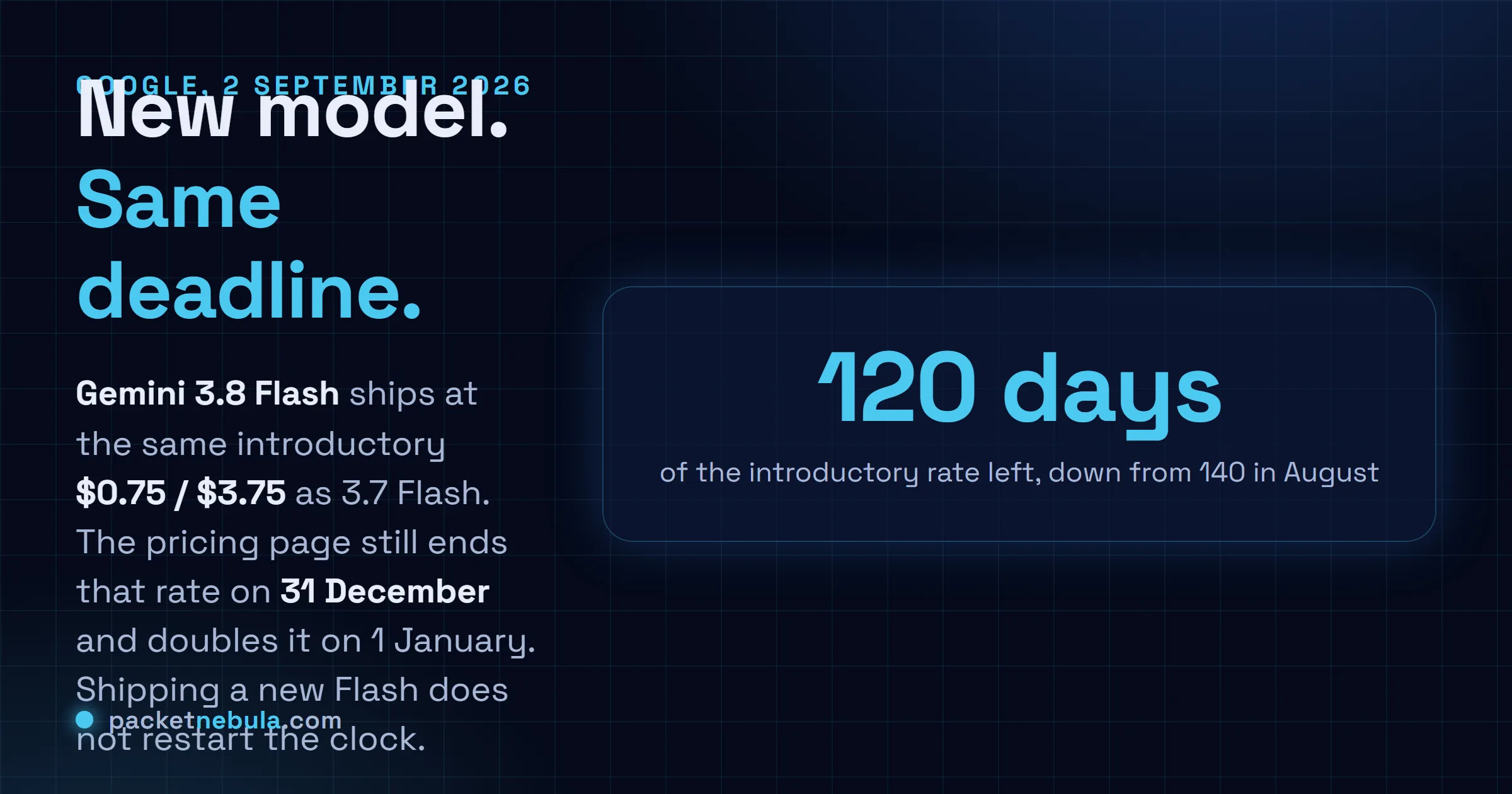
We opened the Gemini pricing page expecting a new row with a new date. The row is new. The date is not. Google shipped Gemini 3.8 Flash on 2 September 2026, three weeks after 3.7 Flash, at the same introductory $0.75 per million input tokens and $3.75 output, and the cell still says that rate runs out on 31 December 2026 before becoming $1.50 and $7.50 on 1 January. Google's own post calls this the third Flash release in six weeks. So the models keep improving while the discount runway keeps shrinking: 140 days when 3.7 landed in August, 120 now. The line that interests us more sits further down the announcement, where Google says outright that 3.8 Flash burns more tokens on purpose.
The short answer
Gemini 3.8 Flash landed on 2 September, three weeks after 3.7 Flash, at the identical introductory price. The pricing page still ends that rate on 31 December and doubles it on 1 January, so a new model does not restart the clock. Google says the model deliberately spends more tokens. And the coding benchmark everyone will quote was published as a chart with no numbers on it.
The clock is a date, not a countdown
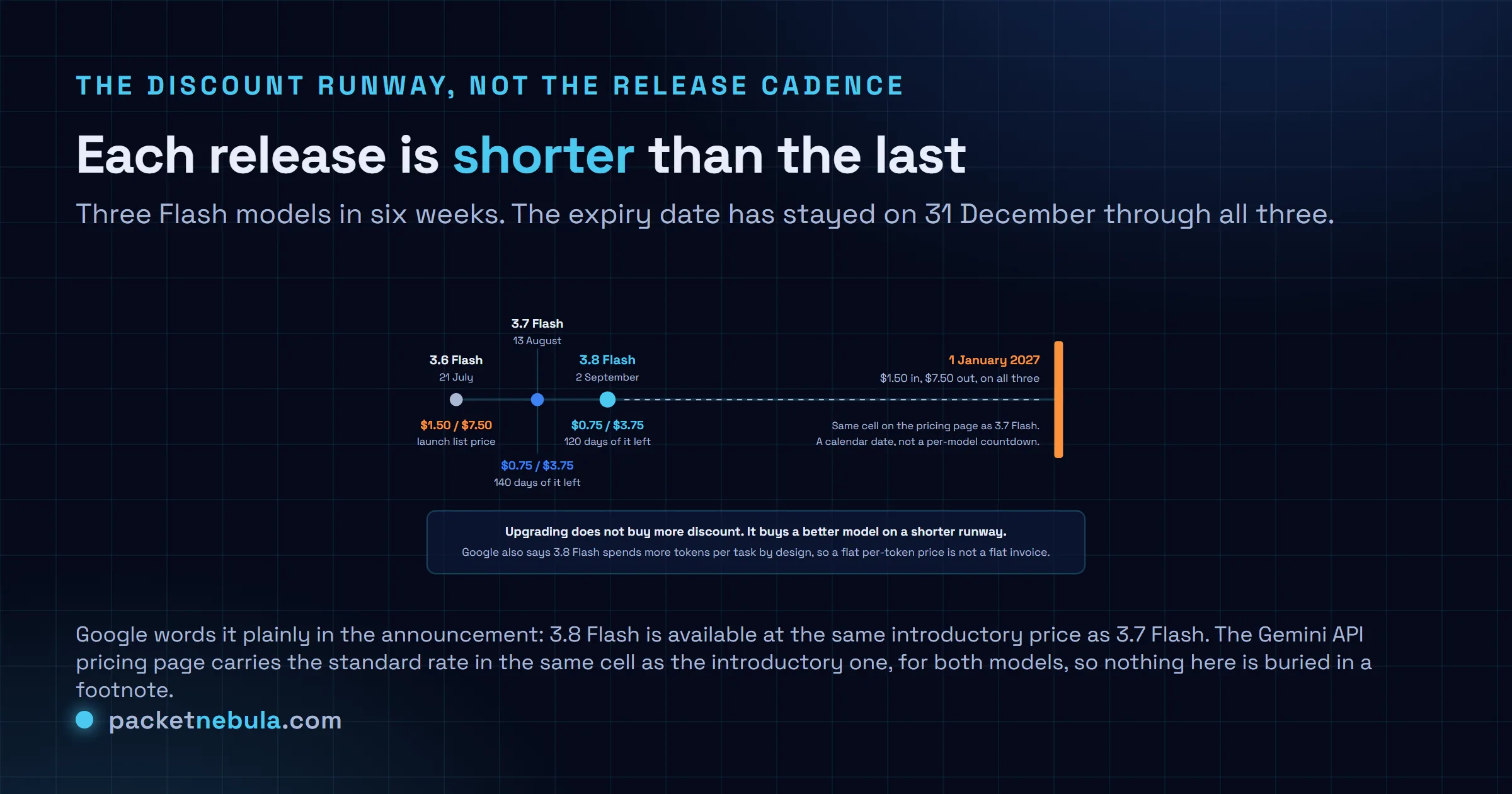
Here is the bit that nobody frames as news, because it looks like nothing happened. Google’s announcement says 3.8 Flash arrives “at the same introductory price as 3.7 Flash”, and it does. What that sentence hides is that the introductory price has a fixed end date attached to it, and that date has not moved once across three releases.
Back in July, 3.6 Flash launched at $1.50 and $7.50 with no discount at all. In August, 3.7 Flash halved that to $0.75 and $3.75, and we wrote up the expiry printed in the same cell: 31 December 2026, then back to $1.50 and $7.50. That gave 140 days of cheap tokens. Now 3.8 Flash inherits the same rate and the same wall, and there are 120 days left.
So if you have been holding off on standardising your agents on Flash while the versions churned, waiting cost you twenty days of runway and bought you a better model. That may well be a fair trade. It is just not a free one.
Image: Google
Google admits the model spends more
This is the paragraph in the announcement worth reading twice. Google writes that the gains “stem from a core design choice: 3.8 Flash works harder”, that on complex tasks it executes extra reasoning steps and calls tools iteratively, and that “at times, the model might use more tokens to maximize performance, especially at higher effort levels”.
Read that as a billing statement, because that is what it is. Your per token rate held flat. Your per task cost did not necessarily. An agent loop that used to close in four tool calls and now closes in seven is more accurate and more expensive at the same price sheet, and no launch post will tell you the ratio for your workload.
Google is unusually direct about the escape hatch, to its credit. Drop to a lower effort level, or stay on 3.7 Flash, which the docs say remains fully supported for efficiency-first workloads. That is a vendor telling you not to upgrade, which we do not see often. Take it at face value: if you are running high volume, cheap, shallow calls, 3.7 Flash is probably still your model.
The benchmark you cannot quote
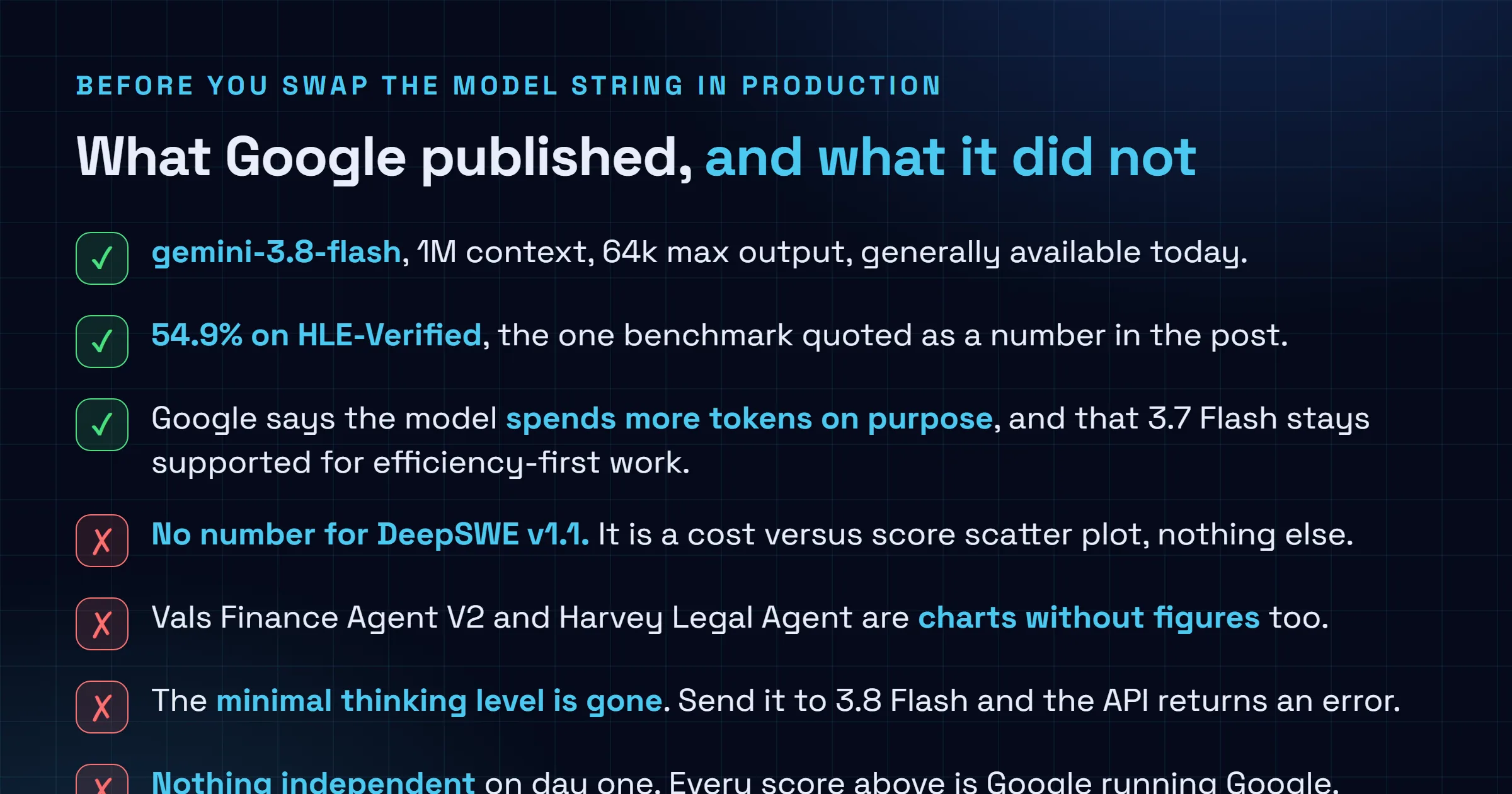
Google’s headline claim is DeepSWE v1.1, a long horizon software engineering evaluation, where 3.8 Flash “outperforms most larger frontier models” at a fraction of their cost. We wanted the number. There isn’t one.
What Google published is a scatter plot of score against average cost per task, sourced to Datacurve AI, with a dozen models plotted and no axis labels on the points themselves. You can eyeball where 3.8 Flash sits relative to Claude Opus 5 and GPT-5.6 Sol, and it sits well, but eyeballing a chart is not a citation. Same story for Vals Finance Agent V2 and Harvey’s Legal Agent Benchmark, both charts, both figure-free. The only number written out in prose is 54.9% on HLE-Verified.
I might be wrong about the intent here, and a cost versus quality plot is genuinely the right shape for a “cheap model beats expensive models” argument. But when the one benchmark everybody will cite has no citable value, that is a choice someone made.
What actually breaks in your code
One real breaking change, and it is small but sharp. The minimal thinking level is gone on 3.8 Flash. Google’s guidance states plainly that minimal is not supported and that setting it explicitly returns an error, leaving low, medium (the default) and high.
If your service pins thinking_level to minimal for latency, swapping the model string will hand you a validation failure rather than a slower response. Worth catching in staging.
Otherwise it is the standard Gemini 3 migration surface you have already dealt with once. Strip temperature, top_p and top_k from your generation config, drop candidate_count, and use the thinking_level enum rather than the older thinking_budget integer. The model id is gemini-3.8-flash, with a 1M token context window and 64k maximum output.
The variant you probably cannot get
The second launch is Gemini 3.8 Flash Cyber, and it is worth two sentences even though most readers will never touch it. It is restricted to what Google calls trusted defenders via the new Fairwind Program, aimed at government authorities, critical infrastructure operators and software maintainers, and you apply for access rather than enabling it.
Google is explicit that it prioritised vulnerability fixing over exploitation, and that the defensive variant ships with looser mitigations precisely because access is gated. The numbers it does put in prose: 47.2% pass@1 on CWE-Bench against a leading frontier model at 47.8%, more than 70% success on an internal vulnerability discovery benchmark across 20 languages, and 2.6 times more correct Chrome patches than much larger commercial models per its own Chrome Security team.
Both variants run on the same core, which is the interesting technical claim underneath all of this. Google says the coding gains in the general model came partly from training hard on defensive security work. If that holds up, general purpose coding models get better by learning to read code adversarially, and that is a more useful idea than another point on a chart.
If you are still working out where Flash fits against the rest of the field, our write up of Gemini 3.6 Flash covers where this generation started, and Claude Opus 5 holding its price is the other side of the same chart, since Opus 5 is the model Google plotted itself against.
Sources
Google, Introducing Gemini 3.8 Flash and 3.8 Flash Cyber, 2 September 2026 (the announcement, the quoted lines, the Cyber figures and the image above). Google AI for Developers, Gemini API pricing (the $0.75 and $3.75 introductory rate, its 31 December 2026 end date and the $1.50 and $7.50 that follows, for both 3.7 and 3.8 Flash). Google AI for Developers, What’s new in Gemini 3.8 Flash (the model id, context window, thinking levels, the removal of minimal and the migration parameters). 9to5Google, Gemini 3.8 Flash rolling out three weeks after last release, 2 September 2026. MarkTechPost, Google DeepMind releases Gemini 3.8 Flash and Gemini 3.8 Flash Cyber, 2 September 2026.
Frequently asked questions
How much does Gemini 3.8 Flash cost?
Seventy five cents per million input tokens and $3.75 per million output, on the paid tier. That is an introductory rate, and the Gemini API pricing page states it applies through December 31, 2026, after which the price becomes $1.50 input and $7.50 output from January 1, 2027. Both numbers sit in the same cell. It is exactly the same pricing line Gemini 3.7 Flash carries.
Is Gemini 3.8 Flash cheaper than 3.7 Flash?
No. The two models list at the same per token price today and at the same price from 1 January. What Google does say is that 3.8 Flash works harder on complex tasks, executing extra reasoning steps and calling tools iteratively, and that it may use more tokens to maximise performance at higher effort levels. Same rate per token, potentially more tokens per task, so budget on your own traces rather than on the price sheet.
What broke when moving from 3.7 Flash to 3.8 Flash?
The minimal thinking level. Google's guidance for 3.8 Flash says minimal is not supported and that setting it returns an error, leaving low, medium (the default) and high. The wider Gemini 3 migration rules still apply too: drop temperature, top_p and top_k, drop candidate_count, and use the thinking_level enum instead of thinking_budget.
How good is Gemini 3.8 Flash at coding?
Google claims it outperforms most larger frontier models on DeepSWE v1.1, a long horizon software engineering benchmark, at a fraction of their cost. It also quotes 54.9% on HLE-Verified. Worth knowing before you quote a figure at anyone: the DeepSWE result is published as a cost versus score scatter plot with no numbers attached, so there is no official percentage to cite. Everything on launch day is Google evaluating Google.
Can I use Gemini 3.8 Flash Cyber?
Almost certainly not. It is restricted to what Google calls trusted defenders through the new Fairwind Program, which prioritises government authorities, critical infrastructure operators and software maintainers, and access is granted by application. The general 3.8 Flash model is what everyone else gets, and Google says both variants share the same underlying core.
Where can I use Gemini 3.8 Flash?
Through the Gemini API in Google AI Studio and Android Studio, plus Google Antigravity, Stitch and Gemini Enterprise. Google AI Pro and Ultra subscribers also get it in the Gemini app, in AI Mode in Google Search and in Gemini in Google Sheets. The model identifier is gemini-3.8-flash, with a one million token context window and 64k maximum output.


