

• Latest
  • Trending
  • All
Official Cohere key art for the Parse 5 launch: the Cohere mark and the wordmark Parse with a superscript 5 in white, centred on a soft out of focus gradient of deep blue, violet and amber curves.

Cohere Parse 5 is $1.50 per 1,000 pages, on three of five dimensions

3 September 2026
Answer card stating that Mullvad announced on 3 September 2026 that it is shutting down its public encrypted domain name system servers on 2 November 2026 and sponsoring the Quad9 Foundation instead, with 194.242.2.2 and its five sibling addresses all going away, and virtual private network customers unaffected.

Mullvad’s DNS servers go dark on 2 November, and Quad9 blocks no ads

5 September 2026
OpenAI announcement image for GPT-6 Astra, a spiral galaxy of white, blue and amber points of light curling around a bright core on a near black star field.

GPT-6 Astra lists at $10 and $50, 2.5x what GPT-5.6 Sol costs

6 September 2026
Google's official announcement image for the release, reading Introducing Gemini 3.8 Flash and 3.8 Flash Cyber in black type over a pale blue background with a blurred white chevron and the four colour Gemini spark below.

Gemini 3.8 Flash keeps the price and the 1 January cliff

3 September 2026
Answer card stating that Anthropic announced Enterprise Frontier Safeguards on 1 September 2026, that activity data used for misuse monitoring moves into cloud storage the customer controls under the customer own encryption keys, that Anthropic charges nothing for the feature while the cloud provider bills storage and egress, and that the phased rollout starts later in autumn 2026 with interim zero data retention on Fable 5 and Fable 5.1 for eligible customers.

Anthropic moves retention into your own cloud, for 30 days

3 September 2026
Official Google diagram of a client connection in three numbered steps: a DNS lookup with a query and an address, a TLS ClientHello and ServerHello, then a content exchange with a website. A callout on the DNS step reads 25% of global web traffic is now protected by encrypted DNS, and a callout beside an Android phone on the ClientHello step reads Android 17 supports ECH GREASE by default.

Android 17 hides the SNI, not your DNS or destination

3 September 2026
Still frame from the Claude Fable 5.1 launch video showing model-designed protein binders in orange docked against twelve grey target proteins, rendered as ESMFold2 structure predictions.

Claude Fable 5.1 breaks forced tool use, cuts cache 75%

1 September 2026
Answer card stating that on 31 August 2026 the European Commission designated ChatGPT a Very Large Online Search Engine under the Digital Services Act, the first conversational AI service classified that way, because it answers user prompts and queries including by searching the web, with OpenAI having declared roughly 159.1 million average monthly users in the European Union for ChatGPT search.

The EU now calls ChatGPT a very large search engine

3 September 2026
Answer card stating that on 31 August 2026 the Department of War added OpenAI ChatGPT Mil and Starshield AI Grok for Government to the GenAI.mil portal alongside Google Gemini, all three accredited at Impact Level 5 for Controlled Unclassified Information, with 1.7 million unique users onboarded out of roughly 3 million eligible personnel, and ChatGPT Mil currently serving GPT-5.4 Terra with GPT-5.6 Terra said to be rolling out.

ChatGPT Mil and Grok reached IL5 on GenAI.mil

3 September 2026
Answer card stating that Anthropic opened a research preview of the Model Hardware Standard on 27 August 2026, standardising the driver layer between an operating system and a laboratory instrument with read and write primitives plus discovery and safety limits, reachable through MCP as well as a command line and code files, with no public specification published.

Anthropic’s Model Hardware Standard is gated, and sits under MCP

3 September 2026
Title card from the OpenAI announcement video: a man sits on a blue sofa in a loft with tall windows and potted plants, a laptop open on the coffee table in front of him, with the words WebMCP in ChatGPT in large white type across the lower left.

WebMCP in ChatGPT needs GPT-5.6 Sol or Terra

3 September 2026
The Agentic Coding section of the official Hy4 preview benchmark appendix published by Tencent, a table comparing Hy3 and Hy4 preview against DeepSeek V4 Pro 0813, Qwen 3.8 Max, GLM 5.3, Kimi K3, GPT 5.6 Sol and Claude Opus 5 across SWE-bench Multilingual, SWE-bench Pro, DeepSWE, three SWE Atlas tasks, SWE-Marathon, Terminal-Bench 2.1, NL2Repo-Bench, CyberGym, ProgramBench, PostTrainBench and Harbor-Index.

Tencent’s 770B Hy4 tops one benchmark row in 46

3 September 2026
Official Qwen architecture diagram for Qwen3.8-Flash-Next, showing input tokens feeding a vocabulary embedding and a separate n-gram embedding layer at layer 2, a stack of Gated DeltaNet layers punctuated by Qwen Sparse Attention layers in a three to one hybrid block, Gated Residual read and write gates around each MoE block, and MTP modules beside the prediction head.

Qwen3.8-Flash-Next runs 6B active and weighs 173 GiB

3 September 2026
  • About
  • Contact
  • Privacy
  • Legal
Sunday, September 6, 2026
  • Login
Packet Nebula
  • Home
  • Articles
    • Security
    • Network
    • Dev
    • Sysadmin
    • SEO
    • Email & DNS
  • Tools
    • Network tools: free, fast, no signup
    • Security tools: free, fast, no signup
    • Developer tools: free, fast, no signup
    • Sysadmin tools: free, fast, no signup
    • SEO tools: free, fast, no signup
    • Email & DNS tools: free, fast, no signup
  • Download
  • About
No Result
View All Result
Packet Nebula
No Result
View All Result
Home Dev

Cohere Parse 5 is $1.50 per 1,000 pages, on three of five dimensions

by stephane
3 September 2026
in Dev
0
Official Cohere key art for the Parse 5 launch: the Cohere mark and the wordmark Parse with a superscript 5 in white, centred on a soft out of focus gradient of deep blue, violet and amber curves.
492
SHARES
1.4k
VIEWS
Share on FacebookShare on Twitter

A finance team handed us forty thousand scanned PDFs last spring and asked for clean Markdown. We priced the job against a frontier model, then quietly closed the spreadsheet. Cohere's Parse 5 is aimed at exactly that flinch: generally available since 27 August 2026, $1.50 per 1,000 pages, a 2.3B vision model that reads one page and returns Markdown with bounding boxes. It is not the best parser on the board and Cohere does not pretend otherwise. What we want to flag is the 79.2 ParseBench figure in the launch post. It averages three of the benchmark's five dimensions, and the two left out are the two where models of this shape usually fall over.

The short answer

Parse 5 turns a document page into Markdown with bounding boxes, cheaply and fast. The benchmark number Cohere leads with is a partial average, and the parts it skips are charts and visual grounding. Useful model, read the footnote before you promise anyone accuracy.
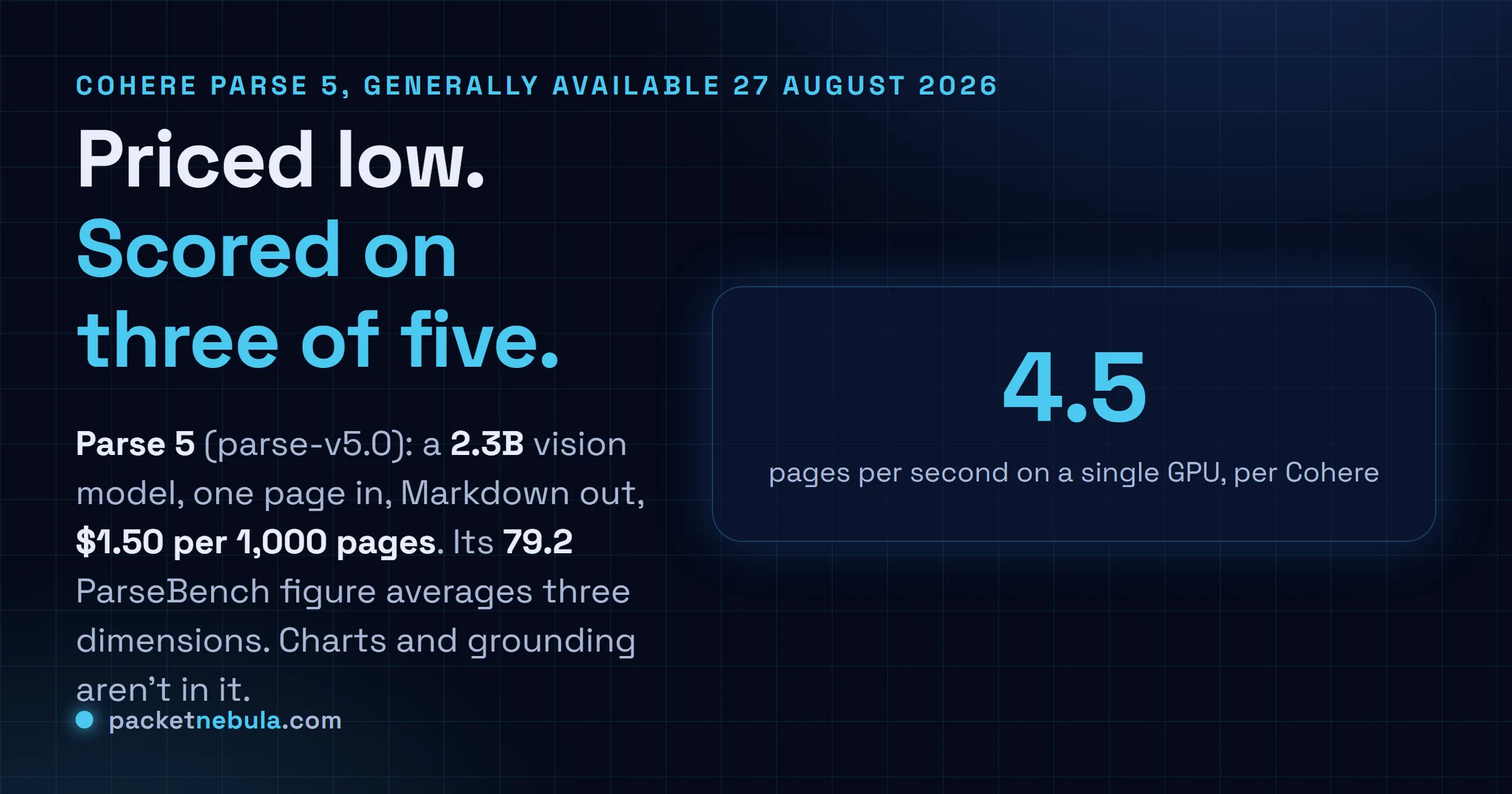
$1.50per 1,000 pages on the Cohere API
2.3Bparameters, about 4.6 GB
3 of 5ParseBench dimensions in the headline score
Answer card: Cohere Parse 5, model id parse-v5.0, generally available 27 August 2026, a 2.3 billion parameter vision language model that turns one PDF, PowerPoint or JPEG page into Markdown with bounding boxes at 1.50 dollars per 1,000 pages, with a quoted ParseBench score of 79.2 that averages three of the benchmark's five dimensions and leaves out charts and visual grounding, and a throughput figure of 4.5 pages per second on a single GPU.
The price, the size, and the asterisk on the score.

The number, and what is missing from it

Cohere leads with 79.2 on ParseBench and puts the component scores right there in the post: 87.0 on tables, 86.6 on content faithfulness, 64.0 on semantic formatting. Add those and divide by three and you get 79.2 exactly. That is how you know the other two dimensions are not in the average.

ParseBench has five. The two absent ones are charts and visual grounding, and they are not decorative. The benchmark’s own paper, arXiv 2604.08538 from the LlamaIndex team, is fairly blunt that grounding is where vision language models come apart: it reports GPT-5 Mini and Haiku below 8% on that dimension while older layout-detection parsers land somewhere in the 55 to 80 band. Grounding is the thing that lets an auditor trace an extracted figure back to a spot on a page. In regulated workflows that is not a nice-to-have.

Cohere does advertise bounding boxes as a feature, so the capability exists. It just is not in the number on the poster. Honestly, I do not read that as dishonest so much as normal launch behaviour, and Cohere published the breakdown that lets you catch it, which is more than most do.
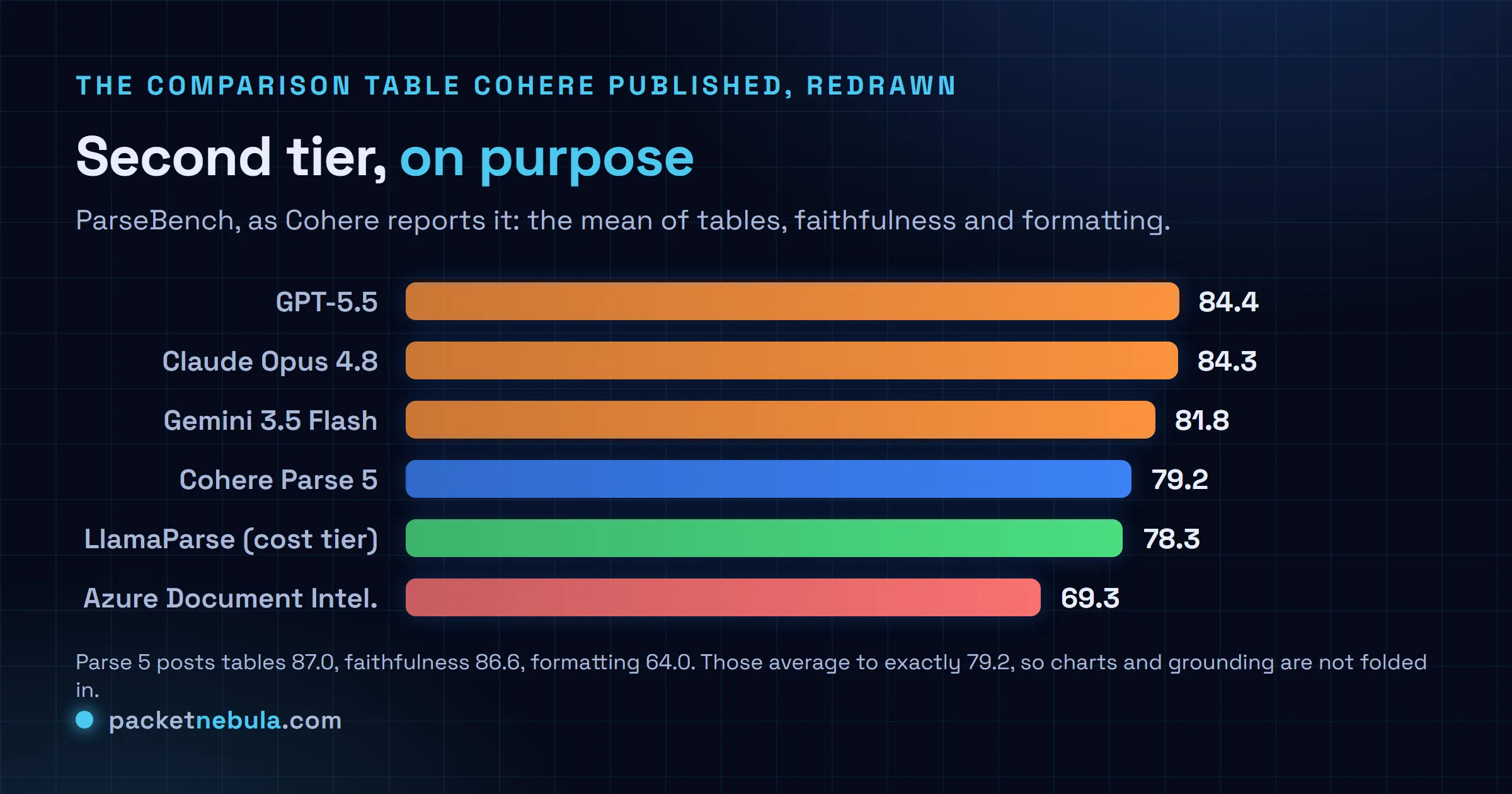
Bar chart of the ParseBench scores Cohere published beside Parse 5: GPT-5.5 at 84.4, Claude Opus 4.8 at 84.3, Gemini 3.5 Flash at 81.8, Cohere Parse 5 at 79.2, the LlamaParse cost tier at 78.3 and Azure Document Intelligence at 69.3, all on the three dimension average Cohere reports.
Cohere put the models that beat it in its own table. Credit where it is due.
Official Cohere key art for the Parse 5 launch: the Cohere mark and the wordmark Parse with a superscript 5 in white, centred on a soft out of focus gradient of deep blue, violet and amber curves.

Image: Cohere, from the Parse 5 announcement

The price is the actual product

$1.50 per 1,000 pages works out to $0.0015 a page. That is the whole pitch, and it is a good one, because document conversion is the least glamorous part of any retrieval pipeline and the one that quietly eats the budget.

Cohere’s own worked example is a company running 13 million pages a month. We checked the arithmetic and it holds together: 13 million pages at $0.0015 is $19,500 a month, so $234,000 a year on the API. Cohere says Model Vault saves that customer about $144,000 a year, which puts the single-tenant deployment near $90,000. Against hyperscaler document services at $10 per 1,000 pages, the same 156 million pages a year would run $1.56 million, and $1.56 million minus $90,000 is the $1.47 million saving Cohere quotes. The numbers are internally consistent, which is not always true of vendor cost slides.

The comparison against GPT-5.5 is a different animal. Cohere models a financial services workflow at 750 million documents a year and claims more than 98% cost reduction. Treat that as an estimate rather than a measurement, because it depends entirely on how many tokens a page turns into, and nobody publishes that number honestly.

What it is, mechanically

2.3 billion parameters, roughly 4.6 GB, built on Cohere Labs’ North-Micro-Vision-Instruct. Context window is 8,192 tokens. You hand it one page at a time as a base64-encoded data URI (our Base64 encoder is right here if you want to eyeball what your client is actually sending) and it returns Markdown: text in reading order, tables as HTML, lists, form key-value pairs, image descriptions, box coordinates.

That 8,192 figure matters more than it looks. This is a per-page tool. Whatever stitches pages back into a document, dedupes headers, or works out that a table runs across a page break, you are writing.

Throughput is 4.5 pages a second on one GPU, or 36 a second on an eight-card H100 node, which Cohere frames as 1.4x faster than dots.mocr and 2.2x faster than Chandra OCR 2. Nine languages hold accuracy. Everything else is zero-shot at lower accuracy, which is Cohere’s phrasing and we appreciate it being said out loud.
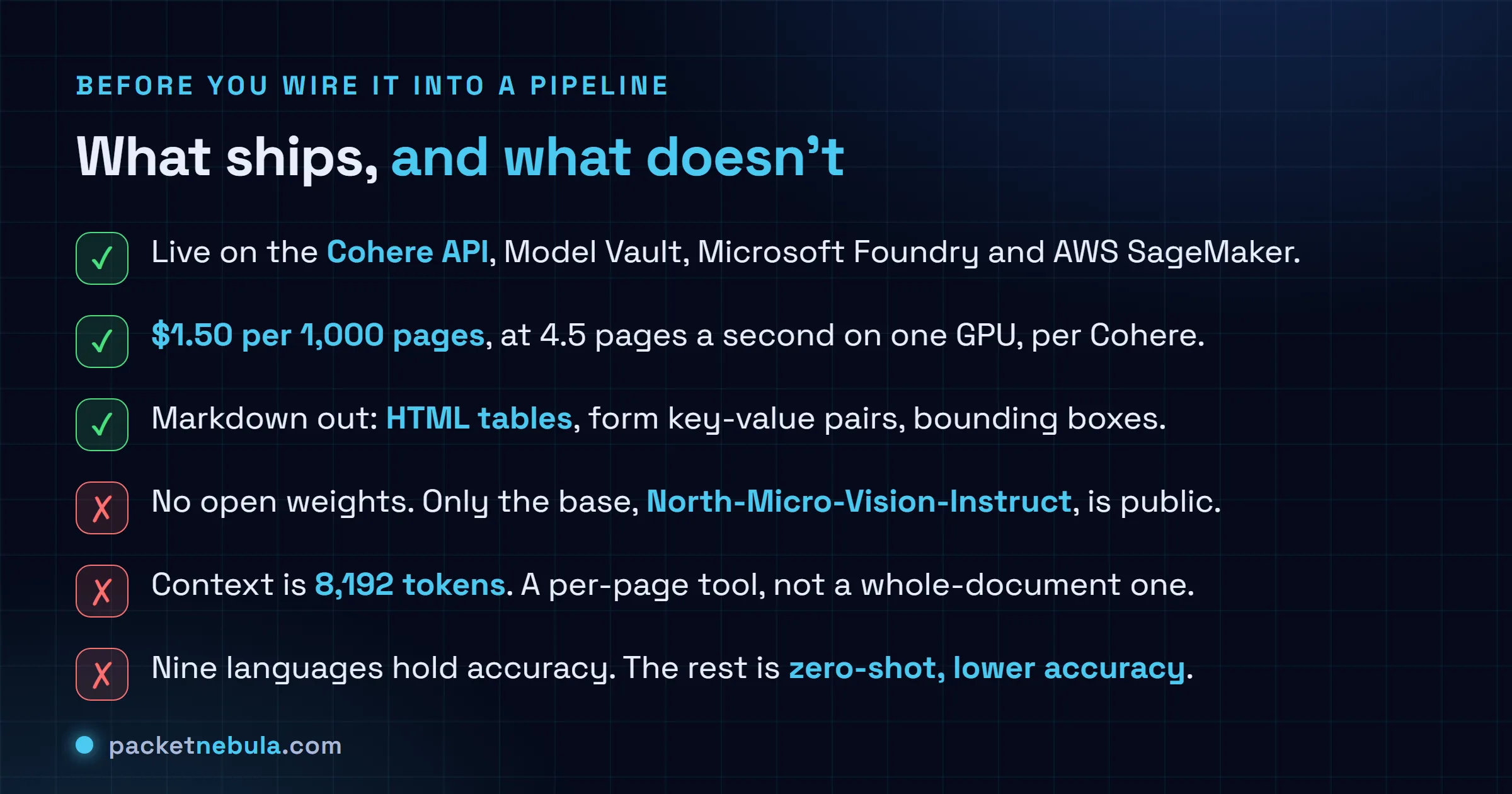
Checklist of what Cohere Parse 5 ships: available on the Cohere API, Model Vault, Microsoft Foundry and AWS SageMaker at 1.50 dollars per 1,000 pages and 4.5 pages a second on one GPU, with Markdown output carrying HTML tables and form key-value pairs and bounding boxes, but no open weights beyond the North-Micro-Vision-Instruct base, an 8,192 token context window, and only nine languages holding accuracy.
Three things to like, three to plan around.

When we would reach for it

If you are already paying frontier token rates to turn PDFs into text for a RAG index, run a bake-off. That is the case Parse 5 was built for, and a five point gap on a partial benchmark is cheap next to the invoice difference. Same shape of argument as Gemini 3.5 Transcribe, which also came fifth on quality and won on price.

If your documents are mostly charts, or an auditor needs every number traceable to a coordinate, do not take 79.2 as the answer. Test the two dimensions Cohere left out, on your own pages.

And if you needed open weights, this is not that release. The base architecture is on Hugging Face. The parser is a service.

Nils Reimers, who runs AI Search at Cohere, put the framing in one line that we think is right even if the launch numbers are selective:

Document parsing isn’t solved because the hard part isn’t reading text, it’s preserving structure and meaning.

Sources

Official announcement: Introducing Parse: Enterprise document intelligence at scale and the Parse product page. Independent coverage and the Reimers quote: VentureBeat and MarkTechPost. Benchmark definition and the grounding figures: ParseBench: A Document Parsing Benchmark for AI Agents and the run-llama/ParseBench repository. Availability on Azure: Microsoft Foundry. The cost arithmetic is our own, worked from Cohere’s published per-page price and its 13 million page example, on 31 August 2026.

Frequently asked questions

How much does Cohere Parse 5 cost?

$1.50 per 1,000 pages through the Cohere API, which is $0.0015 a page. Cohere also sells it through Model Vault, its single-tenant deployment, where it claims 23% savings against the API at 50% GPU utilisation and up to 61% at full hourly utilisation. Parse 5 is on Microsoft Foundry and AWS SageMaker too, and Cohere will deploy it in a private cloud or on-premises.

What is the ParseBench score of Parse 5?

Cohere reports 79.2, broken down as 87.0 on tables, 86.6 on content faithfulness and 64.0 on semantic formatting. Those three average to exactly 79.2, so the charts and visual grounding dimensions are not folded into that number. ParseBench itself is a five dimension benchmark from LlamaIndex, published as arXiv 2604.08538, built on roughly 2,000 human-verified pages from insurance, finance and government documents.

Is Parse 5 better than GPT-5.5 or Claude Opus at reading documents?

No, and Cohere's own table says so. On the three dimensions Cohere reports, GPT-5.5 scores 84.4 and Claude Opus 4.8 scores 84.3 against 79.2 for Parse 5. Gemini 3.5 Flash sits at 81.8. The pitch is not that Parse 5 wins, it is that you pay a per-page rate for a 2.3B model instead of frontier token pricing for a job that is mostly mechanical.

Are the Parse 5 weights open?

No. Parse 5 is served through the Cohere API, Model Vault, Microsoft Foundry and AWS SageMaker. The architecture it is built on, CohereLabs/North-Micro-Vision-Instruct, is published on Hugging Face, and there is a demo space, but the parse-v5.0 checkpoint itself is not a download.

What formats and languages does Parse 5 handle?

You send a PDF, PPT or JPEG page as a base64-encoded data URI and get back Markdown: text in reading order, tables rendered as HTML, lists, form key-value pairs, image descriptions and bounding box coordinates. Nine languages hold their accuracy (Arabic, English, French, German, Italian, Japanese, Korean, Portuguese, Spanish) with zero-shot support elsewhere at lower accuracy, in Cohere's own words. The context window is 8,192 tokens.

Tags: aicoheredocumentsllmnewsocr
Share197Tweet123
stephane

stephane

  • Trending
  • Comments
  • Latest
Answer card: Proton Lumo 2.0 is private by policy, not by locality. Saved history is locked so even Proton cannot read it, but the prompt is decrypted on a Proton EU server to answer it, then forgotten.

Proton Lumo 2.0 review: how private is it, really?

3 September 2026
Google's official announcement image for the release, reading Introducing Gemini 3.8 Flash and 3.8 Flash Cyber in black type over a pale blue background with a blurred white chevron and the four colour Gemini spark below.

Gemini 3.8 Flash keeps the price and the 1 January cliff

3 September 2026
Answer card stating that Anthropic announced Enterprise Frontier Safeguards on 1 September 2026, that activity data used for misuse monitoring moves into cloud storage the customer controls under the customer own encryption keys, that Anthropic charges nothing for the feature while the cloud provider bills storage and egress, and that the phased rollout starts later in autumn 2026 with interim zero data retention on Fable 5 and Fable 5.1 for eligible customers.

Anthropic moves retention into your own cloud, for 30 days

3 September 2026
Answer card: JWTs are not encrypted, anyone can read them; the signature proves who issued the token, not who may read it.

Are JWTs encrypted? No, and the difference will bite you

0
Answer card: a random 8 character password falls in under 2 hours offline, while 16 random characters hold for 1.4 trillion years at the same speed.

How long does it take to crack a password in 2026?

0
Answer card: three DNS records decide if your mail lands or bounces; SPF lists allowed senders, DKIM signs messages, DMARC sets the failure policy.

SPF, DKIM and DMARC explained: the records your email needs

0
Answer card stating that Mullvad announced on 3 September 2026 that it is shutting down its public encrypted domain name system servers on 2 November 2026 and sponsoring the Quad9 Foundation instead, with 194.242.2.2 and its five sibling addresses all going away, and virtual private network customers unaffected.

Mullvad’s DNS servers go dark on 2 November, and Quad9 blocks no ads

5 September 2026
OpenAI announcement image for GPT-6 Astra, a spiral galaxy of white, blue and amber points of light curling around a bright core on a near black star field.

GPT-6 Astra lists at $10 and $50, 2.5x what GPT-5.6 Sol costs

6 September 2026
Google's official announcement image for the release, reading Introducing Gemini 3.8 Flash and 3.8 Flash Cyber in black type over a pale blue background with a blurred white chevron and the four colour Gemini spark below.

Gemini 3.8 Flash keeps the price and the 1 January cliff

3 September 2026
  • About
  • Contact
  • Privacy
  • Legal

Copyright © 2026 Stephane Cardon.

Welcome Back!

Login to your account below

Forgotten Password?

Retrieve your password

Please enter your username or email address to reset your password.

Log In
No Result
View All Result
  • Home
  • Articles
    • Security
    • Network
    • Dev
    • Sysadmin
    • SEO
    • Email & DNS
  • Tools
    • Network tools: free, fast, no signup
    • Security tools: free, fast, no signup
    • Developer tools: free, fast, no signup
    • Sysadmin tools: free, fast, no signup
    • SEO tools: free, fast, no signup
    • Email & DNS tools: free, fast, no signup
  • Download
  • About

Copyright © 2026 Stephane Cardon.