
• Latest
  • Trending
  • All
Meta announcement artwork for Muse Glimmer, an abstract network of blue lines and nodes on a dark background, from the Meta research blog post introducing the model.

Meta Muse Glimmer: the 30B agent needs 24GB of VRAM

10 August 2026
Answer card for Claude Opus 5.5: 4 dollars in and 20 dollars out per million tokens, down from 5 and 25, with cache reads at 20 cents.

Claude Opus 5.5 drops to $4 and $20, and breaks four Opus 5 habits

23 September 2026
The official xAI announcement card for Grok 4.7, white type on a dark grey and navy gradient.

Grok 4.7 keeps $2 and $6, and its gains over 4.6 are xhigh versus high

22 September 2026
Answer card stating that Qwen-Image-2.1, released on 20 September 2026, ships open weights with a 7 billion parameter diffusion transformer, a Qwen3-VL 8B text encoder and an RGBA VAE totalling about 33 gigabytes in BF16, under the Qwen Research License that limits use to research or evaluation and requires a separate commercial licence, unlike the Apache 2.0 licence of Qwen-Image 1.0.

Qwen-Image-2.1 brings the weights back, but not the Apache licence

21 September 2026
Answer card stating that Ternary Bonsai 2 27B, released by PrismML on 17 September 2026 under Apache 2.0, packs Qwen3.8 27B into 5.95 gigabytes at 1.72 bits per weight, keeps 98.2 percent of the 14-benchmark average, about 75 percent on SWE-bench Verified and Terminal-Bench 2.1, and needs PrismML's llama.cpp fork to run.

Does Bonsai 2 27B really keep 98% of Qwen3.8 in 5.95 GB?

20 September 2026
Answer card stating that Jev 1.13 from TypeSafe AI is a decision model in early access since 15 September 2026 that returns typed probabilities instead of text, priced at 42 dollars per billion input tokens with output tokens free, answering in 70 to 500 milliseconds, with a 64K token request budget, text input only, and a documented list of things it does badly, including counting and dates.

Jev 1.13 bills $42 a billion tokens, and it can’t count

19 September 2026
Answer card stating that Qwen3.8-Omni-Flash launched on 17 September 2026 as an API only model on Alibaba Cloud Model Studio, taking text, images, audio and video in a 1M token context and returning text only, priced at 0.15 dollars per million input tokens for every modality and 0.47 dollars per million output tokens in the international regions, with no open weights published and the Qwen-Live Harness GitHub repository returning 404.

Qwen3.8-Omni-Flash bills audio at $0.15 and ships no weights

18 September 2026
Answer card stating that on 15 September 2026 AWS said it is unable to restore access to resources and data hosted exclusively in the Middle East Bahrain region me-south-1 and in the mec1-az2 zone of the UAE region, because the damage spanned multiple Availability Zones and exceeded what multi-AZ services are designed to withstand.

AWS can’t restore me-south-1, six months after the drone strikes

17 September 2026
Answer card stating that Google released Gemini 3.8 Live and Gemini 3.8 Live Extended Thinking on 15 September 2026 at 3 dollars per million audio input tokens and 12 dollars out, that the thinking model requires asynchronous tools, and that Artificial Analysis scores it 82.6 on its Speech to Speech Quality Index.

Gemini 3.8 Live Extended Thinking rejects any tool that blocks

16 September 2026
Answer card summarising the Atria Dawn Preview release: 744B GLM-5.2 base, MIT licence, 1.5 TB BF16 and 756 GB FP8 checkpoints, 256K context, top on five of sixteen benchmark rows and trailing on SWE-bench Pro.

Atria Dawn Preview is 744B under MIT, and the BF16 weighs 1.5 TB

15 September 2026
Answer card stating that OpenAI released the Agents API in public beta on 10 September 2026 with no separate fee, billed through model tokens, tool calls and hosted sandbox time, with a choice of OpenAI hosted, self hosted or partner sandboxes, US only data residency and no Zero Data Retention support.

OpenAI’s Agents API has no fee, no ZDR and a one hour sandbox clock

14 September 2026
Answer card: Sakana Fugu Max at $2 and $6 per million tokens, Fugu Ultra v2 unchanged at $5 and $30, and Sakana saying Ultra v2 scores without Fable 5 or GPT-6 Astra in its pool.

Fugu Max costs $2 and $6 while Fugu Ultra v2 runs without Fable 5

13 September 2026
Answer card stating that DeepSeek released DeepSeek-V4.1-Flash on 10 September 2026 as a 552 billion parameter mixture of experts model with a new causal encoder decoder architecture that activates 8 billion parameters on input and 16 billion on output, with native vision, a one million token context and MIT licensed weights, that the API model name is now deepseek-flash at 0.15 dollars per million input tokens and 0.60 dollars per million output tokens off peak, and that DeepSeek announced V4 Pro would be routed to V4.1-Flash from 14 September and reversed that on 11 September.

DeepSeek V4.1-Flash arrived, and the V4 Pro retirement lasted a day

12 September 2026
  • About
  • Contact
  • Privacy
  • Legal
Wednesday, September 23, 2026
  • Login
Packet Nebula
  • Home
  • Articles
    • Security
    • Network
    • Dev
    • Sysadmin
    • SEO
    • Email & DNS
  • Tools
    • Network tools: free, fast, no signup
    • Security tools: free, fast, no signup
    • Developer tools: free, fast, no signup
    • Sysadmin tools: free, fast, no signup
    • SEO tools: free, fast, no signup
    • Email & DNS tools: free, fast, no signup
  • Download
  • About
No Result
View All Result
Packet Nebula
No Result
View All Result
Home Dev

Meta Muse Glimmer: the 30B agent needs 24GB of VRAM

by stephane
10 August 2026
in Dev
0
Meta announcement artwork for Muse Glimmer, an abstract network of blue lines and nodes on a dark background, from the Meta research blog post introducing the model.
491
SHARES
1.4k
VIEWS
Share on FacebookShare on Twitter

Your card holds 24 GB, or it doesn't. That one number decides whether today's Meta release is something you'll actually run or just something you'll read about. Muse Glimmer went up on 10 August: 30 billion parameters, dense, Apache 2.0, weights already on Hugging Face. It's built for agents that sit on your own machine and keep working without a round trip to anyone's API. Meta's pitch is that it fits on a single consumer GPU, and that's true at 4-bit, in a 17 GB build that costs about a point of quality. What it won't do is hit the throughput figure most of the coverage quoted. That number was measured somewhere else entirely.

The short answer

Meta Superintelligence Labs released Muse Glimmer on 10 August 2026, a 30 billion parameter dense agentic model with a 131,072 token context, distilled from Muse Spark and licensed under plain Apache 2.0. Full precision wants more than 55 GB of memory. The K-Quant-17GB build fits a 24 GB card for about a point of quality, which is what makes the local story real. It leads its size class on tool calling by a wide margin and loses to the smaller Qwen3.6-27B on straight coding.
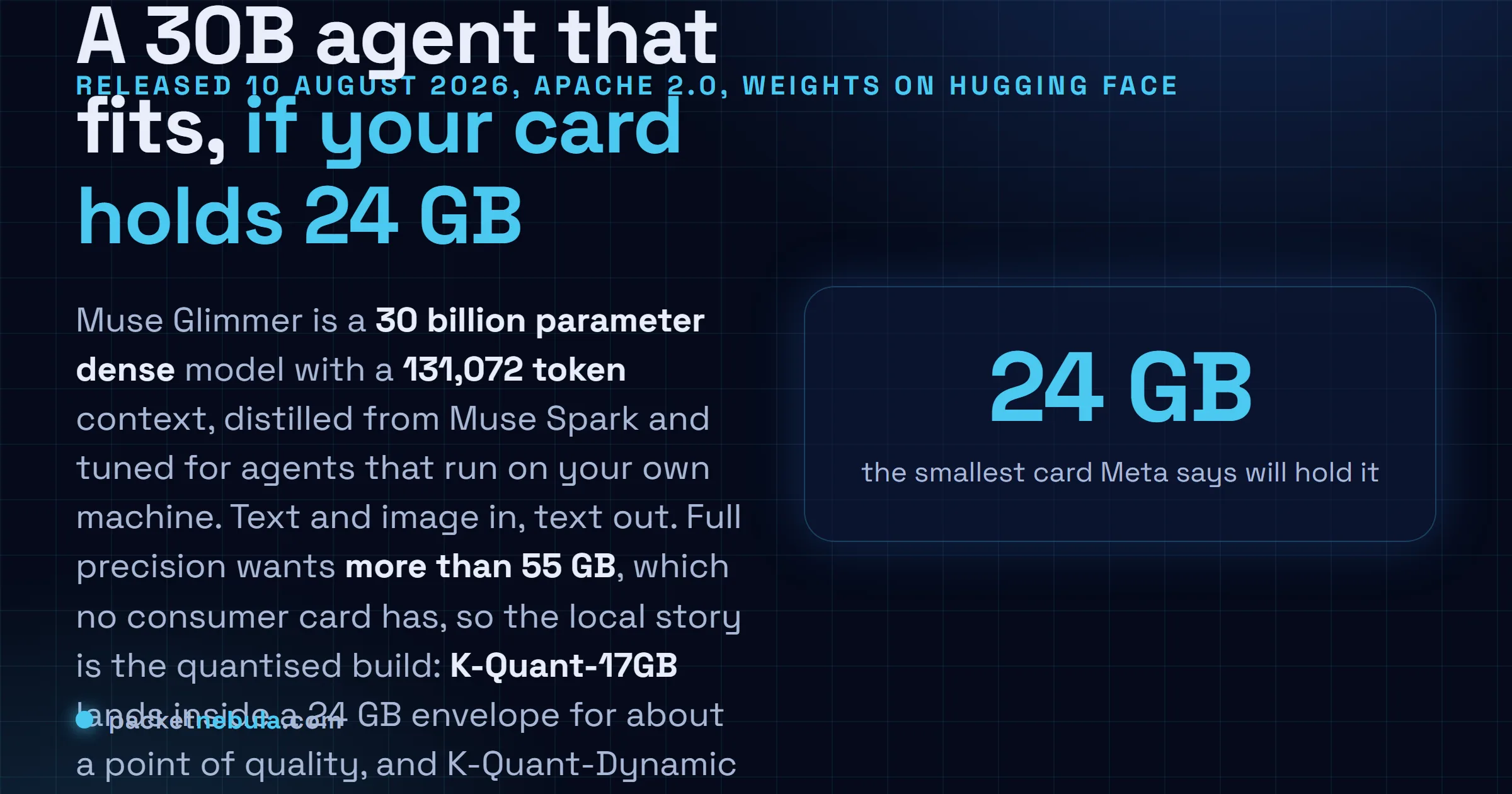
30Bdense parameters, Apache 2.0, weights on Hugging Face
24 GBsmallest card that holds the quantised build
233 tok/smeasured on an RTX 5090, not the 20K in the headlines
Answer card: Meta released Muse Glimmer on 10 August 2026, a 30 billion parameter dense agentic model with a 131,072 token context under Apache 2.0 with open weights on Hugging Face, needing more than 55 GB at full precision but fitting a 24 GB consumer card through the K-Quant-17GB build at roughly one percent quality degradation.
The licence is the headline. The memory floor is the thing that decides it for you.

What Meta actually shipped

A dense 30B, not a mixture of experts. That’s worth pausing on, because most releases at this size lately have gone the sparse route to keep active parameters down. Glimmer didn’t.

Under the hood it’s a causal transformer with grouped query attention, 32 query heads against 2 KV heads, and an attention pattern that runs three local layers to one global with a 2,048 token sliding window. RoPE goes on the local layers only. There’s a separate perception encoder of around 1.8B on top, a ViT-G/14, which is where the image input comes from. Context is 131,072 and the vocabulary is 202,048 tokens.

Training went in three passes: logit distillation from Muse Spark during pretraining, then longer context agent data, then supervised fine-tuning mixed with on-policy distillation and reinforcement learning. So Glimmer is the small sibling of a model Meta already sells access to, which we covered when the Muse Spark 1.2 contributor tier landed.
Meta announcement artwork for Muse Glimmer, an abstract network of blue lines and nodes on a dark background.

Image: Meta

The licence deserves its own sentence. Apache 2.0, no user threshold, no bespoke acceptable use policy stapled to the side. Meta has spent years shipping open weights under terms that made lawyers nervous, and this one just doesn’t. Compare that to the licence gymnastics we walked through on MiniMax H3’s excluded territories and it’s a real change.

The memory floor, honestly

Here’s where “runs on a single consumer GPU” needs unpacking.

Full precision is over 55 GB. Nothing you can buy at retail holds that. So every local deployment is a quantised one, and Meta ships two tiers: K-Quant-Dynamic, which wants 32 GB and costs about 0.2%, and K-Quant-17GB, which lands inside a 24 GB envelope for roughly 1.0%. Compressed weights come in near 4-bit with the language model under 20 GB.

Which means the entry ticket is a 24 GB card. A 4090, a 5090, a 32 GB workstation part, or Apple silicon with enough unified memory. If you’re on 16 GB, and plenty of people are, the 17 GB build doesn’t fit and there’s no smaller official option. That’s not a knock, it’s just the actual gate, and most coverage skipped straight past it.

About that 20,000 tokens per second

This is the part that annoyed us.
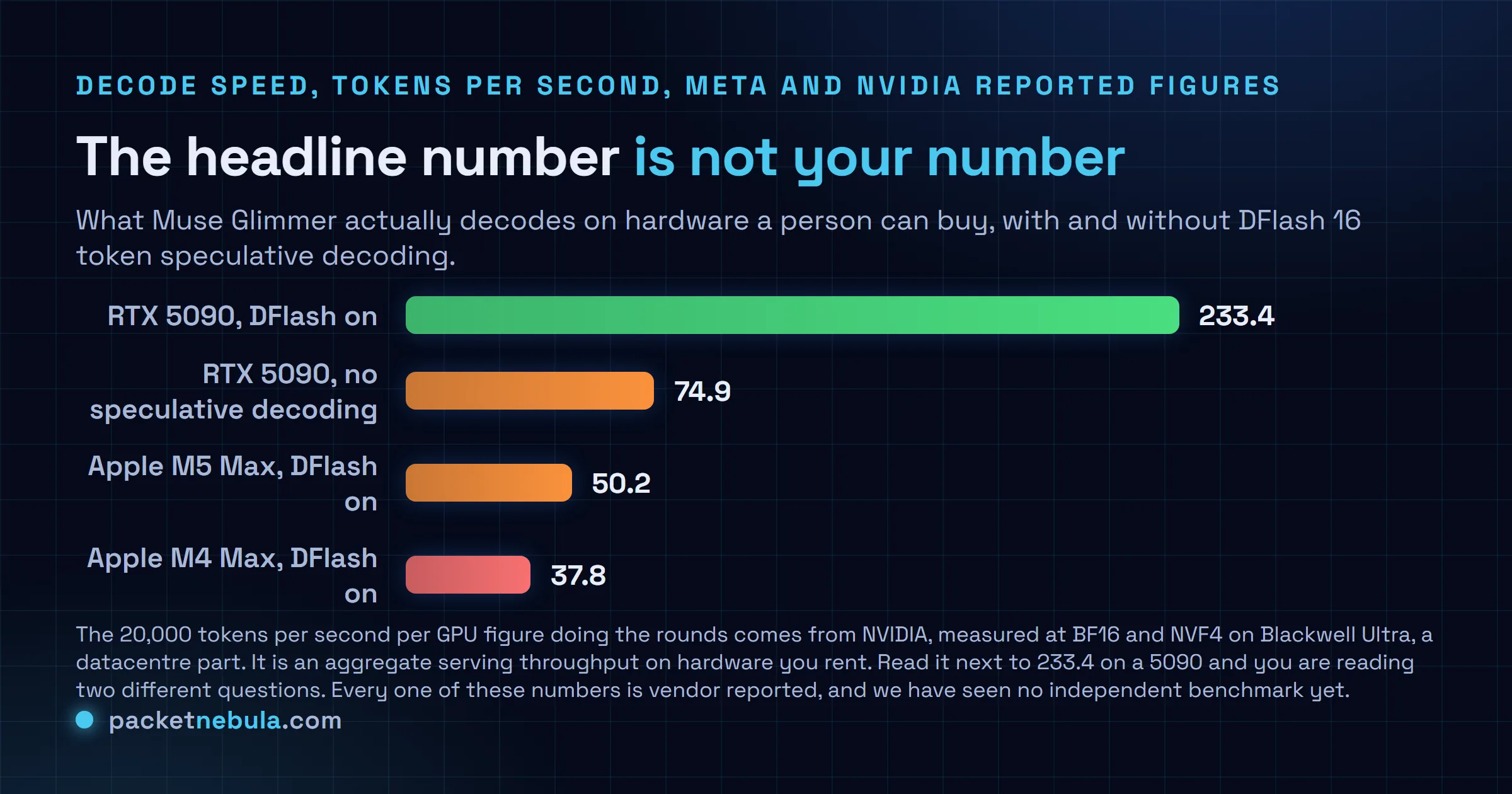
Bar chart of measured Muse Glimmer decode speeds in tokens per second: RTX 5090 with DFlash speculative decoding at 233.4, RTX 5090 without at 74.9, Apple M5 Max at 50.2 and Apple M4 Max at 37.8, all far below the 20,000 tokens per second per GPU figure NVIDIA measured on a Blackwell Ultra datacentre part.
Two real numbers, two different questions. Only one of them describes your desk.

NVIDIA’s post puts Glimmer at over 20,000 tokens per second per GPU at BF16 and NVF4. On Blackwell Ultra. That’s a datacentre accelerator, and the figure is aggregate serving throughput across concurrent requests, not the speed at which one agent thinks.

What you get locally, on Meta’s own numbers, is 233.4 tokens per second on an RTX 5090 with DFlash 16 token speculative decoding enabled, and 74.9 without. The speculative decoding is doing most of the work there, a 3.1x multiplier. Apple fares less well: 50.2 on an M5 Max against 26.6 baseline, 37.8 on an M4 Max against 23.7.

Honestly, 233 tokens per second for a local agent is fine. Better than fine. The problem isn’t the speed, it’s that two numbers got printed next to each other in a lot of write-ups as though they described the same machine.

Where it wins and where it doesn’t
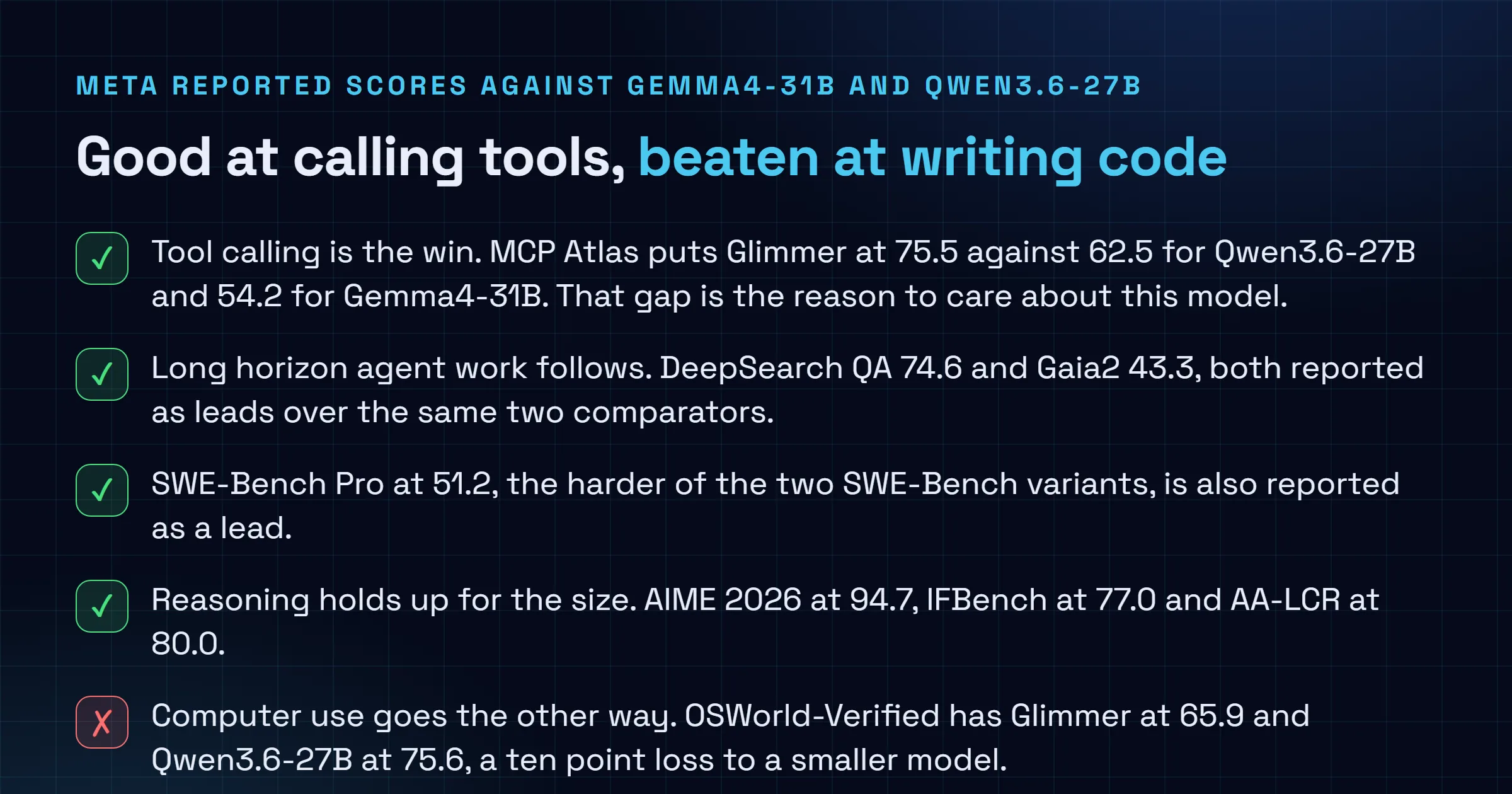
Checklist of Meta reported Muse Glimmer scores against Gemma4-31B and Qwen3.6-27B, showing leads on MCP Atlas at 75.5, DeepSearch QA at 74.6, Gaia2 at 43.3, SWE-Bench Pro at 51.2 and AIME 2026 at 94.7, against losses to Qwen3.6-27B on OSWorld-Verified, SWE-Bench Verified and TerminalBench 2.1, plus the caveat that every score is self reported.
Read the bottom half. That's where the deployment decision actually lives.

The tool calling gap is the story. MCP Atlas has Glimmer at 75.5 against 62.5 for Qwen3.6-27B and 54.2 for Gemma4-31B. Twelve points over the nearest comparator on the benchmark that most closely resembles what an agent does all day. DeepSearch QA at 74.6 and Gaia2 at 43.3 point the same way. Reasoning is strong for the class too, AIME 2026 at 94.7.

Then it loses at coding. Qwen3.6-27B, a smaller model, is ahead on SWE-Bench Verified at 77.2 and TerminalBench 2.1 at 60.7, and takes OSWorld-Verified 75.6 to 65.9. Glimmer does lead SWE-Bench Pro at 51.2, which is the harder variant, so the picture isn’t clean. We’re not sure what to make of that split yet, and I’d want independent numbers before building a workflow on it. It’s the same tension we picked apart when a 276B model beat its own 975B parent at coding while collapsing on recall.

Every one of these figures is Meta, running Meta’s harness, on release day. Nobody has replicated any of it.

So who should take it

If you’re building something that calls tools in a loop on a 24 GB card, this is now the obvious local default, and the licence removes the usual reason to hesitate. Always-on agents are exactly the shape it was trained for, and 100-plus languages plus image input widen that further.

If you mostly want a model to write code, look at Qwen3.6-27B first on these numbers.

Two caveats before you wire it into anything with reach. The knowledge cutoff is 4 January 2026, so recency has to come through tools. And Meta’s own Siren AgentDojo result is 94.2 utility with a 28.4 attack success rate under prompt injection, which for an always-on local agent holding your filesystem is the number I’d think about hardest. Scope its permissions like you would any process that reads untrusted text.

Sources

Meta’s announcement is on the Meta research blog, with the model page at developer.meta.com and weights in the Hugging Face collection. The Blackwell Ultra throughput figure comes from NVIDIA’s developer blog. Architecture and benchmark detail cross-checked against MarkTechPost and Phoronix, which notes Ollama support from 0.32.7.

Frequently asked questions

What GPU do I actually need to run Muse Glimmer?

A 24 GB card is the realistic floor, and that means the K-Quant-17GB build, which Meta puts at roughly 1.0% degradation against full precision. If you have 32 GB, take K-Quant-Dynamic instead at about 0.2%. Full precision needs more than 55 GB, so no consumer card runs it unquantised. Apple silicon works through the same quantised builds, and Meta reports figures on M4 Max and M5 Max. A 16 GB card will not hold the 17 GB build, which rules out most of the installed base.

Is Muse Glimmer really Apache 2.0?

Yes, and that is the genuinely notable part. Meta shipped it under a plain Apache 2.0 licence rather than the bespoke community licence its earlier model families carried, which means commercial use without a user count threshold and without an acceptable use policy bolted on. Weights are on Hugging Face in BF16, GGUF k-quants and ExecuTorch builds. Ollama added support in 0.32.7, and Meta says llama.cpp, MLX and ExecuTorch integrations land in the coming days.

How fast is it on a machine I own?

Meta reports 233.4 tokens per second on an RTX 5090 with DFlash 16 token speculative decoding, up from 74.9 without it. An M5 Max does 50.2 against 26.6, and an M4 Max 37.8 against 23.7. The 20,000 tokens per second per GPU number in circulation is NVIDIA's, measured on Blackwell Ultra, a datacentre part, and it describes aggregate serving throughput rather than the speed of one conversation. Both numbers are real. They answer different questions.

Should I pick Muse Glimmer or Qwen3.6-27B for a local coding agent?

On Meta's own scores, split it by what the agent spends its time doing. If the work is calling tools and chaining steps, Glimmer leads clearly, 75.5 against 62.5 on MCP Atlas. If the work is writing and fixing code directly, Qwen3.6-27B is ahead on SWE-Bench Verified at 77.2 and TerminalBench 2.1 at 60.7, and ahead by ten points on OSWorld-Verified. A smaller model beating a larger one on coding is not the usual shape, which is why we would run both before committing.

What are the real limits to know before deploying it?

Three things we would check first. The knowledge cutoff is 4 January 2026, so anything recent has to arrive through tools rather than from the weights. It takes text and images in and returns text only, with no audio or video. And on Siren AgentDojo, Meta reports a 28.4 prompt injection attack success rate alongside 94.2 utility, which is the figure that should shape how much filesystem and network reach you hand an always-on local agent.

Tags: agentsaillmlocal-ainewsopen-weights
Share196Tweet123
stephane

stephane

  • Trending
  • Comments
  • Latest
Answer card: Proton Lumo 2.0 is private by policy, not by locality. Saved history is locked so even Proton cannot read it, but the prompt is decrypted on a Proton EU server to answer it, then forgotten.

Proton Lumo 2.0 review: how private is it, really?

3 September 2026
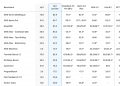
The Agentic Coding section of the official Hy4 preview benchmark appendix published by Tencent, a table comparing Hy3 and Hy4 preview against DeepSeek V4 Pro 0813, Qwen 3.8 Max, GLM 5.3, Kimi K3, GPT 5.6 Sol and Claude Opus 5 across SWE-bench Multilingual, SWE-bench Pro, DeepSWE, three SWE Atlas tasks, SWE-Marathon, Terminal-Bench 2.1, NL2Repo-Bench, CyberGym, ProgramBench, PostTrainBench and Harbor-Index.

Tencent’s 770B Hy4 tops one benchmark row in 46

3 September 2026
Answer card: Qwen 3.7 Max is API-only and cannot run locally yet; the open Qwen models (Qwen 3.6 27B, qwen3:8b to 32b) run offline via Ollama.

Qwen 3.7 local: what you can actually run offline

22 June 2026
Answer card: JWTs are not encrypted, anyone can read them; the signature proves who issued the token, not who may read it.

Are JWTs encrypted? No, and the difference will bite you

0
Answer card: a random 8 character password falls in under 2 hours offline, while 16 random characters hold for 1.4 trillion years at the same speed.

How long does it take to crack a password in 2026?

0
Answer card: three DNS records decide if your mail lands or bounces; SPF lists allowed senders, DKIM signs messages, DMARC sets the failure policy.

SPF, DKIM and DMARC explained: the records your email needs

0
Answer card for Claude Opus 5.5: 4 dollars in and 20 dollars out per million tokens, down from 5 and 25, with cache reads at 20 cents.

Claude Opus 5.5 drops to $4 and $20, and breaks four Opus 5 habits

23 September 2026
The official xAI announcement card for Grok 4.7, white type on a dark grey and navy gradient.

Grok 4.7 keeps $2 and $6, and its gains over 4.6 are xhigh versus high

22 September 2026
Answer card stating that Qwen-Image-2.1, released on 20 September 2026, ships open weights with a 7 billion parameter diffusion transformer, a Qwen3-VL 8B text encoder and an RGBA VAE totalling about 33 gigabytes in BF16, under the Qwen Research License that limits use to research or evaluation and requires a separate commercial licence, unlike the Apache 2.0 licence of Qwen-Image 1.0.

Qwen-Image-2.1 brings the weights back, but not the Apache licence

21 September 2026
  • About
  • Contact
  • Privacy
  • Legal

Copyright © 2026 Stephane Cardon.

Welcome Back!

Login to your account below

Forgotten Password?

Retrieve your password

Please enter your username or email address to reset your password.

Log In
No Result
View All Result
  • Home
  • Articles
    • Security
    • Network
    • Dev
    • Sysadmin
    • SEO
    • Email & DNS
  • Tools
    • Network tools: free, fast, no signup
    • Security tools: free, fast, no signup
    • Developer tools: free, fast, no signup
    • Sysadmin tools: free, fast, no signup
    • SEO tools: free, fast, no signup
    • Email & DNS tools: free, fast, no signup
  • Download
  • About

Copyright © 2026 Stephane Cardon.