
• Latest
  • Trending
  • All
Answer card: on 6 August 2026 AMD signed a definitive agreement to acquire Taalas, a Toronto startup whose HC1 chip etches Llama 3.1 8B weights into TSMC 6nm mask layers instead of holding them in HBM, with terms undisclosed and closing expected in the fourth quarter of 2026.

AMD buys Taalas: the HC1 etches Llama 3.1 into silicon

8 August 2026
Answer card stating that Ternary Bonsai 2 27B, released by PrismML on 17 September 2026 under Apache 2.0, packs Qwen3.8 27B into 5.95 gigabytes at 1.72 bits per weight, keeps 98.2 percent of the 14-benchmark average, about 75 percent on SWE-bench Verified and Terminal-Bench 2.1, and needs PrismML's llama.cpp fork to run.

Does Bonsai 2 27B really keep 98% of Qwen3.8 in 5.95 GB?

20 September 2026
Answer card stating that Jev 1.13 from TypeSafe AI is a decision model in early access since 15 September 2026 that returns typed probabilities instead of text, priced at 42 dollars per billion input tokens with output tokens free, answering in 70 to 500 milliseconds, with a 64K token request budget, text input only, and a documented list of things it does badly, including counting and dates.

Jev 1.13 bills $42 a billion tokens, and it can’t count

19 September 2026
Answer card stating that Qwen3.8-Omni-Flash launched on 17 September 2026 as an API only model on Alibaba Cloud Model Studio, taking text, images, audio and video in a 1M token context and returning text only, priced at 0.15 dollars per million input tokens for every modality and 0.47 dollars per million output tokens in the international regions, with no open weights published and the Qwen-Live Harness GitHub repository returning 404.

Qwen3.8-Omni-Flash bills audio at $0.15 and ships no weights

18 September 2026
Answer card stating that on 15 September 2026 AWS said it is unable to restore access to resources and data hosted exclusively in the Middle East Bahrain region me-south-1 and in the mec1-az2 zone of the UAE region, because the damage spanned multiple Availability Zones and exceeded what multi-AZ services are designed to withstand.

AWS can’t restore me-south-1, six months after the drone strikes

17 September 2026
Answer card stating that Google released Gemini 3.8 Live and Gemini 3.8 Live Extended Thinking on 15 September 2026 at 3 dollars per million audio input tokens and 12 dollars out, that the thinking model requires asynchronous tools, and that Artificial Analysis scores it 82.6 on its Speech to Speech Quality Index.

Gemini 3.8 Live Extended Thinking rejects any tool that blocks

16 September 2026
Answer card summarising the Atria Dawn Preview release: 744B GLM-5.2 base, MIT licence, 1.5 TB BF16 and 756 GB FP8 checkpoints, 256K context, top on five of sixteen benchmark rows and trailing on SWE-bench Pro.

Atria Dawn Preview is 744B under MIT, and the BF16 weighs 1.5 TB

15 September 2026
Answer card stating that OpenAI released the Agents API in public beta on 10 September 2026 with no separate fee, billed through model tokens, tool calls and hosted sandbox time, with a choice of OpenAI hosted, self hosted or partner sandboxes, US only data residency and no Zero Data Retention support.

OpenAI’s Agents API has no fee, no ZDR and a one hour sandbox clock

14 September 2026
Answer card: Sakana Fugu Max at $2 and $6 per million tokens, Fugu Ultra v2 unchanged at $5 and $30, and Sakana saying Ultra v2 scores without Fable 5 or GPT-6 Astra in its pool.

Fugu Max costs $2 and $6 while Fugu Ultra v2 runs without Fable 5

13 September 2026
Answer card stating that DeepSeek released DeepSeek-V4.1-Flash on 10 September 2026 as a 552 billion parameter mixture of experts model with a new causal encoder decoder architecture that activates 8 billion parameters on input and 16 billion on output, with native vision, a one million token context and MIT licensed weights, that the API model name is now deepseek-flash at 0.15 dollars per million input tokens and 0.60 dollars per million output tokens off peak, and that DeepSeek announced V4 Pro would be routed to V4.1-Flash from 14 September and reversed that on 11 September.

DeepSeek V4.1-Flash arrived, and the V4 Pro retirement lasted a day

12 September 2026
Answer card stating that Cognition released SWE-2 on 10 September 2026, a coding model post-trained from Kimi K3, scoring 50.0 percent on FrontierCode 1.1 Main against 50.9 percent for Claude Fable 5.1 and 27.3 percent on Terminal-Bench 4 against 55.8 percent, available only inside Devin.

SWE-2 trails Fable 5.1 by one point, and by 28 on Terminal-Bench 4

11 September 2026
Answer card for Meta Muse, free to 100 million tokens a week then $20 a month, launched 8 September 2026 for United States adults only, running in a dedicated per user virtual machine.

Does Meta Muse do enough to earn your inbox and a card on file?

9 September 2026
Answer card stating that the public download pages for the VMware Virtual Disk Development Kit on developer.broadcom.com began returning 404 errors on 25 August 2026 with no announcement or deprecation notice, that Broadcom support tells customers the kit is no longer available for use or download, and that release lines 7.0.3.1, 8.x and 9.x are all affected.

Broadcom pulled VDDK 8.0 and 9.0, and the 404 is the only notice

8 September 2026
  • About
  • Contact
  • Privacy
  • Legal
Sunday, September 20, 2026
  • Login
Packet Nebula
  • Home
  • Articles
    • Security
    • Network
    • Dev
    • Sysadmin
    • SEO
    • Email & DNS
  • Tools
    • Network tools: free, fast, no signup
    • Security tools: free, fast, no signup
    • Developer tools: free, fast, no signup
    • Sysadmin tools: free, fast, no signup
    • SEO tools: free, fast, no signup
    • Email & DNS tools: free, fast, no signup
  • Download
  • About
No Result
View All Result
Packet Nebula
No Result
View All Result
Home Dev

AMD buys Taalas: the HC1 etches Llama 3.1 into silicon

by stephane
8 August 2026
in Dev
0
Answer card: on 6 August 2026 AMD signed a definitive agreement to acquire Taalas, a Toronto startup whose HC1 chip etches Llama 3.1 8B weights into TSMC 6nm mask layers instead of holding them in HBM, with terms undisclosed and closing expected in the fourth quarter of 2026.
494
SHARES
1.4k
VIEWS
Share on FacebookShare on Twitter

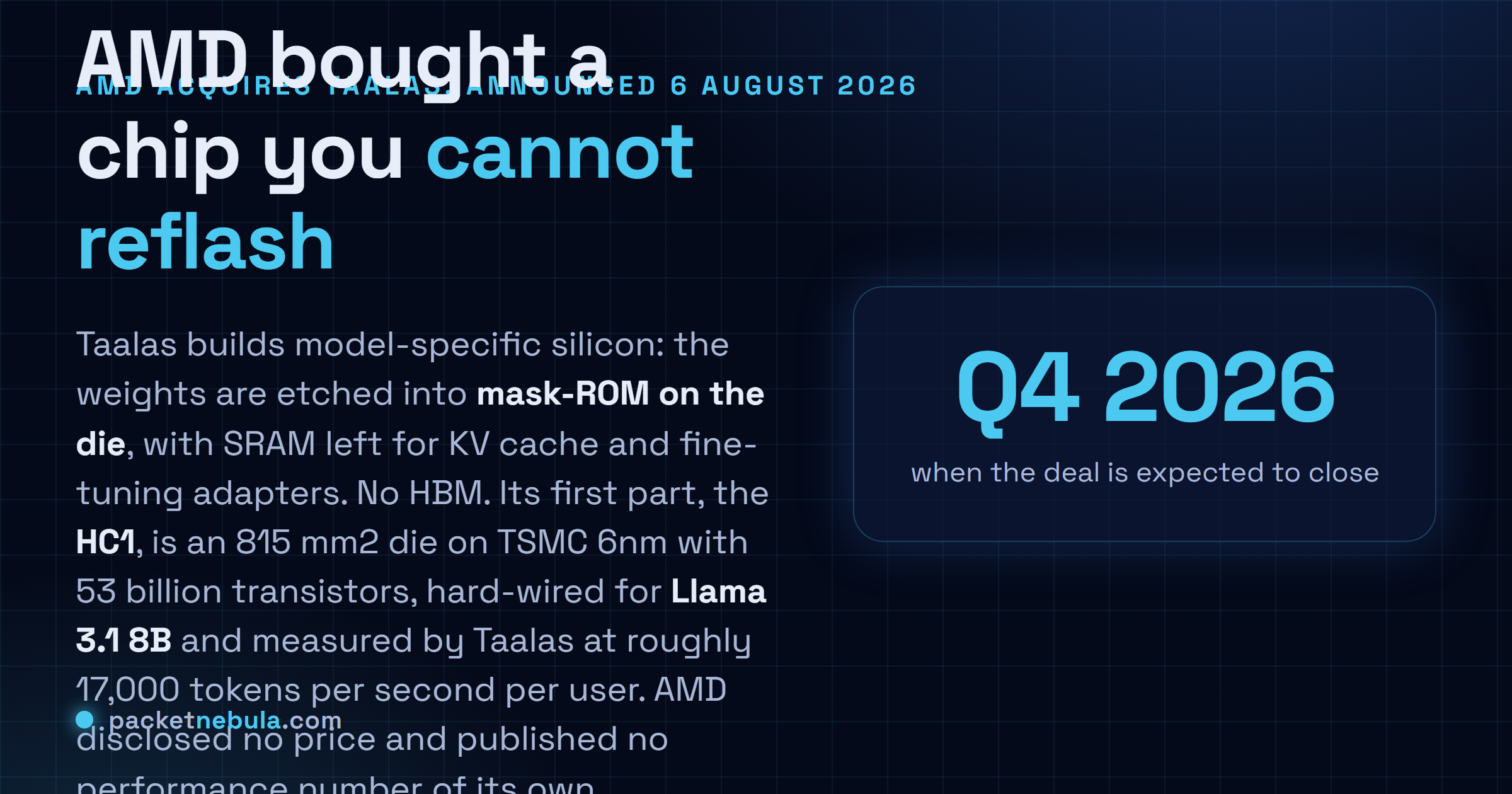
Picture a chip you can't reflash. That's the bet AMD just bought. On 6 August it signed a definitive agreement to acquire Taalas, a three-year-old Toronto outfit that etches model weights straight into the metal layers of a die instead of streaming them out of HBM. Terms weren't disclosed. Closing is expected in Q4 2026, pending regulators. Taalas' first part, the HC1, is an 815 square millimetre die on TSMC 6nm carrying 53 billion transistors, hard-wired for Meta's Llama 3.1 8B, and the company clocked it at roughly 17,000 tokens per second per user. Its own measurement, worth remembering. AMD says the technology joins its accelerator roadmap alongside Instinct, EPYC, Helios and ROCm, and published no performance figure of its own.

The short answer

AMD is buying Taalas, which builds chips with the model weights etched into mask-ROM instead of sitting in HBM. The HC1 is hard-wired for Llama 3.1 8B and Taalas measured it at about 17,000 tokens per second per user. Terms are undisclosed. AMD named no product, no price and no benchmark, and says the technology feeds the Instinct and ROCm roadmap. The catch is structural: a chip built around one model needs new silicon when that model moves.
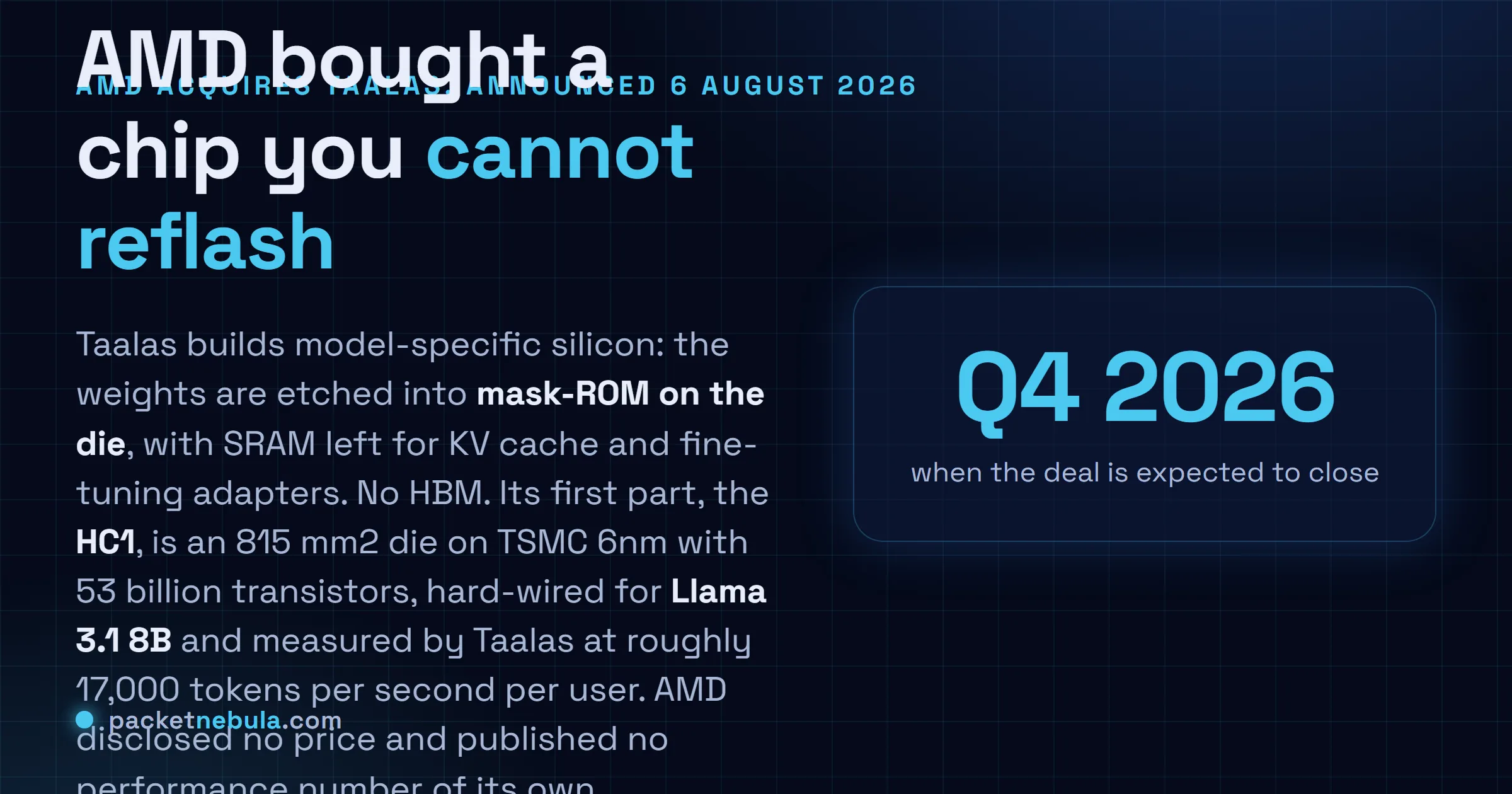
815 mm2HC1 die on TSMC 6nm
0AMD performance figures published
Q4 2026expected close
Answer card: on 6 August 2026 AMD signed a definitive agreement to acquire Taalas, a Toronto startup whose HC1 chip etches Llama 3.1 8B weights into TSMC 6nm mask layers instead of holding them in HBM, with terms undisclosed and closing expected in the fourth quarter of 2026.
The one-card version. A real chip, a real acquisition, and zero numbers from the buyer.

What AMD actually agreed to buy

Taalas is small and specific. Founded in 2023 in Toronto by Ljubisa Bajic, Drago Ignjatovic and Lejla Bajic, it raised $219 million in total, including a $169 million round in February 2026 backed by Quiet Capital, Fidelity and the veteran semiconductor investor Pierre Lamond. Bajic’s history matters here: he was an architect at both AMD and Nvidia before co-founding Tenstorrent, so AMD is partly buying back a person it once employed.

The press release is thin in the way these things usually are. Vamsi Boppana, an AMD senior vice president, said the team and technology strengthen the AI portfolio by delivering differentiated inference performance and efficiency. No number attached. No product name. The one concrete commitment is that the technology gets integrated into the accelerator roadmap and into system-level designs with Instinct GPUs, EPYC, Helios rack-scale and ROCm.

So the announcement itself tells you almost nothing. The interesting part is what Taalas already published.

The trick is in the mask layers

Every conventional accelerator spends an enormous share of its power budget moving weights. The compute die sits next to HBM stacks, and for each token generated the weights get pulled across that link. It’s why memory bandwidth, not FLOPS, is the number people quote when they size inference hardware.

Taalas deletes that link. The weights are patterned into mask-ROM on the die during fabrication, in what the company calls a recall fabric, and a separate SRAM fabric holds the parts that genuinely change while the model runs: the KV cache, plus fine-tuning adapters. Nothing streams. The company’s marketing calls the result a Hardcore Model and claims 1000x the efficiency of the software equivalent, which is the kind of round number that should make you check the footnotes.
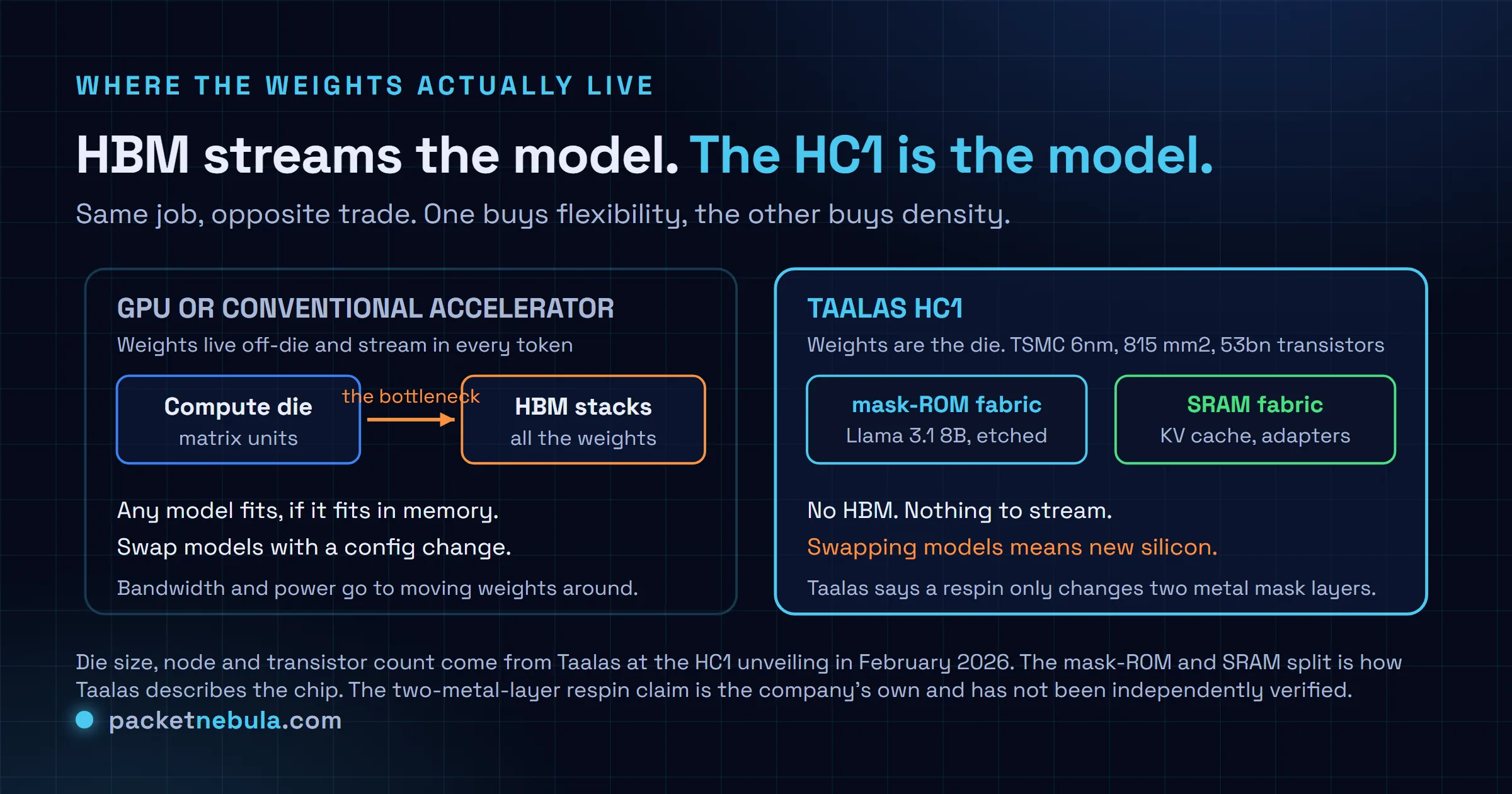
Diagram comparing where model weights live in a conventional GPU accelerator, where they sit in HBM stacks beside the compute die and stream in for every token, against the Taalas HC1 where the weights are etched into a mask-ROM recall fabric on the die itself and SRAM holds only the KV cache and fine-tuning adapters.
Two ways to answer the same question. Only one of them can change its mind afterwards.

The HC1 is the proof point. TSMC 6nm, 815 square millimetres, 53 billion transistors, all of it arranged around one 8-billion-parameter model. Taalas measured it at roughly 16,960 tokens per second per user on Llama 3.1 8B, and when it announced the part in February it framed that as 48 times faster than Nvidia GPUs and 8.5 times faster than Cerebras accelerators. Those are Taalas’ comparisons, run by Taalas, and no independent lab has published a competing set. I’d hold them loosely. The architecture is plausible enough that a large gap wouldn’t surprise me, but “large gap” and “48x” are not the same claim.

Where this breaks

Here’s the part everyone glosses over. A chip built around a specific model is obsolete the day that model is superseded, and models are currently superseded roughly every quarter.

Taalas’ answer is that a new variant only touches two metal mask layers, not the whole stack, so a respin is cheaper and quicker than a fresh design. Fair. That’s a real engineering argument and it’s the reason the company exists rather than being an obvious non-starter. But cheaper than a tape-out is still a manufacturing run, a lead time and a physical swap in a rack. You don’t push it with a deployment.
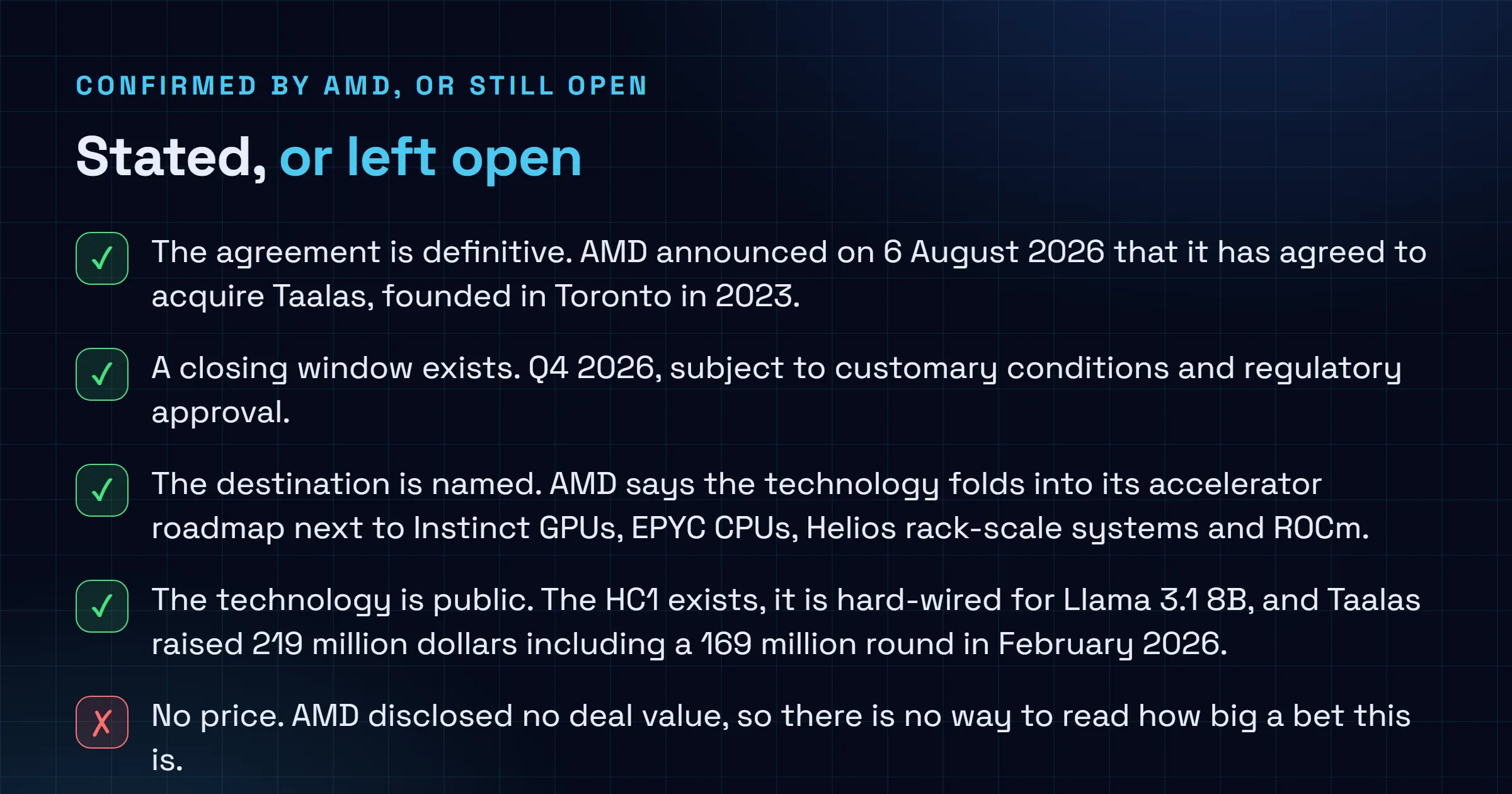
Checklist comparing what AMD confirmed about the Taalas acquisition on 6 August 2026, including the definitive agreement, the fourth quarter closing window and the plan to fold the technology into the Instinct and ROCm roadmap, against what remains undisclosed including the price, any product name, any AMD performance figure and whether the parts will ever be sold separately.
Four things AMD said. Four things it didn't.

The size ceiling is the other constraint. The HC1 carries 8 billion parameters on a die that’s already near the reticle limit. The second-generation HC2 targets 20 billion, with pipeline parallelism across several accelerators for anything bigger. Twenty billion is a useful size, it covers a lot of production classification and routing work, but it is not where the frontier lives. Which means this technology gets deployed by whoever runs one model, at enormous volume, for a long time. That’s a short list. Hyperscalers, a handful of model labs, maybe an inference provider with a stable flagship.

Does it change anything for you

Not this year. The deal hasn’t closed, AMD hasn’t named a part, and there’s no price.

What it does tell you is where AMD thinks the money is. Its current fight is at the top of the stack, where the MI455X and Helios line goes up against Vera Rubin on general-purpose training and inference. Buying Taalas is a bet on a different axis entirely: that a meaningful slice of inference will settle onto models stable enough to bake into a mask set. If that’s right, hard-wired parts undercut GPUs badly on cost per token for that slice. If it’s wrong, AMD spent an undisclosed sum on a very fast Llama 3.1 8B machine.

The pattern is familiar by now. OpenAI put its name on the Broadcom-built Jalapeno inference chip, and Anthropic confirmed a custom silicon team with no chip and no timeline. Everyone with a serious inference bill is trying to get off the merchant GPU curve. What separates the attempts is how far along they are, and Taalas is unusual in that the silicon already exists and already ran a real model.

Honestly, the thing I’d watch isn’t AMD’s roadmap slide. It’s whether any lab publicly commits to freezing a model long enough to justify a mask set. That commitment is the actual product here, and nobody has made it yet.

Sources

  • AMD investor relations, “AMD Acquires Taalas to Advance Compute Solutions for Rapidly Growing AI Inference Market”, 6 August 2026, for the definitive agreement, the undisclosed terms, the Boppana quote and the Instinct, EPYC, Helios and ROCm integration plan.
  • The Register, 6 August 2026, for the mask-ROM and SRAM recall fabric split, the 16,960 tokens per second measurement, the 48x and 8.5x comparisons, the two-metal-layer respin, the HC2 20 billion parameter target and the Q4 2026 closing window.
  • ServeTheHome, for the HC1 die size of 815 square millimetres, the 53 billion transistor count, the TSMC 6nm node and the note that the comparison figures are Taalas’ own.
  • Electronics Weekly, February 2026, for the $169 million round and the $219 million total, with Quiet Capital, Fidelity and Pierre Lamond named.
  • Taalas, for the Hardcore Models framing and the 1000x efficiency claim, checked 8 August 2026.

Frequently asked questions

What exactly did AMD announce on 6 August 2026?

A definitive agreement to acquire Taalas, a Toronto company founded in 2023 that designs model-specific inference silicon. Financial terms were not disclosed. AMD said the deal is subject to customary closing conditions and regulatory approval, with closing expected in the fourth quarter of 2026, and that it intends to fold the technology into its accelerator roadmap alongside Instinct GPUs, EPYC CPUs, Helios rack-scale systems and ROCm.

What does it mean to etch a model into silicon?

Taalas splits its die into two regions. A mask-ROM recall fabric holds the model weights, physically patterned into the chip during manufacturing, and an SRAM recall fabric holds the things that do change at runtime: the KV cache and fine-tuning adapters. There is no HBM. The weights are not loaded, because they are the chip. That removes the memory traffic a GPU spends most of its power on, and removes the ability to run a different model.

Is the 17,000 tokens per second figure verified?

No. It is Taalas' own measurement of the HC1 running Llama 3.1 8B, published when the chip was unveiled in February 2026, and the same goes for the comparisons it drew against Nvidia and Cerebras parts at the time. AMD published no throughput number in its acquisition announcement. Nobody outside the company has run the part on a public benchmark, so treat every figure here as vendor-reported.

What happens when the model gets updated?

You need new silicon. That is the whole trade. Taalas softens it by saying a new model variant only requires changing two metal mask layers rather than a full redesign, which is genuinely cheaper and faster than a fresh tape-out, but it is still a manufacturing run and a hardware swap rather than a config change. This is why the approach fits stable, high-volume serving and fits nothing else.

Should this change what I build on today?

No. There is no AMD product, no price and no date, and the deal has not closed. The second-generation HC2, targeting 20 billion parameters, is still a plan. If you serve inference at scale, the thing worth watching is whether AMD names a model it intends to hard-wire, because that would tell you it believes some weights have stopped moving.

Tags: aiamdchipshardwarellmnews
Share198Tweet124
stephane

stephane

  • Trending
  • Comments
  • Latest
Answer card: Proton Lumo 2.0 is private by policy, not by locality. Saved history is locked so even Proton cannot read it, but the prompt is decrypted on a Proton EU server to answer it, then forgotten.

Proton Lumo 2.0 review: how private is it, really?

3 September 2026
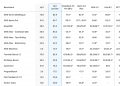
The Agentic Coding section of the official Hy4 preview benchmark appendix published by Tencent, a table comparing Hy3 and Hy4 preview against DeepSeek V4 Pro 0813, Qwen 3.8 Max, GLM 5.3, Kimi K3, GPT 5.6 Sol and Claude Opus 5 across SWE-bench Multilingual, SWE-bench Pro, DeepSWE, three SWE Atlas tasks, SWE-Marathon, Terminal-Bench 2.1, NL2Repo-Bench, CyberGym, ProgramBench, PostTrainBench and Harbor-Index.

Tencent’s 770B Hy4 tops one benchmark row in 46

3 September 2026
Answer card: Qwen 3.7 Max is API-only and cannot run locally yet; the open Qwen models (Qwen 3.6 27B, qwen3:8b to 32b) run offline via Ollama.

Qwen 3.7 local: what you can actually run offline

22 June 2026
Answer card: JWTs are not encrypted, anyone can read them; the signature proves who issued the token, not who may read it.

Are JWTs encrypted? No, and the difference will bite you

0
Answer card: a random 8 character password falls in under 2 hours offline, while 16 random characters hold for 1.4 trillion years at the same speed.

How long does it take to crack a password in 2026?

0
Answer card: three DNS records decide if your mail lands or bounces; SPF lists allowed senders, DKIM signs messages, DMARC sets the failure policy.

SPF, DKIM and DMARC explained: the records your email needs

0
Answer card stating that Ternary Bonsai 2 27B, released by PrismML on 17 September 2026 under Apache 2.0, packs Qwen3.8 27B into 5.95 gigabytes at 1.72 bits per weight, keeps 98.2 percent of the 14-benchmark average, about 75 percent on SWE-bench Verified and Terminal-Bench 2.1, and needs PrismML's llama.cpp fork to run.

Does Bonsai 2 27B really keep 98% of Qwen3.8 in 5.95 GB?

20 September 2026
Answer card stating that Jev 1.13 from TypeSafe AI is a decision model in early access since 15 September 2026 that returns typed probabilities instead of text, priced at 42 dollars per billion input tokens with output tokens free, answering in 70 to 500 milliseconds, with a 64K token request budget, text input only, and a documented list of things it does badly, including counting and dates.

Jev 1.13 bills $42 a billion tokens, and it can’t count

19 September 2026
Answer card stating that Qwen3.8-Omni-Flash launched on 17 September 2026 as an API only model on Alibaba Cloud Model Studio, taking text, images, audio and video in a 1M token context and returning text only, priced at 0.15 dollars per million input tokens for every modality and 0.47 dollars per million output tokens in the international regions, with no open weights published and the Qwen-Live Harness GitHub repository returning 404.

Qwen3.8-Omni-Flash bills audio at $0.15 and ships no weights

18 September 2026
  • About
  • Contact
  • Privacy
  • Legal

Copyright © 2026 Stephane Cardon.

Welcome Back!

Login to your account below

Forgotten Password?

Retrieve your password

Please enter your username or email address to reset your password.

Log In
No Result
View All Result
  • Home
  • Articles
    • Security
    • Network
    • Dev
    • Sysadmin
    • SEO
    • Email & DNS
  • Tools
    • Network tools: free, fast, no signup
    • Security tools: free, fast, no signup
    • Developer tools: free, fast, no signup
    • Sysadmin tools: free, fast, no signup
    • SEO tools: free, fast, no signup
    • Email & DNS tools: free, fast, no signup
  • Download
  • About

Copyright © 2026 Stephane Cardon.