




IonQ published the announcement on 6 August, then published it again a few hours later marked UPDATED. The second version is the one worth reading. The headline held at 125 Evergreen-05 optical atomic clocks for US government customers, but the money underneath it came apart into two pieces: a $28 million contract extension that is signed, and a further $30 million option that is not exercised. Do the subtraction the release invites and the funded delivery is 25 clocks. The other hundred are a maybe. That isn't a scandal, options are how defence procurement has always worked, and 25 production optical clocks is still a genuine milestone. It just isn't the number the headlines ran with.
The short answer
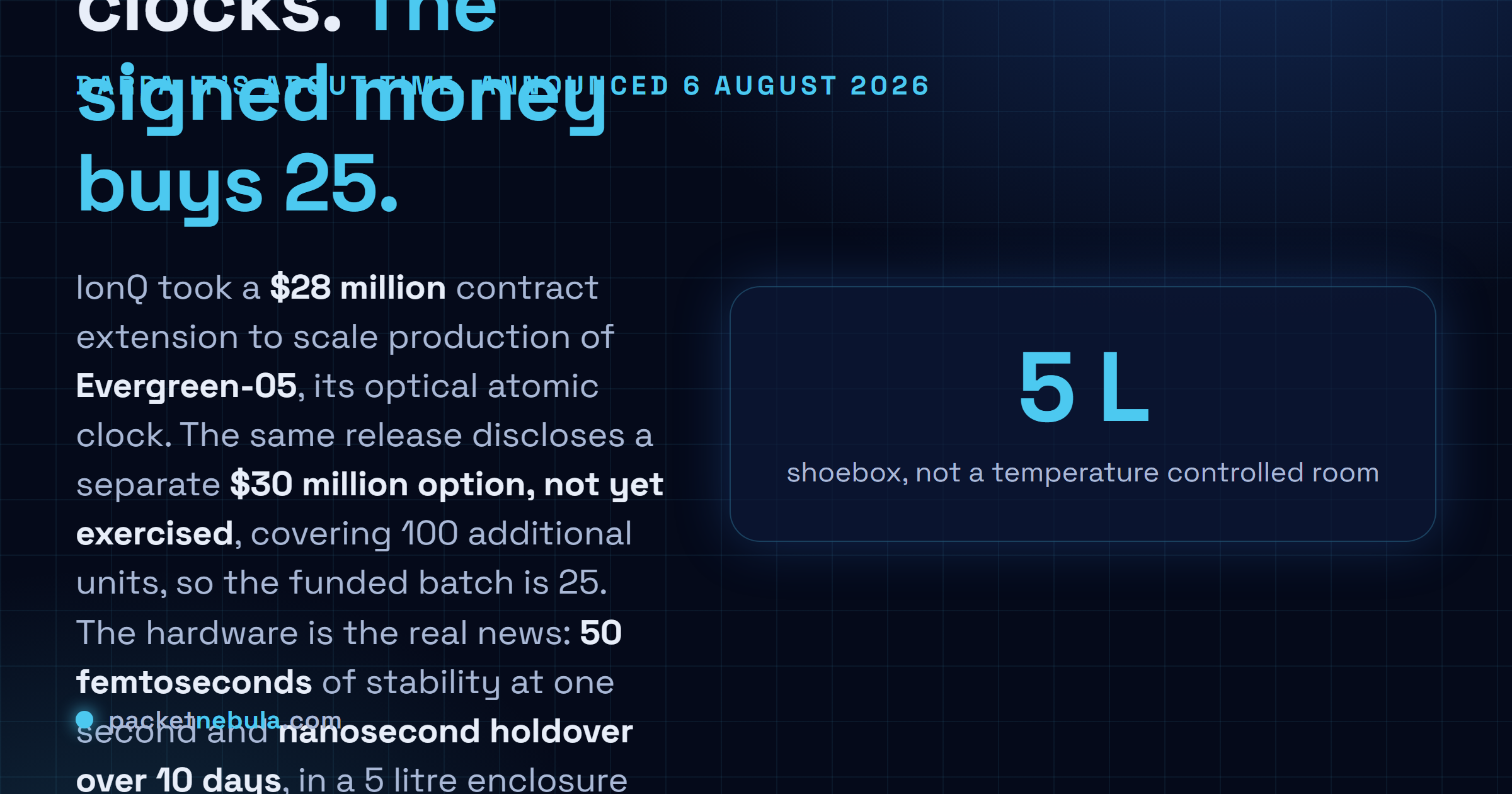
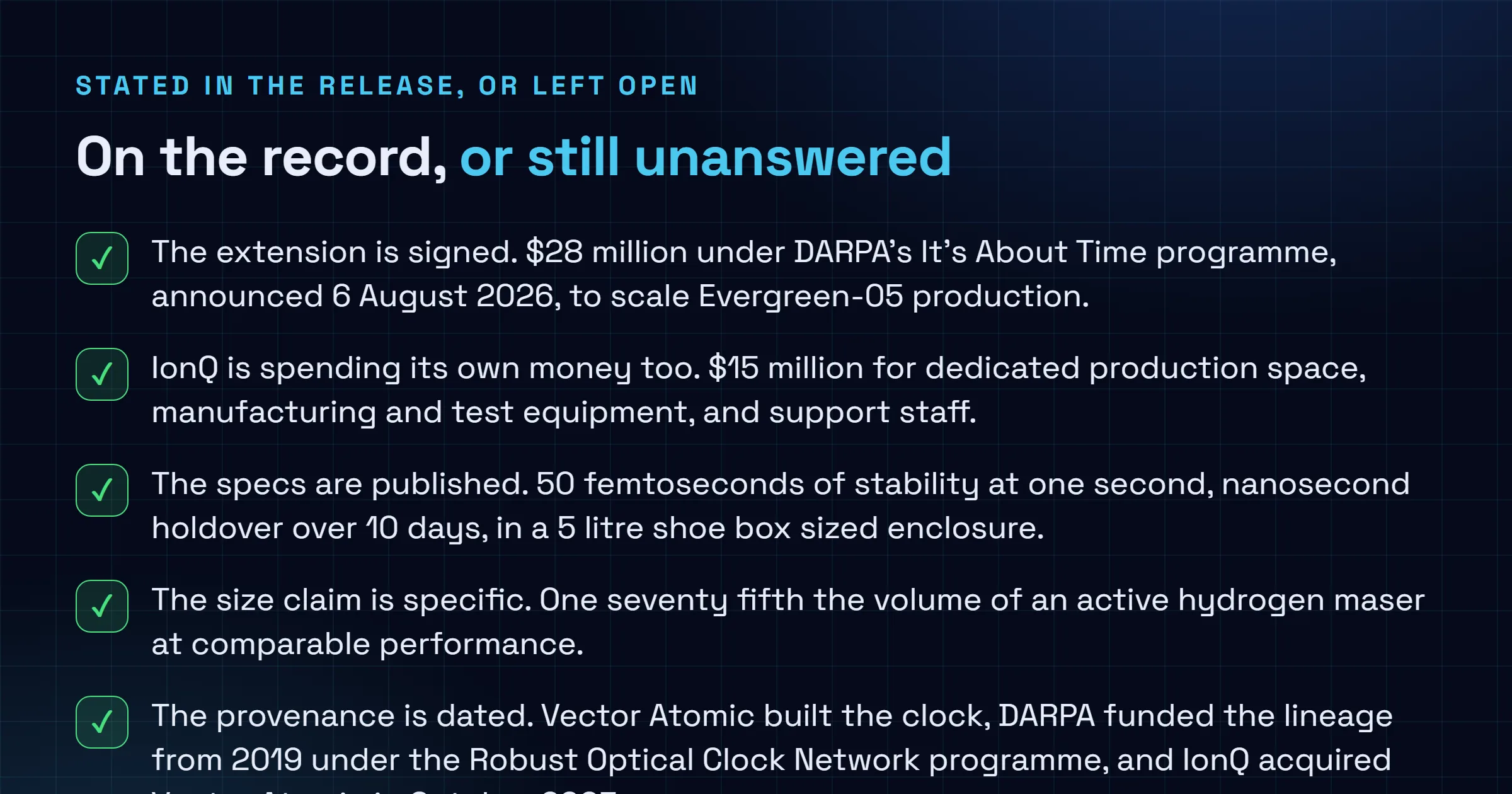
DARPA extended its contract with IonQ by $28 million on 6 August to scale production of the Evergreen-05 optical atomic clock. The release quotes 125 units, but it also discloses a separate $30 million option, not yet exercised, covering 100 of them. So 25 are funded today. The hardware itself is the real story: a 5 litre box holding 50 femtoseconds of stability at one second and nanosecond holdover across 10 days, at one seventy fifth the volume of an active hydrogen maser. It came from Vector Atomic, which IonQ bought in October 2025.
The 125 is a ceiling, not an order
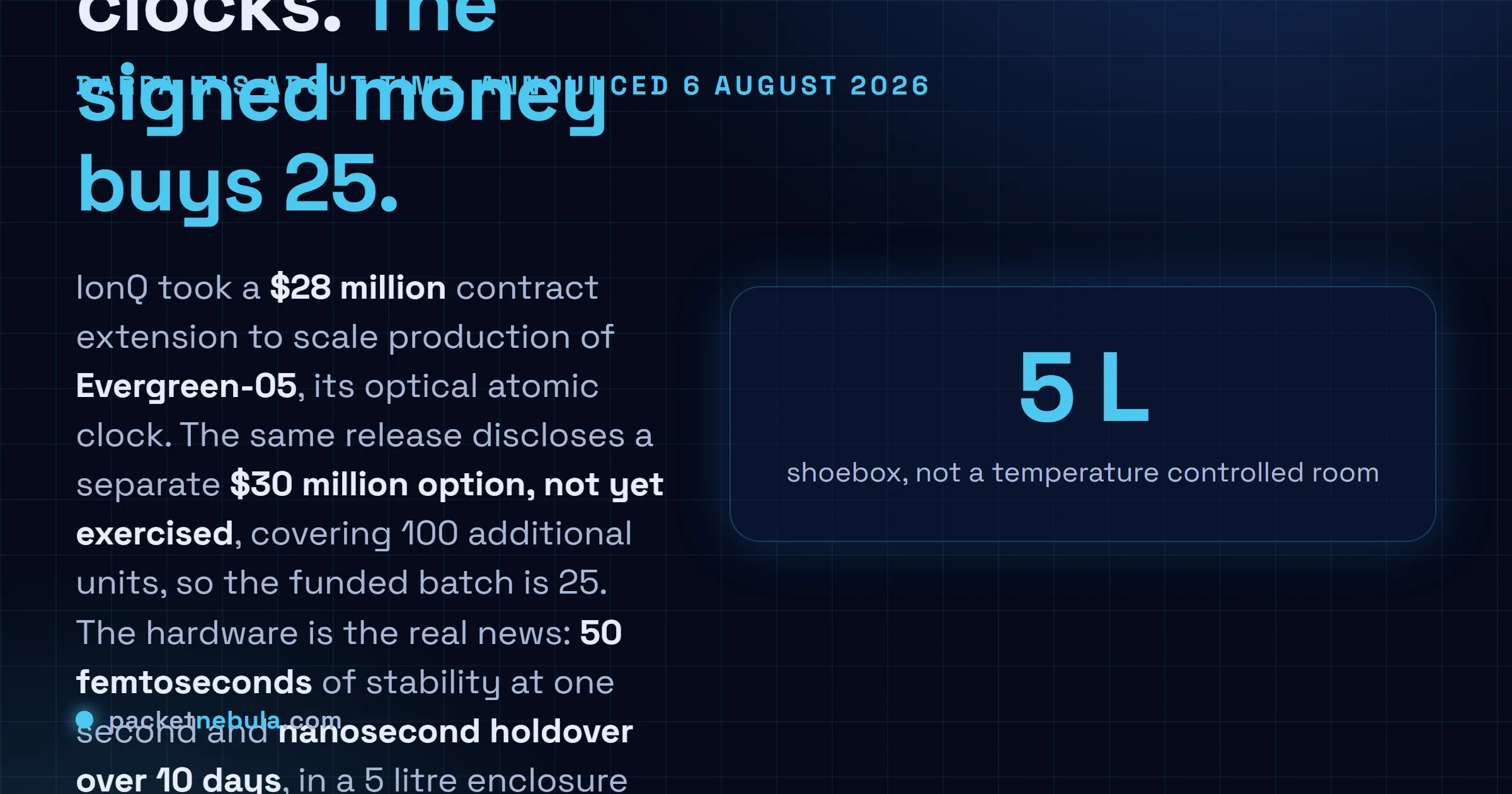
Here is the sentence that reframes the whole announcement, straight from IonQ’s updated release: a further $30 million option, not yet exercised, would cover an additional 100 clocks.
Additional to what? To the batch the signed $28 million pays for. Which leaves 25.
We’re not calling that misleading. Every outlet that ran “IonQ will deliver 125 atomic clocks” was quoting the company’s own headline, and the company then went back and clarified its own release the same day, which is the opposite of hiding something. But the shape matters if you’re reading this as a signal about the market. Twenty five production optical clocks is a pilot buy. A hundred more is DARPA reserving the right to like the pilot. Those are different levels of confidence, and only one of them has money behind it right now.
The $15 million IonQ is putting in itself points the same direction. Production space, manufacturing and test equipment, support staff. You spend that when you’re building a line you expect to run past the first order, not when you already have 125 units booked.
What the box actually does
Strip the contract off and the engineering holds up on its own.
Fifty femtoseconds of stability at one second. Nanosecond holdover over 10 days. That second figure is the one to sit with, because holdover is the whole game in timing. Any clock is accurate while something better is steering it. The question operators care about is what happens when the reference goes away, and Evergreen-05’s answer is that it drifts less than a nanosecond over a week and a half, alone, in a five litre enclosure.
For scale, IonQ says that’s one seventy fifth of the volume of an active hydrogen maser at comparable performance. Masers are the things that live in temperature controlled rooms and get their own maintenance contracts. This is luggage.
The 30 million year line in the press release, less than one second of error, is the same holdover number extrapolated far past anything anyone will ever measure. It’s a nice unit conversion. I’d ignore it. The ten day figure is a spec you could test.
Why a quantum computing company is shipping clocks
Because it bought one that already was.
Vector Atomic built Evergreen-05, and DARPA has been funding that lineage since 2019, when Vector was a one year old startup in Pleasanton. The original vehicle was the Robust Optical Clock Network programme. IonQ acquired the company in October 2025 to push into quantum position, navigation and timing, and this contract is that acquisition paying out.
Worth being precise about, because the ticker moves on the word quantum and the two businesses aren’t the same bet. IonQ’s trapped-ion computers are a long horizon wager on error corrected qubits. Optical clocks are quantum sensing, an area that has been shipping working hardware for decades. Marty Boyd, who co-founded Vector Atomic and now runs IonQ’s timekeeping division, put the history plainly: DARPA’s initial support “was critical to prove the core concepts of our clock.”
Same week, IonQ’s other acquisition, Capella, picked up a National Reconnaissance Office award for commercial radar imagery. Two defence contracts, two acquired subsidiaries, zero qubits. Read the company accordingly.
Does any of this reach your rack
Honestly, no, and I want to be straight about that rather than manufacture relevance.
Twenty five units going to US government customers is not a product you can order, and the applications named are radar, secure communications and precision geolocation. Not enterprise time sync. If you run a network, your holdover problem is almost certainly solved by a GNSS disciplined grandmaster with a rubidium or good OCXO holdover oscillator, and it’s solved cheaply.
Where it gets interesting is the direction. GNSS jamming and spoofing stopped being an exotic threat somewhere over the last few years, and the answer has been either accept degraded holdover or buy a maser you can’t afford. A shoebox that holds a nanosecond for ten days sits exactly in that gap. It isn’t for sale to you today, but production contracts are how a lab instrument becomes a catalogue item, and Vector Atomic already sells a rackmount iodine clock, the Evergreen-30, for anyone who wants to price what that market looks like now.
For the wider quantum picture, the same reading discipline applies to the computing side: DARPA’s $125M PsiQuantum agreement funds verification rather than a working machine, and the IBM and HRL silicon spin qubit work is a materials result, not a product. Clocks are the part of this field that already ships.
Sources
- IonQ newsroom, “UPDATED: DARPA Selects IonQ to Produce Next-Generation Atomic Clocks”, 6 August 2026, for the contract value, the $30 million option covering 100 additional clocks, the $15 million investment and the executive quotes.
- Quantum Computing Report, for the Vector Atomic and Capella acquisition timeline and the NRO radar award.
- Interesting Engineering, for the form factor and stability specifications.
- Investing News Network, carrying the full press release text including the Robust Optical Clock Network history.
Frequently asked questions
What exactly did IonQ win from DARPA?
A $28 million contract extension under DARPA's It's About Time program, announced 6 August 2026, to scale production of its Evergreen-05 optical atomic clock. IonQ's updated release adds a further $30 million option that has not been exercised, and states that the option would cover an additional 100 clocks. The full 125 units quoted in the headline therefore depend on that option being taken up. IonQ says it will invest $15 million of its own money in production space, manufacturing and test equipment, and support staff.
How accurate is the Evergreen-05?
IonQ publishes two figures. Timing stability of 50 femtoseconds at one second, and nanosecond holdover over 10 days, meaning the clock stays within about a nanosecond of true time for ten days with no external reference to steer it. The company projects that out to less than one second of error over 30 million years. Treat the 30 million year line as marketing arithmetic rather than a measured result. The holdover number is the one an operator would actually care about.
Why is a quantum computing company selling atomic clocks?
Because it bought one. IonQ acquired Vector Atomic in October 2025 to move into quantum position, navigation and timing, and Evergreen-05 is Vector Atomic's design. DARPA had been funding that core technology since 2019, originally through the Robust Optical Clock Network programme, long before IonQ was involved. So this contract validates a sensing business IonQ acquired, not its trapped-ion quantum computers. The two share a physics department and very little else.
Can I buy one of these for my own timing stack?
Not this unit. The Evergreen-05 run is a government delivery, and 25 funded units is not a commercial product line. Vector Atomic does sell a rackmount sibling, the iodine-based Evergreen-30, if you want to look at what a commercial optical clock costs. For almost every network, the honest answer is that a GNSS-disciplined grandmaster plus a decent oven-controlled or rubidium oscillator already covers your holdover requirement, and the gap this closes only opens up when GNSS is denied for days.
Does this have anything to do with breaking encryption?
No. Optical clocks measure time, they do not factor integers. Nothing in this announcement moves the date on which a quantum computer threatens RSA or ECC. If that is your worry, the migration to post-quantum cryptography is the thing with an actual calendar attached, and it proceeds on its own schedule regardless of how many clocks DARPA orders.