
• Latest
  • Trending
  • All
Official OpenAI launch artwork for the ChatGPT update: a large white pill-shaped slider on a starfield, its blue fill stopping at the third of five stops, labelled 5.6 High.

GPT-5.6 Sol in ChatGPT is not the Sol in your API calls

7 August 2026
Answer card stating that Ternary Bonsai 2 27B, released by PrismML on 17 September 2026 under Apache 2.0, packs Qwen3.8 27B into 5.95 gigabytes at 1.72 bits per weight, keeps 98.2 percent of the 14-benchmark average, about 75 percent on SWE-bench Verified and Terminal-Bench 2.1, and needs PrismML's llama.cpp fork to run.

Does Bonsai 2 27B really keep 98% of Qwen3.8 in 5.95 GB?

20 September 2026
Answer card stating that Jev 1.13 from TypeSafe AI is a decision model in early access since 15 September 2026 that returns typed probabilities instead of text, priced at 42 dollars per billion input tokens with output tokens free, answering in 70 to 500 milliseconds, with a 64K token request budget, text input only, and a documented list of things it does badly, including counting and dates.

Jev 1.13 bills $42 a billion tokens, and it can’t count

19 September 2026
Answer card stating that Qwen3.8-Omni-Flash launched on 17 September 2026 as an API only model on Alibaba Cloud Model Studio, taking text, images, audio and video in a 1M token context and returning text only, priced at 0.15 dollars per million input tokens for every modality and 0.47 dollars per million output tokens in the international regions, with no open weights published and the Qwen-Live Harness GitHub repository returning 404.

Qwen3.8-Omni-Flash bills audio at $0.15 and ships no weights

18 September 2026
Answer card stating that on 15 September 2026 AWS said it is unable to restore access to resources and data hosted exclusively in the Middle East Bahrain region me-south-1 and in the mec1-az2 zone of the UAE region, because the damage spanned multiple Availability Zones and exceeded what multi-AZ services are designed to withstand.

AWS can’t restore me-south-1, six months after the drone strikes

17 September 2026
Answer card stating that Google released Gemini 3.8 Live and Gemini 3.8 Live Extended Thinking on 15 September 2026 at 3 dollars per million audio input tokens and 12 dollars out, that the thinking model requires asynchronous tools, and that Artificial Analysis scores it 82.6 on its Speech to Speech Quality Index.

Gemini 3.8 Live Extended Thinking rejects any tool that blocks

16 September 2026
Answer card summarising the Atria Dawn Preview release: 744B GLM-5.2 base, MIT licence, 1.5 TB BF16 and 756 GB FP8 checkpoints, 256K context, top on five of sixteen benchmark rows and trailing on SWE-bench Pro.

Atria Dawn Preview is 744B under MIT, and the BF16 weighs 1.5 TB

15 September 2026
Answer card stating that OpenAI released the Agents API in public beta on 10 September 2026 with no separate fee, billed through model tokens, tool calls and hosted sandbox time, with a choice of OpenAI hosted, self hosted or partner sandboxes, US only data residency and no Zero Data Retention support.

OpenAI’s Agents API has no fee, no ZDR and a one hour sandbox clock

14 September 2026
Answer card: Sakana Fugu Max at $2 and $6 per million tokens, Fugu Ultra v2 unchanged at $5 and $30, and Sakana saying Ultra v2 scores without Fable 5 or GPT-6 Astra in its pool.

Fugu Max costs $2 and $6 while Fugu Ultra v2 runs without Fable 5

13 September 2026
Answer card stating that DeepSeek released DeepSeek-V4.1-Flash on 10 September 2026 as a 552 billion parameter mixture of experts model with a new causal encoder decoder architecture that activates 8 billion parameters on input and 16 billion on output, with native vision, a one million token context and MIT licensed weights, that the API model name is now deepseek-flash at 0.15 dollars per million input tokens and 0.60 dollars per million output tokens off peak, and that DeepSeek announced V4 Pro would be routed to V4.1-Flash from 14 September and reversed that on 11 September.

DeepSeek V4.1-Flash arrived, and the V4 Pro retirement lasted a day

12 September 2026
Answer card stating that Cognition released SWE-2 on 10 September 2026, a coding model post-trained from Kimi K3, scoring 50.0 percent on FrontierCode 1.1 Main against 50.9 percent for Claude Fable 5.1 and 27.3 percent on Terminal-Bench 4 against 55.8 percent, available only inside Devin.

SWE-2 trails Fable 5.1 by one point, and by 28 on Terminal-Bench 4

11 September 2026
Answer card for Meta Muse, free to 100 million tokens a week then $20 a month, launched 8 September 2026 for United States adults only, running in a dedicated per user virtual machine.

Does Meta Muse do enough to earn your inbox and a card on file?

9 September 2026
Answer card stating that the public download pages for the VMware Virtual Disk Development Kit on developer.broadcom.com began returning 404 errors on 25 August 2026 with no announcement or deprecation notice, that Broadcom support tells customers the kit is no longer available for use or download, and that release lines 7.0.3.1, 8.x and 9.x are all affected.

Broadcom pulled VDDK 8.0 and 9.0, and the 404 is the only notice

8 September 2026
  • About
  • Contact
  • Privacy
  • Legal
Monday, September 21, 2026
  • Login
Packet Nebula
  • Home
  • Articles
    • Security
    • Network
    • Dev
    • Sysadmin
    • SEO
    • Email & DNS
  • Tools
    • Network tools: free, fast, no signup
    • Security tools: free, fast, no signup
    • Developer tools: free, fast, no signup
    • Sysadmin tools: free, fast, no signup
    • SEO tools: free, fast, no signup
    • Email & DNS tools: free, fast, no signup
  • Download
  • About
No Result
View All Result
Packet Nebula
No Result
View All Result
Home Dev

GPT-5.6 Sol in ChatGPT is not the Sol in your API calls

by stephane
7 August 2026
in Dev
0
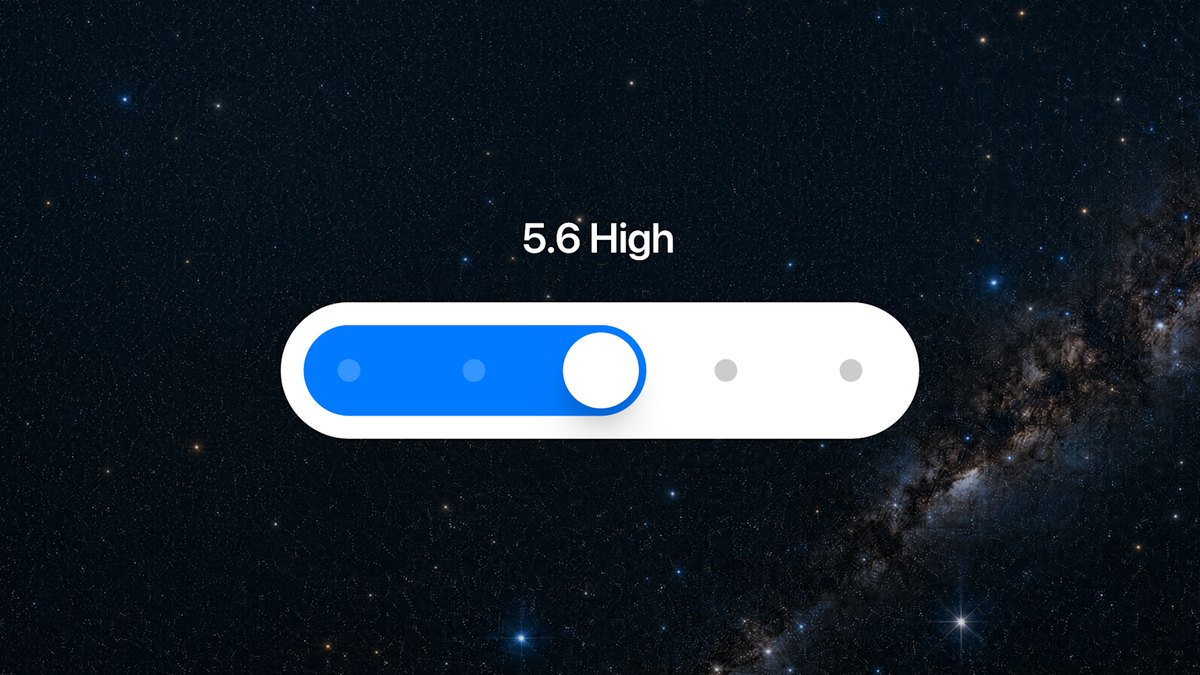
Official OpenAI launch artwork for the ChatGPT update: a large white pill-shaped slider on a starfield, its blue fill stopping at the third of five stops, labelled 5.6 High.
495
SHARES
1.4k
VIEWS
Share on FacebookShare on Twitter

You tune a prompt in ChatGPT until it behaves, paste it into your API call, and the answer comes back longer and mushier. Since 6 August that isn't you imagining things. OpenAI shipped a version of GPT-5.6 Sol tuned specifically for everyday ChatGPT conversation, and it lives only there. The wording in the announcement is unusually blunt: this version will only be available in the Chat experience in ChatGPT, and the Sol powering Work and Codex is not changing. So the model you test in the chat window and the model you bill for now differ on formatting and verbosity, which is most of what prompt work actually is. Free users got the louder half of the news. Unlimited text chats, on a smaller model.

The short answer

On 6 August OpenAI retuned GPT-5.6 Sol for everyday ChatGPT conversation and scoped it to the Chat experience only. Work, Codex and developer traffic keep the model they had. Plus and Pro also get a slider that sets reasoning effort per answer, which quietly retires the Instant and Thinking split. Free and Go drop to GPT-5.6 Luna and gain unlimited text chats. The accuracy claims are real numbers from an eval nobody outside OpenAI has seen.
2differently tuned GPT-5.6 Sols now
68%fewer factual errors, OpenAI internal eval
Lunanew default for Free and Go
Official OpenAI launch artwork for the ChatGPT update: a large white pill-shaped slider on a starfield, its blue fill stopping at the third of five stops, labelled 5.6 High. Image: OpenAI, launch artwork from the 6 August 2026 ChatGPT announcement.

Worth staring at for a second. The artwork is the slider, and it shows five stops with the handle on the third, labelled 5.6 High. The post itself never names a single level.
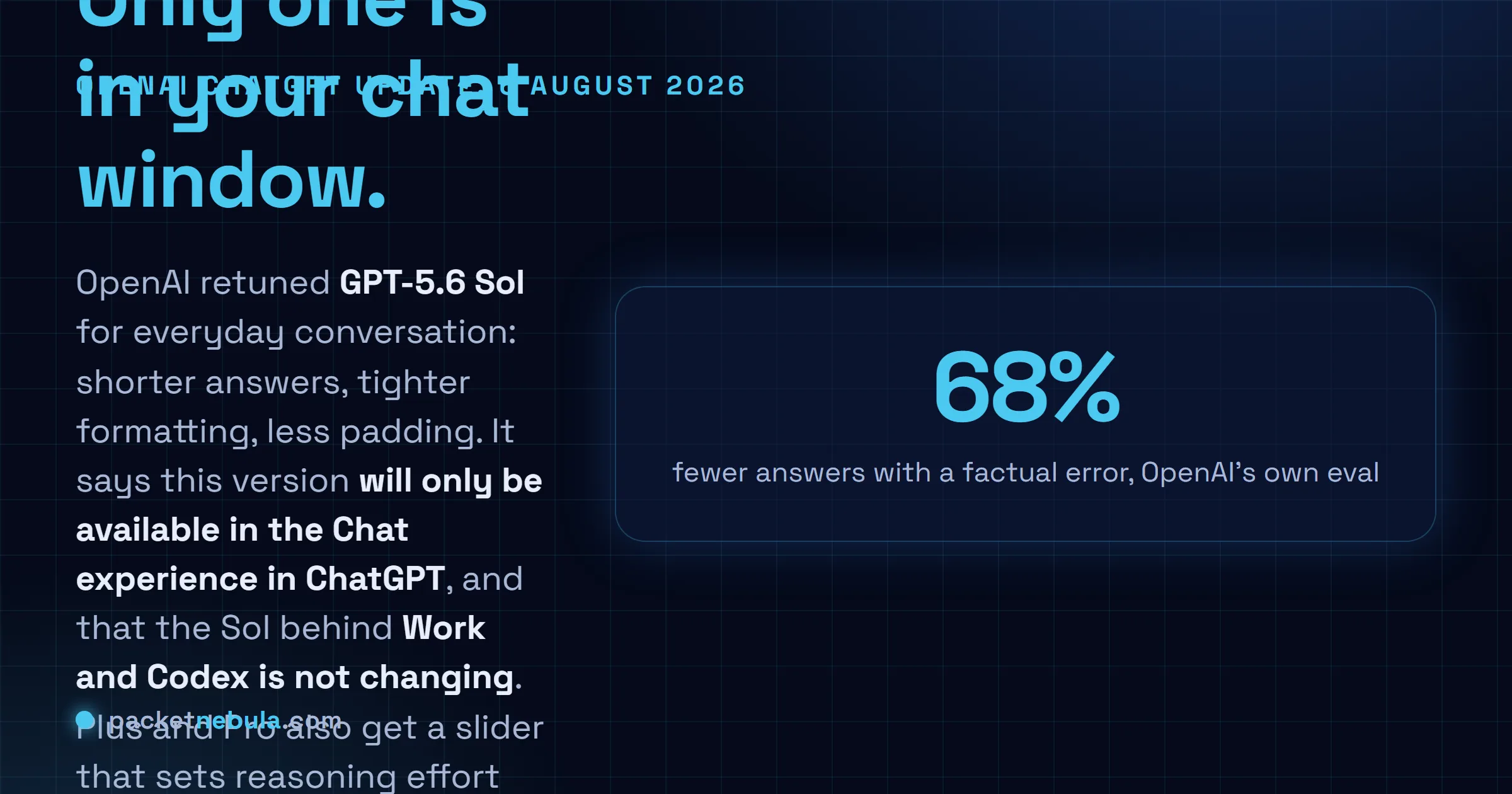
Answer card: on 6 August 2026 OpenAI shipped a version of GPT-5.6 Sol tuned for everyday ChatGPT conversations, available only in the Chat experience, while the Sol powering ChatGPT Work and Codex is unchanged, alongside a reasoning slider for Plus and Pro and a move to GPT-5.6 Luna with unlimited text chats for Free and Go.
Same name, same version number, different tuning depending on where you type.

The fork nobody put in the headline

Every outlet led with unlimited free chats. Fair enough, that’s the consumer story. The line we’d underline sits near the bottom of OpenAI’s post: because this version of GPT-5.6 Sol is optimised for everyday chats, it will only be available in the Chat experience in ChatGPT, and the version powering Work and Codex is not changing.

Read that as an engineer and it’s a fork. Two models, one name, one version string, and no way to tell from a transcript which one answered you. The retune is squarely aimed at output shape: more direct responses, tighter formatting, less detail when detail doesn’t help, and a willingness to correct you instead of agreeing. Those are exactly the behaviours people spend hours prompting around. If your workflow is prototype-in-chat then ship-to-API, your bench and your production just drifted apart, and the drift is invisible because nothing in the model name moved.

Honestly, I don’t think this is sneaky. Tuning a consumer chat surface differently from a developer endpoint is a defensible product call, and OpenAI documented it rather than burying it. But naming both things GPT-5.6 Sol is going to cost somebody an afternoon. We already covered what separated Sol, Terra and Luna at launch, and this is the first time one of those names has stopped meaning one thing.

The practical move is small. Test where you ship. If the answer matters, run the prompt against the endpoint you’ll actually call, not the chat window that happens to be open.

The slider is the real interface change

Plus and Pro no longer pick between Instant and Thinking. One model serves both, and a slider sets how much thought goes into a given answer, on web, mobile and desktop. OpenAI’s framing: moving up should feel like the model taking extra time, not like switching to a different model with its own tone and style.

That framing is the giveaway. Model-switching in ChatGPT has always leaked tone. You’d ask a quick question, get a chatty answer, ask a hard one, and suddenly the voice went formal and bullet-heavy. Collapsing that into an effort dial is the right fix, and it’s one that ChatGPT Work already had before this shipped.

What OpenAI doesn’t publish is how many positions the slider has or what they’re called. The artwork shows five stops and a label reading 5.6 High, which is a design asset rather than documentation, so we’re not going to treat five as a spec. Nothing in the post confirms it.
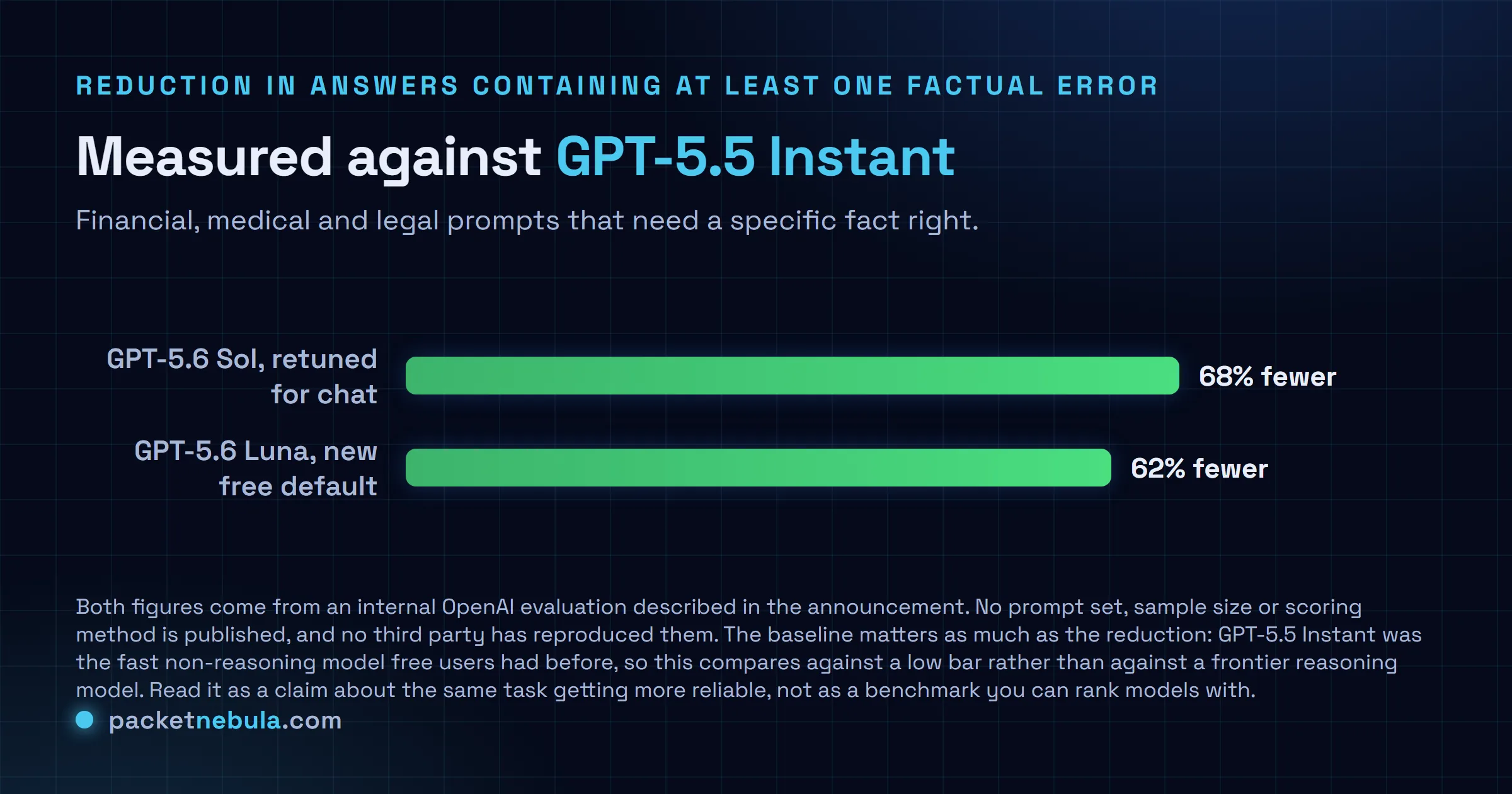
Bar comparison of the reduction in responses containing at least one factual error against GPT-5.5 Instant, from an internal OpenAI evaluation of financial, medical and legal prompts: GPT-5.6 Sol 68 percent fewer, GPT-5.6 Luna 62 percent fewer.
OpenAI's own eval, against a fast non-reasoning baseline. Nobody outside has reproduced it.

Unlimited, with a smaller ceiling

Free and Go users get the headline. GPT-5.6 Luna becomes their default that week, and the week after they get unlimited text chats plus a Think button that gives Luna more time on hard questions. Limits stay on file uploads, images and other tools, and the whole thing is subject to abuse guardrails, so unlimited means unlimited typing.

Two things are true at once here, and the coverage mostly picked one. Luna is genuinely better than what free users had: it replaces GPT-5.5 Instant, and OpenAI’s eval puts factual errors 62% lower. That’s an upgrade in quality and a removal of the message cap, on the same day. Good day to be a free user.

The other truth is that Luna is the smallest model in the GPT-5.6 family, and the free tier’s ceiling now sits there unless you press Think. Some readers will file this as free users losing access to frontier reasoning, and that reading holds. I’d put it less dramatically: OpenAI traded depth for volume at the bottom of the stack, which is the obvious move when you’re serving a billion weekly users and inference is the cost line. If you were leaning on the free tier for anything with real stakes, it’s worth checking what you’re actually getting now.

The accuracy numbers deserve one more caveat. 62% and 68% are reductions against GPT-5.5 Instant, a fast non-reasoning model. That’s a low bar by design, since it’s the thing free users were on. It is not a claim that Sol beats a frontier reasoning model on facts, and the announcement doesn’t make that claim either.
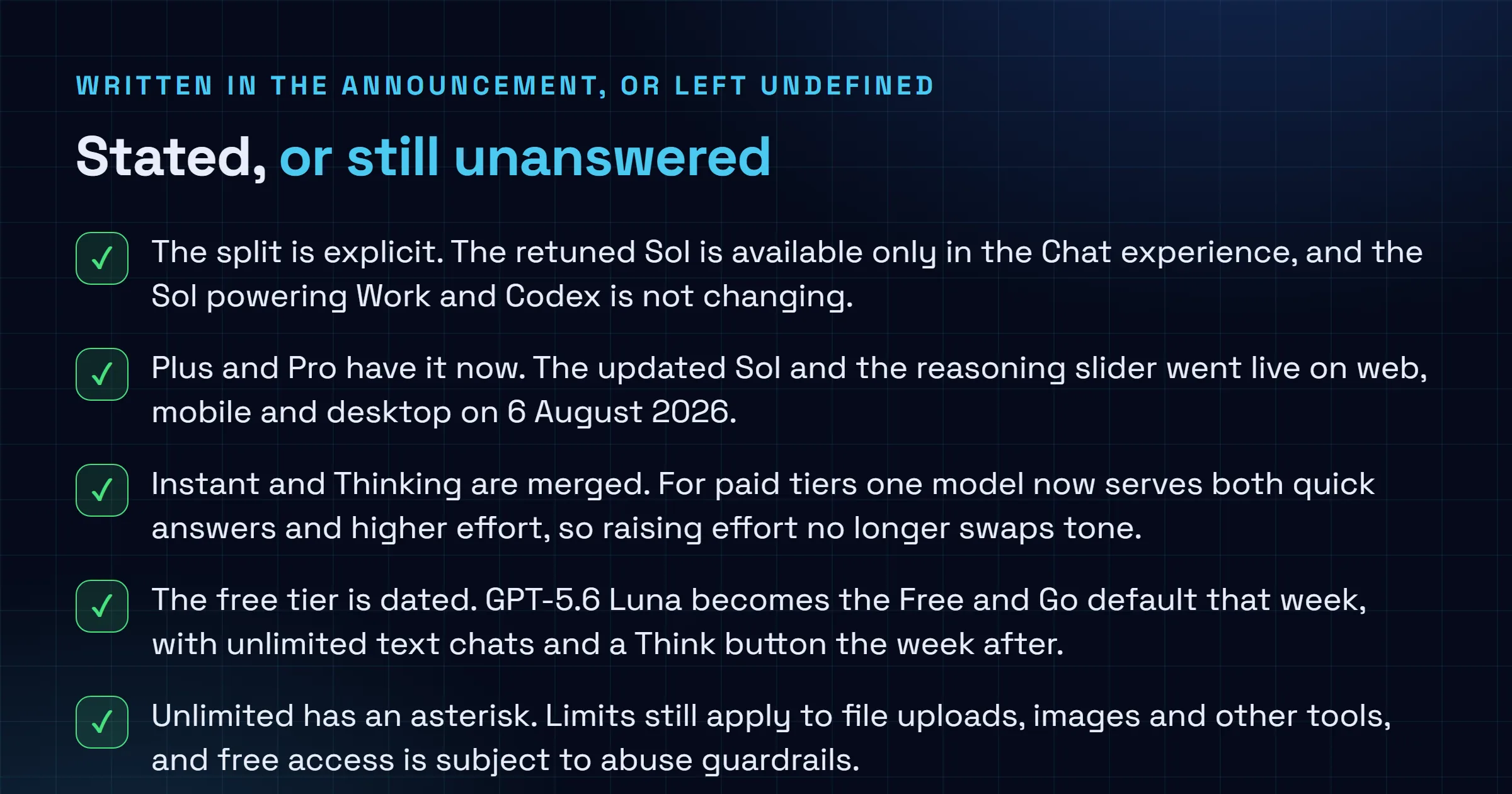
Checklist splitting what the OpenAI announcement states in writing, including the chat-only scope, the same-day Plus and Pro rollout, the merged Instant and Thinking modes and the dated free tier changes, from what it leaves undefined, including the slider levels, the API behaviour, the evaluation method and the absence of a distinct version string.
Dated and written down, against the parts you'd have to ask about.

What to do with this

If you build on OpenAI, the only action item is the boring one: stop treating the chat window as a staging environment. It was already a rough proxy. Now it’s a different tuning of the same model, and the difference is concentrated in exactly the behaviours you’d notice last, formatting and length.

If you use ChatGPT as a tool rather than a dependency, the slider is a genuine improvement and the merged Instant and Thinking behaviour is overdue. Move it up for anything you’d have hit Thinking for. Leave it low for the rest.

And if you’ve been recommending the free tier to people, recheck that recommendation. The message cap is gone, which is a big deal for casual use. The model behind it is smaller than it was two days ago in family terms, even though it’s more accurate than what it replaced. Both halves matter, and they don’t cancel out neatly. For a wider view of where the family sits on cost, we compared GPT-5.6 against GPT-5.5 when it launched.

Sources

Primary source: OpenAI, Improving GPT-5.6 Sol in ChatGPT and expanding access to GPT-5.6 Luna for free users, 6 August 2026, which carries the chat-only scoping, the accuracy figures and the rollout dates quoted above. Independent coverage confirming the same details: TechCrunch on the free tier limits and what stays capped, 9to5Mac on the Work and Codex carve-out, and The Decoder for the GPT-5.5 Instant baseline and a more critical read of the free tier change.

Frequently asked questions

What changed in GPT-5.6 Sol on 6 August 2026?

OpenAI retuned GPT-5.6 Sol for everyday ChatGPT conversations. It gives more direct answers, uses tighter formatting, adapts detail to the question, and pushes back rather than agreeing when agreeing would not help. Plus and Pro users also got a slider that sets how much thought goes into each answer, on web, mobile and desktop. The retuned model went live for those tiers the same day.

Is the ChatGPT version of GPT-5.6 Sol the same model as the API one?

No, and OpenAI says so directly. The announcement states this version is optimised for everyday chats and will only be available in the Chat experience in ChatGPT, and that the GPT-5.6 Sol powering ChatGPT Work and Codex is not changing as part of the release. The post does not describe any change for developers calling the model through the API. If you prototype prompts in the chat window and ship them elsewhere, you are no longer testing on the model you deploy.

What do free ChatGPT users get now?

GPT-5.6 Luna becomes the default model for Free and Go users, replacing GPT-5.5 Instant. Starting the following week those tiers also get unlimited text chats plus a Think button that gives Luna more time on harder questions, subject to abuse guardrails. Limits still apply to file uploads, images and other tools, so unlimited covers text conversation only.

How much more accurate is it really?

OpenAI reports that in an internal evaluation of financial, medical and legal prompts requiring factual detail, responses containing at least one factual error were about 62% less common with GPT-5.6 Luna and 68% less common with GPT-5.6 Sol than with GPT-5.5 Instant. Those are the company's own numbers, with no published prompt set, sample size or grading method, and no independent reproduction. The baseline is also a fast non-reasoning model, so the comparison flatters the result.

What happened to the Instant and Thinking modes?

For Plus and Pro they are merged. One model now serves both quick answers and higher effort, and the slider moves between them. OpenAI frames the goal as making higher effort feel like the model taking more time rather than like switching to a different model with its own tone. The slider was already present in ChatGPT Work before this release.

Tags: aichatgptgpt-5-6llmnewsopenai
Share198Tweet124
stephane

stephane

  • Trending
  • Comments
  • Latest
Answer card: Proton Lumo 2.0 is private by policy, not by locality. Saved history is locked so even Proton cannot read it, but the prompt is decrypted on a Proton EU server to answer it, then forgotten.

Proton Lumo 2.0 review: how private is it, really?

3 September 2026
The Agentic Coding section of the official Hy4 preview benchmark appendix published by Tencent, a table comparing Hy3 and Hy4 preview against DeepSeek V4 Pro 0813, Qwen 3.8 Max, GLM 5.3, Kimi K3, GPT 5.6 Sol and Claude Opus 5 across SWE-bench Multilingual, SWE-bench Pro, DeepSWE, three SWE Atlas tasks, SWE-Marathon, Terminal-Bench 2.1, NL2Repo-Bench, CyberGym, ProgramBench, PostTrainBench and Harbor-Index.

Tencent’s 770B Hy4 tops one benchmark row in 46

3 September 2026
Answer card: Qwen 3.7 Max is API-only and cannot run locally yet; the open Qwen models (Qwen 3.6 27B, qwen3:8b to 32b) run offline via Ollama.

Qwen 3.7 local: what you can actually run offline

22 June 2026
Answer card: JWTs are not encrypted, anyone can read them; the signature proves who issued the token, not who may read it.

Are JWTs encrypted? No, and the difference will bite you

0
Answer card: a random 8 character password falls in under 2 hours offline, while 16 random characters hold for 1.4 trillion years at the same speed.

How long does it take to crack a password in 2026?

0
Answer card: three DNS records decide if your mail lands or bounces; SPF lists allowed senders, DKIM signs messages, DMARC sets the failure policy.

SPF, DKIM and DMARC explained: the records your email needs

0
Answer card stating that Ternary Bonsai 2 27B, released by PrismML on 17 September 2026 under Apache 2.0, packs Qwen3.8 27B into 5.95 gigabytes at 1.72 bits per weight, keeps 98.2 percent of the 14-benchmark average, about 75 percent on SWE-bench Verified and Terminal-Bench 2.1, and needs PrismML's llama.cpp fork to run.

Does Bonsai 2 27B really keep 98% of Qwen3.8 in 5.95 GB?

20 September 2026
Answer card stating that Jev 1.13 from TypeSafe AI is a decision model in early access since 15 September 2026 that returns typed probabilities instead of text, priced at 42 dollars per billion input tokens with output tokens free, answering in 70 to 500 milliseconds, with a 64K token request budget, text input only, and a documented list of things it does badly, including counting and dates.

Jev 1.13 bills $42 a billion tokens, and it can’t count

19 September 2026
Answer card stating that Qwen3.8-Omni-Flash launched on 17 September 2026 as an API only model on Alibaba Cloud Model Studio, taking text, images, audio and video in a 1M token context and returning text only, priced at 0.15 dollars per million input tokens for every modality and 0.47 dollars per million output tokens in the international regions, with no open weights published and the Qwen-Live Harness GitHub repository returning 404.

Qwen3.8-Omni-Flash bills audio at $0.15 and ships no weights

18 September 2026
  • About
  • Contact
  • Privacy
  • Legal

Copyright © 2026 Stephane Cardon.

Welcome Back!

Login to your account below

Forgotten Password?

Retrieve your password

Please enter your username or email address to reset your password.

Log In
No Result
View All Result
  • Home
  • Articles
    • Security
    • Network
    • Dev
    • Sysadmin
    • SEO
    • Email & DNS
  • Tools
    • Network tools: free, fast, no signup
    • Security tools: free, fast, no signup
    • Developer tools: free, fast, no signup
    • Sysadmin tools: free, fast, no signup
    • SEO tools: free, fast, no signup
    • Email & DNS tools: free, fast, no signup
  • Download
  • About

Copyright © 2026 Stephane Cardon.