




OpenAI started previewing GPT-5.6 in June 2026, and the first surprise is that GPT-5.6 isn't a model, it's three. The new naming splits the generation number from the capability tier, so you now choose between Sol, Terra and Luna: a top tier, a cheaper middle, and a lean one. Sol costs the same as GPT-5.5 did ($5 in, $30 out) and pushes coding to a new high on Terminal-Bench. Terra does most of that for half the price. The headline feature is ultra mode, which quietly spins up subagents to chew through hard tasks. It's a limited preview for now, not general release. Here's what actually changed from GPT-5.5, tier by tier, and whether it's worth moving.
The short answer
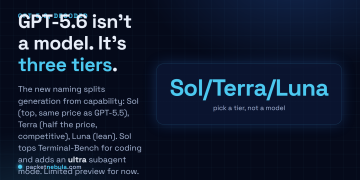
GPT-5.6 isn’t a single model. The new naming splits the generation (5.6) from the capability tier, so you pick Sol (top, same price as GPT-5.5), Terra (half the price, competitive), or Luna (lean and cheap). Sol tops Terminal-Bench for coding and adds an ultra mode that uses subagents. It’s a limited preview, so the real takeaway is the cheaper Terra tier, not a smarter flagship.
GPT-5.6 is a tier system, and here are the prices
The thing to absorb before any benchmark: with GPT-5.6, OpenAI stopped shipping one model per version. The number now marks the generation, and three names mark durable capability tiers that can each advance on their own cadence. So you no longer ask “is GPT-5.6 good,” you ask “which tier.” Sol is the top, Terra the middle, Luna the lean one. Same brain family, three points on the cost-versus-power curve, and the one you pick is now a real decision rather than a footnote.
That’s the actual change from GPT-5.5, which was a single model at a single price. Everything else, the coding score and the new modes, sits on top of this.
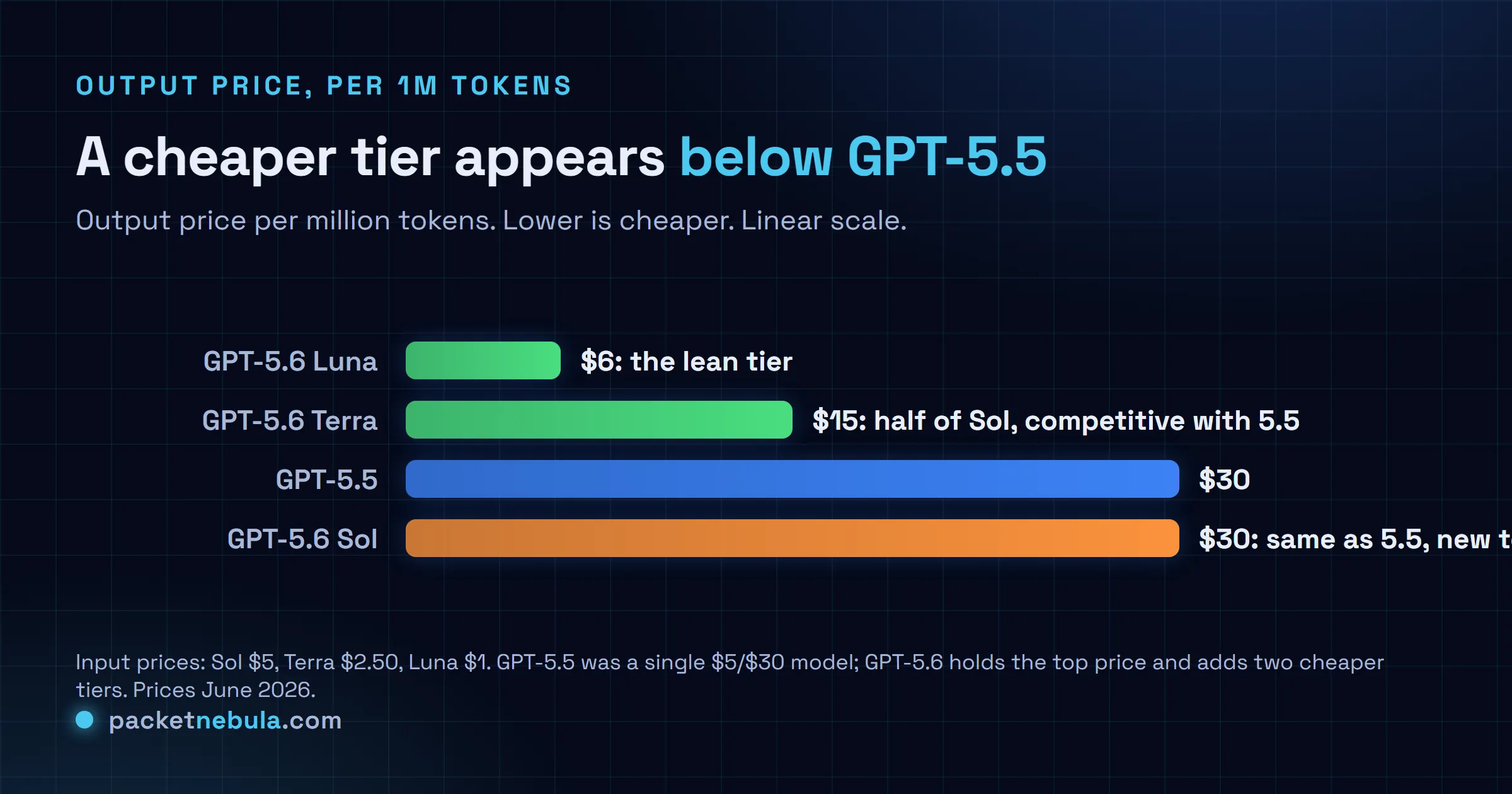
On output tokens, where the money goes: Sol is $5 in and $30 out, identical to GPT-5.5. Terra is $2.50 / $15, exactly half of Sol, and OpenAI describes it as competitive with GPT-5.5 while costing half as much. Luna is $1 / $6, the budget tier for high-volume or simpler work.
Read that the right way and the pricing story isn’t “GPT got more expensive,” it’s the opposite. The flagship held its price, and a near-flagship tier (Terra) now does most of the same work for half the bill. For anyone running GPT-5.5 in production today, Terra is the line item that should get your attention first.
What’s genuinely new, and what stayed unconfirmed
Beyond the tiers, a handful of real additions.
Coding moved up. GPT-5.6 Sol sets a new state of the art on Terminal-Bench 2.1, the benchmark for command-line workflows that need planning, iteration and tool coordination, which is to say agentic coding rather than single-shot snippets. OpenAI also reports better results on its GeneBench evaluation while spending fewer tokens than GPT-5.5, so part of the gain is efficiency, not just raw score.
Ultra mode is the headline. Instead of one agent grinding through a hard task, ultra mode spins up subagents to work in parallel and then combines what they find. It’s paired with a new “max” reasoning effort on Sol for the deepest single-pass thinking. Both are aimed squarely at long, multi-step jobs, the kind where GPT-5.5 would lose the thread halfway through.
Caching got predictable. GPT-5.6 adds explicit cache breakpoints and a 30-minute minimum cache life; cache writes bill at 1.25x the uncached input rate, and cache reads keep the 90% discount. Unglamorous, but if you send the same long system prompt thousands of times a day, controllable caching is a real cost lever.
One security-flavoured data point worth flagging, because it ties to a story we looked at recently: on OpenAI’s ExploitBench, Sol is reportedly competitive with Anthropic’s Mythos Preview while using roughly a third of the output tokens. AI offensive-security capability is becoming a headline number that labs now compete on openly.
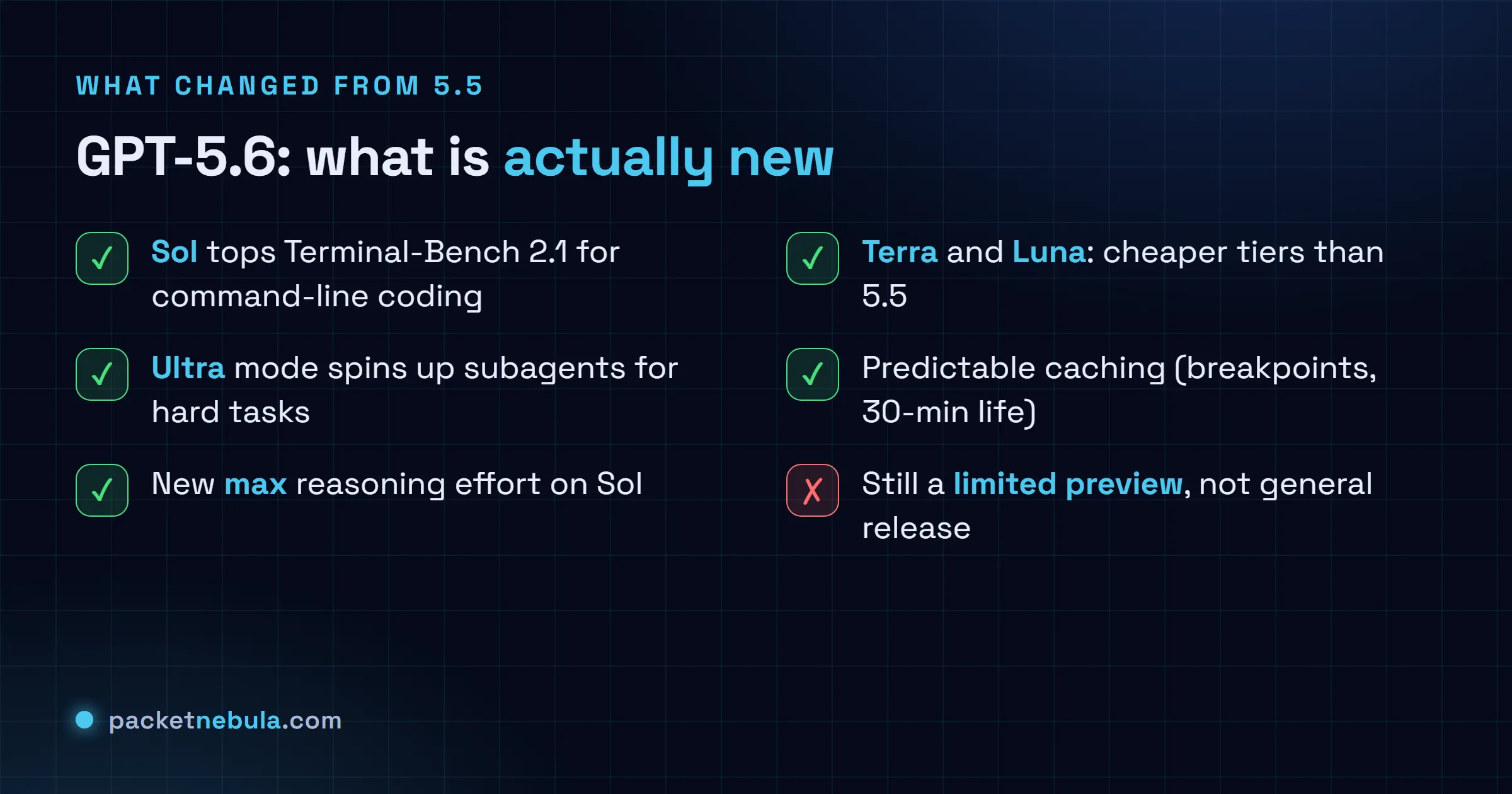
Worth being honest about the gaps, because the hype outran the documentation. OpenAI hasn’t published a full model card or an independent, machine-readable benchmark package, so the scores above are early and partly OpenAI’s own framing. The context window and the knowledge cutoff aren’t officially disclosed; the 1.5 million token context and a May 2026 cutoff that circulated are leaks, not confirmed specs, so don’t build on them. And the whole thing is a limited preview through the API and Codex for select partners, with general availability only described as coming soon. Useful to plan around, too early to bet a product on.
Is it worth switching from GPT-5.5?
The honest decision tree.
If you run GPT-5.5 for general work at $5/$30, the obvious move once it opens up is to try Terra at $2.50/$15: half the price, billed as competitive. That’s the easy win and probably the reason most people will care about GPT-5.6 at all. If you need the absolute ceiling, or you’re building long agentic pipelines that would benefit from subagents, Sol plus ultra mode is the upgrade, at the same price GPT-5.5 charged. If cost dominates and the task is light, Luna at $1/$6 is the new floor.
Two caveats keep it grounded. It’s a preview, so this is a plan, not a migration. And every tier here’s closed and API-only; if what you actually want is a model you can run yourself, that’s a different shelf, and our breakdowns of GLM-5.2 and Qwen 3.7 Max vs GLM-5.2 cover the open and self-hostable side.
The story of GPT-5.6 isn’t a dramatically smarter top model. It’s that OpenAI unbundled “GPT” into tiers, handed you a cheaper-than-5.5 option and a subagent mode, and put it behind a preview gate. Choosing the right tier is the new skill.
Sources: OpenAI’s GPT-5.6 Sol preview announcement, with specs, pricing and benchmark framing collated by Kingy and AIToolsReview, June 2026. Limited preview as of writing; treat unconfirmed specs as provisional.
Frequently asked questions
Is GPT-5.6 better than GPT-5.5?
At the top end, modestly: GPT-5.6 Sol costs the same as GPT-5.5 ($5 in, $30 out) and sets a new state of the art on Terminal-Bench 2.1 for command-line coding, with a new ultra mode that uses subagents. The bigger change is structural: GPT-5.6 splits into three tiers, so the real win for most people is Terra at half the price rather than a smarter flagship.
What are Sol, Terra and Luna in GPT-5.6?
They’re capability tiers, not separate models. OpenAI changed the naming so the number (5.6) marks the generation while Sol, Terra and Luna mark durable tiers that can improve on their own schedule. Sol is the top tier ($5/$30 per 1M tokens), Terra the mid tier ($2.50/$15), Luna the lean one ($1/$6).
How much does GPT-5.6 cost vs GPT-5.5?
GPT-5.6 Sol is $5 input and $30 output per million tokens, identical to GPT-5.5. The new options are cheaper: Terra at $2.50/$15 (half of Sol, and OpenAI calls it competitive with GPT-5.5), and Luna at $1/$6. So GPT-5.6 mainly adds a cheaper-than-5.5 path rather than raising the top price.
What’s GPT-5.6 ultra mode?
Ultra mode goes beyond a single agent by spinning up subagents to work in parallel on a complex task, then combining the results. It’s paired with a new max reasoning effort on Sol for the deepest single-pass reasoning. Both target long, multi-step agentic and coding work.
Can I use GPT-5.6 right now?
Only partly. As of June 2026 it’s a limited preview through the API and Codex for select partners, with broader availability described as coming soon. OpenAI also hasn’t published a full model card or an independent benchmark package, so treat the numbers as early and unconfirmed, and don’t migrate production to it yet.