
• Latest
  • Trending
  • All
Answer card: Alibaba put Qwen-Image-3.0 live in Qwen Chat on July 21 2026 claiming text legible to 10 pixels, native rendering in 12 languages and infographics from live data, while shipping no open weights, no benchmark score and no model card.

Qwen-Image-3.0 is here: no weights, no benchmarks

21 July 2026
Answer card stating that OpenAI published its research acceleration measurements on 6 September 2026, that as of mid August 2026 its research organisation logged 3.1 agent workdays of coding agent runtime for every workday of human labour normalised to a standard eight hour day, and that OpenAI states this should not be read as a 3.1 times productivity gain because it measures runtime rather than delivered output.

OpenAI’s 3.1 agent-workdays per human day is not a 3.1x gain

7 September 2026
Answer card stating that Mullvad announced on 3 September 2026 that it is shutting down its public encrypted domain name system servers on 2 November 2026 and sponsoring the Quad9 Foundation instead, with 194.242.2.2 and its five sibling addresses all going away, and virtual private network customers unaffected.

Mullvad’s DNS servers go dark on 2 November, and Quad9 blocks no ads

5 September 2026
OpenAI announcement image for GPT-6 Astra, a spiral galaxy of white, blue and amber points of light curling around a bright core on a near black star field.

GPT-6 Astra lists at $10 and $50, 2.5x what GPT-5.6 Sol costs

6 September 2026
Google's official announcement image for the release, reading Introducing Gemini 3.8 Flash and 3.8 Flash Cyber in black type over a pale blue background with a blurred white chevron and the four colour Gemini spark below.

Gemini 3.8 Flash keeps the price and the 1 January cliff

3 September 2026
Answer card stating that Anthropic announced Enterprise Frontier Safeguards on 1 September 2026, that activity data used for misuse monitoring moves into cloud storage the customer controls under the customer own encryption keys, that Anthropic charges nothing for the feature while the cloud provider bills storage and egress, and that the phased rollout starts later in autumn 2026 with interim zero data retention on Fable 5 and Fable 5.1 for eligible customers.

Anthropic moves retention into your own cloud, for 30 days

3 September 2026
Official Google diagram of a client connection in three numbered steps: a DNS lookup with a query and an address, a TLS ClientHello and ServerHello, then a content exchange with a website. A callout on the DNS step reads 25% of global web traffic is now protected by encrypted DNS, and a callout beside an Android phone on the ClientHello step reads Android 17 supports ECH GREASE by default.

Android 17 hides the SNI, not your DNS or destination

3 September 2026
Still frame from the Claude Fable 5.1 launch video showing model-designed protein binders in orange docked against twelve grey target proteins, rendered as ESMFold2 structure predictions.

Claude Fable 5.1 breaks forced tool use, cuts cache 75%

1 September 2026
Answer card stating that on 31 August 2026 the European Commission designated ChatGPT a Very Large Online Search Engine under the Digital Services Act, the first conversational AI service classified that way, because it answers user prompts and queries including by searching the web, with OpenAI having declared roughly 159.1 million average monthly users in the European Union for ChatGPT search.

The EU now calls ChatGPT a very large search engine

3 September 2026
Answer card stating that on 31 August 2026 the Department of War added OpenAI ChatGPT Mil and Starshield AI Grok for Government to the GenAI.mil portal alongside Google Gemini, all three accredited at Impact Level 5 for Controlled Unclassified Information, with 1.7 million unique users onboarded out of roughly 3 million eligible personnel, and ChatGPT Mil currently serving GPT-5.4 Terra with GPT-5.6 Terra said to be rolling out.

ChatGPT Mil and Grok reached IL5 on GenAI.mil

3 September 2026
Answer card stating that Anthropic opened a research preview of the Model Hardware Standard on 27 August 2026, standardising the driver layer between an operating system and a laboratory instrument with read and write primitives plus discovery and safety limits, reachable through MCP as well as a command line and code files, with no public specification published.

Anthropic’s Model Hardware Standard is gated, and sits under MCP

3 September 2026
Official Cohere key art for the Parse 5 launch: the Cohere mark and the wordmark Parse with a superscript 5 in white, centred on a soft out of focus gradient of deep blue, violet and amber curves.

Cohere Parse 5 is $1.50 per 1,000 pages, on three of five dimensions

3 September 2026
Title card from the OpenAI announcement video: a man sits on a blue sofa in a loft with tall windows and potted plants, a laptop open on the coffee table in front of him, with the words WebMCP in ChatGPT in large white type across the lower left.

WebMCP in ChatGPT needs GPT-5.6 Sol or Terra

3 September 2026
  • About
  • Contact
  • Privacy
  • Legal
Monday, September 7, 2026
  • Login
Packet Nebula
  • Home
  • Articles
    • Security
    • Network
    • Dev
    • Sysadmin
    • SEO
    • Email & DNS
  • Tools
    • Network tools: free, fast, no signup
    • Security tools: free, fast, no signup
    • Developer tools: free, fast, no signup
    • Sysadmin tools: free, fast, no signup
    • SEO tools: free, fast, no signup
    • Email & DNS tools: free, fast, no signup
  • Download
  • About
No Result
View All Result
Packet Nebula
No Result
View All Result
Home Dev

Qwen-Image-3.0 is here: no weights, no benchmarks

by stephane
21 July 2026
in Dev
0
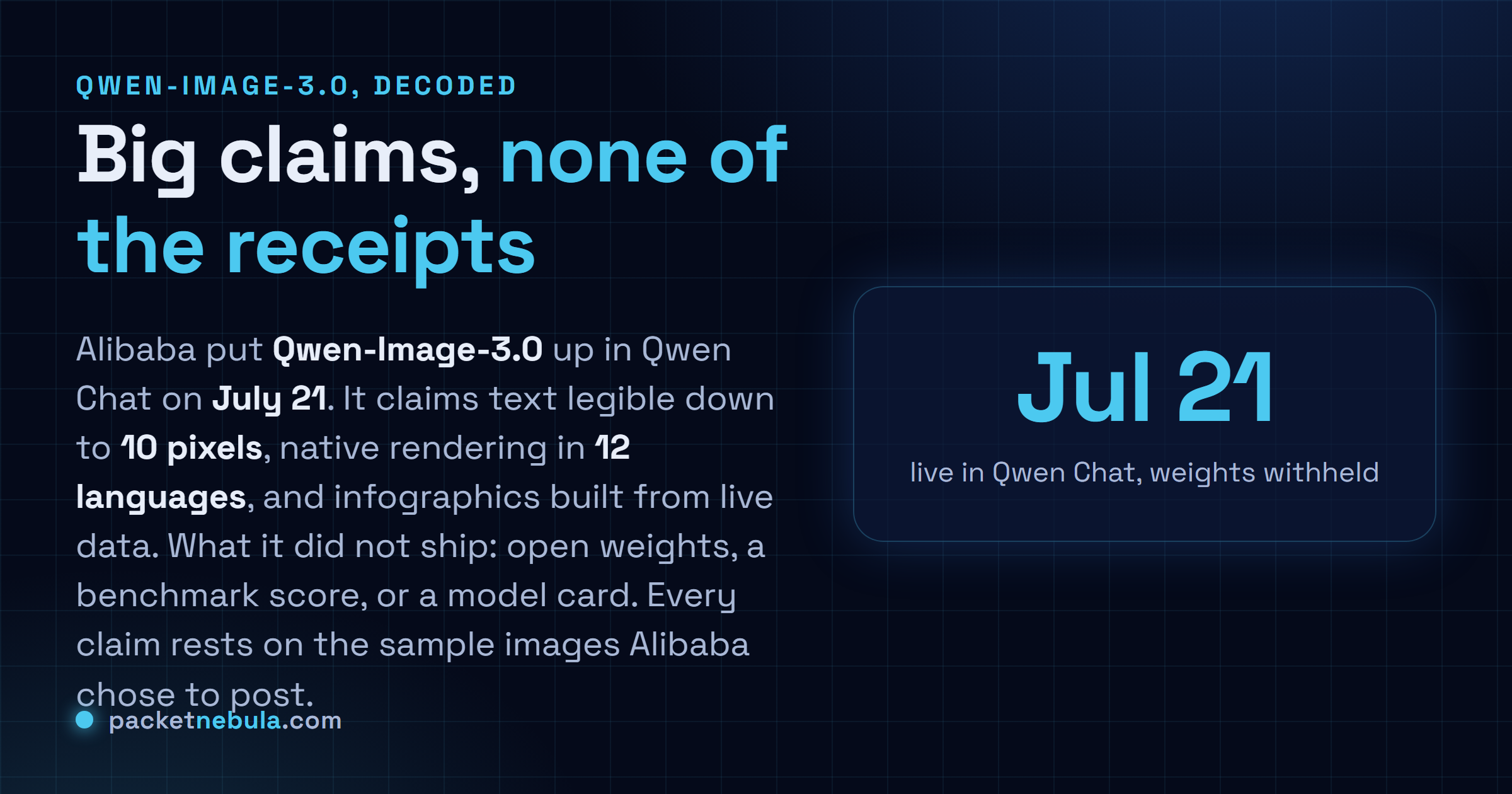
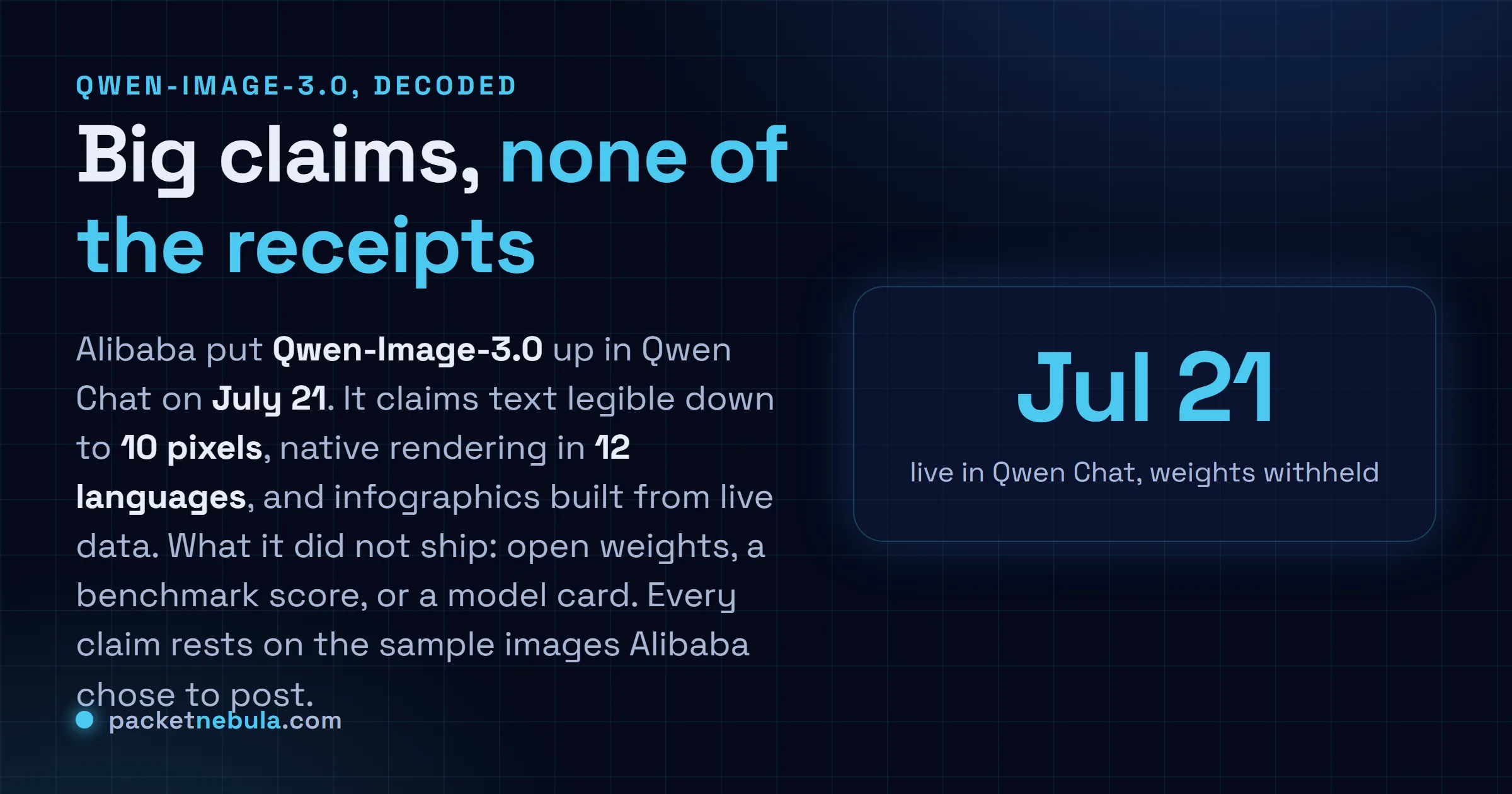
Answer card: Alibaba put Qwen-Image-3.0 live in Qwen Chat on July 21 2026 claiming text legible to 10 pixels, native rendering in 12 languages and infographics from live data, while shipping no open weights, no benchmark score and no model card.
492
SHARES
1.4k
VIEWS
Share on FacebookShare on Twitter

Open Qwen Chat this morning and there's a new image model waiting, Qwen-Image-3.0, with a demo reel of dense infographics and UI mockups that mostly hold together. So what actually shipped? A hosted model you can prompt right now, live in Qwen Chat since July 21, and a set of loud capability claims: text legible down to 10 pixels, in-image rendering across 12 languages, whole charts built from live data. What did not ship is the part that lets you trust any of it. No open weights. No benchmark score. No model card, no technical report. That's a real break from how Qwen shipped the last two versions, and it's the whole story here. We went to separate the model you can use today from the numbers you're being asked to take on faith.

The short answer

Alibaba launched Qwen-Image-3.0 on July 21, hosted in Qwen Chat. It claims in-image text legible down to 10 pixels, rendering in 12 languages and 20+ fonts, and full infographics built from live data. What’s missing is telling: no downloadable weights, no benchmark score, no model card. The last two versions shipped all of that. Here’s the line between what you can use and what you’re asked to believe.
July 21live in Qwen Chat
4,500token instructions
Noneweights, benchmarks, card
Answer card: Alibaba put Qwen-Image-3.0 live in Qwen Chat on July 21 2026 claiming text legible to 10 pixels, native rendering in 12 languages and infographics from live data, while shipping no open weights, no benchmark score and no model card.
The one-card version. A model you can prompt, wrapped in claims you can't check.

What actually shipped

A model you can generate with. That’s the solid part. As of July 21, Qwen-Image-3.0 is reachable through Qwen Chat, so if you’ve got an account you can throw prompts at it this afternoon. Alibaba frames it as the third generation of its image line, and the pitch is specific: this isn’t for pretty wallpapers, it’s meant to output images you’d actually use as a tool. Knowledge diagrams. UI interfaces. Charts with real labels.

The headline feature is text that survives being small. Qwen says the model renders in-image text legibly down to about 10 pixels, across 12 languages and more than 20 fonts. If you’ve ever asked an image model for a poster and watched it spell the title wrong, you know why that matters. It also claims it can pull live data off the internet and lay it into a graphic, a weather card being the example everyone’s passing around.

And the instruction window grew. Qwen-Image 2.0 took prompts of roughly 1,000 tokens. 3.0 takes up to 4,500. That’s not a rounding tweak.
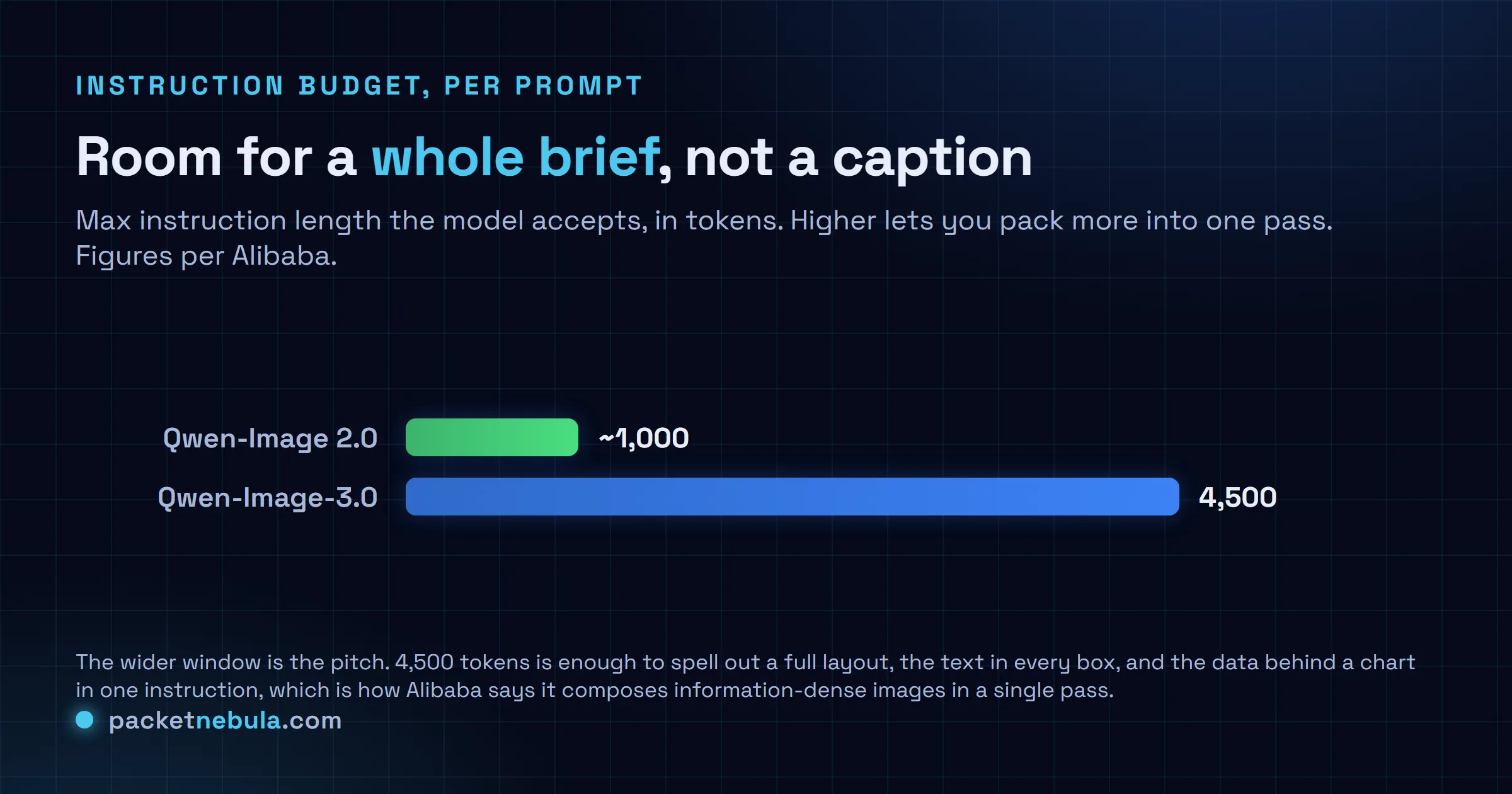
Bar chart of maximum instruction length: Qwen-Image 2.0 accepts about 1,000 tokens, Qwen-Image-3.0 accepts 4,500 tokens, both figures per Alibaba.
The wider window is the pitch: enough room to spell out a whole layout in one instruction.

More room per prompt is the mechanism behind the “information-dense in a single pass” claim. You can describe the layout, the text in each box, and the data behind a chart all at once, instead of generating and patching. Honestly, that’s the part I’d want to test first, because dense composition is exactly where image models tend to fall apart.

The receipts that didn’t come

Here’s where we slow down. Everything above is Alibaba’s description of Alibaba’s model, illustrated with images Alibaba picked. There is no benchmark score. No model card. No technical report. Nothing a third party can pull up and rerun.

That’s not the bar we’re inventing. It’s the bar Qwen set itself. Qwen-Image 1.0 landed in August 2025 with open weights under an Apache 2.0 license and a proper writeup. Version 2.0 came with a technical report too, and Alibaba even ranked Qwen-Image 2.0 Pro fifth on its own Qwen-Image-Bench. Modest, but a number. For 3.0 there isn’t even a self-reported score. The launch is a blog post and a gallery.

And the weights stayed home. This is the bigger shift. The whole reason a lot of us paid attention to Qwen-Image in the first place is that it was open: you could pull it down and run it on your own box. 3.0 is hosted-only. No files on Hugging Face, no license posted. So the one thing that made the line special, self-hosting, is exactly what’s absent from the version with the biggest claims.
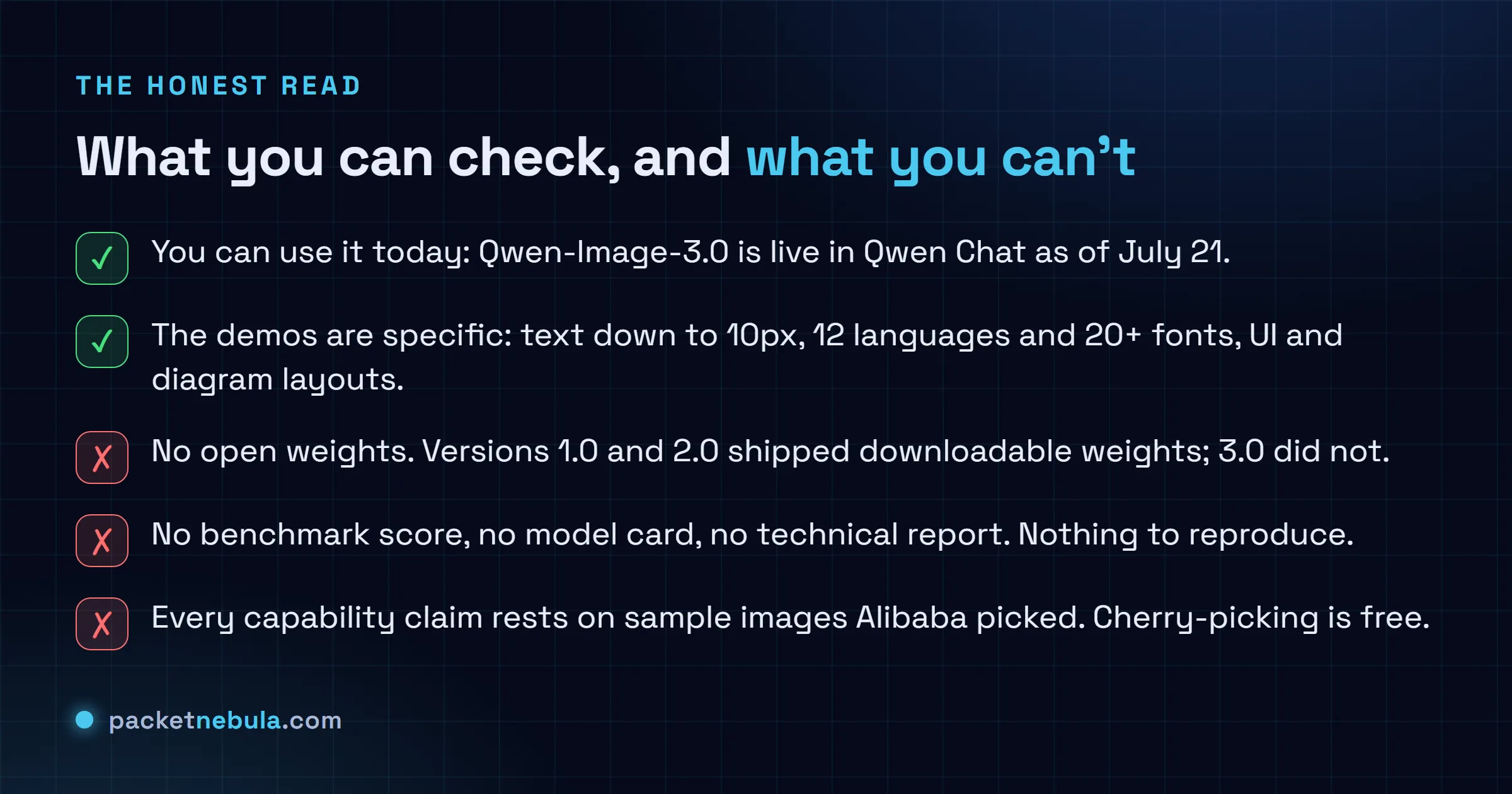
Checklist separating what is confirmed about Qwen-Image-3.0 from what is not: it is live in Qwen Chat and the demos are specific, but there are no open weights, no benchmark score, no model card, and every claim rests on sample images Alibaba chose.
One usable model. Everything with a number or a download attached is still missing.

We’ve seen this shape twice this month

If this pattern feels familiar, it should. Alibaba ran nearly the same play with its language side a couple of days ago: Qwen3.8’s preview went live with a giant parameter claim and open weights “soon”, none of it backed by a card or a benchmark. Same lab, same week, same move. Announce the impressive thing, ship the hosted preview, keep the weights and the numbers back.

Which is worth holding next to the other big image drop this month. ByteDance’s Seedream 5.0 Pro also pushed in-image text and a headline feature, but it shipped with an actual per-image price and a concrete workflow you could poke at. I’m not saying Seedream is better. I’m saying you can weigh it. With Qwen-Image-3.0 right now, you mostly can’t.

The honest read

I’m genuinely interested in this model, and I’m not going to repeat its demo reel as proof. Both are true at once.

Use it. Really, go generate with it in Qwen Chat and see if the tiny-text and diagram claims hold on your own prompts, because your prompts are the only test that counts. Just don’t wire it into anything on the strength of a gallery, and don’t quote “10 pixels, 12 languages” as a measured fact when it’s a caption under a picture. If you need open image weights you can actually run, the older Qwen-Image releases and Seedream are still where the receipts are. When the weights, a model card, or one reproducible benchmark shows up for 3.0, that’s when the claims become facts. Not before.

Sources: Qwen (qwen.ai), the official Qwen-Image-3.0 announcement of July 21, 2026, for the capability claims (10px text, 12 languages and 20+ fonts, UI and diagram generation, live-data graphics) and hosted availability in Qwen Chat. Unite.AI and Phemex News for the July 21 date, the 4,500-token instruction limit versus about 1,000 for Qwen-Image 2.0, the absence of open weights, benchmarks, a model card and a license, and the context that Qwen-Image 1.0 shipped Apache 2.0 open weights in August 2025 and Qwen-Image 2.0 Pro ranked fifth on Alibaba’s own Qwen-Image-Bench. All capability figures are as claimed by Alibaba and are not independently reproduced.

Frequently asked questions

Is Qwen-Image-3.0 released?

Yes, but only as a hosted model. On July 21, 2026, Alibaba made Qwen-Image-3.0 available through Qwen Chat, so you can generate with it today. It has not released downloadable weights, unlike Qwen-Image 1.0 and 2.0, which both shipped open weights. So you can use it, you just cannot run it yourself.

Can I download the Qwen-Image-3.0 weights?

Not as of July 21. Qwen-Image 1.0 shipped in August 2025 under a permissive Apache 2.0 license, and 2.0 followed with a technical report. Version 3.0 launched with none of that: no weights on Hugging Face, no license posted. If you need open image-generation weights you can self-host today, the older Qwen-Image releases are still the honest pick.

What can Qwen-Image-3.0 actually do?

Alibaba says it renders in-image text legibly down to about 10 pixels, across 12 languages and more than 20 fonts, and that it can compose knowledge diagrams, UI mockups and data-driven graphics like weather cards in a single pass. Instructions can run up to 4,500 tokens. All of that comes from example images the company published, not from an independent test.

Are there benchmarks for Qwen-Image-3.0?

No. There is no benchmark score, no model card and no technical report. For contrast, Alibaba ranked Qwen-Image 2.0 Pro fifth on its own Qwen-Image-Bench at that launch. For 3.0 there is not even a self-reported number, so every quality claim rests on the samples Alibaba chose to show.

How is it different from Seedream 5.0 Pro?

Both are July image models with strong in-image text. Seedream 5.0 Pro leans on splitting a render into editable layers, and it shipped with a per-image price. Qwen-Image-3.0 leans on dense information design, diagrams and UIs, and it shipped hosted-only with no weights and no numbers. Different bets, and one of them you can measure.

Tags: aialibabaimage-generationnewsopen-sourceqwen
Share197Tweet123
stephane

stephane

  • Trending
  • Comments
  • Latest
The Agentic Coding section of the official Hy4 preview benchmark appendix published by Tencent, a table comparing Hy3 and Hy4 preview against DeepSeek V4 Pro 0813, Qwen 3.8 Max, GLM 5.3, Kimi K3, GPT 5.6 Sol and Claude Opus 5 across SWE-bench Multilingual, SWE-bench Pro, DeepSWE, three SWE Atlas tasks, SWE-Marathon, Terminal-Bench 2.1, NL2Repo-Bench, CyberGym, ProgramBench, PostTrainBench and Harbor-Index.

Tencent’s 770B Hy4 tops one benchmark row in 46

3 September 2026
Answer card: Proton Lumo 2.0 is private by policy, not by locality. Saved history is locked so even Proton cannot read it, but the prompt is decrypted on a Proton EU server to answer it, then forgotten.

Proton Lumo 2.0 review: how private is it, really?

3 September 2026
Answer card: Apple released iOS 26.6 and iPadOS 26.6 on 27 July 2026 with a release note covering bug fixes, security updates and an optimized Spotlight index to prepare for iOS 27, the index the rebuilt Siri reads for personal context.

iOS 26.6 is out: the Spotlight index it quietly builds

27 July 2026
Answer card: JWTs are not encrypted, anyone can read them; the signature proves who issued the token, not who may read it.

Are JWTs encrypted? No, and the difference will bite you

0
Answer card: a random 8 character password falls in under 2 hours offline, while 16 random characters hold for 1.4 trillion years at the same speed.

How long does it take to crack a password in 2026?

0
Answer card: three DNS records decide if your mail lands or bounces; SPF lists allowed senders, DKIM signs messages, DMARC sets the failure policy.

SPF, DKIM and DMARC explained: the records your email needs

0
Answer card stating that OpenAI published its research acceleration measurements on 6 September 2026, that as of mid August 2026 its research organisation logged 3.1 agent workdays of coding agent runtime for every workday of human labour normalised to a standard eight hour day, and that OpenAI states this should not be read as a 3.1 times productivity gain because it measures runtime rather than delivered output.

OpenAI’s 3.1 agent-workdays per human day is not a 3.1x gain

7 September 2026
Answer card stating that Mullvad announced on 3 September 2026 that it is shutting down its public encrypted domain name system servers on 2 November 2026 and sponsoring the Quad9 Foundation instead, with 194.242.2.2 and its five sibling addresses all going away, and virtual private network customers unaffected.

Mullvad’s DNS servers go dark on 2 November, and Quad9 blocks no ads

5 September 2026
OpenAI announcement image for GPT-6 Astra, a spiral galaxy of white, blue and amber points of light curling around a bright core on a near black star field.

GPT-6 Astra lists at $10 and $50, 2.5x what GPT-5.6 Sol costs

6 September 2026
  • About
  • Contact
  • Privacy
  • Legal

Copyright © 2026 Stephane Cardon.

Welcome Back!

Login to your account below

Forgotten Password?

Retrieve your password

Please enter your username or email address to reset your password.

Log In
No Result
View All Result
  • Home
  • Articles
    • Security
    • Network
    • Dev
    • Sysadmin
    • SEO
    • Email & DNS
  • Tools
    • Network tools: free, fast, no signup
    • Security tools: free, fast, no signup
    • Developer tools: free, fast, no signup
    • Sysadmin tools: free, fast, no signup
    • SEO tools: free, fast, no signup
    • Email & DNS tools: free, fast, no signup
  • Download
  • About

Copyright © 2026 Stephane Cardon.