
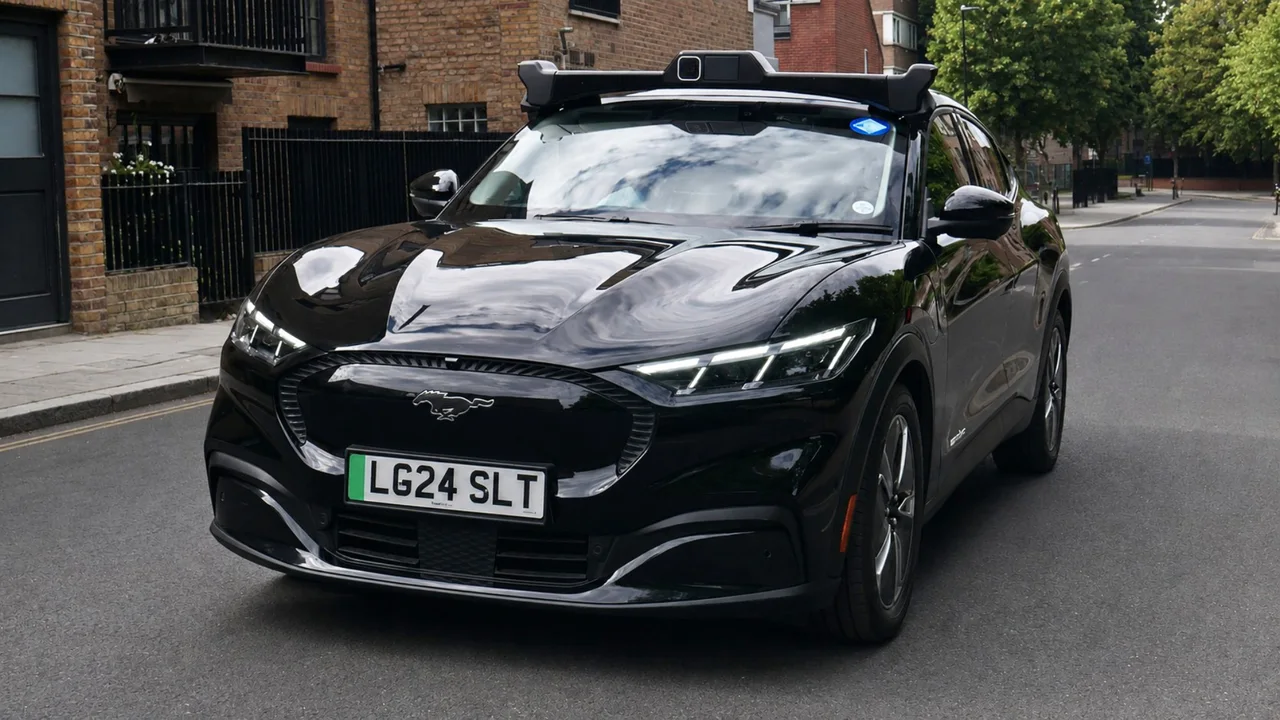
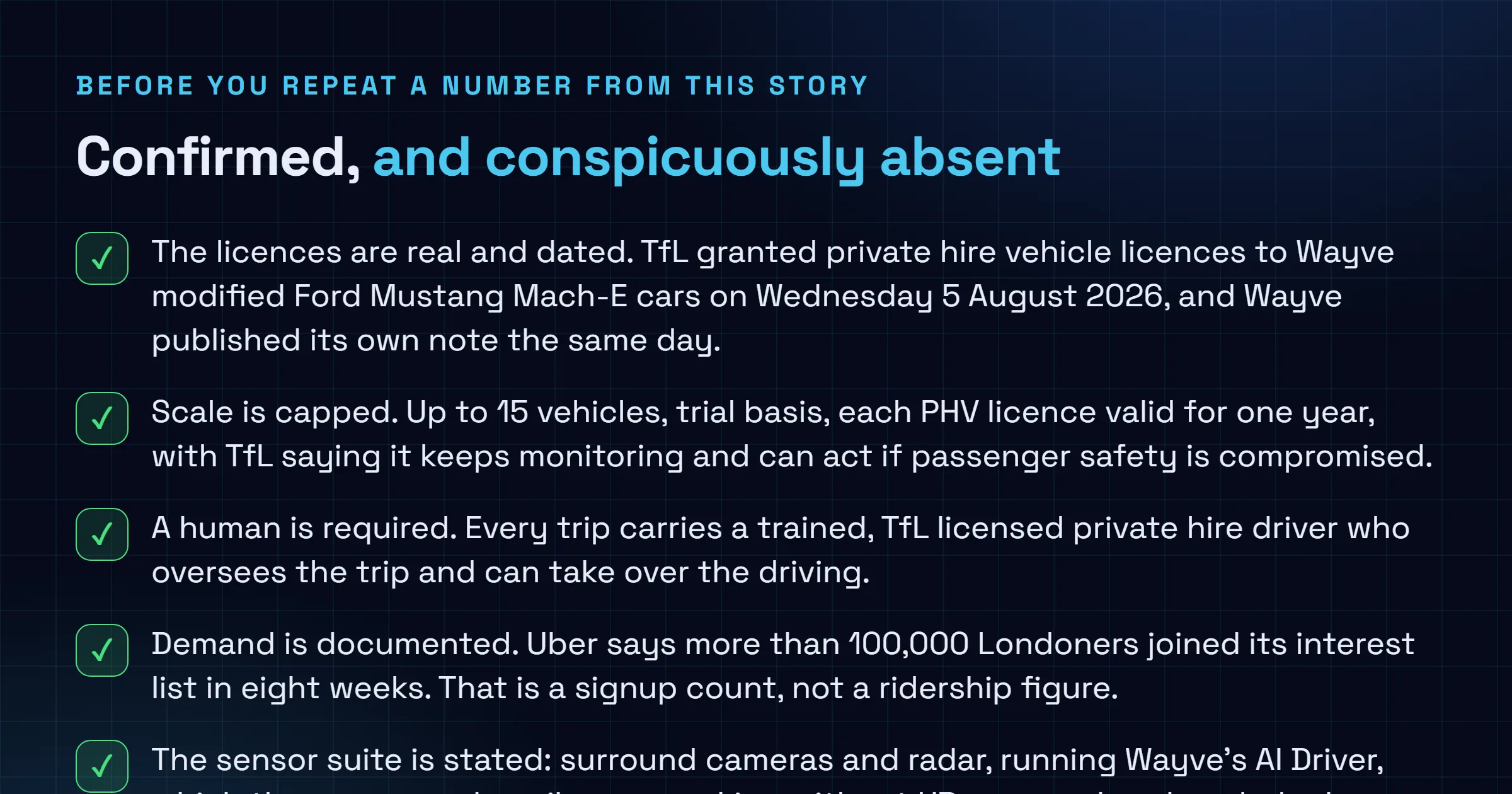
Picture the car that just got licensed. A Ford Mustang Mach-E with surround cameras and radar, and a person sat behind the steering wheel who is legally the driver. That is the London robotaxi. On Wednesday 5 August, Transport for London issued private hire vehicle licences to Wayve's autonomous cars, which is the last permission Uber needed to put passengers in them, and the approval runs to a maximum of 15 vehicles on a trial basis with each licence valid a year. Plenty of headlines called it a robotaxi launch. It's a supervised trial. The distance between those two descriptions is basically the whole story.
The short answer
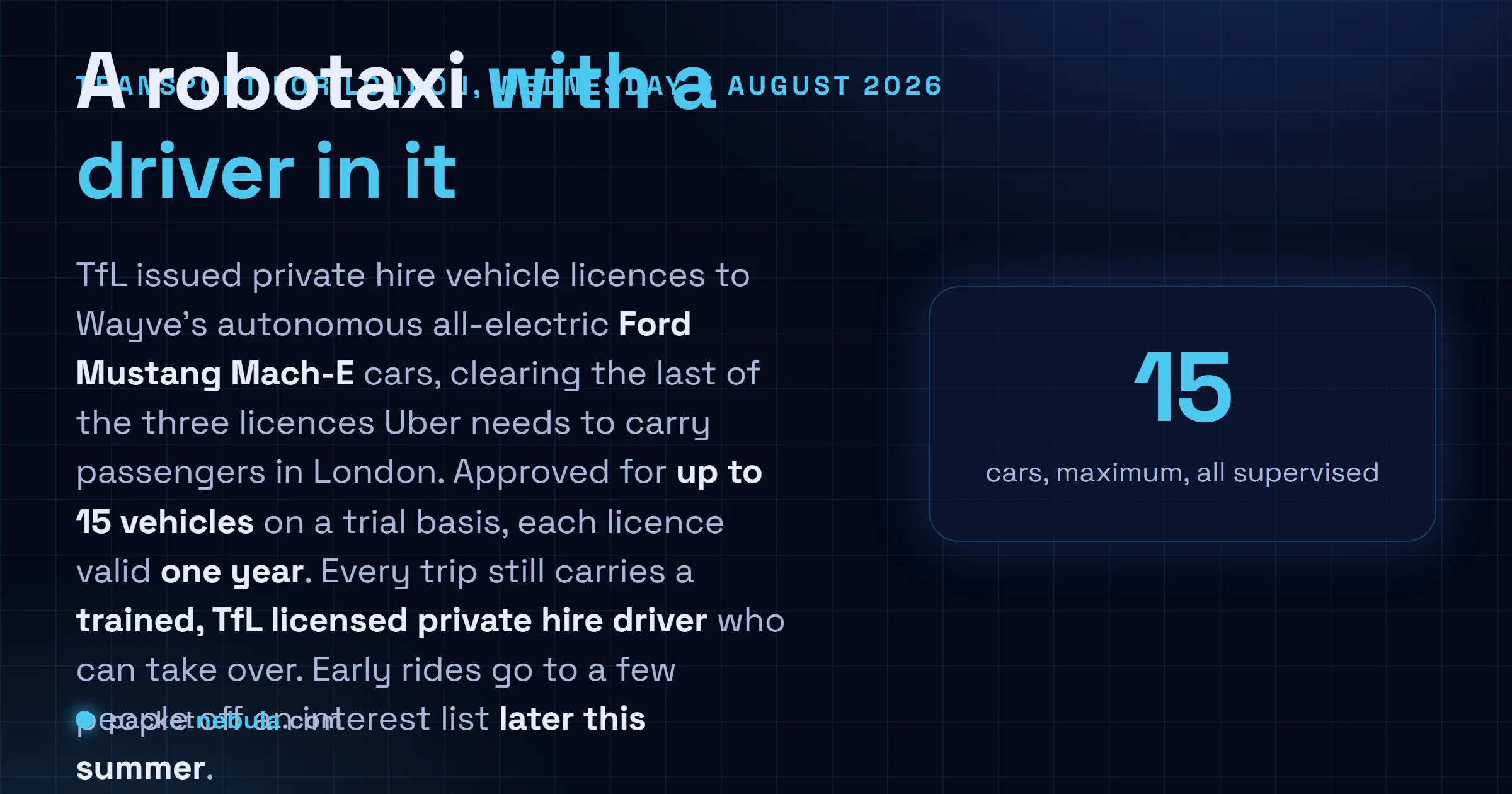
TfL granted private hire vehicle licences to Wayve’s autonomous Ford Mustang Mach-E cars on 5 August 2026, completing the set of three licences Uber needs to carry passengers in London. Up to 15 cars, trial basis, one year per licence. A trained TfL licensed driver sits in every one and can take over. Early rides go to a handful of people off an interest list later this summer. Driverless operation needs a separate permit under the Automated Vehicles Act 2024, which nobody has said they applied for.
What TfL actually signed
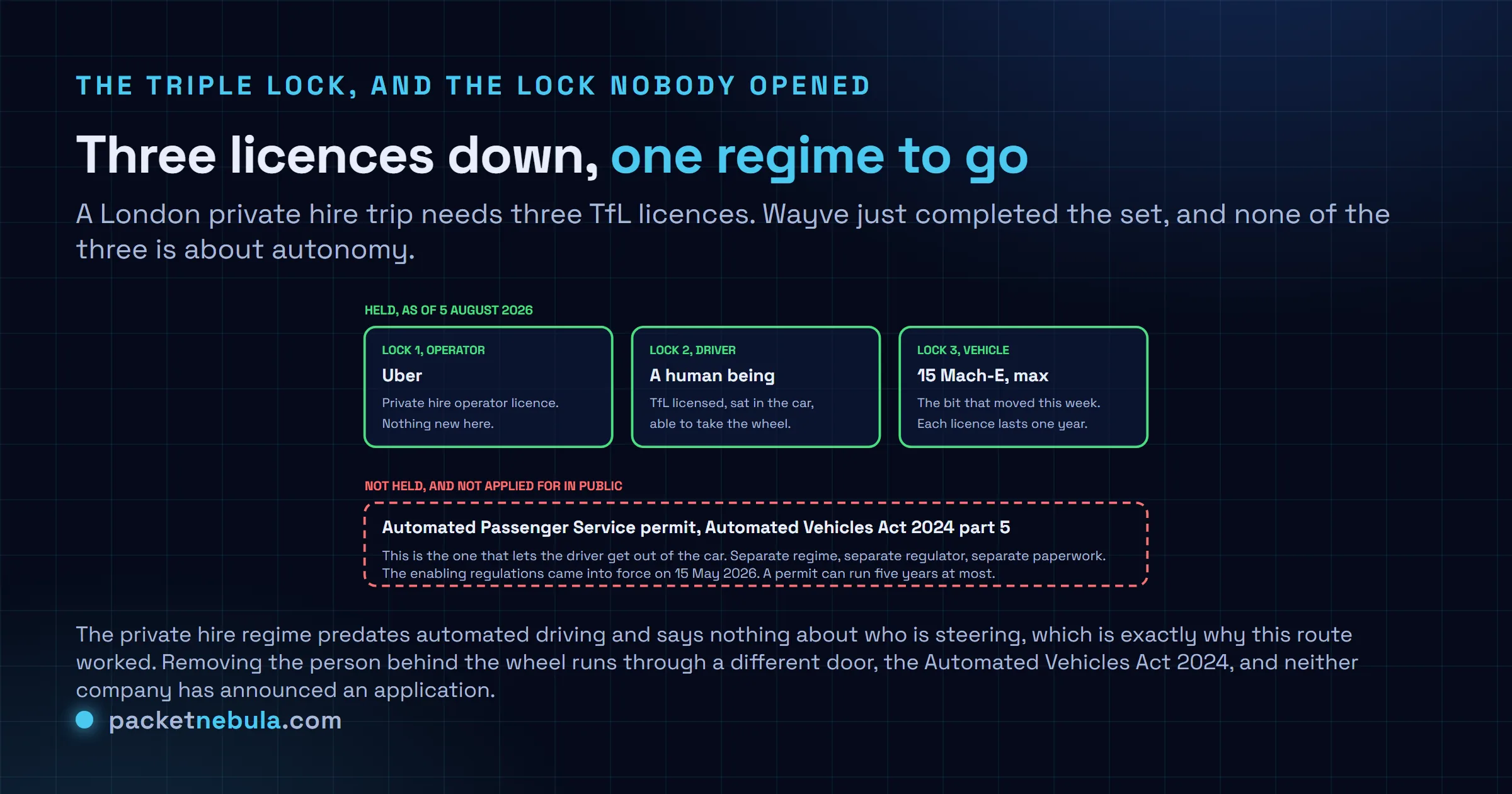
London has a rule that turns out to matter more than any of the autonomy talk. A private hire trip needs three licences from the same authority: one for the operator, one for the driver, one for the vehicle. TfL calls it the triple lock, and until last week Wayve’s cars failed the third one, because a car modified with an autonomous driving stack is a modified car and modified cars need approval.
That’s what moved on 5 August. Not a self-driving authorisation. A vehicle licence.
Uber has held the operator licence for years. TfL licensed private hire drivers number in the tens of thousands. The only missing paperwork was for the machines, and TfL approved the modifications for up to 15 of them on a trial basis, each licence running twelve months, with the agency saying it keeps monitoring and can act if passenger safety is compromised.
The vehicles are all-electric Ford Mustang Mach-E cars running Wayve’s AI Driver on surround cameras and radar. Wayve describes its approach as learning from experience rather than leaning on HD maps, hand-coded rules or geofenced domains, which is the company’s own framing and not something a licence assesses.
The word robotaxi is doing a lot of work here
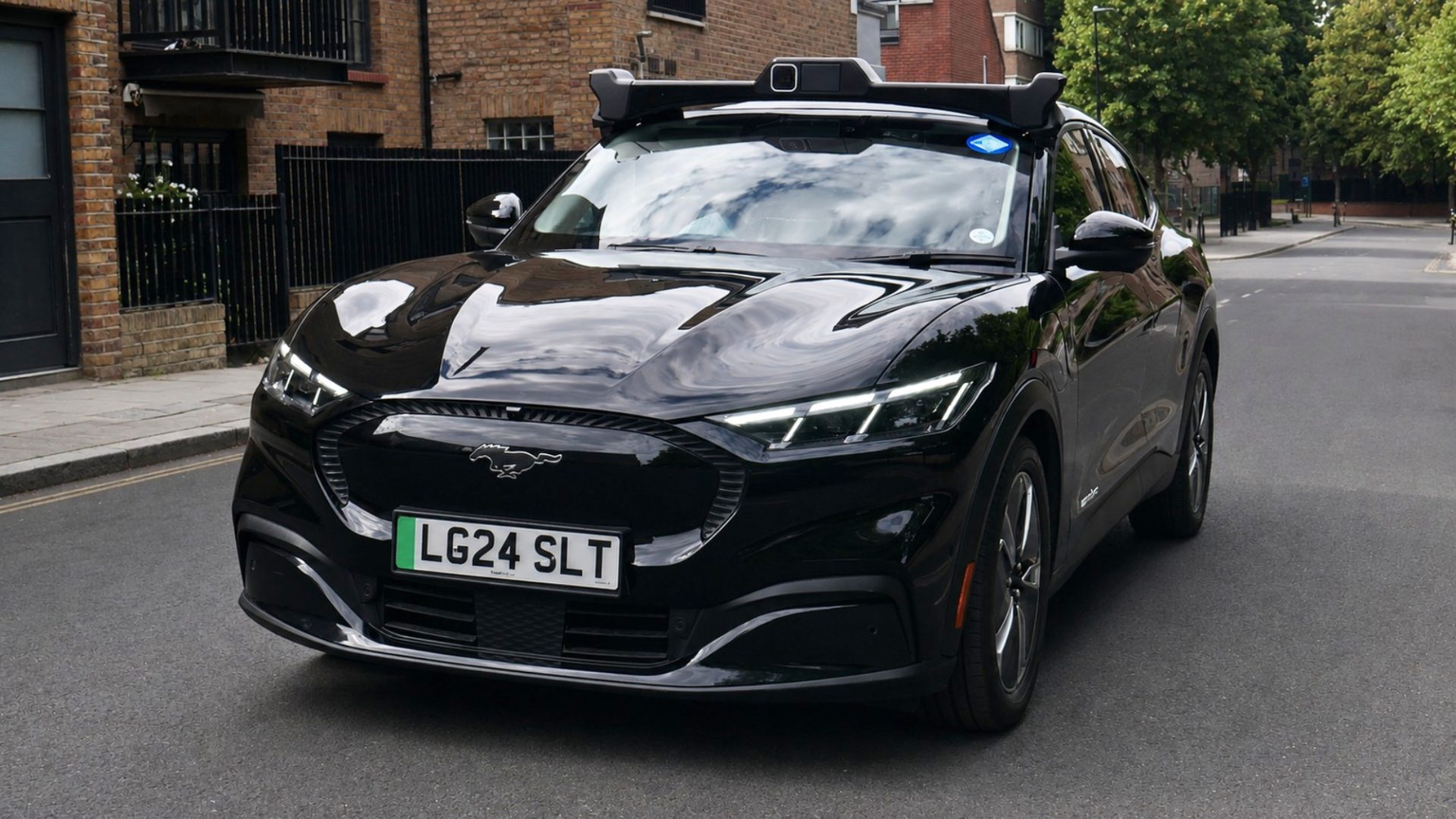
Image: Wayve, from its press release on the TfL licence.
Here’s the bit that gets flattened in the coverage. A trained, TfL licensed private hire driver is on board every single trip, overseeing the journey and able to take the wheel. So the passenger experience is an Uber that drives itself while a professional watches, which is genuinely a milestone and is not a robotaxi in the sense anyone uses the word.
Sarah Gates, Wayve’s VP of Global Affairs and Assurance, called the licence “an important step towards giving Londoners the chance to experience autonomous driving”. Notice the shape of that sentence. A step towards a chance to experience. Uber’s Annie Duvnjak, who runs global autonomous mobility operations, went with “a key milestone”, pointing at the interest list.
That list is the number everyone repeated: more than 100,000 Londoners signed up in eight weeks. It measures curiosity. Fifteen cars cannot serve a hundred thousand people, and nobody claimed they would.
Caroline Russell, who chairs the London Assembly transport committee, described the approval for up to 15 vehicles on a trial basis for a year as “not entirely unexpected”. The GMB union was blunter, with regional organiser Matthew Wright calling it worrying for private hire driver members. Both reactions are about the second-order question, which is what happens when the trial stops being a trial.
What has to happen before the driver gets out
The private hire regime is old. It regulates who may carry passengers for money, and it never had an opinion about who is holding the steering wheel, because until recently the question was silly. That silence is why this route worked at all.
Taking the human out is a different door. The Automated Vehicles Act 2024 created a permitting scheme for automated passenger services, and the regulations that switched it on came into force on 15 May 2026. A permit lasts five years at most. Separate application, separate assessment, and one that actually looks at the driving system rather than the vehicle’s modifications.
Neither Wayve nor Uber has announced an application. Until one lands and is granted, every ride in London has a person in the driver’s seat as a matter of law, no matter how little that person does.
Why this matters if you never open Uber
Most people reading this run infrastructure or ship software, so the transferable part isn’t the car.
It’s that a company got to market by finding a regime that didn’t contemplate it. Wayve did not win an argument about autonomy. It satisfied a vehicle licensing checklist written for taxis, and the autonomy sat in the blind spot of the rules. We see the same manoeuvre constantly in tech: the fastest path to shipping is usually the regulation that predates your product, not the one written for it. It works right up until someone writes the new one.
Compare it with how the same week reads in the US. Zoox got a federal exemption that lets it charge fares in a pod with no steering wheel at all, which required arguing head-on that a software system substitutes for mandatory hardware. Harder argument, bigger prize. London took the easy door and got a smaller thing: fifteen supervised cars.
I think the supervised phase deserves more respect than it gets. It’s where the disengagement data comes from, and right now none of that data is public for this fleet. TfL published no reporting commitment alongside the licence, and Wayve published no intervention rate. That’s the gap I’d watch, not the launch date. Cities that skipped straight to enthusiasm are the ones now fighting their robotaxi operators in court over parking and charging.
A year is a short licence. Somebody has to renew it, and by then there will be numbers.
Sources: the licence, the vehicle model, the sensor suite, the safety driver requirement, the interest list figure and both executive quotes are in Wayve’s own Wayve and Uber move a step closer to autonomous rides in London (5 August 2026). The 15 vehicle cap, the one year licence term and TfL’s monitoring position are reported by Zag Daily and Highways Magazine, which also carries the Caroline Russell quote. The triple lock framing and the GMB reaction come from Tech Digest, with further detail in electrive. The permitting scheme for driverless passenger services is The Automated Vehicles (Permits for Automated Passenger Services) Regulations 2026, in force 15 May 2026 under part 5 of the Automated Vehicles Act 2024. Image: Wayve.
Frequently asked questions
What exactly did Transport for London grant on 5 August 2026?
Private hire vehicle licences for Wayve's modified all-electric Ford Mustang Mach-E cars, so they can legally carry paying passengers on the Uber platform in London. TfL approved the modifications for up to 15 vehicles on a trial basis, and each PHV licence is valid for one year. It is a vehicle licence under the ordinary private hire regime, not an authorisation to drive without a human.
Are these cars driverless?
No. Every trip carries a trained, TfL licensed private hire driver on board who oversees the journey and can take over the driving if needed. The car does the driving with Wayve's AI Driver, using surround cameras and radar, but a person holds the legal driver role and sits in the driver's seat. Nothing in this licence permits an empty front seat.
What is the triple lock TfL keeps referring to?
London requires three separate TfL licences for a private hire trip: the operator, the driver and the vehicle must each be licensed by the same authority. Uber already held the operator licence and TfL licensed drivers already exist, so the vehicle licence was the missing piece. Worth noticing that none of the three has anything to say about autonomy. The private hire rules predate self-driving cars and are silent on who or what is steering, which is exactly why this route was available.
When can Londoners actually book one?
No date has been published. Wayve and Uber say a select few people from the interest list will get an early trip later this summer, ahead of a wider public launch that nobody has dated. Uber says more than 100,000 Londoners joined that interest list in eight weeks, which is a signup number and tells you nothing about how many rides will run.
What would Wayve need to remove the safety driver?
A different regime entirely. Taking the person out of the driver's seat for a paid passenger service runs through the Automated Vehicles Act 2024, whose Automated Passenger Services permitting regulations came into force on 15 May 2026 and cap a permit at five years. Separate application, separate assessment. Neither Wayve nor Uber has announced that they have applied.


