

Somebody is going to forward you a headline this week saying the US government released an open-weight AI model. It didn't. What the Department of Energy put online on 7 August 2026 is a program and an application form: the Genesis Open Models Initiative, hosted by Argonne National Laboratory, with a model called Genesis-Science-1 named as its first output and Arcee AI building it. No parameter count. No license, no benchmark, no weights, no ship date. The one hard thing in the whole announcement is a deadline of 14 August for organisations that want to contribute pretraining material. So this is a calendar story more than a model story, and that's fine, as long as nobody files it under downloads.
The short answer
The Department of Energy launched the Genesis Open Models Initiative on 7 August 2026 through Argonne National Laboratory, naming Genesis-Science-1 as its first open-weight scientific model, built with Arcee AI. The announcement carries no parameter count, no license, no training composition and no benchmark. There is no date for the weights. What there is: a contribution portal with applications due 14 August for pretraining material and 25 August for fine-tuning, recurring roughly quarterly. Treat it as a call for collaborators, because that is exactly what it is.
What actually went live
A page and a form.
That sounds dismissive and it isn’t meant to be. The Genesis Open Models Initiative sits under the Genesis Mission, the DOE-led program created by executive order on 24 November 2025 with the stated goal of doubling the productivity and impact of American science and engineering inside a decade. Seventeen national laboratories, a federal AI platform, $320 million pushed into the labs. Big machinery. On 7 August, one gear of it turned: DOE said it wants open-weight foundation models for science, and opened applications from anyone who can supply models, domain data or domain-adapted variants.
Genesis-Science-1, or GS1, is the first one. Arcee AI leads the model development. DOE scientists at the participating labs supply reviewed scientific material, define the tasks, design the evaluations and validate the results. The stated first domains are high-performance-computing code modernization, experimental analysis, simulation campaigns, materials science and energy systems.
The model itself was announced earlier, in a 23 July press release, where Arcee co-founder and CEO Mark McQuade put it this way: “A country cannot lead in AI if everything it leads in is closed.” Fair enough as a position. It’s also the only quotable thing in either announcement that commits to anything.
Image: Arcee AI
And yes, GS1 is also the name of the global barcode standards body. Searching for this thing is going to be miserable.
The interesting part is Fortran
Skim the Arcee description and you hit a list of what the training environments will support: Python, Fortran, C/C++, MPI, OpenMP, CUDA, HIP, plus simulation packages. Read that again.
Commercial coding models are tuned on what’s on GitHub, which means TypeScript and Python and a long tail. Nobody optimises for a 200,000-line Fortran solver that someone’s postdoc wrote in 1998 and that still runs the group’s science. That code exists in enormous quantity, it’s expensive to modernise by hand, and it’s precisely the kind of work a national lab has and a startup doesn’t. If GS1 turns out to be genuinely good at porting old numerical code to GPUs, that’s a real capability gap being filled rather than another leaderboard entry.
I might be wrong about the priority, but it’s the first thing in this announcement that isn’t generic.
The second thing is the harness. Arcee describes a governed execution environment that sandboxes approved tools, keeps task state, checkpoints progress, handles retries, and records the prompts, tool calls, code changes, datasets, intermediate artifacts and conclusions for every run. Human review stays in the loop for anything touching safety, security, publication or resource allocation.
That’s a reproducibility ledger. For a lab that has to defend a result, the log is worth as much as the answer. I suspect the harness is more transferable than the weights will be, and it’s the part least likely to get copied, because it’s unglamorous.
Arcee is the only thing here you can measure
DOE published nothing quantitative about GS1. So the only way to size up the effort is to look at what its builder has already shipped.
The Trinity family is public. Trinity-Large-Preview on Hugging Face lists roughly 398 billion total parameters with about 13 billion active per token, routing 4 of 256 experts, an 8,192 token pretraining context extended out to 512K, released under OpenMDW-1.1, a permissive Linux Foundation license written for model distributions. Trinity Mini is 26B with 3B active, Trinity Nano 6B with 1B active, both at 128K context.
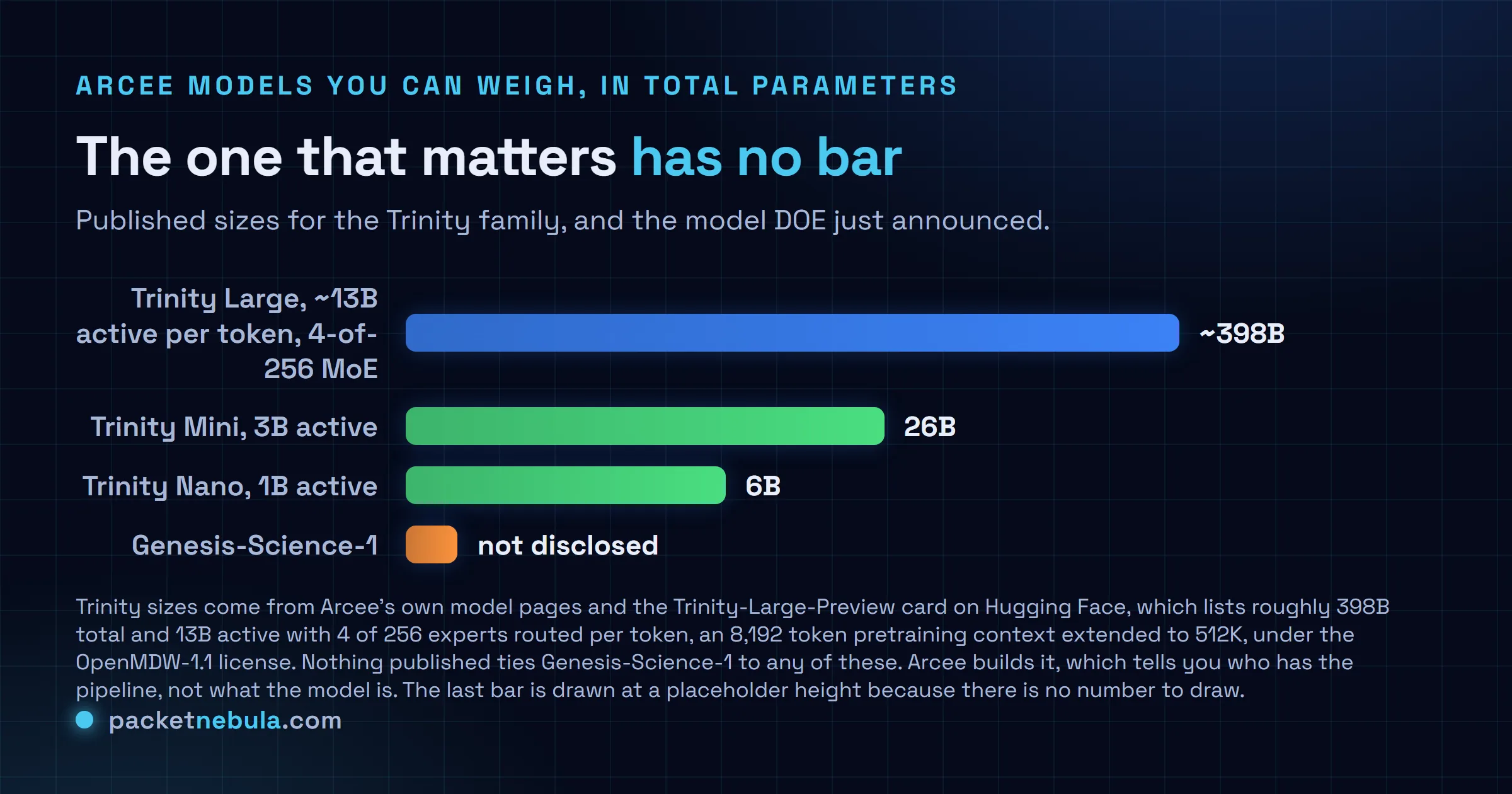
None of that transfers to GS1 automatically. A frontier-scale MoE trained for agentic coding is not the same object as a model trained on curated lab data for simulation work, and the two could easily land at different sizes. What it does tell us is that the pipeline is real, and that Arcee has already picked a license we’d call genuinely open, which makes it slightly more likely GS1 lands somewhere permissive. Slightly. DOE has said nothing about terms, and federal programs have their own opinions about redistribution. If you care about the license, that’s the question to raise in your application, not after.
We wrote about the open-weights letter and its 25 signers a while back, and about how quickly a nominally open release can carry territorial restrictions in its license. Both are worth a glance before anyone celebrates the word “open” in a government press release.
So do you apply
If you run a lab, a university group or a company with reviewed scientific material and people who could judge model output in your domain, then yes, and this week. The pretraining window closes 14 August. What you get back is early evaluation access, contact with the GS1 researchers, and named credit in the technical reports. The application asks about your work, your materials, your reviewers and your usage terms, so the terms conversation happens up front, which is the right place for it.
Everyone else: nothing to do. There’s no endpoint, no repo, no eval to run. Put a reminder in for the next window and get back to work.
The thing I’ll be watching is whether a technical report shows up with an evaluation designed by lab scientists rather than by the vendor. That would be new. Model cards graded by the people who actually have to reproduce the result is a better idea than most of what passes for benchmarking right now, and it’s the one promise in this announcement that would be hard to fake.
Sources
Department of Energy, US Department of Energy Launches the Genesis Open Models Initiative, 7 August 2026. The initiative portal at genesisopenmodels.anl.gov, hosted by Argonne National Laboratory. Arcee AI, Announcing Genesis-Science-1, and the GlobeNewswire release of 23 July 2026 carried by the Manila Times for the McQuade quote. Trinity specifications from Arcee’s Trinity page and the Trinity-Large-Preview model card on Hugging Face. Genesis Mission background from the executive order of 24 November 2025. Announcement image published by Arcee AI.
Frequently asked questions
Can I download Genesis-Science-1 today?
No. Nothing published gives a release date, a repository or a preview endpoint. Arcee says the eventual release will include weights, a technical report and public workbench artifacts, which is a good commitment and not a schedule. What went live on 7 August 2026 is the Genesis Open Models Initiative page at genesisopenmodels.anl.gov and a contribution portal. If you want the model, the only useful action right now is to bookmark the portal.
What is the 14 August deadline for?
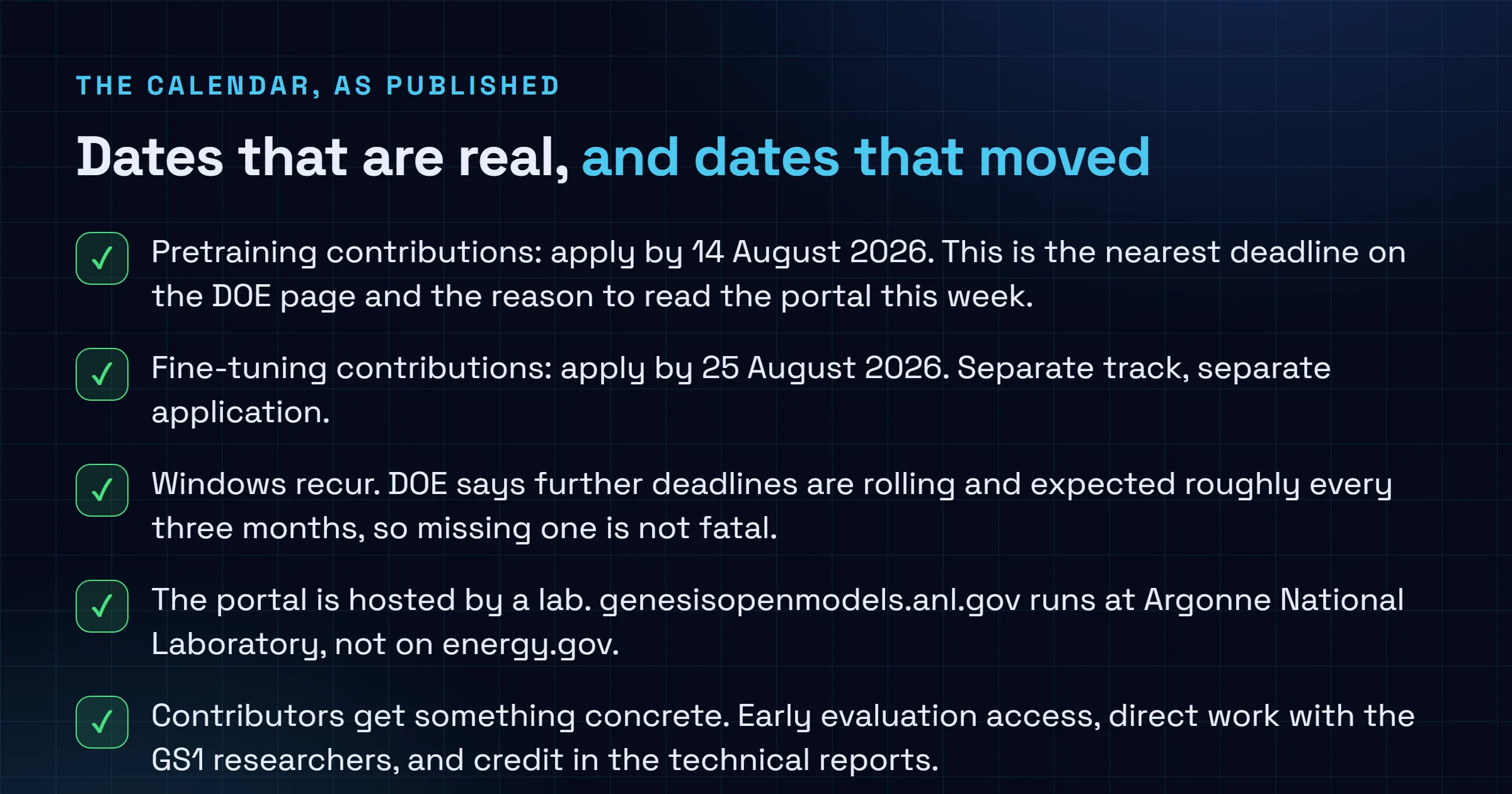
Contributing to the pretraining stage. DOE's page splits participation into two tracks with separate application dates: pretraining contributions by 14 August 2026, fine-tuning contributions by 25 August 2026, with further windows expected roughly every three months. Applicants describe the scientific work they do, the materials they can supply, the experts who would review results, and the terms under which their material can be used. Selected contributors get early evaluation access and credit in the technical reports.
The dates I saw in July were different. Which ones are right?
Use the DOE page and the portal. The Arcee press release of 23 July 2026 named a first contribution window closing 6 August and foundation-stage data due 20 August. The DOE announcement of 7 August lists 14 and 25 August instead. We can't tell you which internal process moved, only that the later, government-hosted page is the one to trust, and that a program advertising rolling quarterly windows is going to keep adjusting them.
Is this an American answer to the Chinese open-weight labs?
That's the framing everyone reaches for, and it's premature. A program with no model in the wild answers nothing yet. What it does establish is a funding and data pipeline aimed at a target commercial labs mostly skip: reproducible scientific computing, in Fortran and MPI as much as Python. If GS1 ships weights with a permissive license and a real evaluation, the comparison becomes worth having. Ask again in six months.
Who is Arcee AI and can they actually build this?
A US open-weight lab with shipped artifacts, which is the relevant credential. Its Trinity family is public on Hugging Face, and the Trinity-Large-Preview card lists roughly 398 billion total parameters with about 13 billion active per token, a 4-of-256 mixture-of-experts routing, an 8,192 token pretraining context extended to 512K, under the OpenMDW-1.1 license. Smaller Trinity Mini and Trinity Nano models sit at 26B and 6B. None of that tells you what GS1 will be, but it does mean the pretraining pipeline exists.


