




Eleven at night on Broadway in Santa Monica, and the cars come home. Not to a garage, to two open lots, where they beep and reverse into the chargers and the sound bounces off the alley walls. On 27 July a Los Angeles County Superior Court judge told Waymo to stop doing that between 11pm and 6am, a preliminary injunction that holds until trial. Rides are untouched. You can still hail a Waymo in Santa Monica at 2am. What the company lost is the right to charge and service its fleet at the two Broadway lots overnight, which sounds like a small thing until you remember that overnight is precisely when a robotaxi fleet is supposed to be plugged in.
The short answer
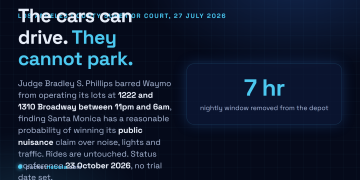
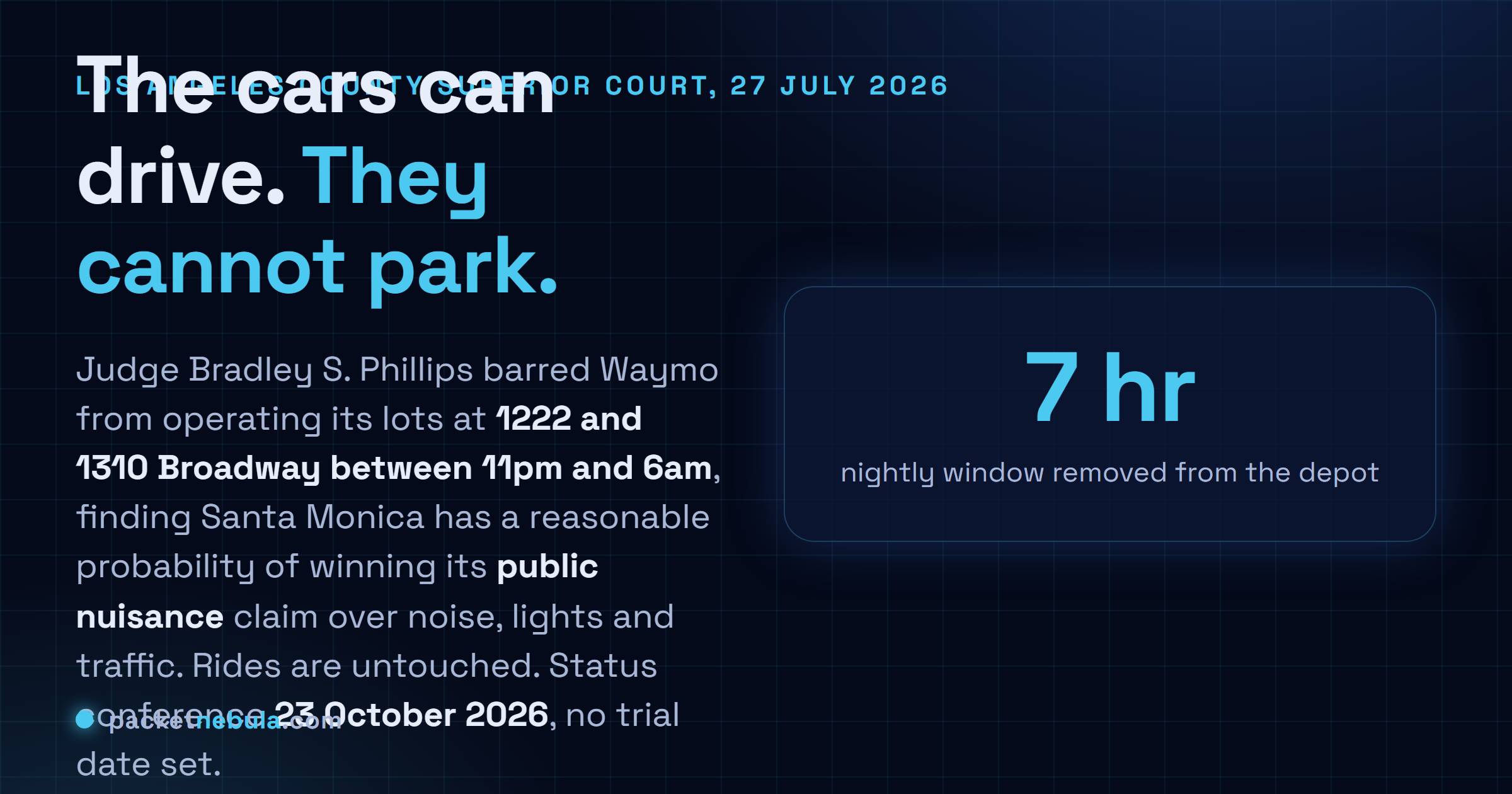
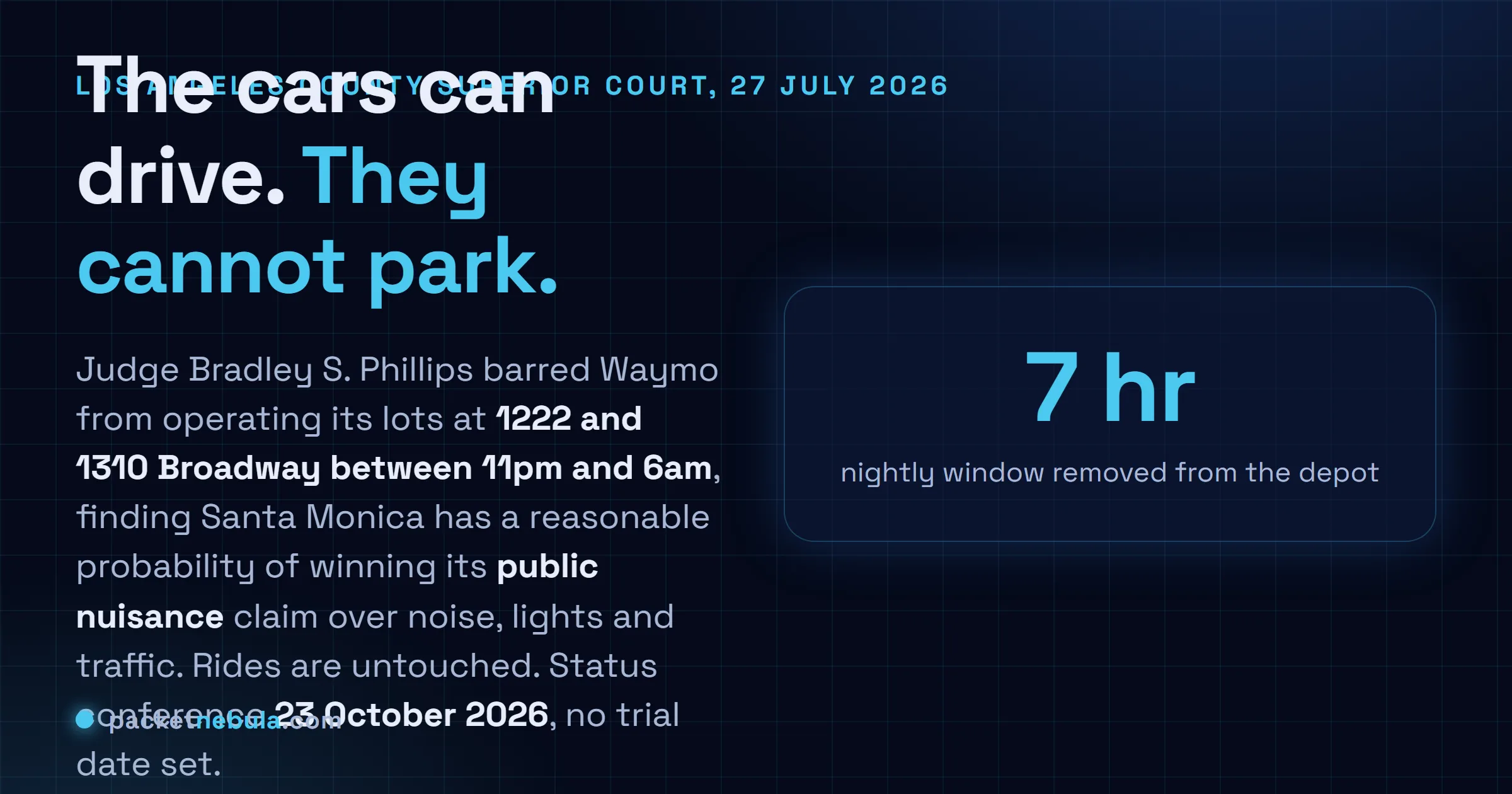
A Los Angeles County Superior Court judge granted Santa Monica a preliminary injunction on 27 July 2026, barring Waymo from operating its charging and servicing lots at 1222 and 1310 Broadway between 11pm and 6am until trial. The claim is public nuisance, brought over noise, lights and traffic. Rides carry on. What the fleet loses is the cheap, idle hours it was built around, and the lever that did it is older than the car.
What the order does, and what it leaves alone
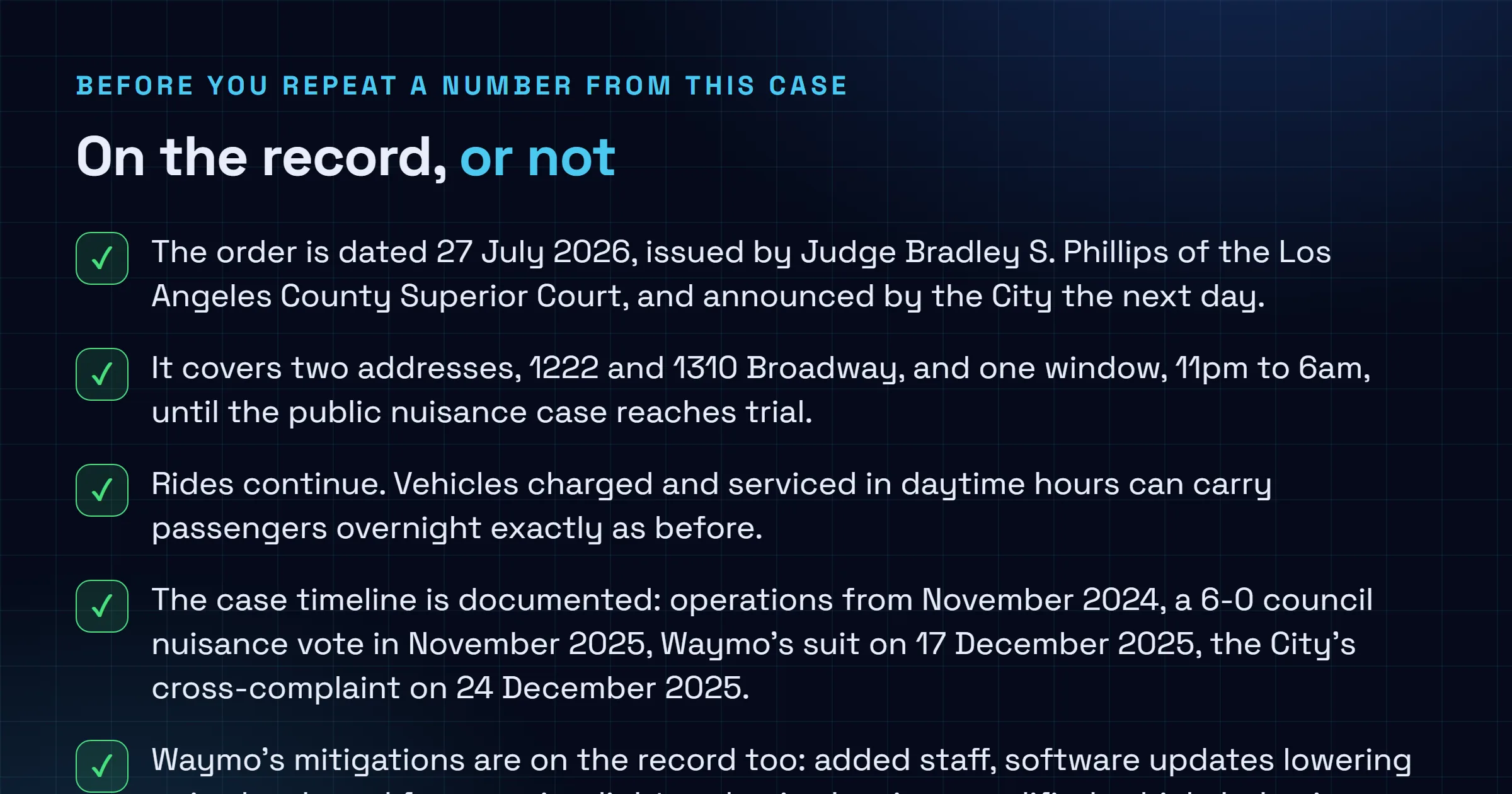
Judge Bradley S. Phillips granted the injunction on 27 July. Two addresses, 1222 and 1310 Broadway. No operations between 11pm and 6am, in force until the public nuisance case reaches trial. The City announced it the following day.
A preliminary injunction isn’t a verdict. Santa Monica had to show a reasonable probability of winning at trial and a balance of harms tipping its way, and the court found both. Waymo’s defence was that its mitigations had already fixed the problem: extra staff, software updates to lower noise levels and frequencies, light and noise barriers, modified vehicle behaviours. The judge’s response is the sentence to keep. The company had not shown those efforts were “sufficiently successful to eliminate the public nuisance that is created.”
Rides are untouched. A car charged and wiped down at noon can work all night, and Waymo hasn’t announced any change to Santa Monica availability. The company said it was disappointed, and that the order “may restrict our ability to provide visitors and residents with a safer, more accessible transportation option during some of the most dangerous hours of the day for road users.” Mayor Caroline Torosis gave the other side just as flatly: “Our residents’ ability to sleep peacefully in their own homes is not negotiable.”
Neither statement is wrong. That’s what makes this worth reading if you never go near Santa Monica.
Nobody models the depot
Here’s the thing about a driverless fleet. The car doesn’t sleep, but it does eat.
An electric vehicle in commercial service needs charging, cleaning, sensor calibration and the whole dull logistics tail that used to happen at somebody’s house. Human rideshare externalises all of it for free. Your driver charges at home, vacuums the back seat in their own driveway, and the platform never books a square foot of real estate for any of it. Delete the driver and every one of those minutes moves onto land the operator has to lease, inside the city it serves, close enough that deadhead miles don’t eat the margin.
So you take the cheapest urban land that fits. Which is a surface lot. Which, in a dense coastal city, is next to housing.
Then you schedule the work at night, because that’s when the cars aren’t earning and the power is cheapest.
That’s not a mistake in the plan. That is the plan. And the injunction removes exactly those hours.
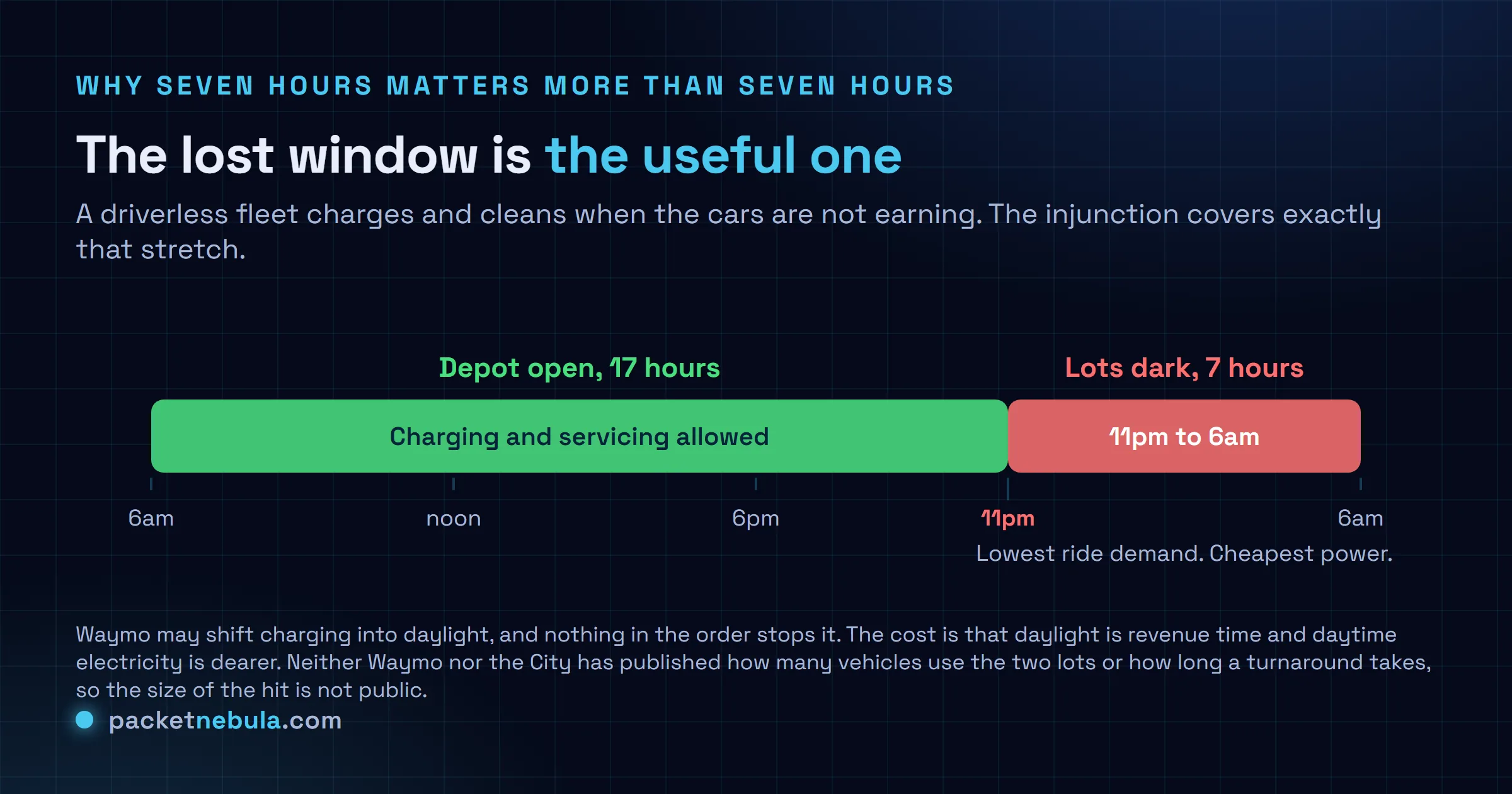
Waymo can move charging into daylight. Nothing stops it. But daylight is when a robotaxi should have a passenger in it, so every kilowatt-hour shifted forward is a car parked during revenue hours, drawing power at a worse rate, in a business where the effective fleet size is however many vehicles you can turn around per day. That isn’t a rounding error in the unit economics. It’s most of them.
I might be wrong about the size of the hit, and honestly nobody outside Waymo can size it, because the company has never published how many vehicles use those two lots or how long a turnaround takes. But the direction isn’t ambiguous.
The lever wasn’t an AV rule
Look at which law did this.
Not the DMV, and not the CPUC, the body that licenses paid autonomous rides in California. NHTSA handles the vehicle itself, and last week it handed Zoox a federal exemption to sell rides in a car with no steering wheel. Every one of those regulators has said yes to driverless operation in some form.
What closed the lots at midnight is public nuisance, a doctrine that predates the internal combustion engine, brought by a city on behalf of people who can’t sleep. One neighbour told a local broadcaster the motors echo down the alleys “like a canyon”. Another described a five year old woken two to four nights a week. There is no decibel figure in any of the coverage we could find, and no vehicle count either, which is a real gap in the public record. The court didn’t need one.
The industry spent a decade fighting the patchwork of state and local autonomous vehicle rules, and mostly won at the vehicle level. This case walks around that fight. Santa Monica is not regulating an autonomous vehicle. It’s regulating what happens on a parking lot at 2am, which it has always been entitled to do, and which no preemption argument reaches.
The shape is the same one we saw when the FCC used equipment authorisation to block foreign-produced robots: the decisive instrument is rarely the one the sector is watching.
If you plan infrastructure for anything
The transferable lesson has nothing to do with cars.
Any system that removes a human operator tends to move that human’s invisible, unpriced overhead onto a balance sheet, usually as real estate, usually in the exact place where it annoys somebody. Self-driving fleets moved home charging into a neighbourhood lot. Cloud regions did it with power and water. Same move, different decade.
Which means the constraint that eventually bites is a local one, arriving through a body nobody in the sector reads: a council vote, a nuisance suit, a noise ordinance written in 1974. If you’re siting anything that runs at night near people, treat the neighbours as a hard technical constraint at the lease stage rather than a PR problem afterwards. Waymo did the mitigation work, and by the court’s reading it did quite a lot of it. It just did it after the complaints, against a standard that asks whether the nuisance is gone, not whether you tried.
Status conference on 23 October. No trial date yet.
Sources: the ruling date, the two Broadway addresses, the 11pm to 6am window, the public nuisance finding, the Torosis quote and the 23 October status conference come from the City’s own announcement, Court grants City’s request for preliminary injunction (28 July 2026). The judge’s name and his line about mitigation not eliminating the nuisance, plus the resident accounts, are reported by FOX 11 Los Angeles and Patch Santa Monica. The case timeline, the 6-0 council vote of November 2025 and Waymo’s list of mitigations are in the Santa Monica Daily Press and Westside Current. Waymo’s statement is quoted in both Patch and the Daily Press. No decibel measurements, vehicle counts or trial date have been published by any party.
Frequently asked questions
What exactly did the judge order Waymo to stop doing?
Judge Bradley S. Phillips issued a preliminary injunction on 27 July 2026 barring Waymo from operating its two charging and servicing facilities, at 1222 and 1310 Broadway in Santa Monica, between 11pm and 6am. It holds while the City's public nuisance case proceeds toward trial. It covers those two lots only.
Can you still get a Waymo ride in Santa Monica at night?
Yes. The order restricts operations at the two Broadway lots, not the service. Vehicles charged and serviced during daytime hours can carry passengers overnight as before. Waymo has not announced any change to its Santa Monica ride availability.
Why did the City win when Waymo says it already reduced the noise?
The standard for a preliminary injunction is a reasonable probability of success at trial plus a balance of harms, not a final verdict. Waymo told the court it had hired staff, pushed software updates to lower noise levels and frequencies, installed light and noise barriers and modified vehicle behaviours. The judge accepted that mitigation happened but found the company had not shown those efforts were, in his words, sufficiently successful to eliminate the public nuisance that is created.
How did this case start?
Charging operations at the Broadway lots began in November 2024. Residents complained for more than a year about noise, lighting and traffic. In November 2025 the City Council voted 6-0 to declare the facilities a public nuisance. Waymo sued the City on 17 December 2025, and the City filed a cross-complaint on 24 December 2025.
What happens next, and when?
A status conference is set for 23 October 2026 to review remediation measures. No trial date has been scheduled. The injunction stays in force in the meantime, and an appeal has not been announced.