
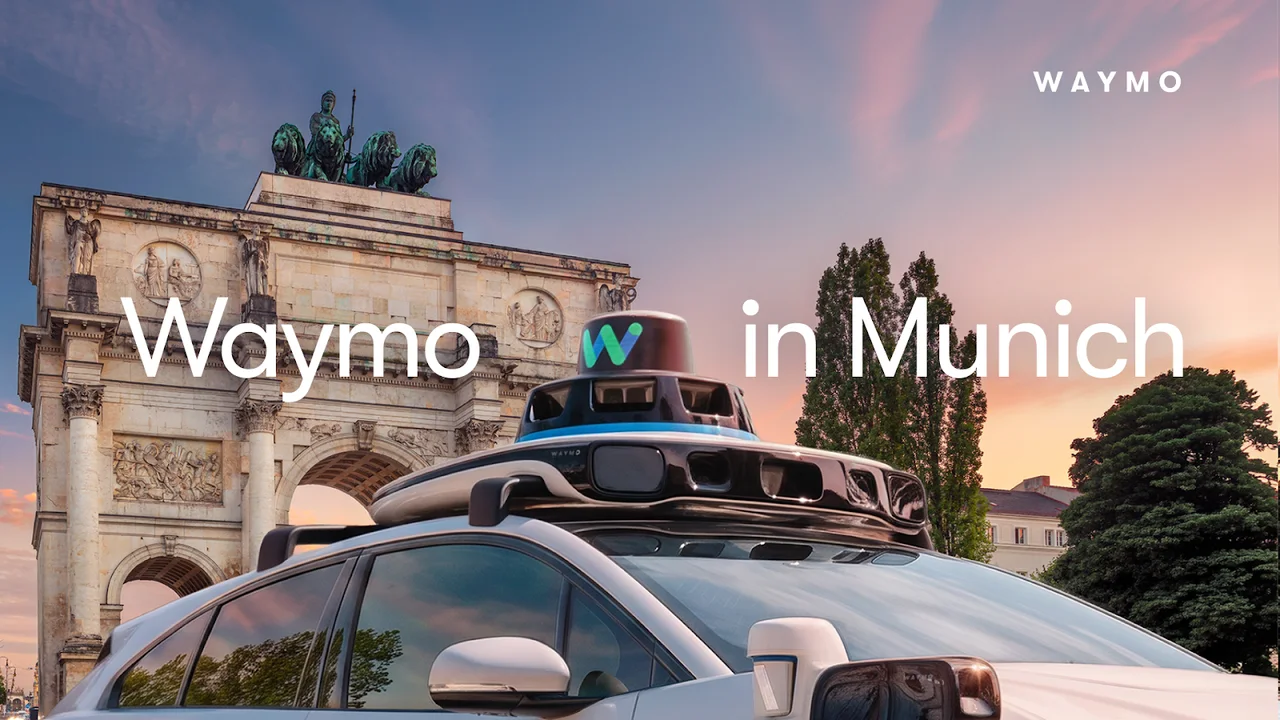
The picture Waymo put out is a white Jaguar under the Siegestor at sunset, sensor dome on the roof, nobody visibly in it. Right now that picture is the whole product. On 25 August the company said it's bringing its robotaxi service to Munich, the first city it has named inside the European Union, with paid public rides targeted for the end of 2027. Mapping starts in the coming weeks, driven manually by trained specialists. Between that and a fare sit two separate German permits, and Waymo holds neither of them. One of those permits is federal and one is Bavarian, which is the part almost every write-up folded into a single sentence about the KBA.
The short answer
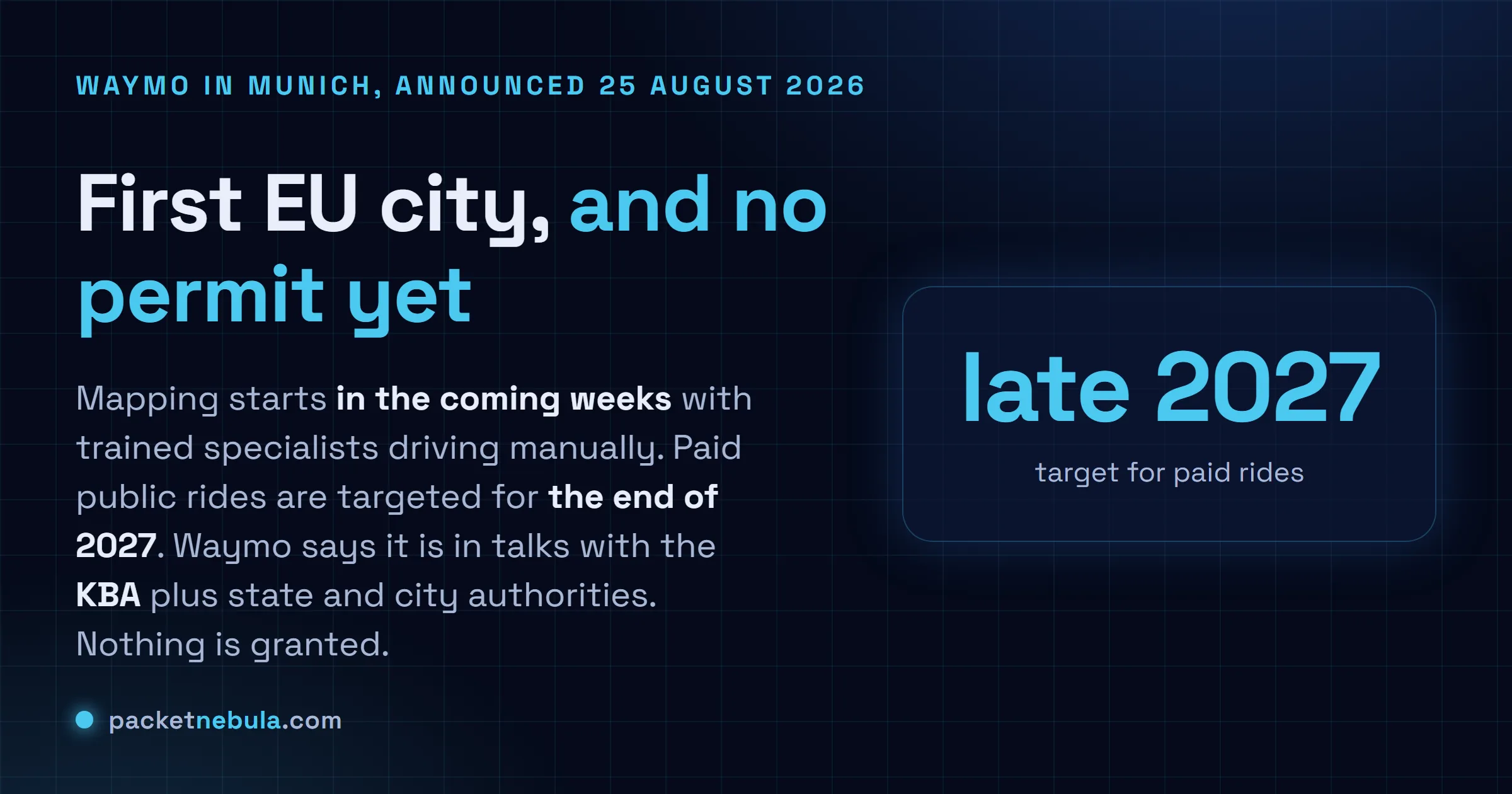
Waymo announced Munich on 25 August 2026. It’s the company’s first named city in the European Union and its third international one, after Tokyo and London, where it is still testing rather than selling rides. Manual high definition mapping begins in the coming weeks. A commercial service is targeted for the end of 2027, subject to approvals nobody has granted. Germany’s 2021 law makes that a two desk problem: the KBA signs off the vehicle, Bavaria signs off the operating area.
What Waymo actually announced
A blog post titled “Servus München”, published 25 August. In it Waymo says it is bringing fully autonomous driving to Munich, that vehicles will start driving the city manually in the coming weeks so its specialists can build high definition maps and see how the Waymo Driver handles local roads, and that it aims to open a commercial service to the public towards the end of 2027. It says it is working with the Kraftfahrt-Bundesamt, with state authorities and with city officials on what it needs.
That’s the announcement. Everything else is context the company chose to put around it.
Image: Waymo, from its Munich announcement.
The context is a safety pitch, and the numbers are Waymo’s own. More than 20 million trips completed. Hundreds of thousands of commercial rides a week. Over 350 million fully autonomous kilometres, across which the company reports 16 times fewer serious injury crashes than human drivers over the same distance, 14 times fewer injury crashes involving pedestrians, 6 times fewer involving cyclists. Those are self published figures against a benchmark Waymo constructs, which doesn’t make them fake, it makes them a company’s account of itself. Read them as the argument being made to the KBA, because that is what they are.
Waymo also lined up political cover in the post. Christian Hirte, Parliamentary State Secretary at the Federal Ministry of Transport, and Dr. Florian Herrmann, who heads the Bavarian State Chancellery. Federal and state, which is not an accident.
The bit that got flattened: Germany needs two permits
Here’s why that pairing matters. Germany passed the Act on Autonomous Driving, which took effect on 28 July 2021 and made it the first country in the EU with a legal route to commercial Level 4 operation. Good news for Waymo. The catch is how the law splits the job.
The Kraftfahrt-Bundesamt issues the vehicle’s operating permit, the Betriebserlaubnis. That’s federal, and it covers the car and its autonomous driving function. Separately, the operating area the car is allowed to drive in, the festgelegter Betriebsbereich, has to be approved by the competent state authority. For Munich that’s Bavaria. Then the vehicles get registered and plated like anything else on the road.
So when a headline says Waymo is working with the KBA, that’s half a sentence. The KBA can bless the Jaguar and Bavaria can still take its time over which streets it runs on, and neither of those is a rubber stamp for a company that has never operated a metre of public road service in Europe.
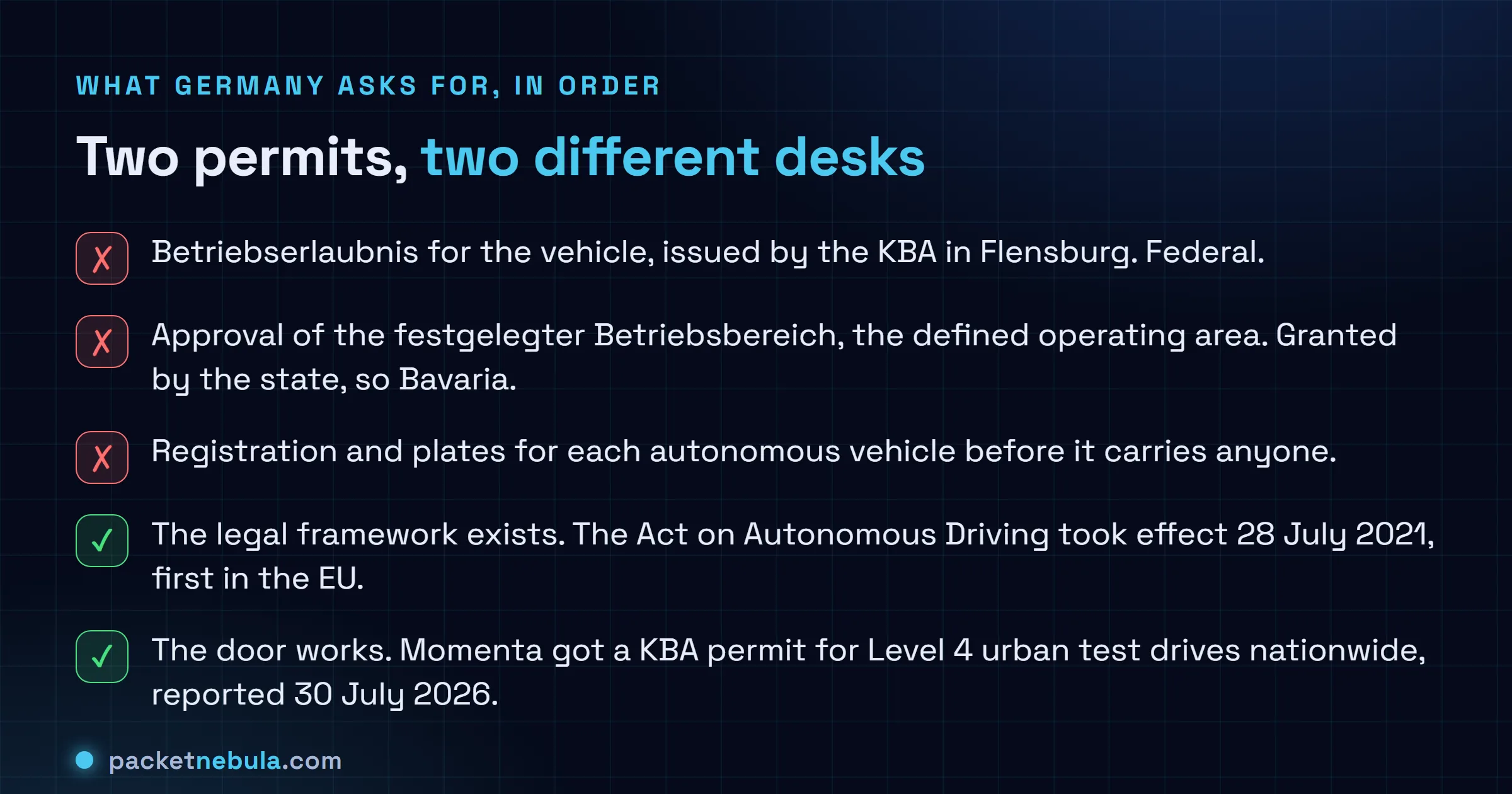
Worth knowing: Waymo isn’t first through the KBA door, or even first in Munich. On 30 July 2026 it was reported that Momenta, the Chinese autonomous driving firm partnered with Uber, had cleared a KBA permit for Level 4 test drives on urban roads across Germany, with Munich as its primary market. Testing permit, not an operating licence, and the coverage said so plainly. But it’s evidence the process moves, and it means the first driverless car you see near the Isar might not have a Waymo dome on it.
Sixteen months, and what that would take
Now the honest bit. Waymo has given itself roughly fifteen months from the first mapping car to a paying passenger in a European capital city where it holds nothing today. I might be wrong about this, but that would be the fastest international ramp the company has ever run.
Tokyo is the comparison nobody likes. Waymo began testing there in April 2025. Sixteen months later, at the time of the Munich announcement, Tokyo is still described as a market where Waymo is testing. London started in spring 2026 with Jaguar I-PACE cars and safety drivers, and a launch pencilled in for 2026 that depends on the UK finalising its approval process. Neither city sells a driverless ride yet.
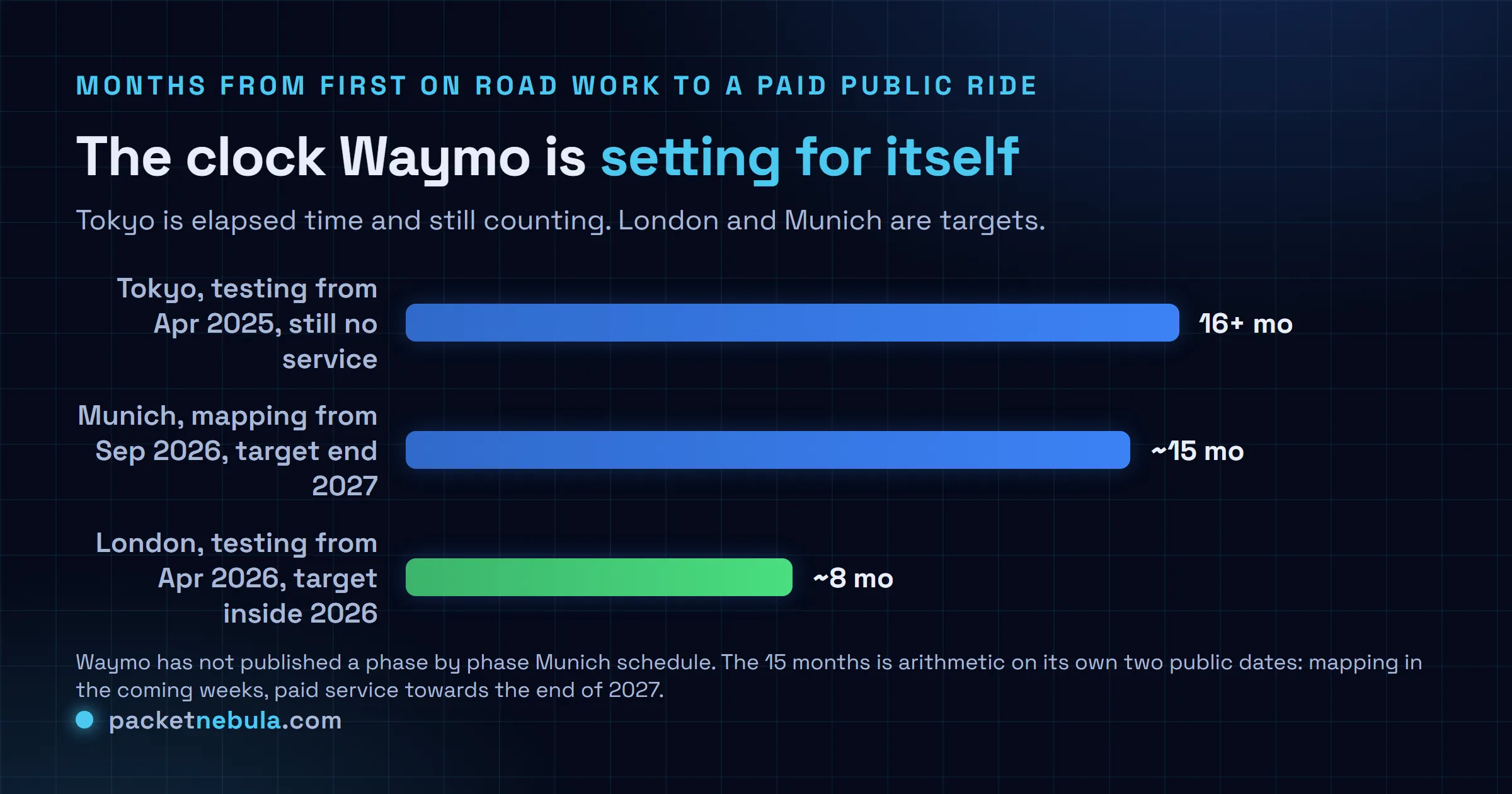
None of that makes the Munich plan hollow. Waymo’s US record is the strongest in the business and the company doesn’t announce cities it walks away from. It does mean the useful mental model for the next year is mapping and validation, not rides. And the boring parts bite late: in Santa Monica the thing that actually constrained Waymo this summer was where it parks and charges overnight, not the driving. The phases it runs everywhere: manual mapping, then autonomous testing with a trained validation driver in the seat, then employee and press rides, then a limited public service, then commercial operations. Munich is at step zero of five.
Why anyone outside Munich should care
Because Germany is the test of whether the EU framework does anything. Every other European market either lacks a Level 4 commercial route or has one on paper that nobody has walked through. If Waymo gets a Betriebserlaubnis and a Bavarian operating area, the template exists and the next city is an administrative exercise instead of a legislative one. If it stalls, the 2021 law was a press release with a legal citation.
The competitive picture around it is already crowded and mostly non American. Volkswagen’s MOIA runs autonomous shuttles in Hamburg. Verne operates commercially in Zagreb. Momenta has its test permit and its Uber deal. Wayve is in London with Uber, licensed by TfL in August for up to 15 cars, every one of them with a human driver on board. That last detail is the one to keep in your head when you read the word robotaxi this year, because it keeps meaning “supervised trial” in Europe and “empty driver’s seat” in Phoenix.
Munich would be the first EU city where the word means the American thing. Late 2027, if the paperwork lands.
Sources
Waymo’s announcement post, Servus München: Waymo is Coming to Germany (25 August 2026), for the phases, the target and the safety figures. TechCrunch, Waymo robotaxis are headed to Munich, for the permit status and the European competitive context. Zag Daily for the Jaguar I-PACE and validation driver detail, and for the undisclosed fleet size. Electrive for the pending approvals. The German legal split comes from the KBA’s own page on autonomous driving and the CMS guide to autonomous vehicle regulation in Germany. The Momenta permit is from Electrive, 30 July 2026. Waymo’s Tokyo and London timelines come from TechCrunch’s April 2026 report on London testing.
Frequently asked questions
When can you actually hail a Waymo in Munich?
Waymo targets the end of 2027 for a commercial service open to the public, and it calls that a target, not a date. Before then it plans manual mapping starting within weeks of the 25 August 2026 announcement, then autonomous testing with trained validation drivers on board, then limited rides. Every step past mapping depends on approvals the company does not have yet.
Which German authority has to approve a driverless robotaxi?
Two of them. Under the Act on Autonomous Driving, in force since 28 July 2021, the Kraftfahrt-Bundesamt issues the operating permit for the vehicle itself, and the responsible state authority approves the defined operating area the car may drive in. For Munich that second approval is Bavaria's to give. The vehicles also have to be registered like any other car.
Is Munich really the first robotaxi city in the EU?
It would be the first EU city with a regular driverless commercial service if Waymo hits its 2027 target, which nobody has done yet. Autonomous vehicles already run in Europe in other shapes. Volkswagen's MOIA operates autonomous shuttles in Hamburg, and Verne runs a commercial service in Zagreb, which is outside the EU's largest markets but inside the EU.
Which cars will Waymo use in Munich, and how many?
Waymo has not disclosed a fleet size, and its own blog post does not name the vehicle. Coverage of the announcement describes a small fleet of all-electric Jaguar I-PACE cars across several Munich districts, which matches the vehicle in Waymo's own announcement image and the fleet it put on the road in London. Treat the platform as very likely rather than confirmed by the company.
Is Waymo the first company through the KBA door in Germany?
No. Momenta, which is partnered with Uber, was reported on 30 July 2026 to have cleared a KBA permit for Level 4 test drives on urban roads across Germany, with Munich as its primary market. That permit is for testing, not for carrying paying passengers, and plenty of approval steps sit between the two.


