




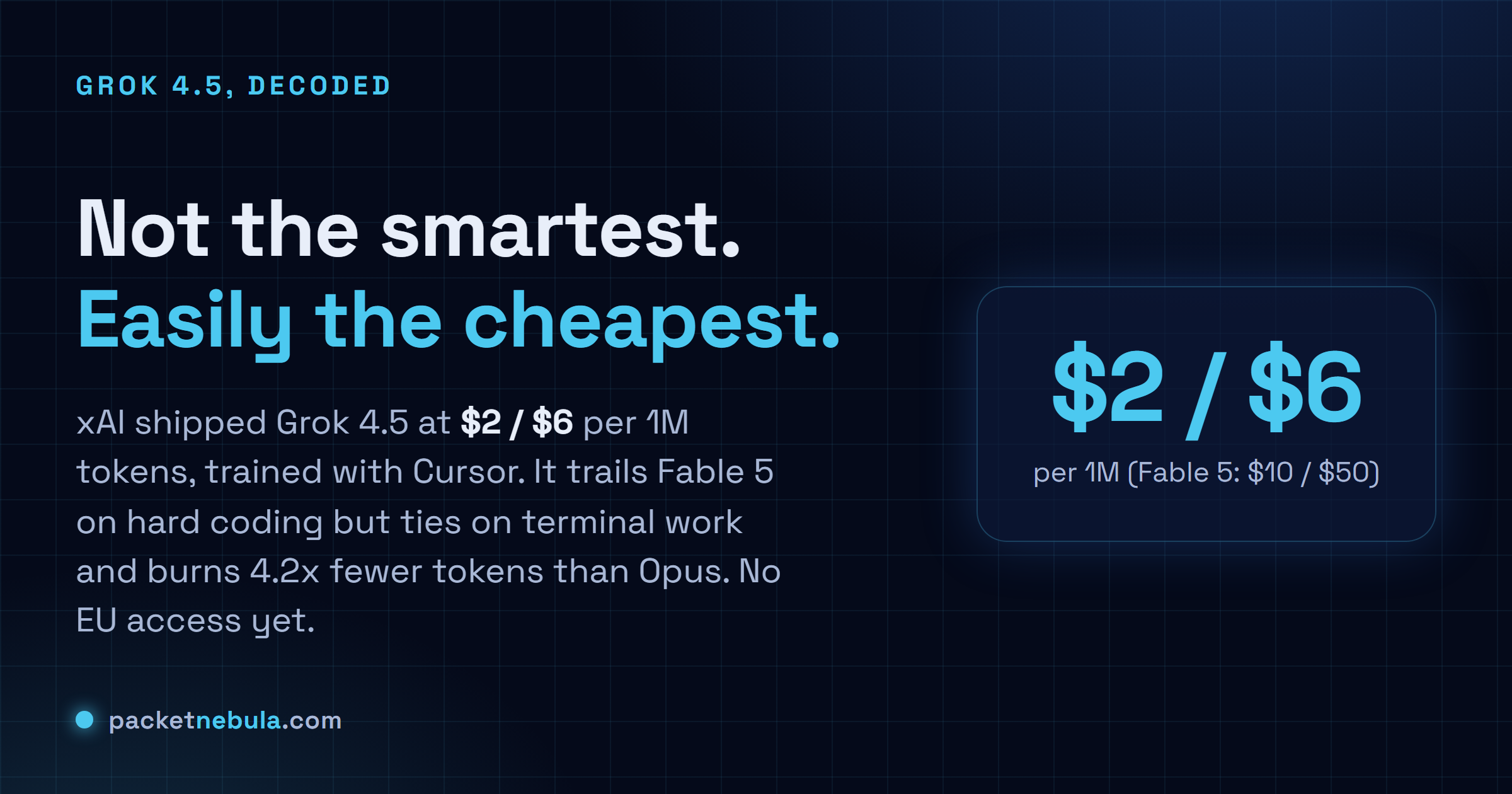
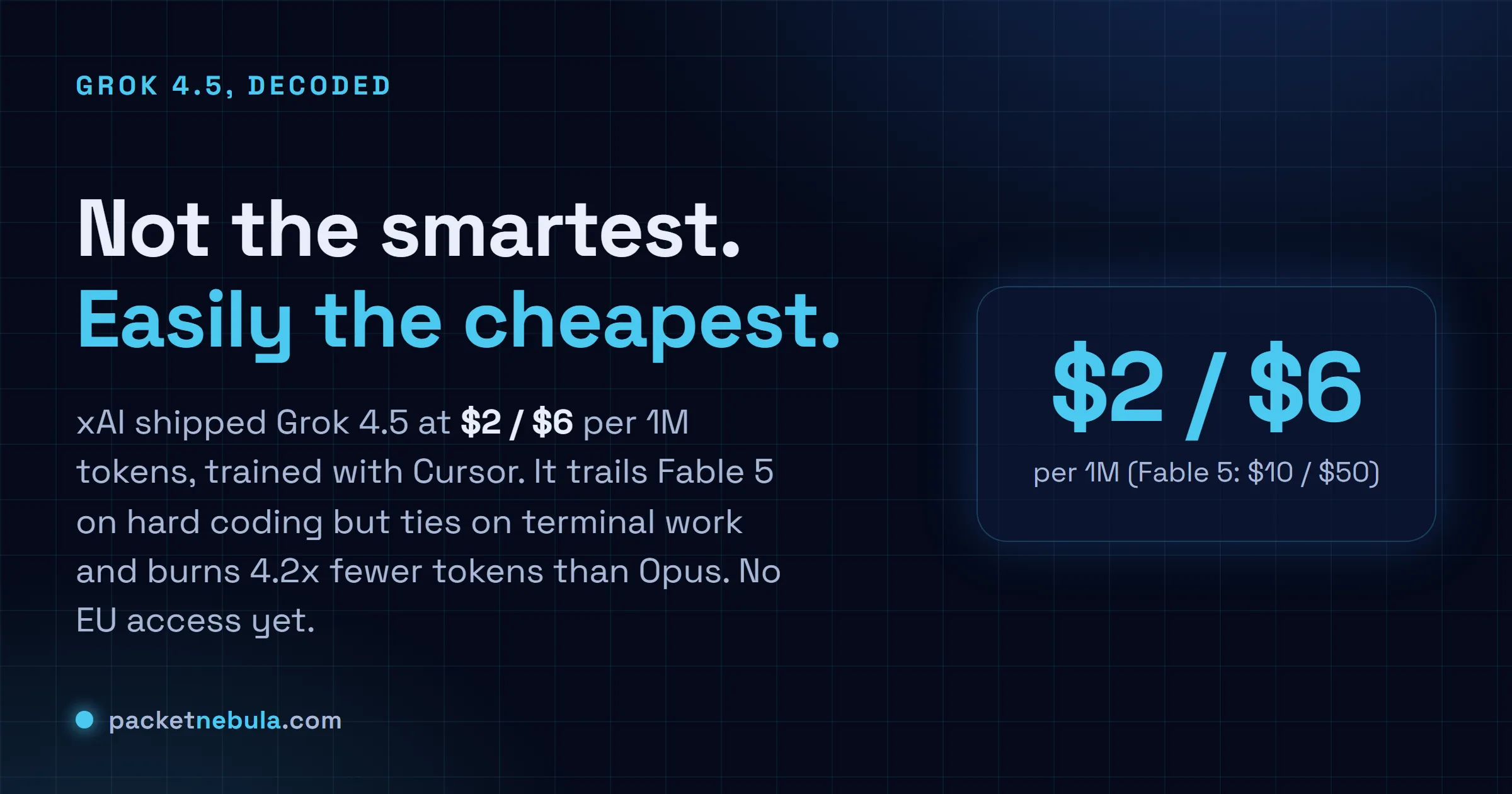
xAI shipped Grok 4.5 on July 8, and the number that matters is not a benchmark, it's the price: $2 in, $6 out per million tokens. That undercuts every frontier coding model, some of them badly. Grok 4.5 is not the smartest model on the market, it trails Anthropic's Fable 5 on the hard coding tests, but it is by a distance the cheapest one anyone takes seriously, and it burns far fewer tokens getting there. It was trained alongside Cursor and ships inside it, aimed at coding and agent work rather than chat. One catch for us in Europe: it isn't available in the EU yet. Here is what actually launched, and whether the price makes the gaps forgivable.
The short answer
Grok 4.5 landed July 8 as the cheapest serious coding model: $2 in, $6 out, about 80 tokens a second, trained alongside Cursor and shipping inside it. It trails Fable 5 on the hard coding benchmarks but is essentially tied on terminal work, and it burns a fraction of the tokens. The price is the pitch. The catch, for us: no EU access yet.
The launch, in one line: price
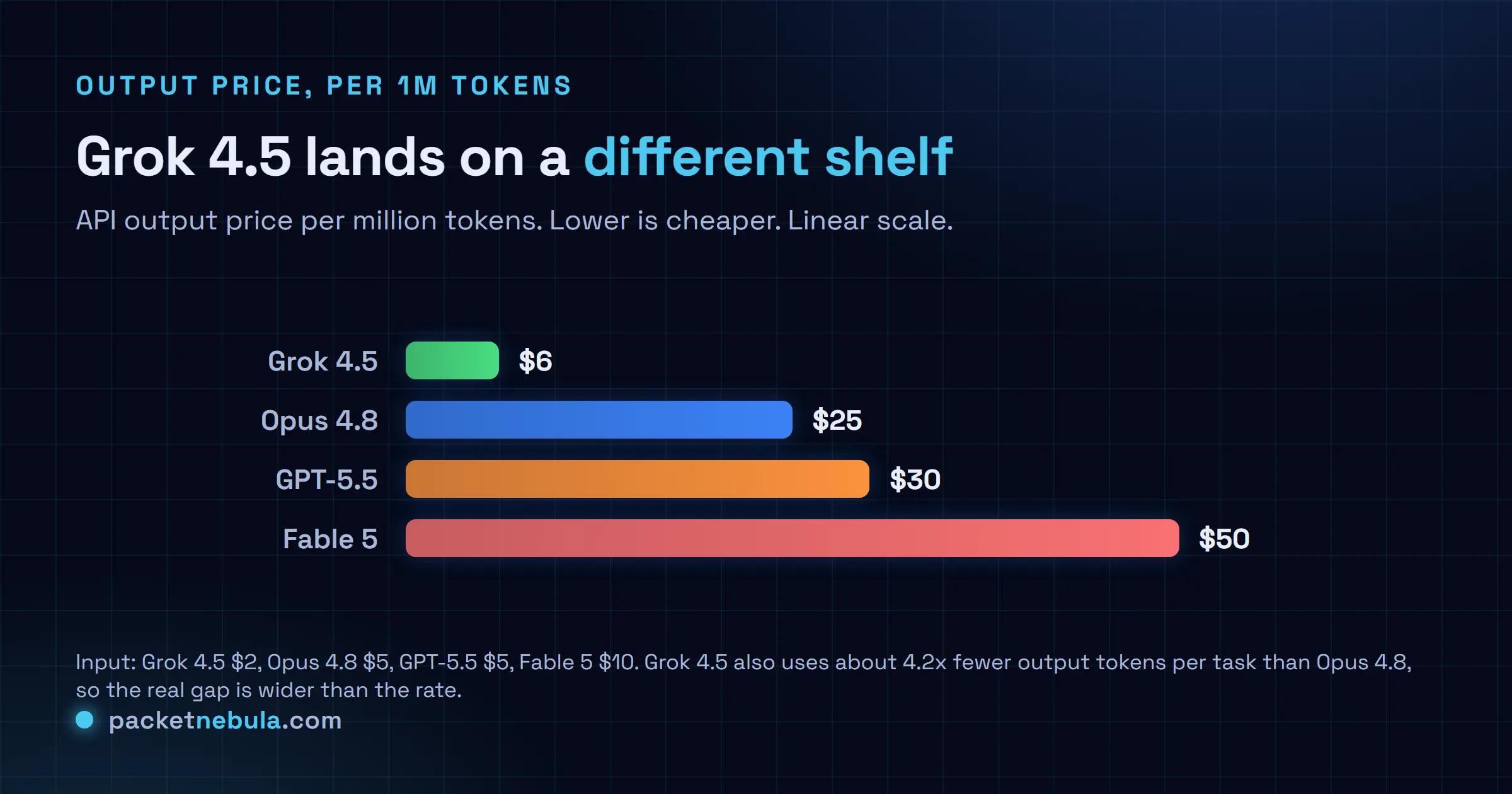
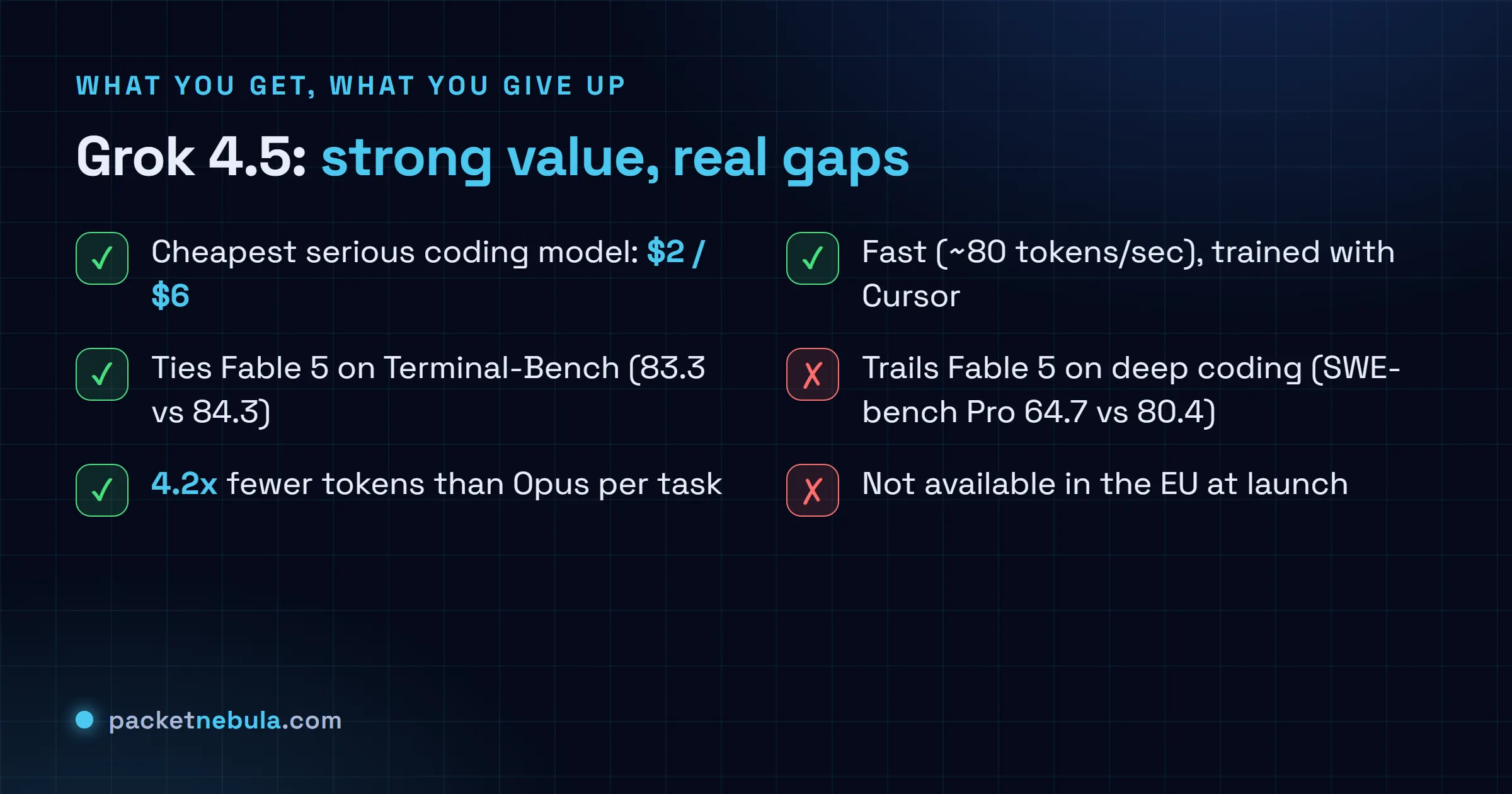
xAI does not usually win on modesty, so it is a little funny that Grok 4.5’s headline is a spreadsheet. At $2 input and $6 output per million tokens, it undercuts the field: Opus 4.8 sits at $5/$25, GPT-5.5 at $5/$30, and Anthropic’s flagship Fable 5 at $10/$50. On output tokens, the part of any bill that hurts, Grok 4.5 is roughly four times cheaper than Opus and more than eight times cheaper than Fable 5. That is not a discount. That is a different shelf.
The model went public on July 8, live inside Cursor on all plans and through xAI’s own console. It was trained alongside Cursor, the AI coding editor, which tells you what it is for: writing and fixing code, driving agents, grinding through office work, not holding a conversation. It runs around 80 tokens a second, which feels quick when you are watching it edit a file.
Where Grok 4.5 actually holds up
Cheap would not matter if the model were bad, and it isn’t. On Terminal-Bench 2.1, the test for command-line and agent work, Grok 4.5 scores 83.3, a hair behind Fable 5’s 84.3 and ahead of Opus 4.8’s 78.9. For the everyday shape of agentic coding, the kind of loop that reads a file, runs a test and patches, it is right there with models that cost five to eight times more per token.
Then the efficiency. xAI reports Grok 4.5 resolves SWE-bench Pro tasks using about 15,954 output tokens on average, against roughly 67,020 for Opus 4.8 at maximum effort. That is a 4.2x gap, and it stacks on top of the cheaper rate. Cheaper tokens, and far fewer of them. For anyone running an agent at volume, where the token meter never stops, that combination is the whole argument, and it is a strong one.
Where it trails, and it does
Now the honest column. On the deep coding benchmarks, Grok 4.5 is not frontier. SWE-bench Pro, the multi-file repository test, has it at 64.7 against Fable 5’s 80.4 and Opus 4.8’s 69.2. On DeepSWE 1.1, which measures resolving real GitHub issues, it hits 53 against Fable 5’s 70. Those are not small gaps. On a genuinely hard, sprawling change, the more expensive models still land more of them, and the difference is the kind you find in production rather than in review.
So Grok 4.5 is not the model you reach for when a task is at the edge of what any model can do. It is the model you reach for when the task is normal, the volume is high, and the bill is real, which describes most of the coding most teams actually do.
The catch we can’t ignore: no EU
For readers here, there is a blocker that no benchmark shows. At launch, Grok 4.5 is not available in the European Union. If you are in the EU and you want to use it today, you can’t, full stop, and that decides the question before any price or score does. It is a fair bet xAI opens access later, but “later” is not a plan you can build on this week.
If you are outside the EU and you spend real money on coding tokens, Grok 4.5 is the most interesting launch of the month, and you should try it on your own workload before trusting any benchmark, ours included. If you want the model that wins the hardest coding outright, that is still Fable 5, and we put the two head to head in Claude Fable 5 vs Grok 4.5. If you want the cheaper end of the Anthropic family instead, our Sonnet 5 vs Opus 4.8 breakdown covers it. The pattern across all of them holds: the frontier keeps getting more crowded, and cheaper, from the bottom.
Sources: xAI’s Grok 4.5 announcement and provider listings; benchmark and pricing tables collated by The Decoder and OpenRouter, July 8 2026. Some figures are xAI-reported and not yet independently reproduced; EU availability and exact context limits may change.
Frequently asked questions
How much does Grok 4.5 cost?
Two dollars per million input tokens and six per million output. For comparison, Opus 4.8 is $5/$25, GPT-5.5 is $5/$30, and Fable 5 is $10/$50. On output, the most expensive part, Grok 4.5 is about four times cheaper than Opus and more than eight times cheaper than Fable 5.
Is Grok 4.5 better than Claude Fable 5?
Not on raw capability. Fable 5 leads the hard coding tests: SWE-bench Pro 80.4 against Grok 4.5's 64.7, and DeepSWE 1.1 70 against 53. Grok 4.5 is essentially tied on Terminal-Bench (83.3 vs 84.3). So Fable 5 wins the benchmarks; Grok 4.5 wins the invoice, by a wide margin.
Why is Grok 4.5 so cheap to run?
Two reasons. The per-token rate is low, and the model is unusually token-efficient: xAI reports it resolves SWE-bench Pro tasks using about 15,954 output tokens on average, against roughly 67,020 for Opus 4.8 at max effort, a 4.2x gap. Cheaper tokens and fewer of them compound, so the real per-task cost is lower still.
Can I use Grok 4.5 in the EU?
Not yet. At launch Grok 4.5 is not available in the European Union. If you are in the EU and want a frontier coding model today, that points you back to the Claude, GPT or open-weight options until xAI opens access.
What is Grok 4.5 built for?
Coding, agentic tasks and office work rather than open-ended chat. It was trained alongside Cursor, the AI coding editor, and ships inside it on all plans, plus xAI's own console. It runs at roughly 80 tokens per second, which is quick for a model in this tier.