




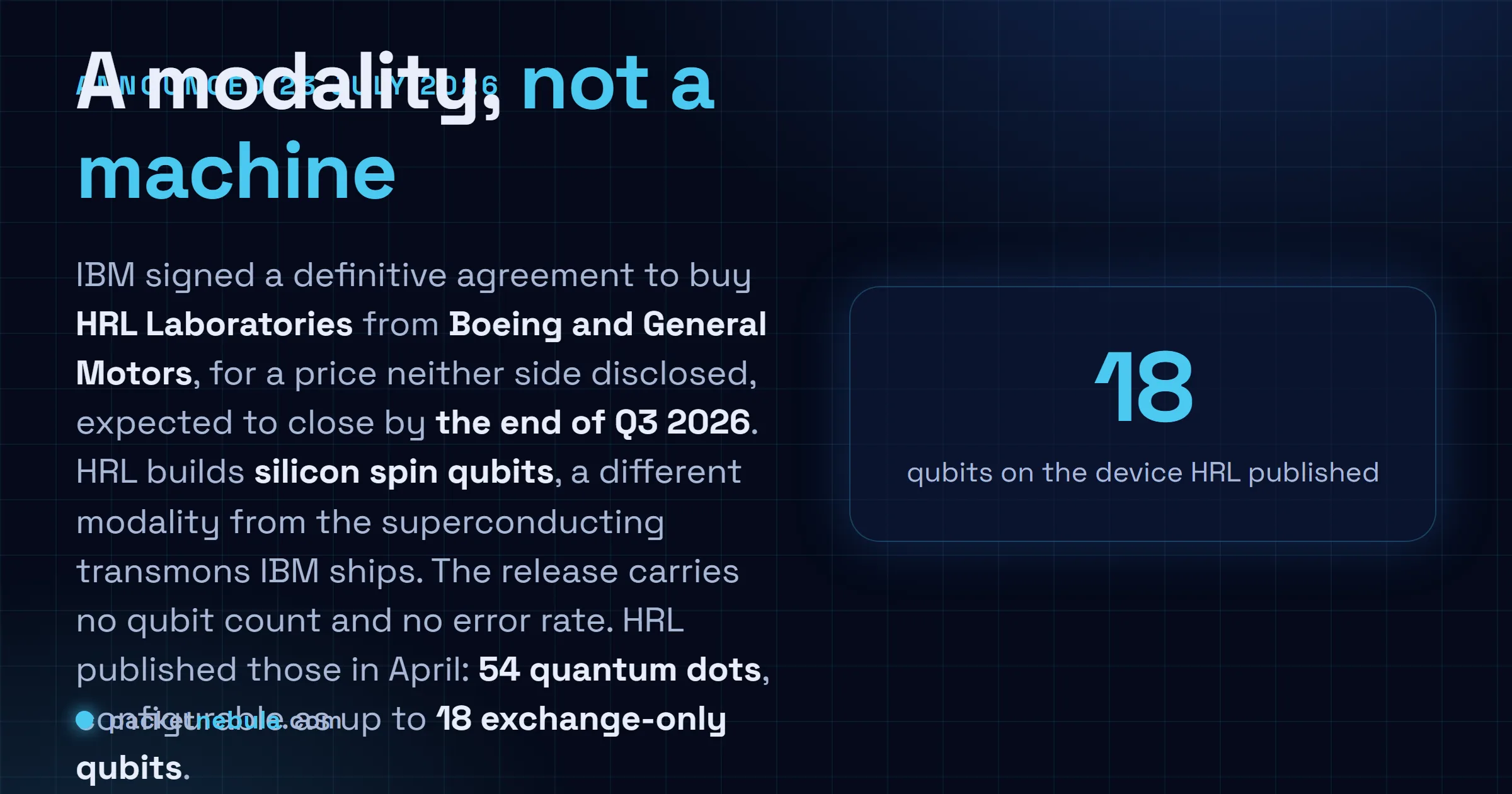
Read IBM's July 23 announcement twice and you still won't find a number in it. Not a price. Not a qubit count either. What it does say is that IBM signed a definitive agreement to buy HRL Laboratories from Boeing and General Motors, and that HRL builds silicon spin qubits, a different way of making a qubit from the superconducting transmons IBM has shipped for years. The receipts sit somewhere else entirely. HRL posted them on arXiv back in April: a chip carrying 54 quantum dots, wired up as as many as 18 exchange-only qubits, with the control electronics sitting down in the cold with them. That's the substance. The better question is why IBM wanted it two months after announcing a 300mm quantum foundry.
The short answer
IBM signed a definitive agreement on July 23 to acquire HRL Laboratories from Boeing and General Motors, buying a silicon spin qubit programme that sits alongside, not inside, its superconducting line. Terms weren’t disclosed and the release carries no qubit count. The real technical record is an April preprint from the HRL team: 54 exchange-coupled quantum dots, configurable as up to 18 exchange-only qubits, with a cryogenic CMOS controller on the same cold stage. Nothing here moves IBM’s 2029 Starling target, which is a superconducting machine. What it does look like, to us, is IBM finding a second product line for the 300mm quantum foundry it announced in May.
What IBM actually signed
The paperwork is the firm part. It’s a definitive agreement, not a letter of intent, and IBM expects it to close by the end of the third quarter of 2026 subject to customary closing conditions and regulatory approvals. We’d flag that last clause harder than most coverage did. HRL has spent decades doing work for government customers, and Boeing owns half of it, so “regulatory approvals” here is a real gate rather than boilerplate.
HRL itself is an odd and rather wonderful thing to be able to buy. Based in Malibu, running for over eighty years, and jointly owned by Boeing and GM. Its portfolio goes well past qubits into quantum sensing and materials science. Jay Gambetta, IBM’s director of research, framed the purchase around the people: the HRL team “brings a broad portfolio of technologies that will strengthen IBM’s long-term plans to deliver useful quantum computing to the world.”
Both Boeing and GM stay on as partners on quantum applications. So this isn’t a retreat by the sellers so much as a change in who funds the hard part.
The number nobody put in the coverage
Here’s what bugged us reading the roundups. Every one of them repeated that HRL does silicon spin qubits, and not one linked the paper where HRL says how well.
It’s public, and it’s free. “A digitally controlled silicon quantum processing unit”, arXiv:2604.16216, submitted April 17 and released under CC BY 4.0. The chip is a three-rail array of 54 exchange-coupled quantum dots that can be configured to host up to 18 exchange-only qubits. Around it sits a custom cryogenic CMOS controller and a high-density superconducting ribbon cable, which is the unglamorous half of the problem: wiring. The team reports single-qubit and entangling performance an order of magnitude past the previous exchange-only state of the art, then validates the system by running a distance-5 repetition code and an error detecting code against simulation.
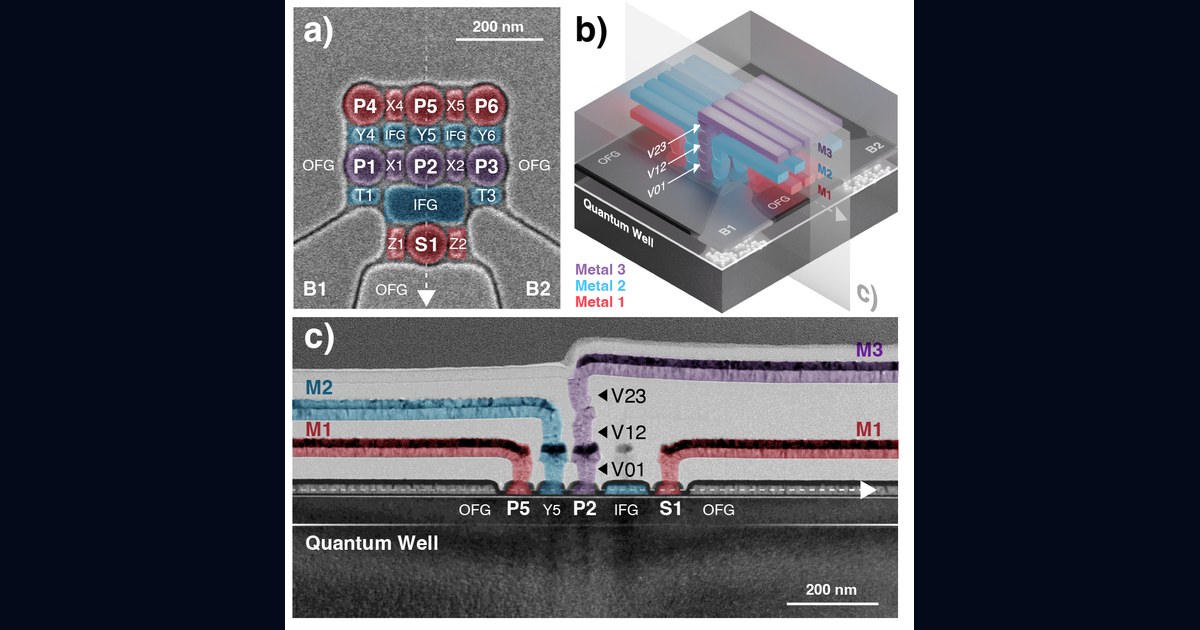
Image: HRL Laboratories, Figure 1 of arXiv:2604.16216, CC BY 4.0, placed on our background without cropping.
Look at the scale bars. Two hundred nanometres across the whole gate structure. That’s the argument for this modality in one picture, and it’s why the phrase “CMOS compatible” keeps coming up.
Two tracks feeding one fab
Now the part we think matters, and we’ll mark it clearly as our reading rather than IBM’s framing.
On May 21, IBM announced Anderon: a pure-play quantum wafer foundry in Albany, New York, built on a proposed $1 billion CHIPS award matched by $1 billion of IBM money. The pitch was 300mm quantum wafers, manufactured as a service for other quantum hardware companies too. A neutral fab, in other words.
Two months later IBM buys a silicon spin qubit team.
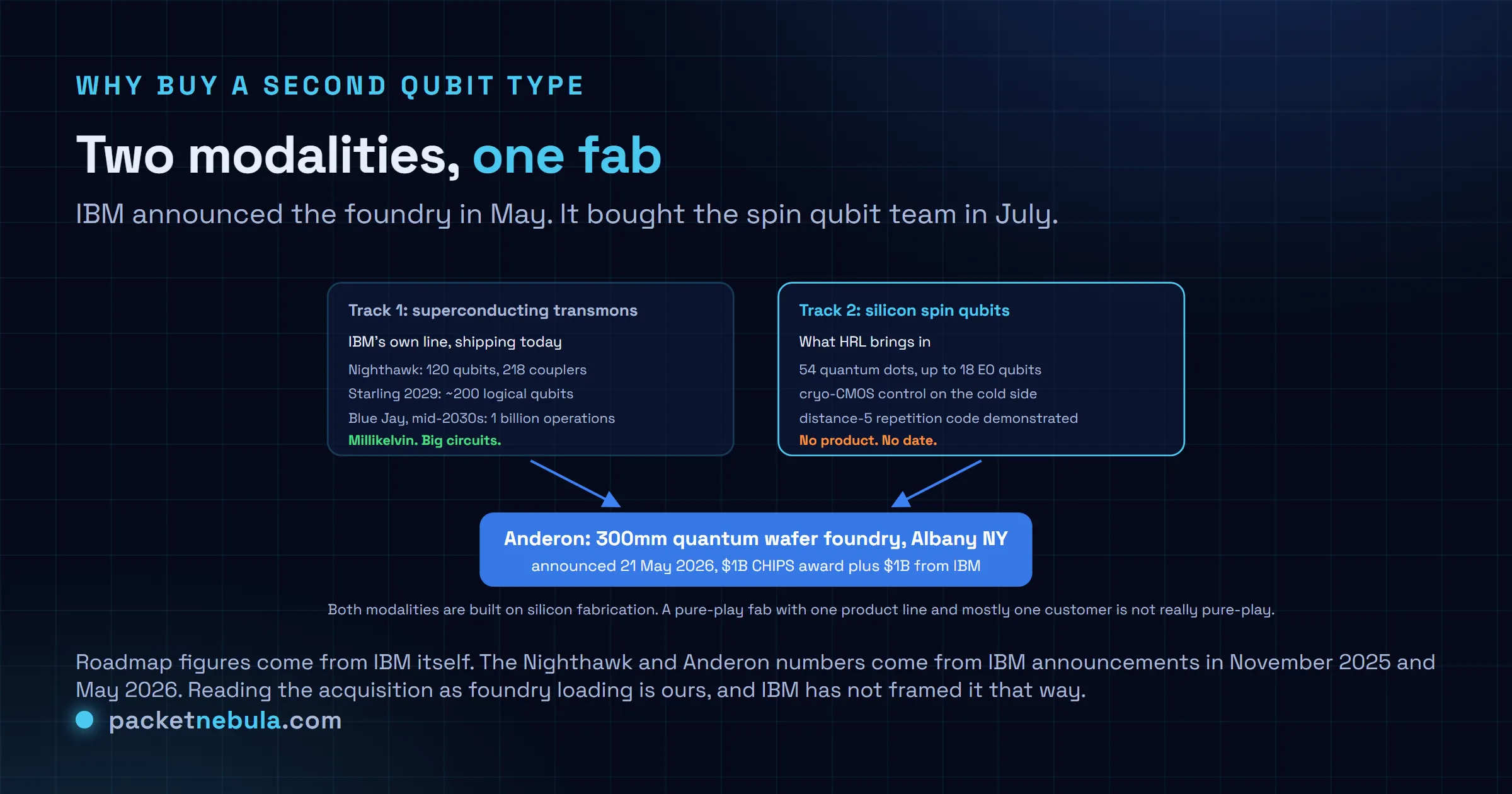
Spin qubits are the modality that most obviously belongs on a CMOS line. They’re patterned in silicon, they’re small, and reporting on the deal notes they can run at roughly a kelvin rather than the millikelvin range transmons demand. Whatever else this acquisition buys, it buys Anderon a second thing to make and a reason for outside customers to take the “pure-play” label seriously. IBM hasn’t said that. We’re saying it.
Where spin qubits honestly stand
Eighteen qubits. Against IBM’s Nighthawk, which carries 120 superconducting qubits and 218 tunable couplers and supports circuits of around 5,000 two-qubit gates.
Those aren’t the same unit and we won’t pretend they are, since a physical transmon and an exchange-only spin qubit aren’t interchangeable currency. But the gap in maturity is the point. Spin qubits trade a decade of engineering lead for a manufacturing story, and manufacturing stories only pay off at scales nobody has reached yet.
Which is why the timing in IBM’s own roadmap is the tell. Starling arrives in 2029 with about 200 logical qubits, running 100 million operations, and it’s superconducting. Blue Jay follows in the mid-2030s at a billion operations. Spin qubits show up in the conversation around and after that. This is a bet on the 2030s, bought at 2026 prices that nobody will tell us.
What changes for you this week
Nothing. Really.
If your job involves cryptography, the clock that matters is the post-quantum migration one, and it’s driven by standards work and by harvest-now-decrypt-later exposure rather than by corporate development. That clock was already running before July 23 and it runs at exactly the same speed after. The useful reading is which post-quantum signature actually ships in TLS and what the first ISO post-quantum standard covers.
What this deal does tell you is that the leader in superconducting quantum just paid an undisclosed sum for optionality on a completely different qubit. Read it next to the DARPA money going to a photonic approach and a pattern shows up. Nobody with real money is certain which modality wins. Neither should you be.
Sources
IBM’s announcement on the IBM newsroom, July 23, 2026. The HRL preprint “A digitally controlled silicon quantum processing unit” (arXiv:2604.16216, CC BY 4.0). Coverage and context from SiliconANGLE, The Quantum Insider, Techzine and Quantum Computing Report. Anderon foundry details from the IBM and Department of Commerce announcement of May 21, 2026, and Nighthawk figures from Tom’s Hardware.
Frequently asked questions
What exactly did IBM agree to buy?
HRL Laboratories, LLC, the Malibu research institution jointly owned by Boeing and General Motors. IBM announced the definitive agreement on July 23, 2026 and expects to close by the end of the third quarter, subject to customary closing conditions and regulatory approvals. No purchase price was disclosed by anyone involved. Boeing and GM both said they will keep partnering with IBM on quantum applications afterwards.
What is a silicon spin qubit, and how is it different from what IBM already builds?
A spin qubit stores quantum information in the spin of one or a few electrons trapped in a quantum dot, which is a tiny electrostatic well defined by gates on a silicon chip. IBM's current machines use superconducting transmons instead, circuits with Josephson junctions that are physically far larger. The spin qubit pitch is density and manufacturability, because the devices are small and are patterned with processes close to standard CMOS. The catch is qubit count, where spin qubits are years behind.
How many qubits does HRL actually have working?
The published device holds a three-rail array of 54 exchange-coupled quantum dots that can be configured as up to 18 exchange-only qubits. That comes from the HRL preprint "A digitally controlled silicon quantum processing unit", arXiv:2604.16216, submitted April 17, 2026 under CC BY 4.0. The team reports single-qubit and entangling performance an order of magnitude better than the previous exchange-only state of the art, and demonstrates a distance-5 repetition code plus an error detecting code.
Does this change IBM's 2029 quantum roadmap?
No. Starling, the fault-tolerant machine IBM has promised for 2029 with roughly 200 logical qubits and 100 million quantum operations, is a superconducting system and does not depend on this deal closing. IBM presents spin qubits as a parallel track that matters later, around and after Blue Jay in the mid-2030s. There is no published spin qubit roadmap, no qubit target and no product date.
Should this change anything about my security planning?
Not this week, and honestly not this year. An acquisition with no qubit count in it does not move the day a quantum computer can break RSA or elliptic curve crypto. Your post-quantum migration clock is set by standards timelines and by harvest-now-decrypt-later risk, both of which are already running. If you want a concrete next step, look at which post-quantum signature your TLS stack supports rather than at IBM press releases.