




Your September quote for a batch of Android handsets comes back higher than the August one, and the line that moved isn't memory this time. On 29 July Qualcomm confirmed what Bloomberg had reported five days earlier: prices go up across the chip portfolio for anything shipping after 1 September, by a double-digit percentage the company still won't name. CFO Akash Palkhiwala called it broad across different end markets. The part worth holding onto came from Cristiano Amon, who volunteered that a double-digit chip rise is small next to what memory has done to a bill of materials. He's right. It's a strange thing for a CEO raising prices to point out.
The short answer
Qualcomm confirmed a double-digit price increase across its chip portfolio for products shipping after 1 September 2026, blamed on wafer, packaging and memory input costs. It has never published a percentage or a product list. The increase layers in over quarters, not on the day, because contracts have to expire first. And it is the smaller half of what is happening to your bill of materials.
What was actually said, and by whom
Two things happened, five days apart, and the coverage kept blending them.
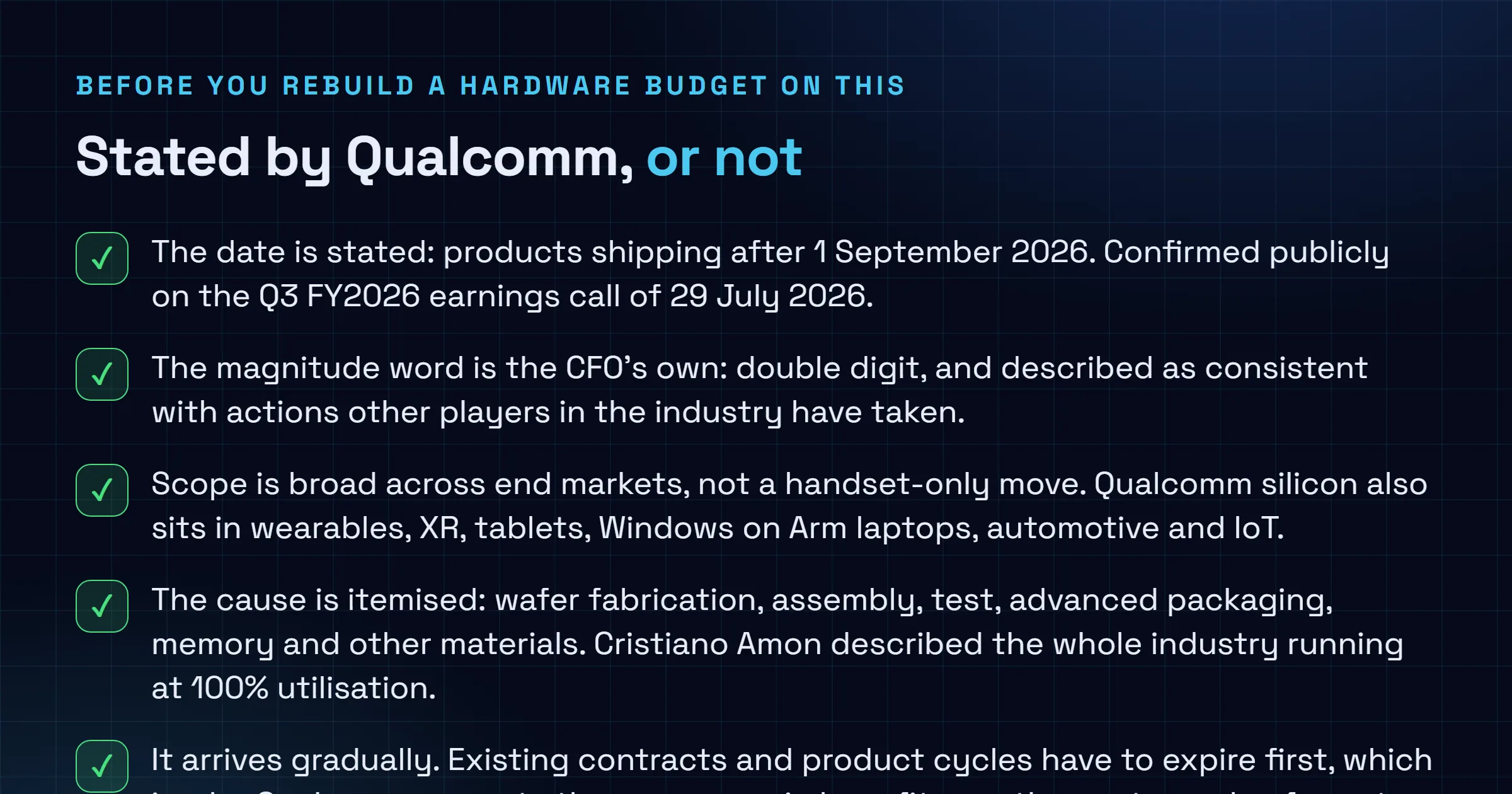
On 24 July Bloomberg reported a customer letter saying prices would rise by a double-digit percentage on products shipped after 1 September. That was reporting on a document nobody else has seen. Then on 29 July Qualcomm put it on the record itself, in the prepared remarks for its third fiscal quarter: “the semiconductor industry is experiencing broad-based increase in input costs across wafer fabrication, assembly, test, advanced packaging, memory, and other materials. We are taking concrete actions to reflect the higher input costs in our product pricing.”
That’s the confirmation. Notice what it doesn’t contain. No number, no date, no products.
The number arrived under questioning. JPMorgan’s Joseph Cardoso asked directly for the magnitude and whether the action was broad or concentrated, and Palkhiwala gave the only figure Qualcomm has ever attached to this: “the scale of the increase that we’re looking at is double digit and consistent with some of the actions from other players.” Broad across different end markets, he added, with the caveat that contracts and product cycles delay it in places.
So the honest state of knowledge is one date, one adjective, and a direction. If you see a specific percentage in a headline, somebody made it up or extrapolated it from a rival.
The profit line explains the rest
Here’s why we don’t think this is opportunism.
Qualcomm’s quarter ended 28 June 2026. Revenues came in at $9,947 million against $10,365 million a year earlier, which is a 4 percent decline and still at the high end of its own guidance. Not a disaster. Then GAAP net income fell 25 percent, to $2,002 million from $2,666 million, and diluted EPS went from $2.43 to $1.87.
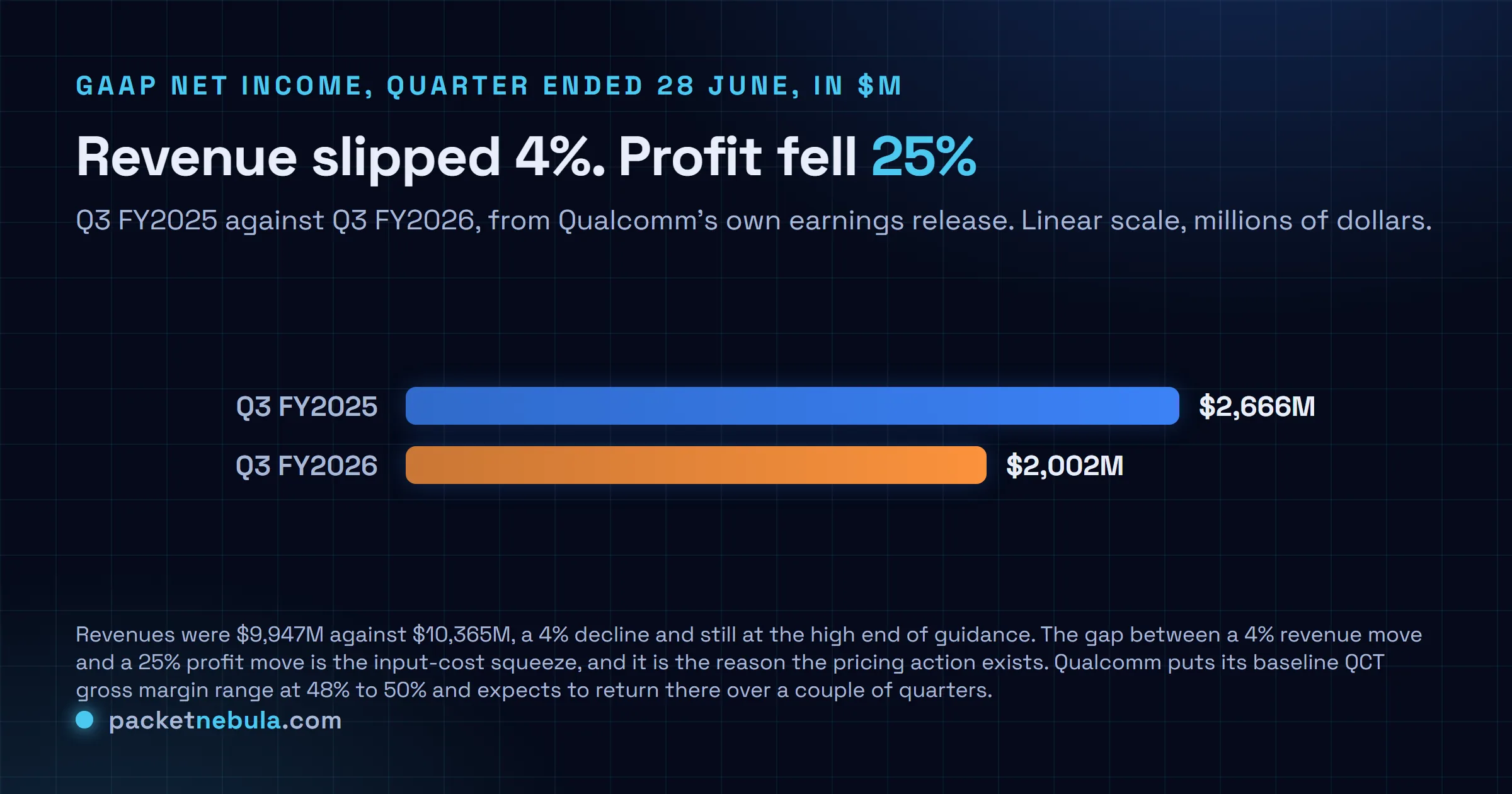
A four-point revenue slip producing a twenty-five-point profit slip is not a demand problem. It’s cost coming in the door faster than price goes out of it. Palkhiwala named two drivers when Cowen’s Joshua Buchalter pushed on margins: higher input cost across the supply chain, plus a weaker mix inside the premium tier, because handset makers are picking cheaper chips and even prior-generation parts to claw back the money memory took from them. That second one is quietly brutal. Qualcomm is being squeezed by the shortage and then squeezed again by how its customers respond to the shortage.
The target is stated too. Baseline QCT gross margin sits in the 48 to 50 percent range, guidance for the current quarter had QCT EBT margin at 23 to 25 percent, and the pricing action is meant to walk that back over a couple of quarters. Amon’s description of the supply side was the bluntest thing on the call: the industry is operating much as it did during the pandemic, everything at 100 percent utilisation, with shortages and increases across wafers, across assembly, across testers.
Not a phone story, and not the biggest number in your quote
Every write-up we read framed this as flagship Android getting dearer. Fair enough, since Snapdragon powers roughly 70 percent of Samsung’s flagship devices by Qualcomm’s own count. But read Palkhiwala’s phrasing again: broadly across different end markets.
Qualcomm’s IoT segment did $1.8 billion in the quarter, growing 9 percent on industrial, networking and robotics products. Automotive did $1.6 billion, up 61 percent, its twenty-third straight quarter of double-digit annual growth. Those are the modules in a factory gateway, the compute in a car, the silicon in a Windows on Arm laptop or an XR headset. If you’re specifying any of that for a 2027 programme, your unit cost assumption from June is stale.
Then there’s the part that should reframe the whole thing. Amon, unprompted, told Cardoso that even a double-digit price increase “which is just a pass-through of the input cost increase and wafer price increases, it’s actually small when you compare it to the order of magnitude of the memory bill of materials.” A CEO defending a price rise by saying it’s minor next to the component he doesn’t sell is unusual, and as far as we can tell he’s simply describing the arithmetic. The Pixel 11 memory numbers Google cited had a gigabyte of RAM going from $2.80 to $12 inside a year. A double-digit rise on an SoC does not live in that weight class.
What we’d do with a Q4 hardware budget
Re-quote anything scheduled to ship after 1 September, and ask your distributor which line items are already under contract. That question is the useful one, because Palkhiwala’s whole answer on timing was about contracts and product cycles delaying the change. Some of your parts are insulated for a while. Some aren’t, and the difference isn’t visible from the datasheet.
Don’t move a programme forward purely to beat the date. The increase layers in gradually, the expediting fees are real, and you’d be paying a premium to dodge a percentage nobody has published. Honestly I’d rather carry the increase than pay a rush charge to avoid an unknown.
And keep the causal chain straight when you explain the variance upstairs. Memory and storage moved first, because HBM for accelerators earns more per wafer than the LPDDR in a handset. That’s the same shortage behind the 2 gigawatt AI factory NVIDIA and SK signed for, and it’s what pushed wafer, assembly and test costs into Qualcomm, which is now pushing them into you. Blaming the chip vendor is the easy version. It’s also off by an order of magnitude.
One last thing worth watching. Qualcomm expects the handset market to be down low teens in 2027 relative to 2026, and it’s betting on non-handset revenue growing more than 60 percent next fiscal year to cover an accelerating step-down in Apple business. Price rises into a shrinking market are a tightrope. I might be wrong, but the automotive and IoT numbers suggest they’ve already worked out which foot to stand on.
Sources
The confirmation, quotes and figures come from Qualcomm’s own Q3 fiscal 2026 earnings call transcript of 29 July 2026 and its third quarter earnings release. The 1 September date and the customer letter were first reported by Bloomberg on 24 July, cross-checked against Android Authority and 9to5Google. The caveat that Qualcomm has published no specific rate is Igor’s Lab, and it still holds.
Frequently asked questions
How much is Qualcomm raising chip prices?
Nobody outside Qualcomm knows the number. CFO Akash Palkhiwala told analysts on the 29 July 2026 earnings call that "the scale of the increase that we're looking at is double digit and consistent with some of the actions from other players." That is the entire published magnitude. Double digit spans 10 to 99 percent, Qualcomm has issued no press release naming a rate for the Snapdragon portfolio, and there is no per-product breakdown anywhere.
When does the increase take effect?
Products shipping after 1 September 2026. That date came from the customer letter Bloomberg reviewed on 24 July and Qualcomm has not contradicted it. The date is not the same as the impact, though. Palkhiwala was explicit that existing contracts and product cycles have to run out first, so the company expects the gross margin benefit over the next couple of quarters rather than in September.
Is this only about smartphones?
No, and treating it as a phone story is how you get caught. Palkhiwala described "a pricing action that we are taking broadly across different end markets." Qualcomm silicon sits in wearables, XR headsets, tablets, Windows on Arm laptops, cars, and the industrial and networking modules in its IoT segment. If you buy any of those on a bill of materials, the same increase is coming toward you.
Will my next phone cost more because of this?
Probably, but not mainly because of Qualcomm. Amon's own framing is that a double-digit rise on the chip "is actually small when you compare it to the order of magnitude of the memory bill of materials." Memory went up more than fourfold per gigabyte on the figures Google cited for the Pixel 11. Whether a device maker absorbs the chip increase or passes it on is that vendor's call, and none of them have published one.
Why is Qualcomm raising prices at all?
Margin. Revenues for the quarter ended 28 June 2026 were $9,947 million against $10,365 million a year earlier, a 4 percent decline that still landed at the high end of guidance. GAAP net income fell 25 percent over the same period, to $2,002 million from $2,666 million. Qualcomm puts its baseline QCT gross margin range at 48 to 50 percent and says the pricing action brings it back there. Amon described an industry running at 100 percent utilisation with shortages and increases across wafers, assembly and test.