




A credit card, for a checkout that totals zero. That's step six of applying to the program OpenAI announced on 29 July, and it tells you more about the shape of this thing than the headline does. The headline: 100,000 academic researchers get free access to frontier models, GPT-5.6 Sol Pro included, starting with 10,000 this summer at institutions like the Institute for Advanced Study and the École normale supérieure. The fine print is where it gets specific. What you actually get, if approved, is a five-seat workspace for twelve months at ChatGPT Pro rate limits. Not a hundred thousand individual grants. Twenty thousand small team workspaces, on a clock.
The short answer
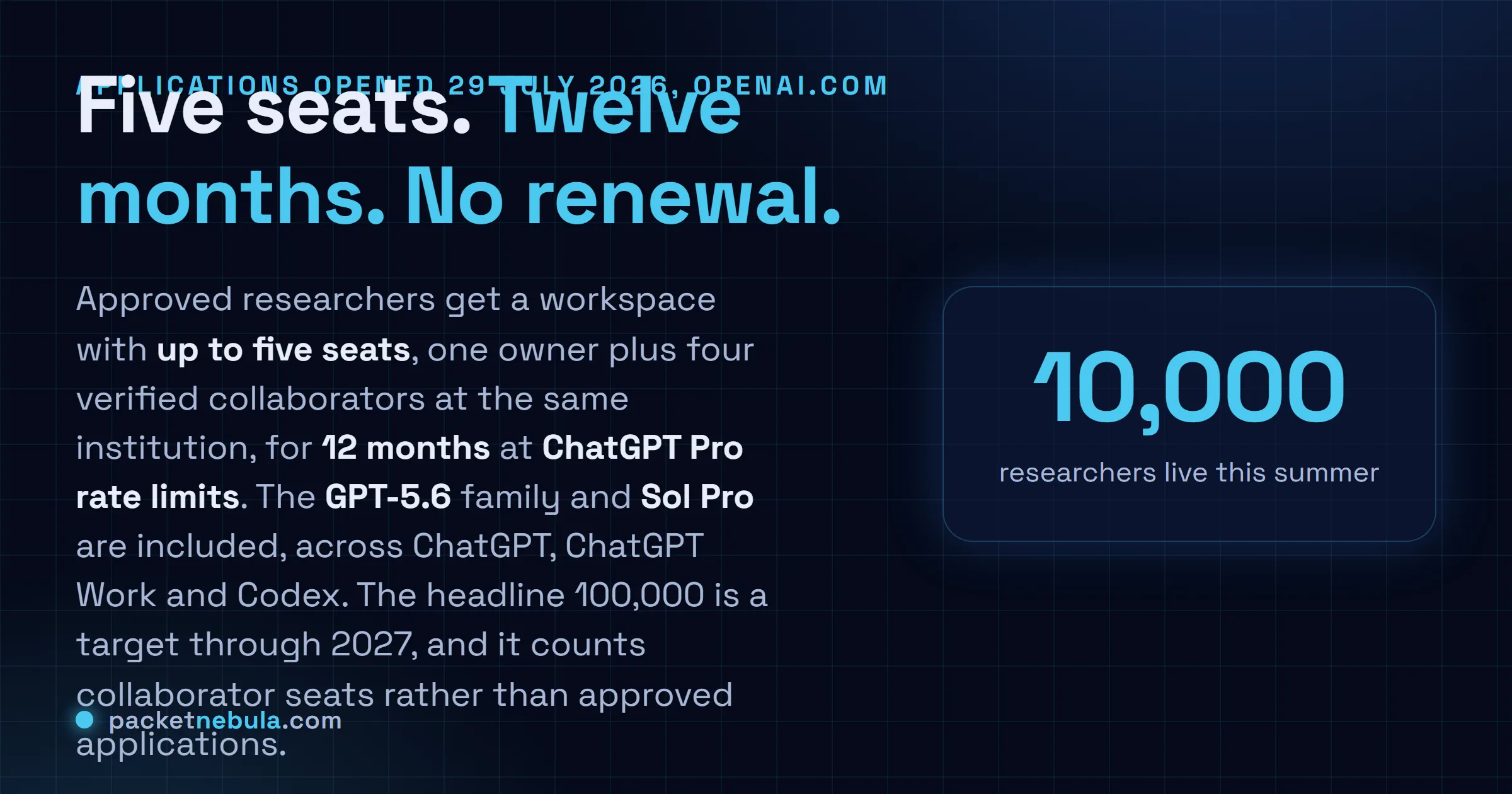
OpenAI opened applications on 29 July 2026 for ChatGPT for Academic Researchers. Approved teams get a five-seat workspace for twelve months, at ChatGPT Pro rate limits, with the GPT-5.6 family and Sol Pro included. Eligibility is narrow: an allowlisted institution, a faculty or postdoc role, and a preprint from the last three years in one of seven fields. The 100,000 figure is a 2027 target, and it counts collaborator seats.
What OpenAI actually announced
The post went up on 29 July and applications opened the same day. Free access to frontier models for 100,000 researchers at selected academic institutions, framed around a belief that the benefits of frontier AI shouldn’t stay concentrated in a few well-resourced labs.
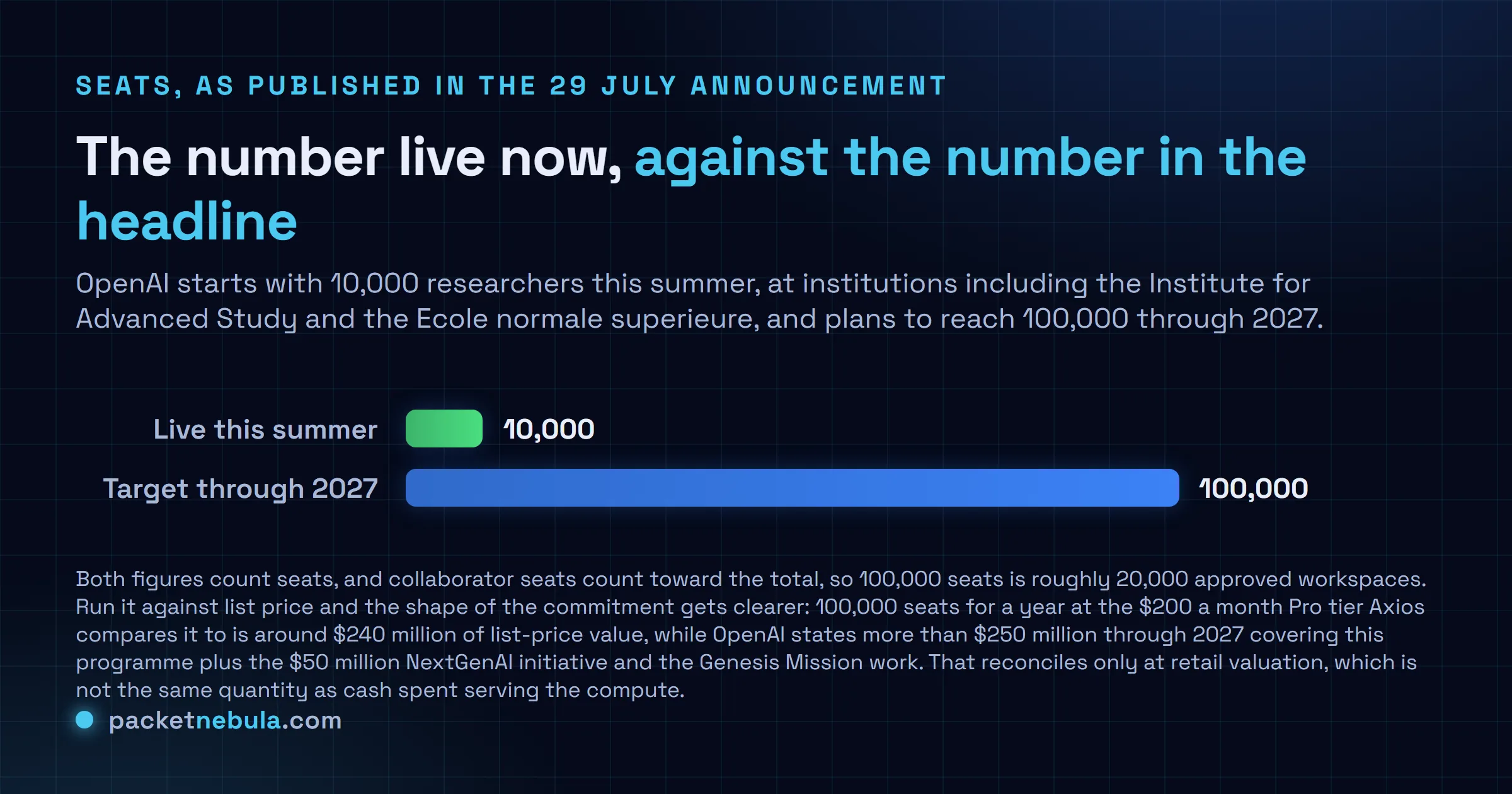
The rollout is staged. Ten thousand researchers this summer, with access already running at the Institute for Advanced Study and the École normale supérieure, and the 100,000 figure sitting out at 2027. OpenAI puts the program inside a stated commitment of more than $250 million through 2027 for external scientific research, alongside the $50 million NextGenAI initiative and work with the Department of Energy’s Genesis Mission.
What participants get, in OpenAI’s words: frontier models across ChatGPT, ChatGPT Work and Codex, the GPT-5.6 family at launch, expanded deep research, higher usage limits, larger context windows. More than 75 life science skills covering genetics through protein modelling and drug discovery. Connectors into scientific literature, public genomic and clinical databases, satellite imagery, notebooks.
Image: OpenAI, from the 29 July 2026 announcement.
The benchmark numbers in the post are OpenAI’s own, so quote them as such. On FrontierMath Tier 4, which targets research-level mathematics, GPT-5.6 Sol is given as 83% against 72.5% for GPT-5.5. On GeneBench Pro, GPT-5.6 Sol Pro is given as solving 31.5% of tasks. We went through the family’s positioning when GPT-5.6 went public as Sol, Terra and Luna, and the generational delta got its own look in GPT-5.6 versus GPT-5.5.
The terms that decide whether you get in
Here’s where the announcement and the help centre article diverge in tone, and the help centre is the one you should read.
Eligibility is tight. You need to be research faculty or a postdoc, at an institution on OpenAI’s allowlist, in a supported country. You need a paper on arXiv, bioRxiv or ChemRxiv posted within the last three years, naming you as an author, in one of seven permitted fields. Affiliation gets verified through SheerID, a third-party service, and the documentation tells you not to be on a VPN while you do it. Review takes one to two weeks, typically. Then checkout, card required, total $0.
Meeting every criterion, OpenAI says, allows you to apply and does not guarantee approval.
Then the ceiling. Five seats per workspace: the owner and four collaborators, all at the same institution, all separately verified. One verified email, one workspace, no joining two. And the rate limits are the same as ChatGPT Pro, which the help centre spells out plainly as not unlimited, with model and feature availability liable to change during the term.
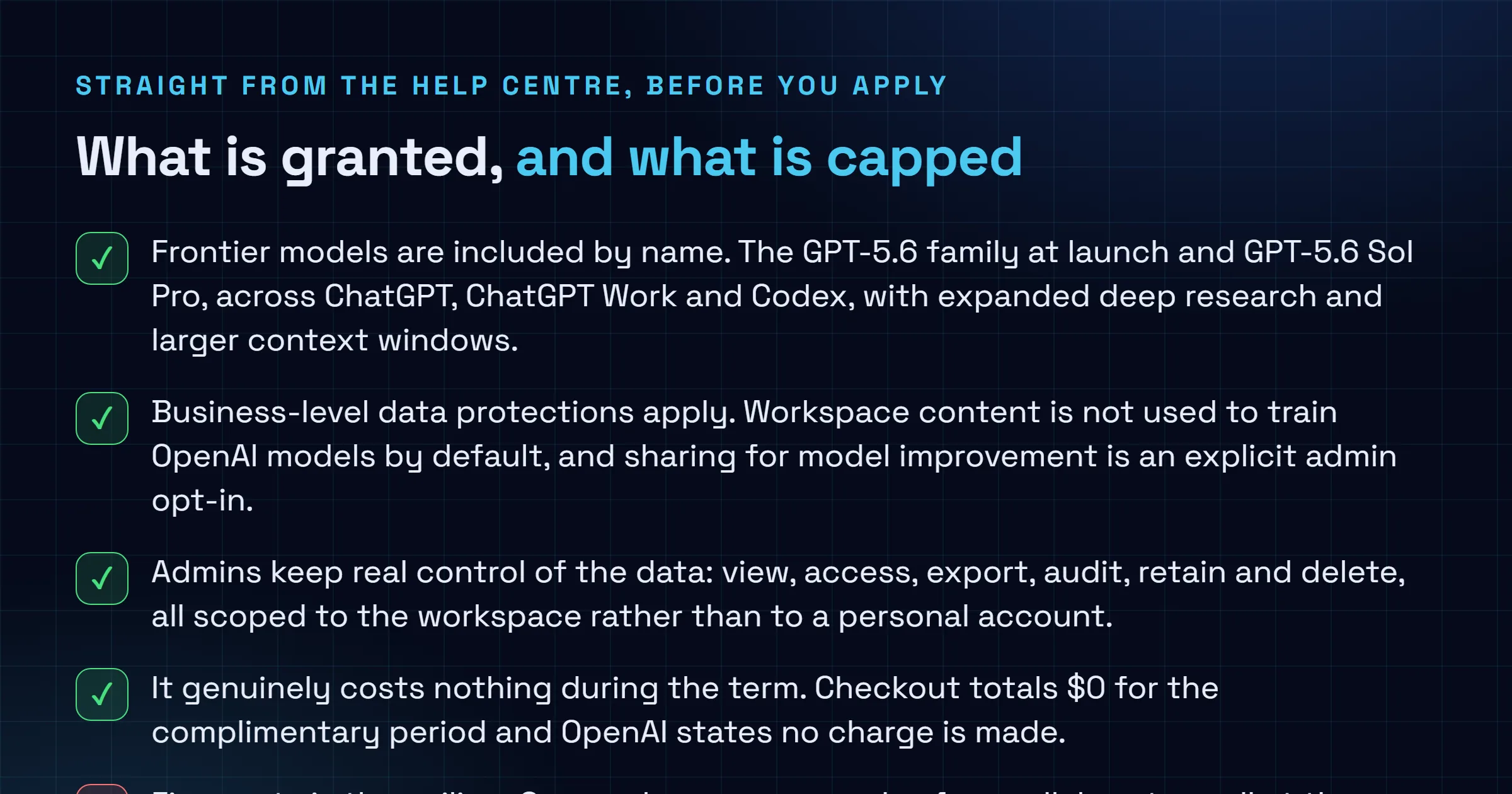
Twelve months, and it does not renew. That’s the one to diary. OpenAI says it will share continuation options before the offer ends, and if none is taken the workspace deactivates after a grace period. A year of a research group’s chat history, project files and custom setup lives inside a workspace with a scheduled end date, which is a thing to set up an export habit around rather than discover in month thirteen.
Data handling is the part that comes out well, honestly. Business-level protections, content not used for training by default, admin controls for export and retention, and an explicit opt-in if you want to share. Your personal ChatGPT account stays separate under the ordinary consumer terms. That distinction matters more than it sounds: the protection attaches to the workspace, not to you.
The arithmetic underneath
Axios pegged the value at roughly the $200-a-month ChatGPT Pro tier, which lines up with the help centre’s rate-limit language.
Run it out. A hundred thousand seats at Pro list price for twelve months is about $240 million of list-price value. OpenAI’s stated commitment is more than $250 million through 2027, and that same figure also covers NextGenAI at $50 million plus the Genesis Mission work. The numbers only reconcile if you value the seats at list, which is a very different quantity from what the compute costs OpenAI to serve. Not a criticism, just the correct way to read a headline number: it’s inventory valued at retail, not cash out the door.
I think the distribution logic is the real story, and OpenAI is fairly open about it. Get frontier models into the hands of the people writing the papers, in the fields where the outputs are checkable, and you get three things at once: usage data from hard problems, acknowledgements in the literature, and a cohort of early-career researchers whose tooling defaults are set by 2027. The post already cites 1.3 million people a week using ChatGPT for advanced science and mathematics, around 8.4 million messages, and a growing count of papers acknowledging it.
If you don’t work in a lab
Two things carry over.
The eligibility design is worth copying, or at least noticing. Requiring an authored preprint from the last three years is a cheap, verifiable filter that almost nobody can fake, and it does the work that a manual review would otherwise have to. Whoever specified that has run an abuse-prone signup before.
And the seat maths is the general lesson for reading any of these programs. A number of beneficiaries and a number of accounts are different quantities, and the gap here is a factor of five. Twenty thousand approved workspaces reads less impressively than a hundred thousand researchers. Both describe the same program.
Sources: the programme description, the 100,000 and 10,000 figures, the IAS and ENS institutions, the model list, the FrontierMath Tier 4 and GeneBench Pro numbers, the $250 million and $50 million commitments and the weekly usage statistics all come from OpenAI’s official announcement, Accelerating scientific discovery with ChatGPT for Academic Researchers, published 29 July 2026. The seat count, the twelve-month term and non-renewal, the eligibility criteria, the SheerID verification steps, the zero-dollar checkout, the Pro-level rate limits and the data handling terms are from OpenAI’s help centre article, ChatGPT for Academic Researchers. The ChatGPT Pro price comparison is Axios reporting on the launch. Benchmark scores are OpenAI’s own published figures and are not independently verified here.
Frequently asked questions
Who is eligible for ChatGPT for Academic Researchers?
Research faculty and postdoctoral researchers at institutions on OpenAI's eligibility list, in supported countries. You also need a paper on arXiv, bioRxiv or ChemRxiv posted in the last three years that names you as an author and sits in one of seven fields: biological sciences, chemistry and materials, computer science, earth and planetary sciences, engineering, mathematics or physics. Meeting all of it lets you apply. OpenAI says it does not guarantee approval.
How long does the free access last?
Twelve months. OpenAI's help centre is explicit that the workspace does not auto-renew and that you will not be charged for the offer period. Before the twelve months end, OpenAI says it will share any continuation options that exist. If you do not take one, the workspace deactivates after a grace period. Plan your data export around that date rather than around the renewal email.
Why does the application ask for a credit card if it is free?
Verification, per OpenAI's own documentation. The workspace owner completes a normal checkout flow, the total is $0 for the complimentary period, and no charge is made. It is the standard card-on-file pattern for a free tier, and it does mean the workspace owner needs a card that clears.
How many people can use one approved workspace?
Five. One workspace owner plus up to four collaborators, and every collaborator must be at the same institution and pass the same SheerID verification. A verified email can only belong to one of these workspaces at a time. Those collaborator seats count toward the programme total, so 100,000 seats is not 100,000 approved applications.
Which models and limits are included?
Frontier models across ChatGPT, ChatGPT Work and Codex, including the GPT-5.6 family at launch and GPT-5.6 Sol Pro. OpenAI describes expanded deep research, higher usage limits and larger context windows, and the help centre pins the number down: the same usage rate limits as ChatGPT Pro. Not unlimited, and OpenAI notes model and feature availability can change during the term.
Is research data from the workspace used to train OpenAI models?
Not by default. The workspace carries business-level data protections, and OpenAI states content from it is not used for training unless an admin opts in. Your personal ChatGPT account stays separate and is governed by the ordinary terms, so the protection follows the workspace and not your login.