




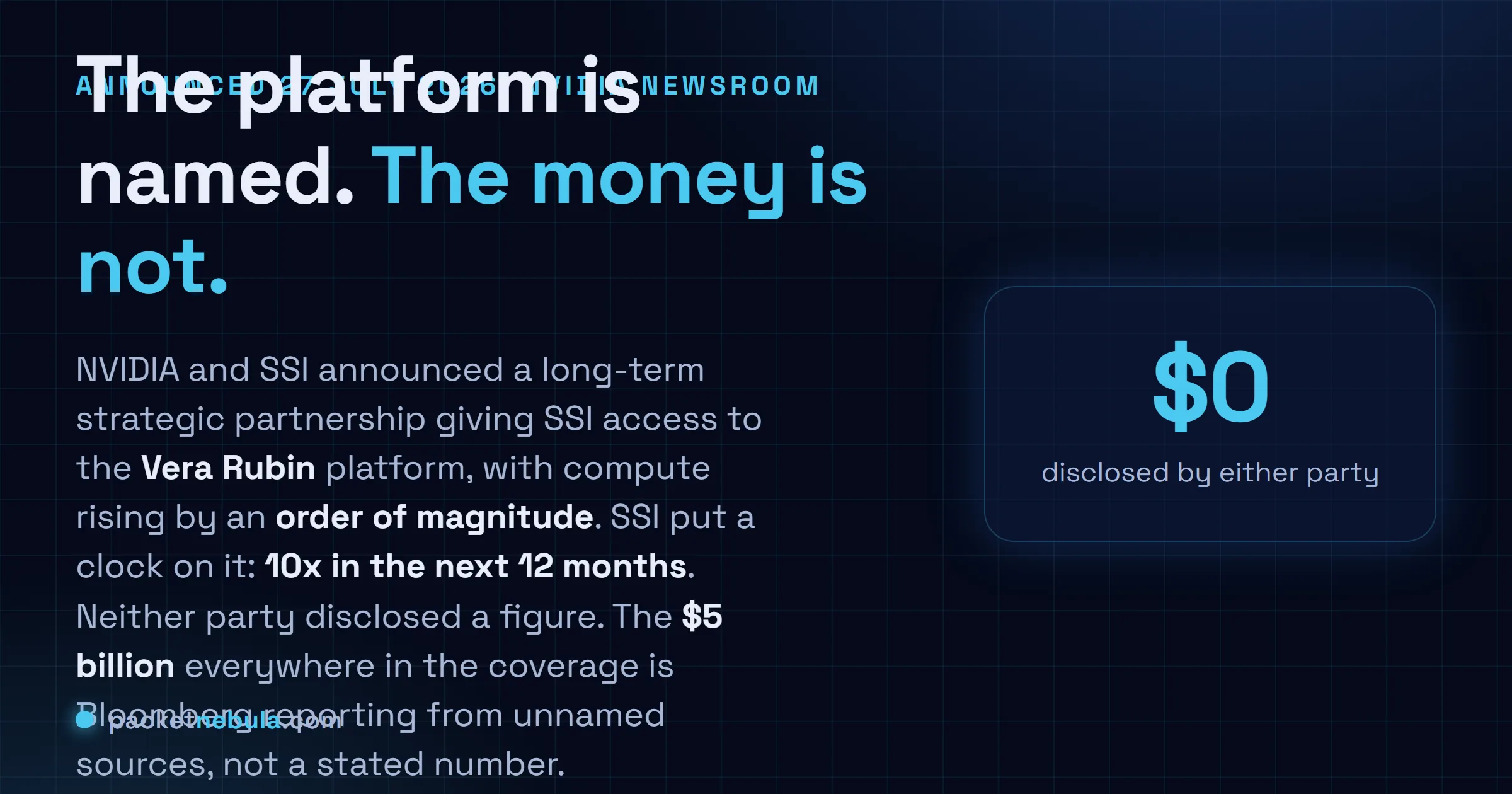
A four-line post on X, from an account that had barely spoken in two years. That's how the biggest number in this week's AI coverage got loose. On 27 July, Nvidia and Ilya Sutskever's Safe Superintelligence announced a long-term strategic partnership: SSI gets access to the Vera Rubin platform and, by its own account, will 10x its compute in the next 12 months. Both parties called the investment substantial. Neither put a figure on it. The $5 billion now welded to every headline came from Bloomberg citing people familiar with the matter, and nobody with a signature on the deal has confirmed it. So we have a genuinely interesting announcement, wrapped in a number nobody stated.
The short answer
Nvidia and Safe Superintelligence announced a long-term strategic partnership on 27 July 2026. SSI gets access to the Vera Rubin platform and says that will 10x its compute within a year. The $5 billion in the headlines is Bloomberg’s reporting from unnamed sources, not a stated figure. SSI has never said what it runs on today, so the multiplier has no base under it.
What Nvidia and SSI actually said
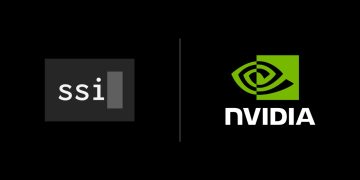
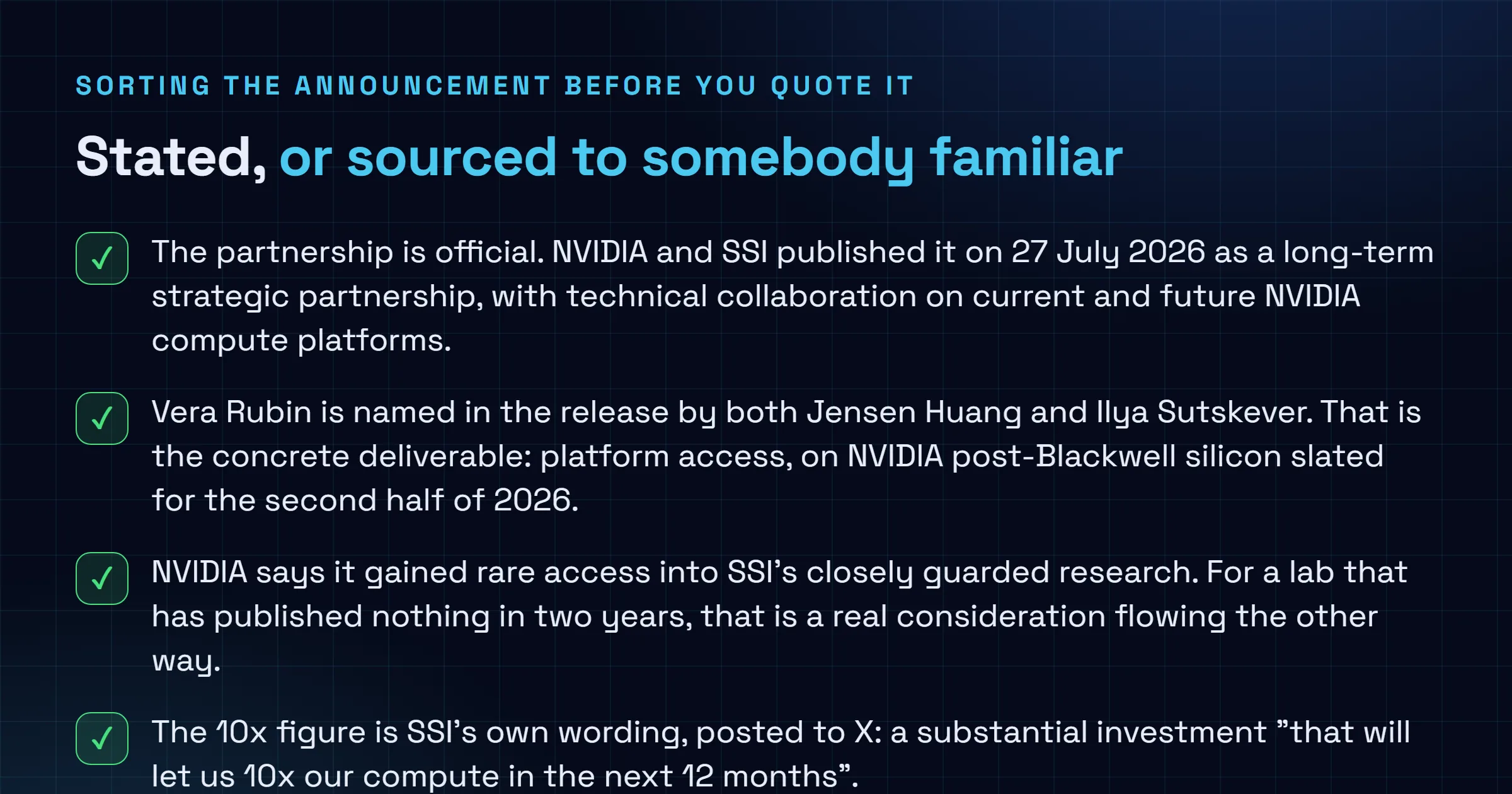
The release went up on Nvidia’s newsroom on 27 July, and it’s short. A long-term strategic partnership, SSI getting access to Vera Rubin systems, technical collaboration on current and future Nvidia compute platforms, and compute rising by an order of magnitude.
Jensen Huang’s line: “Ilya has pioneered fundamental breakthroughs at the foundation of modern AI, beginning with AlexNet. We are excited to see what new breakthroughs SSI will discover powered by our Vera Rubin platform.”
Sutskever’s: “We have research that is worthy of scaling up, and having access to a big NVIDIA computer will let us do so.”
A big NVIDIA computer. I like that phrasing more than I expected to. It’s the least marketing sentence in any GPU press release this year.
The clock came from SSI’s own post, not the release:
“We are announcing a long-term strategic partnership with NVIDIA. NVIDIA is making a substantial investment in SSI that will let us 10x our compute in the next 12 months. We reached the point where our research is worth scaling and with this partnership we will be able to. We are honored by NVIDIA’s conviction.”
SSI Inc. (@ssi on X), 27 July 2026.
One line in Nvidia’s release runs the other direction and mostly got skipped in the coverage: Nvidia says it obtained rare access into SSI’s closely guarded research. For a company that has published nothing since 2024, that isn’t a small concession. Whatever the cash number turns out to be, research access was part of the price.
Image: Nvidia, from the 27 July partnership announcement.
Ten times what, exactly
Here’s where it stops being clean.
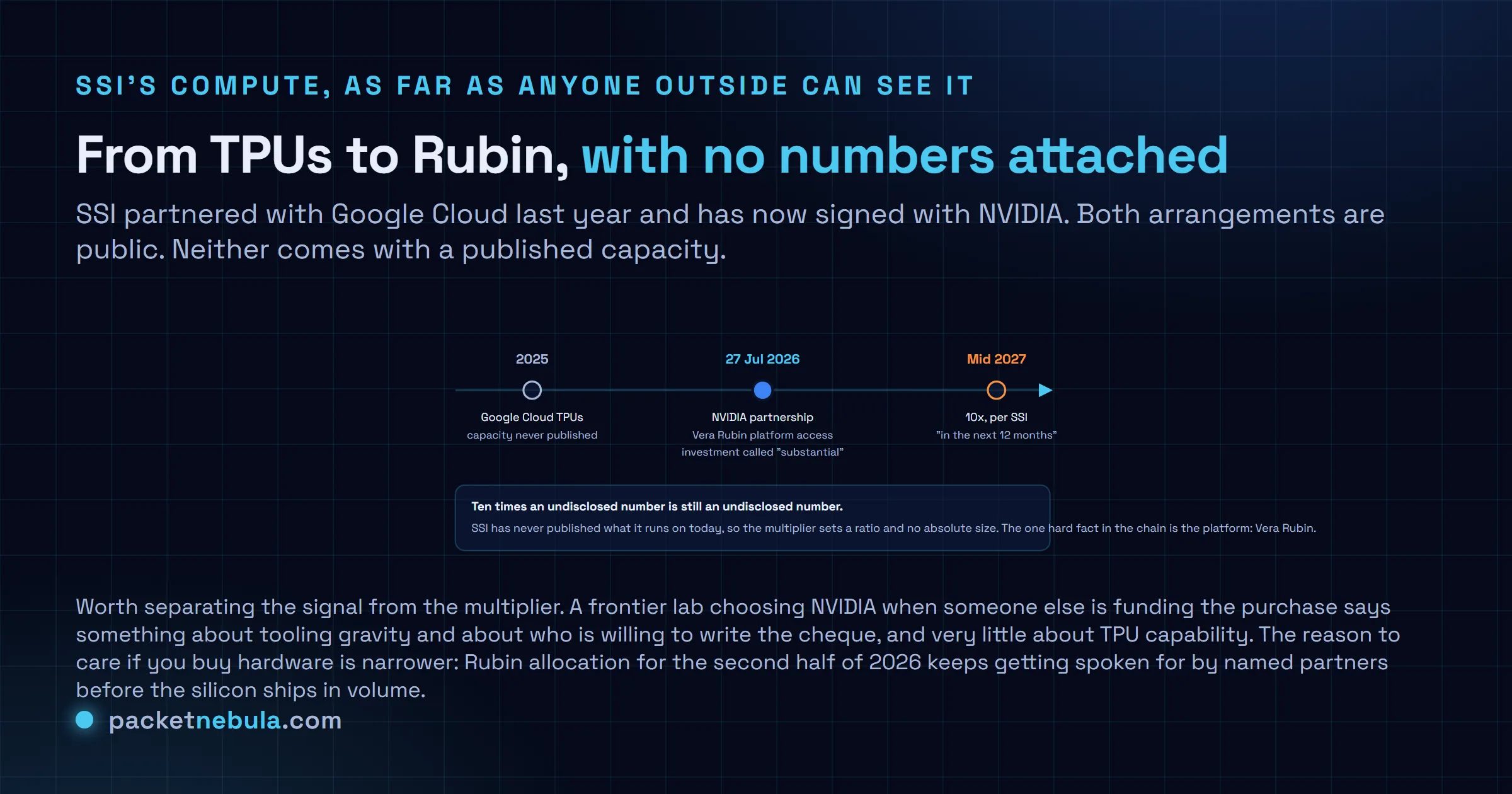
SSI has never disclosed its compute. Not GPU counts, not megawatts. It partnered with Google Cloud last year to power its research, and that arrangement came with no published capacity either. So 10x fixes a ratio against a number nobody outside the company knows. Ten times a modest research cluster and ten times a serious training fleet are different announcements, and we can’t tell which one this is.
Same problem with the money. Bloomberg put it at $5 billion, sourced to people familiar with the matter, and other outlets have credited the same figure elsewhere. It might be exactly right. It just isn’t a disclosure, and it’s already being quoted as though it were, which is how a sourced estimate becomes a fact in about three weeks.
What we can size is the history. SSI raised $1 billion at a $5 billion valuation in 2024, then $2 billion at $32 billion in February 2025. Against that, a multi-billion strategic investment isn’t a rounding error. It’s most of what the company has ever raised, arriving from its hardware vendor.
Which is worth naming plainly, without getting dramatic about it. Nvidia invests in SSI, SSI buys Nvidia hardware. That structure is all over 2026 AI capex, it isn’t fraud, and it does mean “Nvidia invested” and “Nvidia sold” stop being independent signals about demand. Read them as one event.
The part that matters if you buy GPUs
Forget the valuation for a second. The useful fact here is the platform.
Vera Rubin is Nvidia’s generation after Blackwell, second-half-of-2026 silicon that’s only now reaching its first named customers. We went through that when BMS committed to eight DGX Vera Rubin NVL72 systems, and again when SK signed a 2 GW build in Korea. SSI now joins that list.
None of these are clusters running workloads. They’re allocation. And the pattern across July is that Rubin capacity keeps getting spoken for by named partners before the parts ship in volume, which is the thing to model if you’re budgeting Rubin-class capacity for 2027. You aren’t first in the queue, and the queue is being published one press release at a time.
The softer signal: SSI ran on TPUs and is now building on Nvidia. That doesn’t tell you TPUs are worse. Honestly I think it says more about tooling gravity and about who was willing to write the cheque than about silicon. But a frontier lab with no revenue picking the expensive ecosystem because somebody else is funding the purchase is exactly the dynamic that makes GPU demand look sturdier than the businesses underneath it.
My read, and I might be wrong: the research access clause is the most informative sentence in the whole release, and it got almost no coverage. Nvidia doesn’t need SSI’s revenue. What it bought was a window into what a lab that hasn’t published in two years is actually doing. That’s a strange thing to pay for, and a fairly strong hint that somebody at Nvidia has already seen something.
Sources: the partnership terms, the Vera Rubin platform access, the order-of-magnitude framing, the research access clause and both executive quotes come from the official Nvidia newsroom announcement of 27 July 2026. The 10x-in-12-months wording is SSI’s own, posted to @ssi on X. SSI’s funding history, the $32 billion valuation, the earlier Google Cloud arrangement and the absence of any commercial product are from TechCrunch’s report on the partnership. The $5 billion figure is Bloomberg’s, cited to people familiar with the matter and relayed by Tech Startups. No investment amount is asserted here as confirmed, because neither party disclosed one.
Frequently asked questions
How much did Nvidia invest in Safe Superintelligence?
Neither company said. The 27 July announcement describes a substantial investment and gives no figure, and SSI's own post uses the same word. The $5 billion quoted across the coverage comes from Bloomberg citing people familiar with the matter, with other outlets attributing the same number elsewhere. It may well be accurate, but it is reporting from unnamed sources rather than a disclosure, and it should be quoted that way.
What does 10x compute actually mean for SSI?
As an absolute quantity, nothing you can check. SSI posted that the investment "will let us 10x our compute in the next 12 months", and Nvidia's release describes an order of magnitude increase. But SSI has never published what it runs on today, so the multiplier sets a ratio against an unknown base. Ten times a modest research cluster and ten times a large training fleet are very different announcements, and there is no public way to tell them apart.
Is SSI switching from Google TPUs to Nvidia GPUs?
It is adding an Nvidia path, and how much of the TPU work moves is not public. SSI partnered with Google Cloud last year to power its research, and that arrangement came with no published capacity either. The new deal names the Vera Rubin platform and commits both sides to technical collaboration on current and future Nvidia compute platforms. Neither company has said the Google arrangement ends.
When will SSI actually get Vera Rubin systems?
No schedule was announced. Vera Rubin is Nvidia's generation after Blackwell, second-half-of-2026 silicon that is only now reaching its first named customers, so this is a commitment to future capacity rather than a cluster running workloads. No system count, no site and no delivery date appear in the release.
Has SSI released anything since it launched?
No product and no published research. The company launched in 2024 on a stated straight-shot approach to safe superintelligence, deliberately skipping commercial releases and short-term revenue, and has operated in stealth since. That is what makes one clause in Nvidia's release notable: Nvidia says it obtained rare access into SSI's closely guarded research as part of the deal.