
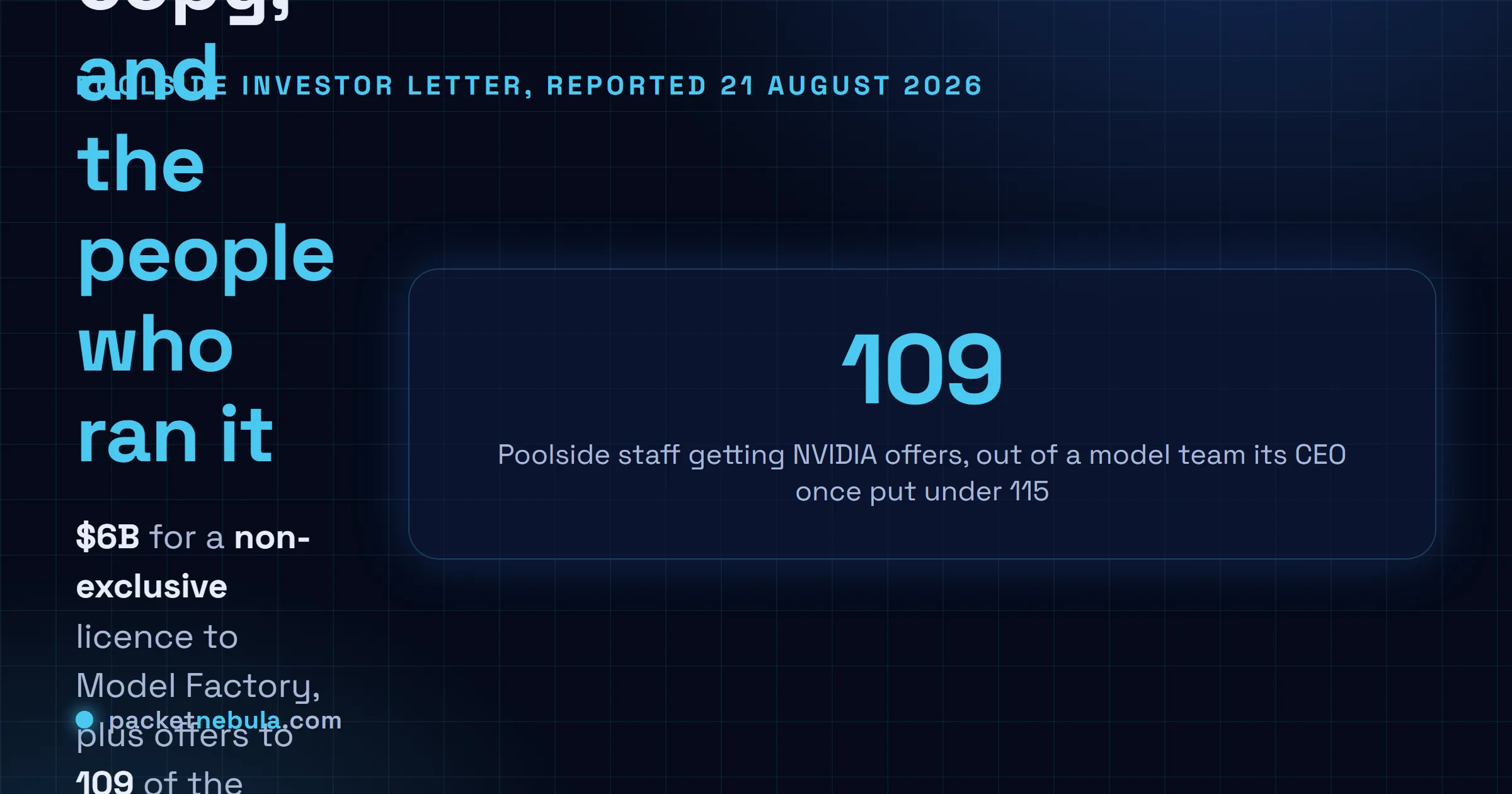
Friday afternoon, and the news arrives the way these things do now, through somebody's letter to their investors rather than a press release. Nvidia is paying Poolside $6 billion for a non-exclusive licence to Model Factory, the system Poolside used to build its Laguna coding models, and making job offers to 109 of the people who built them. A separate $1 billion goes in as equity at a $12 billion pre-money valuation. The letter, first reported by Newcomer, insists this is not an acquisition and not an acquihire. Technically that holds. The three co-founders stay, and the licence is non-exclusive, so Poolside can license the same software to Google next week. We've still seen this shape before. Twice.
The short answer
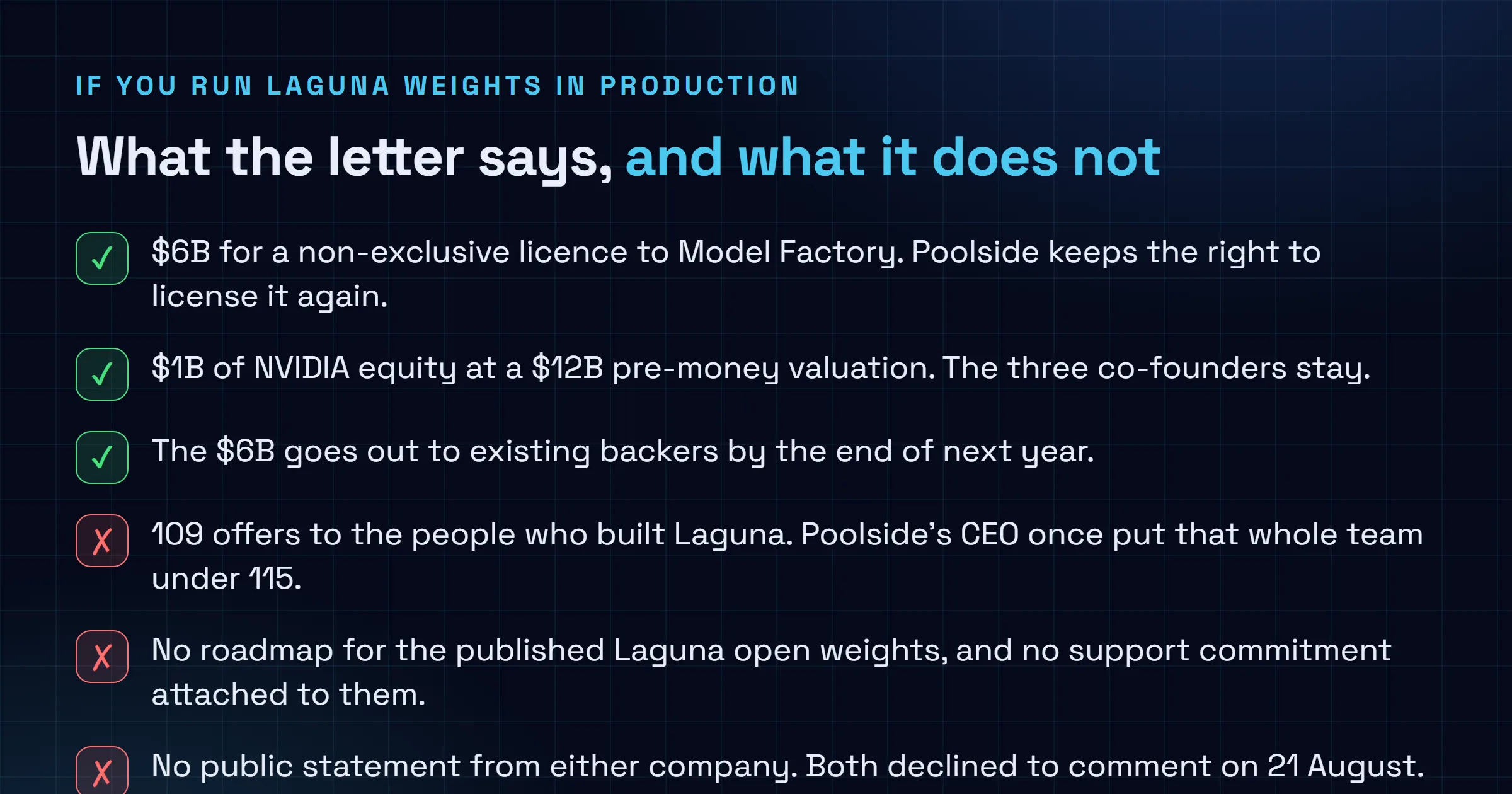
A Poolside letter to investors, first reported by Newcomer on 20 August 2026, says Nvidia will pay $6 billion for a non-exclusive licence to Model Factory, the system behind the Laguna open-weight coding models, and will make offers to 109 of the engineers and researchers who built them. Nvidia is separately investing $1 billion at a $12 billion pre-money valuation. The letter states this is not an acquisition and not an acquihire. Poolside stays independent under its three co-founders, and the $6 billion goes to existing backers by the end of next year. Neither company has commented publicly.
What actually changed hands
Model Factory is the interesting noun here, and it isn’t a model. It’s the machinery: the system Poolside built to train models, which it then pointed at code and got Laguna out of. Nvidia is licensing that pipeline, not the weights.
Non-exclusive, so Poolside keeps it too. On paper Poolside can turn around and license the identical thing to Amazon on Monday. Whether anyone wants a model factory whose operators have all moved to Santa Clara is the part the paperwork doesn’t cover.
That’s where the 109 lands. Poolside chief executive Eiso Kant said earlier this year that “less than 70 people built this model”, with “fewer than 115 between engineering and researchers” in total. Set 109 offers against that second figure and you can see the shape of what’s leaving. The founders stay. The company stays. The bench does not.
The sentence that explains the whole thing
Buried in the letter is the reason, and it’s blunter than anything in the coverage. “At the end of last year, we had a 6 week window in which to raise $2 billion dollars to pay for a 40,000 GB300 cluster coming online in January. We didn’t close it in time, and we lost the cluster.”
Read that again. A company valued in the billions, with a genuinely respected open model, lost its next training run because it couldn’t wire two billion dollars inside six weeks. The same letter says Poolside had been “directionally correct in a race where capital requirements went vertical”, which is a polite way of saying the strategy was fine and the balance sheet wasn’t.
So the honest framing isn’t that Nvidia raided Poolside. It’s that independently funded frontier training now has an entry fee most private companies can’t clear on a deadline, and the company selling the hardware is the one holding enough cash to fix that. Poolside’s own reasoning, per the letter, is that it would have needed more Nvidia hardware than it could realistically get while staying independent.
Run three of the same play
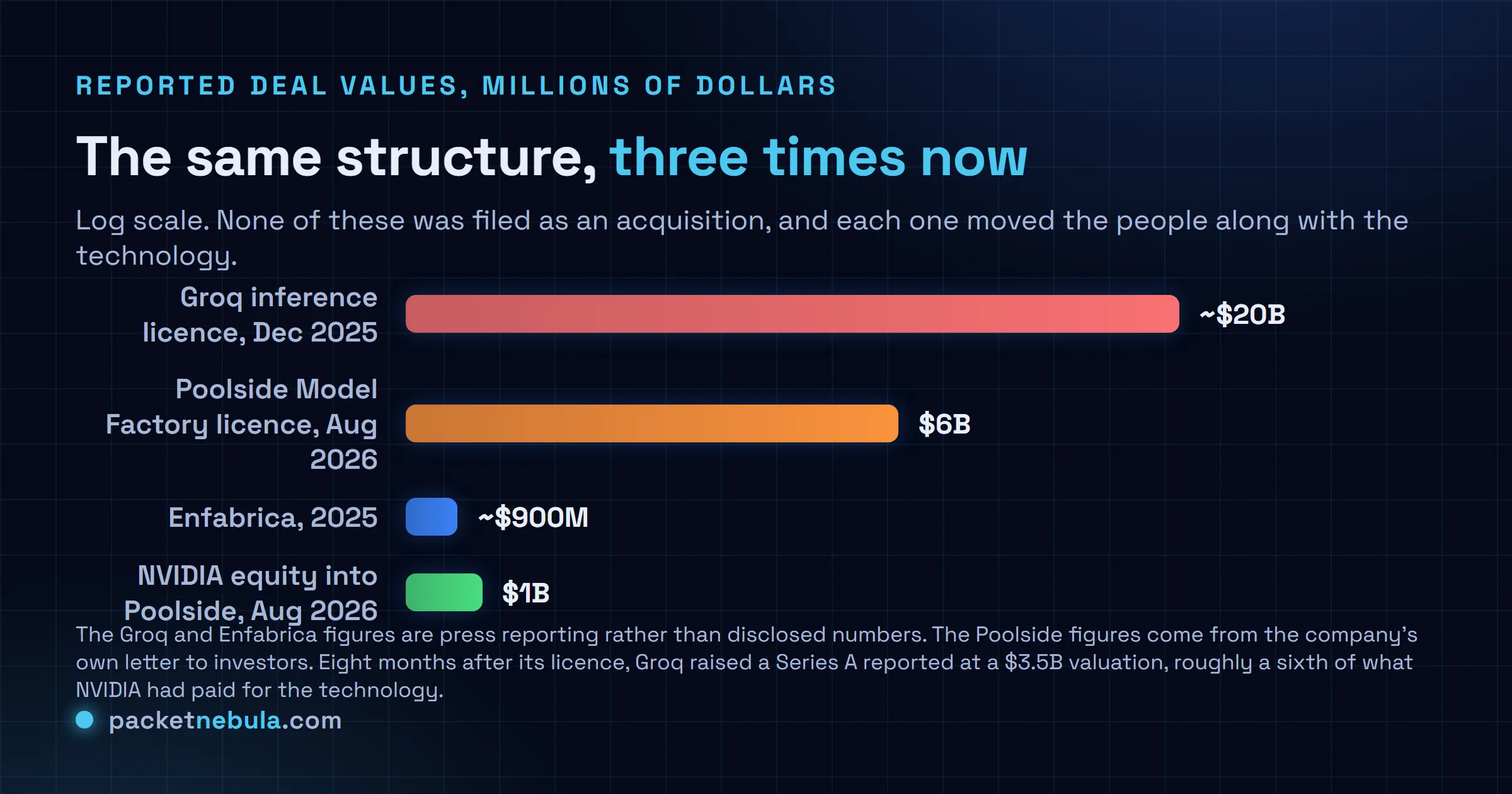
We covered the last one. In December 2025, Nvidia signed a non-exclusive licence for Groq’s inference technology, reported at around $20 billion, and hired founder Jonathan Ross. Enfabrica went the same way for roughly $900 million. Now Poolside at $6 billion. None of the three was structured as a purchase, which is exactly the point: a licence plus a hiring wave doesn’t trip the merger review a purchase would.
What happened to Groq afterwards is the useful precedent, and we wrote it up last week. Eight months on, it’s still trading and still shipping, and it closed a $350 million Series A at a reported $3.5 billion valuation. That’s about a sixth of what Nvidia paid for the technology. It also became an Nvidia Cloud Partner five days before the round closed. The company survived. The independent pitch didn’t.
There’s a wrinkle specific to Poolside that Groq didn’t have. Nvidia ships its own open models under the Nemotron name, so it now holds a licence to the factory that produced a direct competitor to its own line. I’d guess Model Factory ends up as internal tooling rather than a product, but that’s a guess, and nobody at Nvidia has said a word.
If you’re running Laguna in production
Nothing breaks today. Open weights that have shipped stay shipped, and Laguna S 2.1 is still 118B parameters with 8B active and a 1M context sitting on whatever you downloaded it to. No licence change was announced.
What we’d stop planning around is the next release. There’s no published roadmap, no support commitment, and the team that shipped the last one is being hired somewhere else. If Laguna is load-bearing for you, pin the version you have, keep your own copy of the weights rather than pulling from a hub at deploy time, and start benchmarking an alternative now instead of in six months when you actually need it.
The thing I keep turning over isn’t the $6 billion. It’s the six weeks.
Sources
The deal terms, the $12 billion pre-money valuation, the 109 job offers and the quotes from the investor letter were first reported by Newcomer on 20 August 2026, and carried in reporting by Bloomberg, TNW and The Decoder. The note that neither company responded to a request for comment, and the letter’s reasoning about Nvidia hardware access, come from PYMNTS, 21 August 2026. The Groq licence value and the Enfabrica figure are press reporting rather than disclosed numbers.
Frequently asked questions
What exactly is Nvidia buying from Poolside?
A non-exclusive licence to Model Factory, which is the system Poolside built and used to train its Laguna family of open-weight coding models. Nvidia pays $6 billion for it. Non-exclusive matters: Poolside keeps the software and can license it to anyone else. Separately, Nvidia is making job offers to 109 Poolside employees who worked on Laguna, and investing $1 billion in the company at a $12 billion pre-money valuation.
Is this an acquisition of Poolside?
No, and Poolside's letter to investors says so in as many words: "this is not an acquisition and it is not an acquihire". The three co-founders remain, the company keeps operating independently, and the $6 billion is due to be distributed to existing backers by the end of next year. Whether that distinction survives contact with a competition regulator is a different question, and it is the reason the structure keeps getting used.
Does this kill the Laguna open weights?
Nothing published says so, and nothing published guarantees the opposite either. The weights already released stay released, since an open licence cannot be recalled. What has no commitment attached is the next one. The letter's own reasoning is that Poolside could not get enough Nvidia hardware to keep competing in open-source model development on its own, which reads less like a roadmap than an explanation for stopping.
Has Nvidia done this before?
Twice, on public reporting. In December 2025 it signed a non-exclusive licence for Groq's inference technology, valued by TechCrunch at around $20 billion, and hired founder Jonathan Ross. It paid roughly $900 million in a similar arrangement with Enfabrica. Neither was filed as an acquisition. Groq is still trading, and closed a $350 million Series A in August 2026 at a reported $3.5 billion valuation.
Why did Poolside take the deal?
Compute. The investor letter gives one very specific reason: "At the end of last year, we had a 6 week window in which to raise $2 billion dollars to pay for a 40,000 GB300 cluster coming online in January. We didn't close it in time, and we lost the cluster." The letter adds that continuing to compete in open-source models would have needed more Nvidia hardware than Poolside could realistically get on its own.


