
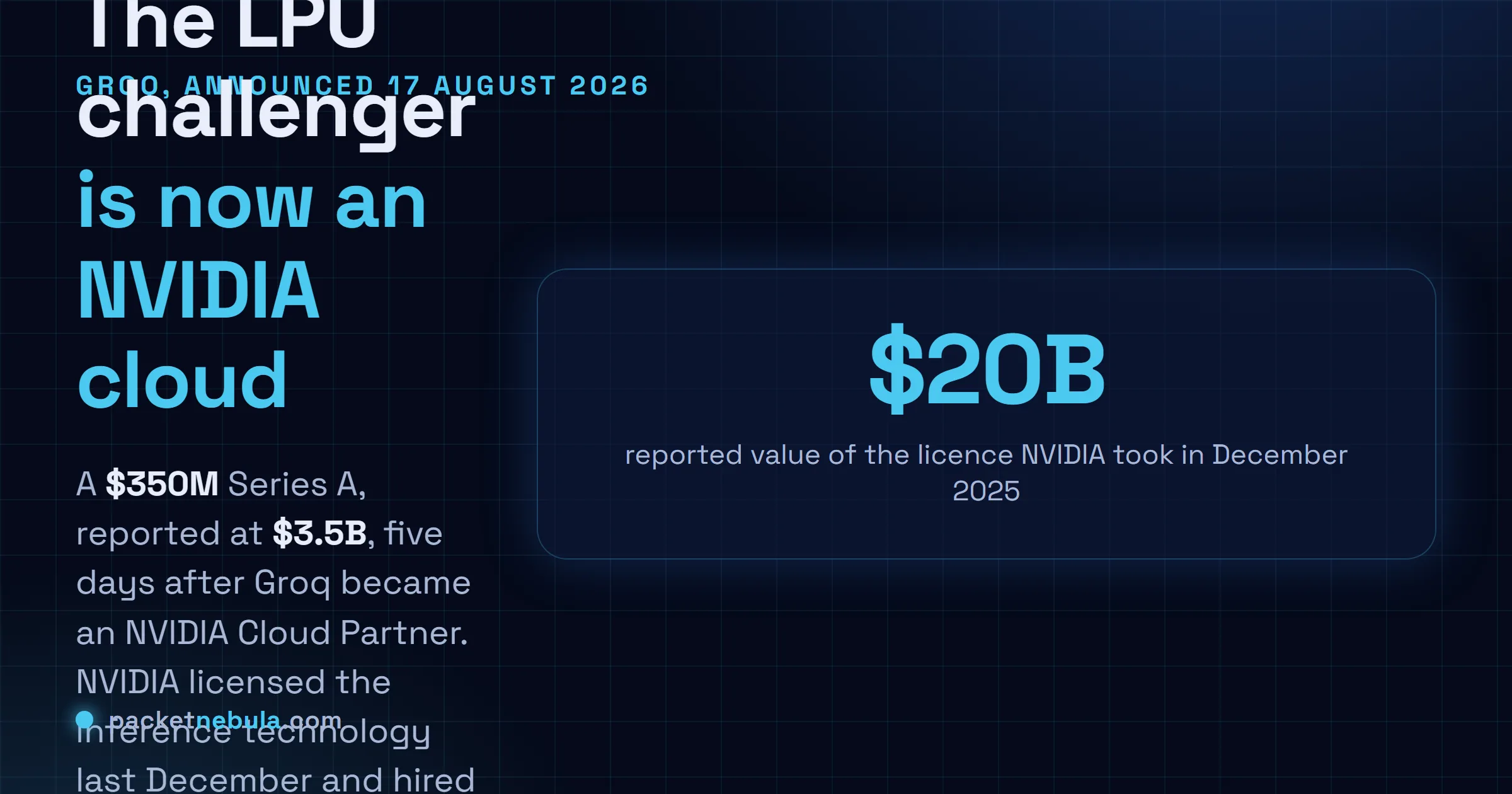
Groq spent years selling one idea, that Nvidia was the wrong shape for inference and a custom chip called an LPU was the right one. On 12 August it became an Nvidia Cloud Partner. Five days later it closed a $350 million Series A, reported at a $3.5 billion valuation, with Nvidia itself planning to join the round. So the short answer to what Groq is now: an inference cloud running on the silicon it was built to displace. The turn came on 24 December 2025, when Nvidia signed a non-exclusive licence for Groq's inference technology, valued by TechCrunch at around $20 billion, and hired founder Jonathan Ross along with president Sunny Madra. What's left is thirteen data centres and a token business. Which is doing fine, actually.
The short answer
Groq raised $350 million and called it a Series A, which tells you how completely the company reset. Nvidia licensed its inference technology last December for a reported $20 billion and hired the founder. Groq kept the data centres, the developer base and the name, became an Nvidia Cloud Partner on 12 August, and is now taking money from Nvidia too. Nothing changes on the API this week. The thing worth tracking is that fast inference is no longer a claim about custom silicon.
The eight months that inverted the pitch
Rewind to September 2025. Groq raised $750 million at $6.9 billion, and the story was clean: GPUs were built for training and bent into inference, the LPU was built for inference from the start, and the token-per-second numbers backed it up.
Then 24 December 2025. Groq and Nvidia signed what Groq’s own newsroom calls a Non-Exclusive Inference Technology Licensing Agreement. TechCrunch put the value at around $20 billion. Along with the licence, Nvidia hired Jonathan Ross, the founder and chief executive who had come out of Google’s TPU work, and president Sunny Madra. Not an acquisition. Everyone reached for the phrase not-acqui-hire, because there wasn’t a better one.
By March, Nvidia was showing inference hardware carrying the Groq name at GTC. TechCrunch refers to it as the Nvidia Groq 3 LPX system. SiliconANGLE’s account of the current arrangement is the detail we keep coming back to: feed-forward network modules run on the Groq-derived silicon, attention calculations go to Nvidia GPUs sitting next to it, and training doesn’t run on the Groq part at all. Whatever you want to call that, it isn’t a competitor.
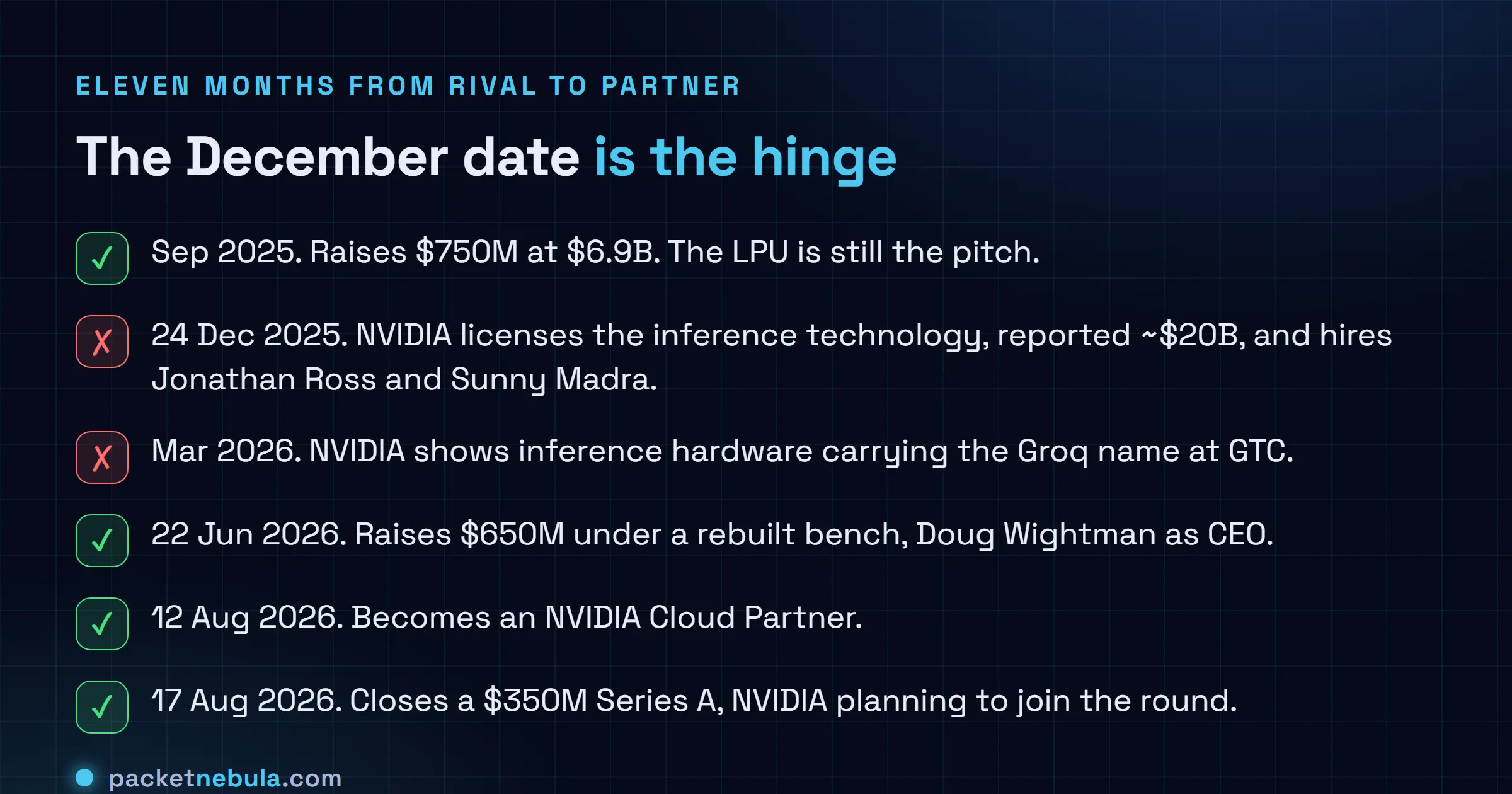
June brought $650 million, led by Disruptive with Infinitum, and a rebuilt executive bench under Doug Wightman. August brought the Cloud Partner badge and then the $350 million. Note the gap: less than three months between a $650 million round and a $350 million one. That’s either strong demand for capacity or a company that needs a lot of concrete quickly, and I think it’s mostly the first.
What Groq actually sells you in 2026
Tokens. That’s the whole product now, and the numbers behind it are the healthiest part of this story.
Thirteen data centres across North America, Europe, the Middle East and Asia Pacific. TechCrunch reports the current footprint at 54 megawatts, SiliconANGLE says 57, and neither cites a figure we could check against a Groq filing, so treat it as mid-fifties. The target is above 200 megawatts in 2027. Developer count went from over five million in June to more than six million in August, which is the kind of growth that makes a $3.5 billion valuation look less like a haircut and more like a re-baseline.
Alex Davis, who chairs Groq and runs Disruptive, framed it plainly: “We are building Groq into the world’s leading AI inference cloud. Inference will without a doubt become the largest and most critical layer of AI infrastructure.”
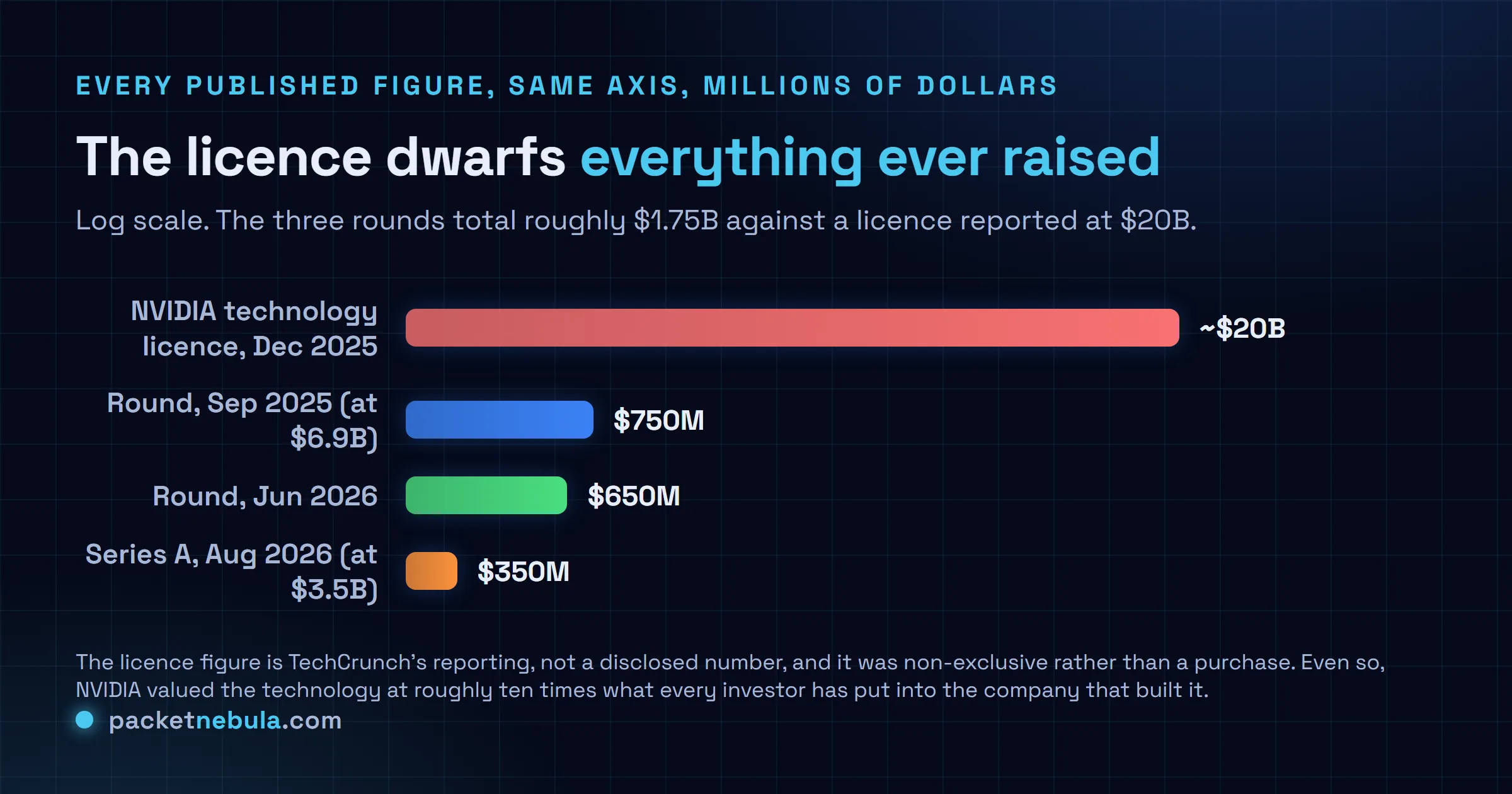
Put the licence on the same axis as the funding and the shape of the last year stops being ambiguous. Groq’s investors have put on the order of $1.75 billion into the company across those three rounds. Nvidia’s licence was reported at about $20 billion. The technology was worth an order of magnitude more than the business built around it, and Nvidia is the one who got to decide that.
If you’re calling the API, here’s the honest read
Nothing to do this week. No pricing change was announced, no rate limit change, no deprecation. The $350 million buys megawatts, and more megawatts is good for anyone who has hit a capacity ceiling.
What we’d stop assuming is the architectural story. If you picked GroqCloud specifically because a non-GPU design gave you latency characteristics you couldn’t get elsewhere, that reasoning has quietly expired. The silicon is licensed to Nvidia, the deployments mix it with Nvidia GPUs, and the company selling it is now a certified Nvidia cloud partner taking Nvidia money. Benchmark the endpoint you actually get, on your actual prompts, and stop reasoning from the chip diagram.
There’s a pattern worth noticing across the inference-silicon cohort. We wrote about where Etched’s $300M and its Sohu chip ended up, and the shape rhymes: raising against a bet that transformers would sit still long enough for fixed silicon to win. Nvidia’s answer, repeatedly, has been to write a cheque rather than a competing roadmap. It did something structurally similar when it backstopped $105 billion of OpenAI’s Ohio lease obligations instead of building the campus itself.
I might be wrong about the direction, but the Cloud Partner listing five days before the round doesn’t look like a coincidence to me. It looks like a term.
Sources
Funding figures, the $3.5 billion valuation, the September 2025 comparison and the spokesperson’s response come from TechCrunch, 17 August 2026, with the valuation also reported by TNW and Bloomberg. The megawatt figures, the feed-forward and attention split and the note that training runs on the accompanying GPUs are from SiliconANGLE. The 24 December 2025 Non-Exclusive Inference Technology Licensing Agreement, the 12 August 2026 Nvidia Cloud Partner announcement and the round dates are listed on Groq’s newsroom, and the June round plus the leadership changes are detailed in TechCrunch’s June report and Groq’s own $650M release.
Frequently asked questions
Is Groq still making its own inference chips?
Not as an independent challenger to Nvidia. Nvidia took a non-exclusive licence to Groq's inference technology on 24 December 2025 and hired much of the leadership, and it announced inference hardware carrying the Groq name at GTC in March 2026. Groq the company now sells inference capacity as a neocloud. SiliconANGLE describes a split arrangement where feed-forward network modules run on the Groq silicon while attention calculations go to accompanying Nvidia GPUs, and it notes that training is not supported on the Groq part at all.
Was the $3.5 billion valuation a down round?
Reported as one, disputed by the company. Groq was valued at $6.9 billion in September 2025 after a $750 million raise, so $3.5 billion is roughly half that a year later. A Groq spokesperson told TechCrunch the company sees it not as a down round but as establishing a new valuation for the post-licensing version of Groq, which is a fair point given that Nvidia bought the technology and hired the founder in between. Note the valuation figure comes from press reporting rather than an official Groq disclosure.
Does this affect GroqCloud pricing or the API today?
No published change. Neither the funding announcement nor the Nvidia Cloud Partner listing came with new pricing, new rate limits or a deprecation notice. What the money buys is capacity: Groq runs 13 data centres at roughly 54 to 57 megawatts today and wants to pass 200 megawatts in 2027. If you are on the API, the practical read is more headroom rather than a different bill.
Who runs Groq now?
Doug Wightman is chief executive, with Alan Rice as COO, Sinclair Schuller as CTO and Rakesh Malhotra as CPO. Alex Davis chairs the company and runs Disruptive, the Dallas firm that led both this round and the $650 million raise in June 2026. Jonathan Ross and Sunny Madra left for Nvidia as part of the December licensing agreement.
Why would Nvidia invest in a company it already licensed and staffed?
Because a neocloud is a customer. Groq buying GPUs to serve six million developers is demand for Nvidia hardware, and the Cloud Partner badge on 12 August makes that relationship formal. We would not read it as a strategic hedge on alternative silicon, since Nvidia already holds the licence to the alternative silicon. Nvidia's participation was described as planned rather than closed at announcement, so the amount is not public.


