
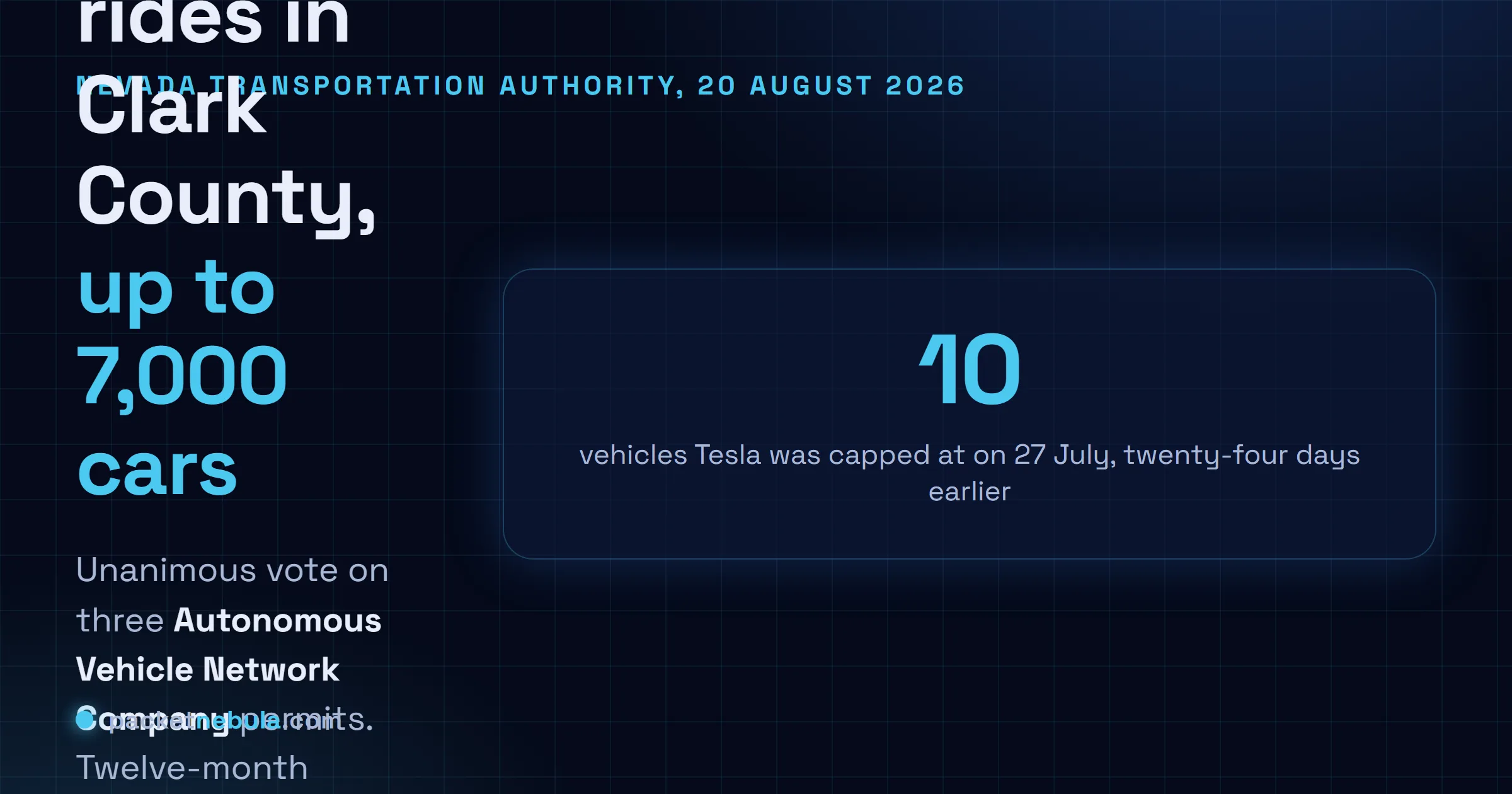
Three weeks ago Tesla was allowed ten robotaxis on one stretch of the Strip. On 20 August the same regulator handed it a permit for up to five thousand across all of Clark County, and did the same for Waymo and Uber at a thousand each. So the ceiling in Las Vegas went from 10 to 7,000 in twenty-four days. Before you picture the Strip clogged with empty Teslas, read what Tesla's own Cybercab chief engineer told the hearing: five thousand has always been a ceiling, and he doubts they get near it by this time next year. Permits are not cars.
The short answer
The Nevada Transportation Authority voted unanimously on 20 August 2026 to let Tesla, Waymo and Uber charge for driverless rides in Clark County. Caps are 5,000, 1,000 and 1,000 over twelve months. The same body had limited Tesla to 10 cars on a slice of the Strip on 27 July. Nobody is deploying anything close to the ceiling. Tesla’s Cybercab chief engineer said so at the hearing.
What actually got approved
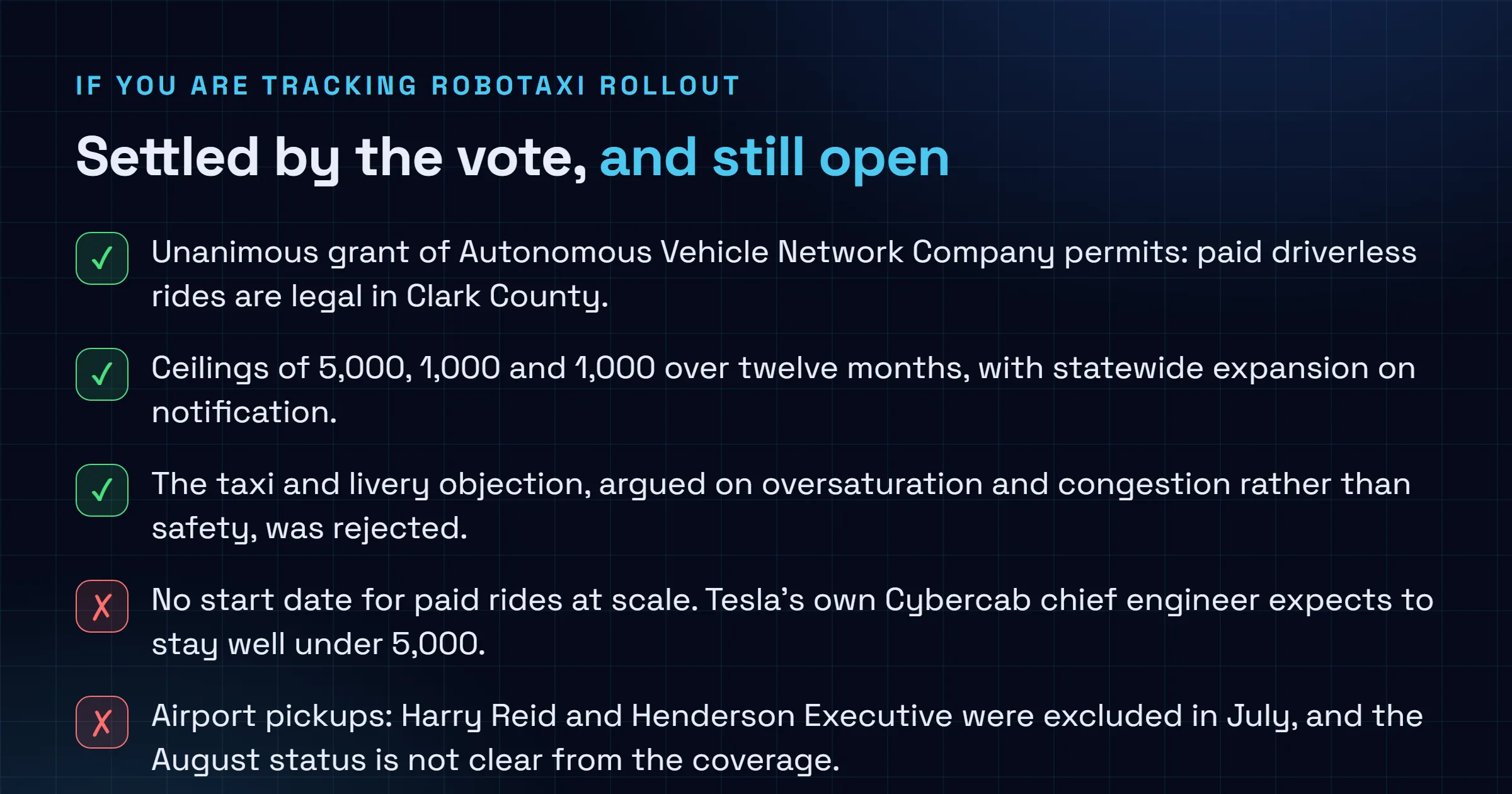
The permit class is the interesting bit. Tesla, Waymo and Uber each received an Autonomous Vehicle Network Company permit, which is the piece of paper that turns a demonstration into a business. A testing permit lets you drive. This one lets you charge.
Geography is Clark County, the chunk of Nevada that holds Las Vegas, with the option to spread statewide after notifying the agency. The caps are twelve-month ceilings. Not targets, not orders.
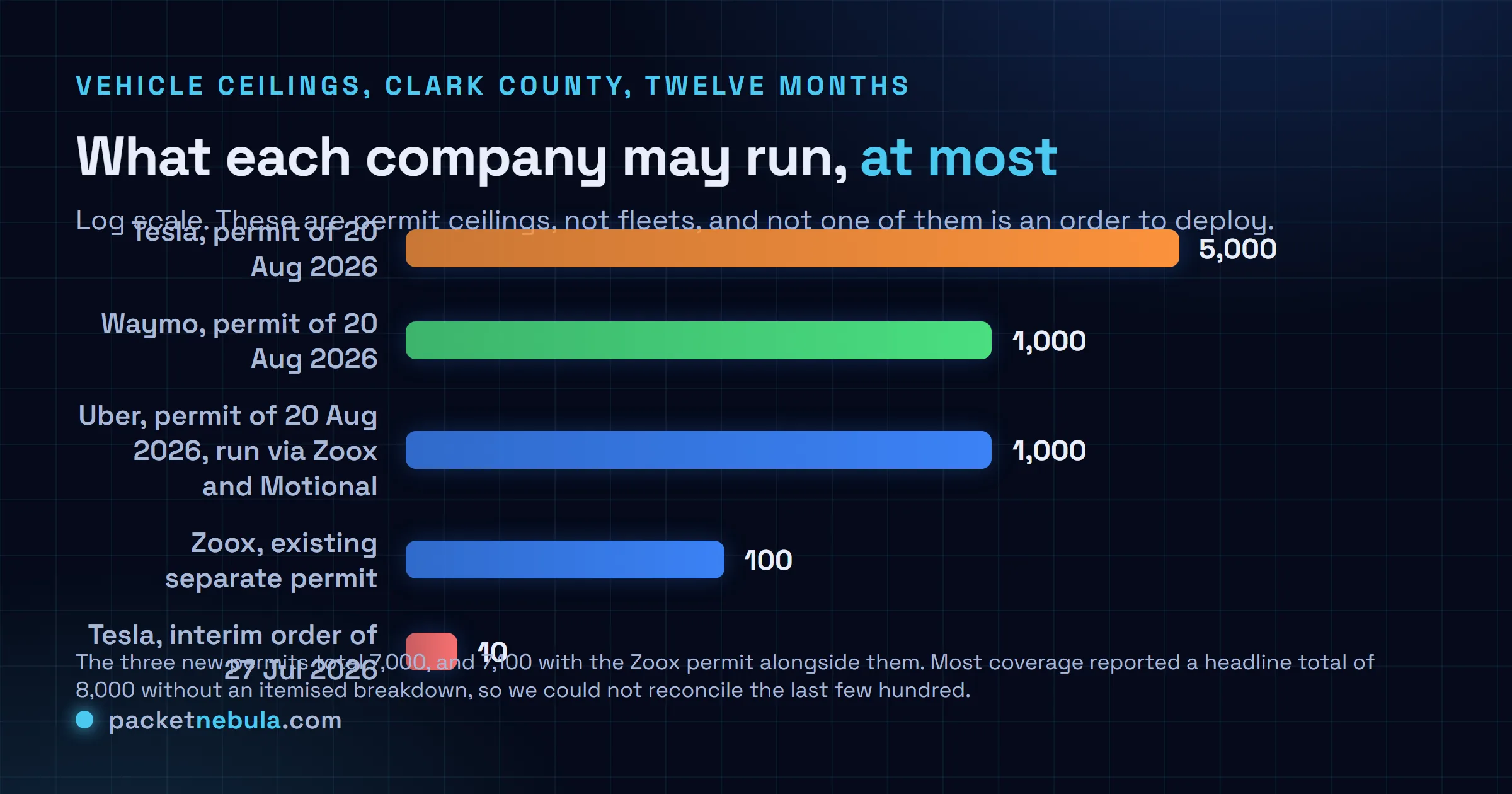
Tesla got 5,000. Waymo got 1,000. Uber got 1,000, which it plans to fill through Amazon’s Zoox and Hyundai’s Motional rather than any vehicle of its own. Zoox separately already holds a permit for 100.
Add the three new permits and you get 7,000. Add Zoox and you get 7,100. Almost every headline said 8,000. We could not find the itemisation that gets there, and we are not going to pretend otherwise. Treat the round number as press shorthand.
The 10-car permit that came first
Here is the part that reframes the story.
On 27 July the same authority granted Tesla a permit for ten vehicles. Ten. Geofenced to a stretch of the Las Vegas Strip, 45 mph ceiling, no pickups at Harry Reid International or Henderson Executive, every car wearing a robotaxi label, every passenger told they were riding driverless. Growing past ten meant going back for a new approval.
Tesla had applied for 5,000 county-wide with airport access. It got 0.2% of the ask, and Electrek noted at the time that regulators never publicly explained how a five-thousand-vehicle request became a ten-vehicle permit.
Twenty-four days later they granted the original request.
We do not know what moved in between, and neither does anyone writing about it, because the reasoning is not in the public record we can read. Maybe the interim order was always a bridge while the full applications got heard. That reading fits the “requires new regulatory approval” clause sitting inside it. Still a strange sequence to watch from outside.
Ceilings, not fleets
Tesla’s Cybercab chief engineer Eric Early told the hearing: “The 5,000 has always been a ceiling for us. I don’t think we’ll be in a position by this time next year to deploy 5,000 vehicles.”
That is a vendor talking down its own headline number, at the hearing, on the record. Engadget reported Tesla aiming at roughly 2,500 by 2027, which is half the ceiling and a year past the permit window.
So the honest reading: Nevada removed a bottleneck. It did not create a fleet. What limits robotaxis in Las Vegas next spring will be vehicle production, depot capacity, remote-operations staffing, plus whatever the incident rate does to public appetite. Permit headroom stopped being the binding constraint on 20 August.
Waymo is the one I would watch. A thousand cars in a single county is a serious step up from its usual metro rollout pace, and it has the operational history the other two are still assembling. I might be wrong, but I would bet Waymo hits a higher fraction of its cap than Tesla hits of the ceiling it just called a ceiling.
Who lost the vote
Nevada Yellow Cab, Nevada Checker Cab, Nevada Star Cab and the Livery Operators Association petitioned against the applications back in July. Their lawyer, Kimberly Maxson-Rushton, argued oversaturation of commercial transport and roadway crowding, pointing at the area near the airport and Las Vegas Boulevard.
They lost, unanimously.
Worth noting what they argued. The case was economic and congestion-based rather than a safety case, which is a weak hand in front of a transportation authority. The taxi industry has run this play against ride-hailing for a decade with a poor record.
What to actually watch
Emergency response is the live thread. Tesla told the hearing it is working with law enforcement on a five-minute video walking first responders through incidents involving its vehicles, which sounds like a formality and is not. An unoccupied Zoox drove into heavy smoke from an active fire in Las Vegas on 20 June, producing a 105-vehicle recall in July. Same city, same year, same category of problem. We covered that one when Zoox won its Part 555 exemption, and the open question there is open here.
Airports are the second thread. Harry Reid was explicitly excluded from the July order. Whether the August permits open it is not something we can confirm from the coverage, and for a Las Vegas robotaxi business the airport run is a large slice of the revenue. If you are tracking this, chase that detail.
A smaller one: statewide expansion is available on notification. Reno is a different driving problem from the Strip. Snow, for a start. Nobody has said anyone intends to go there, and the permit language means they would not have to ask first.
Sources
Vote, permit caps and the Eric Early quote: TechCrunch, 20 August 2026. Permit class, paid rides, statewide clause and the 2,500-by-2027 figure: Engadget. The 27 July interim order and its conditions: Electrek. The Nevada Transportation Authority had published no statement we could link at the time of writing, so every number here comes from hearing reporting rather than an agency document.
Frequently asked questions
What exactly did Nevada approve on 20 August 2026?
The Nevada Transportation Authority voted unanimously to grant Autonomous Vehicle Network Company permits to Tesla, Waymo and Uber. That permit class is what lets a company charge money for a driverless ride. The area is Clark County, which contains Las Vegas, with expansion to the rest of the state allowed on notification to the agency. The caps run twelve months: up to 5,000 vehicles for Tesla, up to 1,000 for Waymo, up to 1,000 for Uber.
Why do most headlines say 8,000 when the three permits add up to 7,000?
Good question, and we could not resolve it from the coverage we could read. TechCrunch lists the three permits plus a separate existing 100-vehicle permit held by Zoox, which gets you to 7,100, then still reports a total of 8,000. Several outlets repeated the 8,000 figure without a breakdown. Treat 7,000 as the number the three new permits actually document, and 8,000 as a round figure nobody has itemised in public.
How does Uber run a thousand robotaxis when it does not build cars?
Through partners. Uber told the authority it will operate its allocation with Amazon's Zoox and with Motional, the Hyundai subsidiary. Uber also argued at the hearing for a mixed fleet where human drivers and autonomous vehicles run side by side, which is a different bet from the one Tesla and Waymo are making.
What was the 10-vehicle interim order, and is it gone?
On 27 July 2026 the same authority gave Tesla a much narrower permit: 10 fully autonomous vehicles, a geofence covering part of the Las Vegas Strip, a 45 mph limit, no airport pickups at either Harry Reid International or Henderson Executive, every car labelled robotaxi, riders told they are in a driverless vehicle, and any expansion past 10 requiring fresh approval. Tesla had asked for 5,000 county-wide including the airports. The August vote is the fresh approval that order required.
Does this mean paid driverless rides start immediately?
No. The permits authorise paid service and describe deployment over the coming twelve months, but none of the reporting we checked gives a start date for paid rides at scale. Tesla said it is producing a five-minute instructional video for first responders handling incidents involving its vehicles. Nevada Yellow Cab, Nevada Checker Cab, Nevada Star Cab and the Livery Operators Association opposed the applications on oversaturation and congestion grounds, and lost.


