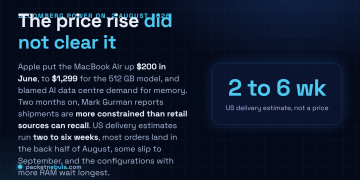





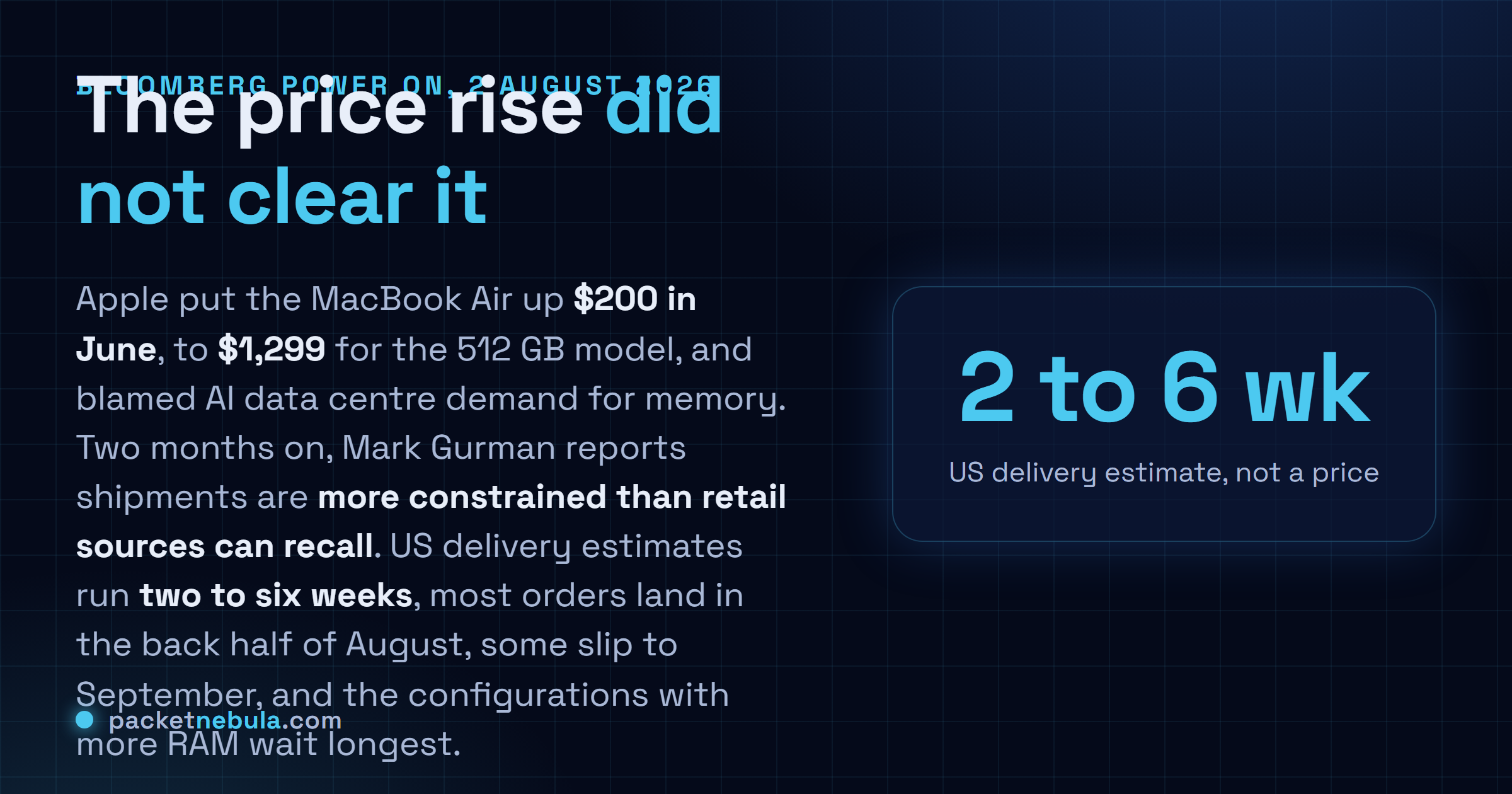
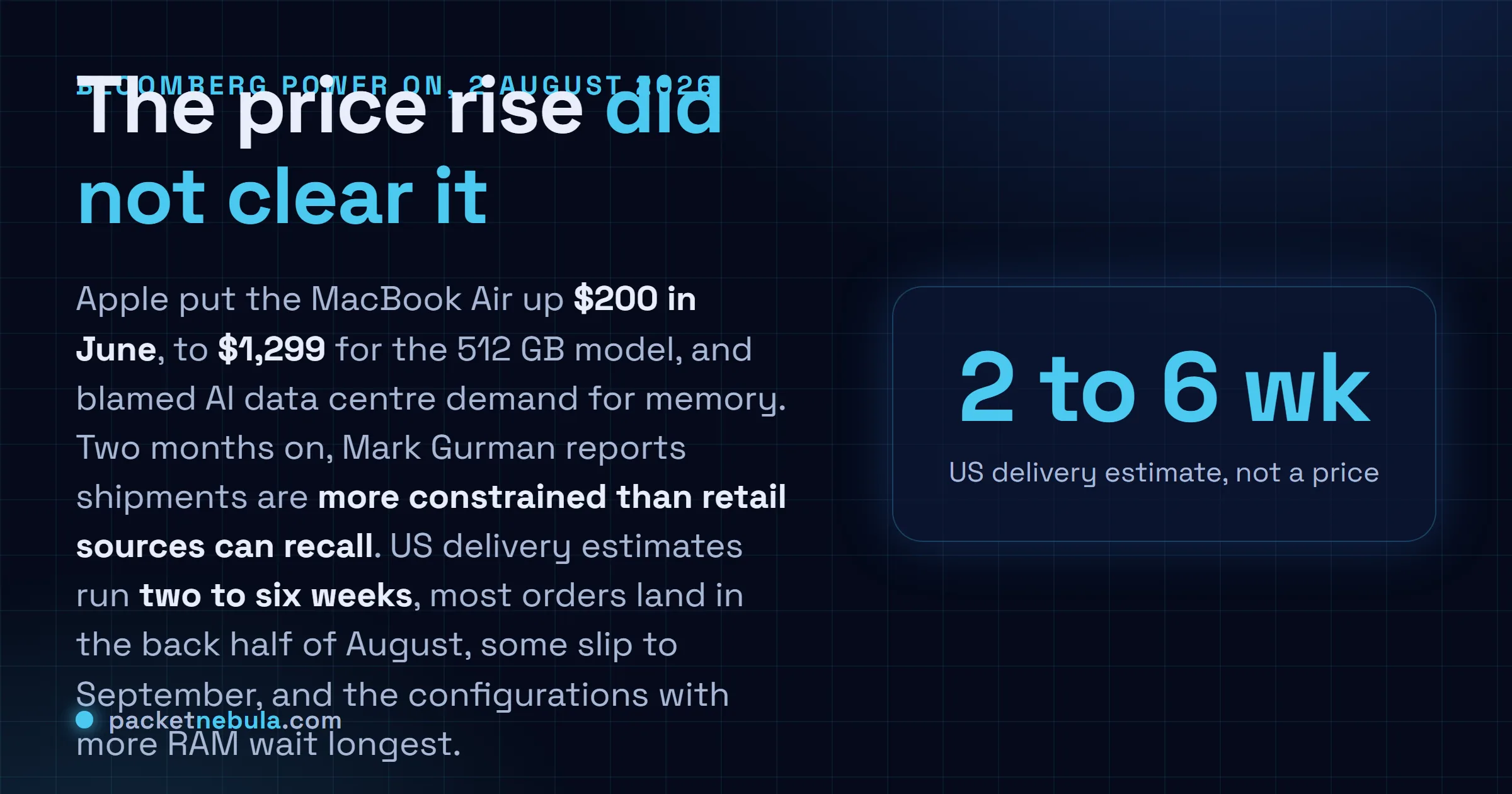
You go to order six Airs for the new starters, and the checkout says late September. That's roughly where this is: Apple put the MacBook Air up $200 in June, to $1,299 for the 512 GB model, and two months on it still can't keep the laptop in stock. Bloomberg's Mark Gurman reported on 2 August that shipments are more constrained than retail sources can recall, with US delivery estimates running two to six weeks. The configurations carrying more memory wait longest. That last detail is the one worth holding onto, because it says the shortage isn't being cleared by price. It's being rationed by lead time.
The short answer
Apple raised Mac prices in late June and blamed AI demand for memory. Two months later the MacBook Air is in short supply anyway, with US delivery estimates of two to six weeks and the higher memory configurations waiting longest. The useful signal isn’t the price. It’s that a $200 increase didn’t buy availability, which tells you where consumer devices now sit in the queue for DRAM.
What was actually reported
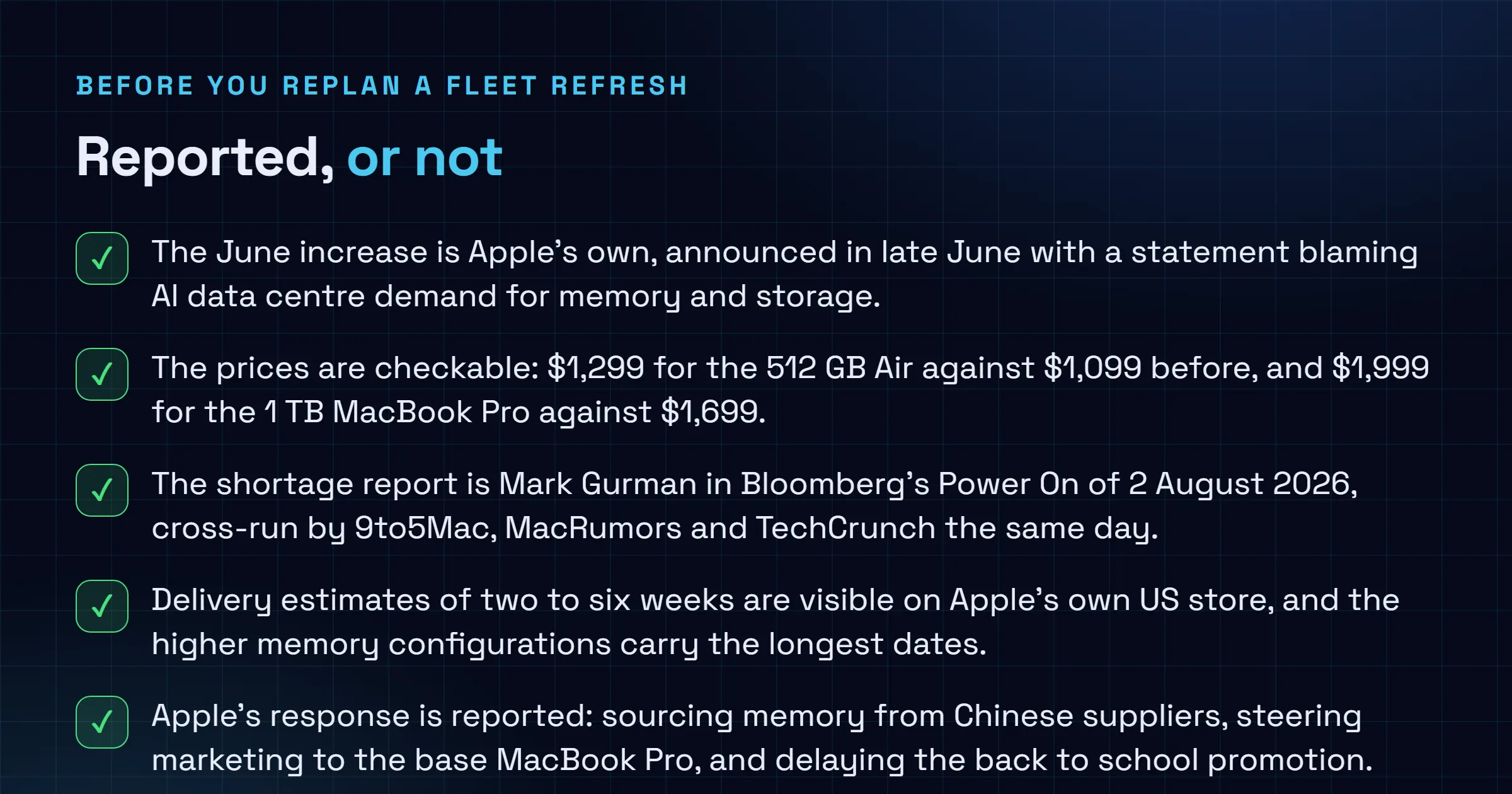
Gurman’s Power On newsletter on 2 August is the source, and the line everyone picked up came from Apple retail: shipments of new units are more constrained than store sources can ever recall. MacRumors, 9to5Mac and TechCrunch all ran it the same day, and none of them added a unit number, because there isn’t one.
What you can check yourself is the store. Delivery estimates on Apple’s US site ran two to six weeks, most orders landing in the back half of August, a few pushed into September. TechCrunch also noted the marketing tell: Apple has been steering front-page attention toward the base MacBook Pro, with the Air marked subject to availability. The back to school promotion slipped from June too.
Gurman reports Apple is sourcing memory from Chinese suppliers to cover the gap. Which, for a company that has spent a decade de-risking its supply chain in the other direction, is a reasonable measure of how tight this is.
The bit that isn’t in the headline
Look at the sequence rather than the shortage.
Apple raised prices in late June and said why, on the record: the rapid expansion of AI data centres created an extraordinary surge in demand for memory and storage, and it had never seen a component price increase this much this quickly. The 512 GB Air went to $1,299 from $1,099. The 1 TB MacBook Pro went to $1,999 from $1,699. Then the Air sold out anyway.
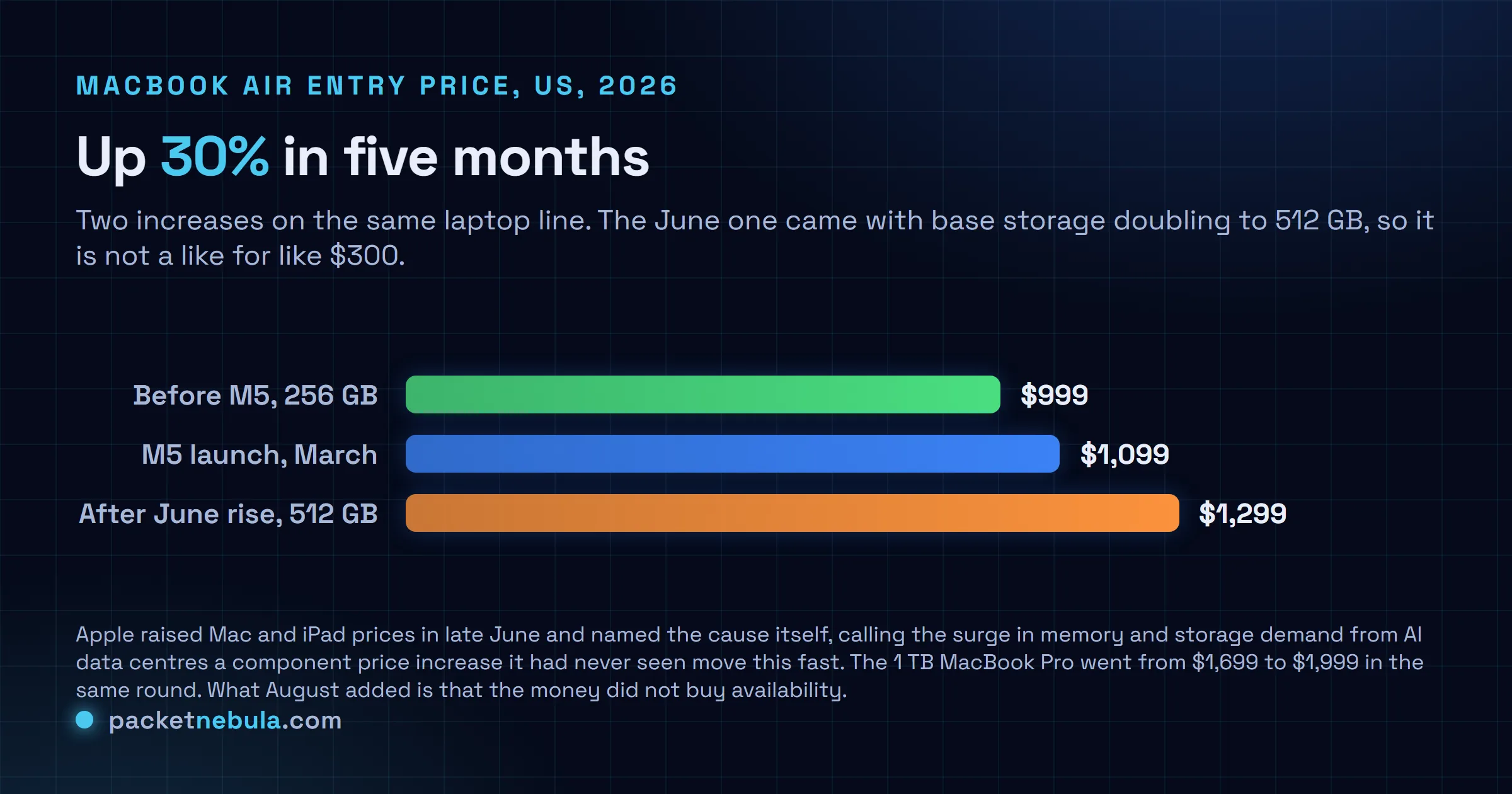
Normally a $200 increase does some of the rationing for you. Demand softens, the queue shortens, everyone grumbles and moves on. That didn’t happen here, and the reason is that Apple isn’t really competing with its own customers for these parts. It’s competing with hyperscalers, and they’re not price-sensitive in any way a laptop buyer would recognise. When an accelerator’s HBM stack earns more per wafer than the LPDDR in a MacBook, consumer devices get whatever’s left.
Honestly, I think that’s the whole story, and it generalises well past Apple. The consumer price rises we’ve been covering all year were the polite phase of this shortage. Rationing by lead time is the impolite one.
Why the RAM tier matters more than usual
Here’s the practical bit, and it’s the detail most of the coverage buried.
The delivery estimate isn’t attached to the model. It’s attached to the configuration, and higher memory configurations carry the longest dates. So the spec decision and the schedule decision have collapsed into the same decision. Order the 16 GB base and you might see August. Order 24 or 32 with a storage bump and you’re reading September, on a machine you priced in July.
Anyone who buys laptops in batches knows why that’s annoying. You don’t spec a fleet machine and then find out when it ships. You promise a start date to a manager, and the machine has to be on the desk for it.
What we’d do with a Q3 laptop budget
Order the spec you actually need, now, and stop treating the RAM tier as a nice to have you can revisit. It’s the line item that decides your delivery date, and it’s also the one that ages a machine fastest if you under-buy. Under-specifying to dodge a wait means paying the wait again in two years.
Ask the reseller for committed dates rather than the store estimate. Apple’s own window is a range, and a range is what a supply team says when it doesn’t know. Business channels often hold allocation that the consumer store doesn’t show, which is worth ten minutes on the phone before you accept September.
And keep the causal chain straight when the variance lands on someone’s desk. This is the same shortage behind the Pixel 11 price increase Google confirmed and behind Qualcomm’s double-digit chip rise starting 1 September. Three vendors, three different ways of passing the same problem on. Apple is simply the only one that shows you the constraint as a date on a checkout page.
One last thought, and I might be wrong about this. Apple absorbed years of component swings without moving list prices, and it burned that credibility in a single June. If memory contract prices keep climbing into 2027, the interesting question isn’t whether the Air goes up again. It’s whether the base configuration quietly gets worse instead, which is the move nobody has to announce.
Sources
The shortage report is Mark Gurman’s Bloomberg Power On newsletter of 2 August 2026, as covered by MacRumors, 9to5Mac and TechCrunch, all published the same day. The June price increase and Apple’s statement about AI data centre demand are reported by the Associated Press via US News and TechRepublic. The Q3 DRAM forecast is TrendForce’s press release of 3 July 2026. We have not seen any published unit volumes for MacBook Air production, and we’d treat any that appear without a source with suspicion.
Frequently asked questions
Why is the MacBook Air out of stock in August 2026?
Memory. Apple said in late June that the rapid expansion of AI data centres created an extraordinary surge in demand for memory and storage, and that it had never seen a component price rise this much this quickly. The same shortage hit the Mac mini and Mac Studio first. Bloomberg's Mark Gurman reported on 2 August 2026 that MacBook Air shipments are now more constrained than retail store sources can recall.
How long is the wait for a MacBook Air right now?
Apple's US online store showed two to six week delivery estimates when the report ran on 2 August 2026. Most configurations land in the back half of August and some slip into September. The estimate is per configuration, not per model, so the number you see depends on which memory and storage tier you pick.
How much has the MacBook Air gone up in 2026?
The entry price went from $999 to $1,099 when the M5 model arrived in March 2026, then to $1,299 in the late June increase, which also moved base storage from 256 GB to 512 GB. So it is up about 30 percent across the year, though the June step is not a like for like $200 because you get twice the storage. The 1 TB MacBook Pro moved from $1,699 to $1,999 in the same round.
Should I order a high-RAM MacBook Air now or wait?
Order it now if the spend is approved and the machine has a job waiting. Higher memory configurations carry the longest dates, so the wait grows with the spec rather than shrinking. Nobody credible is forecasting memory prices falling in 2026, and TrendForce still had conventional DRAM rising another 13 to 18 percent in Q3 in its 3 July release. Waiting risks paying more for the same wait.
Is this only an Apple problem?
No. Google confirmed Pixel 11 price rises for the same reason, and Qualcomm is raising chip prices on products shipping after 1 September 2026. Apple is just the visible case because it publishes per-configuration delivery dates on a public store, so you can watch the constraint instead of inferring it from a press release.