
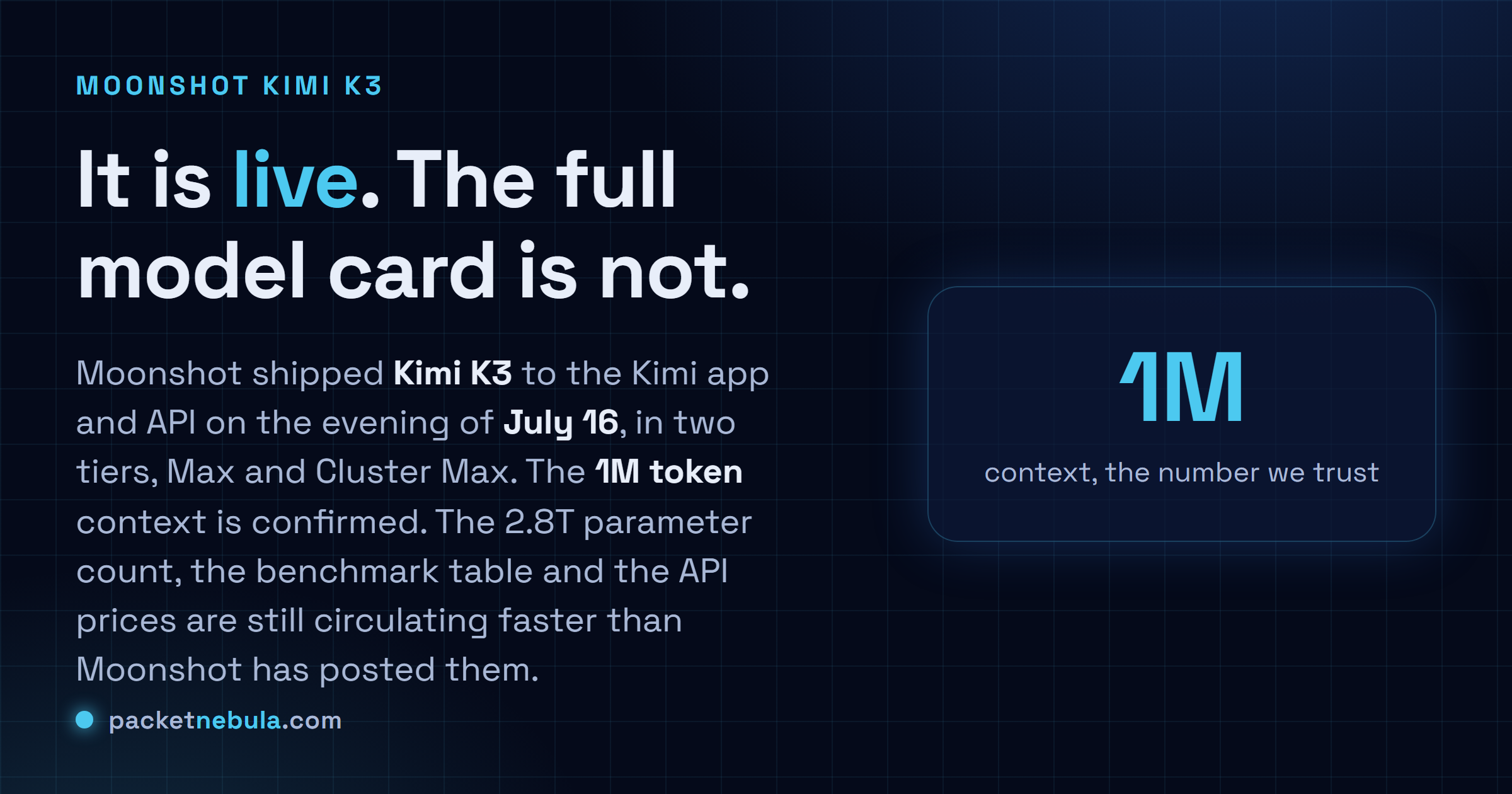
Open the Kimi app tonight and there's a fresh name in the model picker: K3, in two flavors, Max and Cluster Max. So it's real. Moonshot shipped it the evening of July 16, and you can already chat with it and hit it over the API. What we can't hand you yet is a clean model card. The context window is confirmed at 1M tokens. Almost everything else making the rounds, the 2.8 trillion parameters, the benchmark table where it slots just under Fable 5 and GPT-5.6 Sol, the API prices, the license, is circulating faster than Moonshot has published it. Some of it traces to the launch page. Some of it is user tests and leaks wearing an official coat. We went looking for the line between the two.
The short answer
Moonshot pushed Kimi K3 into the Kimi app and API on the evening of July 16, in Max and Cluster Max tiers. The 1M token context window is confirmed. The 2.8T parameter count, the benchmark table that beats Opus 4.8, and the API prices are all circulating ahead of an official model card. Weights aren’t out. Here’s the line between what shipped and what’s still rumor.
What actually shipped tonight
A model you can talk to. That part isn’t in dispute. Sometime on the evening of July 16 the Kimi client and the API picked up a new entry, K3, split into a Max tier and a Cluster Max tier. If you’re logged in, it’s there now.
Funny detail: reporting from earlier the same day still framed K3 as “upcoming”, “coming days” stuff sourced from the Financial Times. Then it just showed up. So if you read that it hadn’t launched, you weren’t wrong at breakfast and wrong by dinner, the story moved under everyone.
The one hard spec Moonshot has stated out loud is the context window: up to 1M tokens. That’s it for confirmed technicals. The company said itself it didn’t disclose the full spec sheet in the initial announcement. Which is exactly why the internet filled the gap for them.
The numbers everyone is quoting
Here’s where we have to slow down. A lot of very specific figures are flying around, and they read like an official model card. They aren’t one. Not yet.
The parameter count you’ll see most is 2.8 trillion total, pitched as the biggest open-weight model China has produced. Some reports say 2.5T instead. Both trace back to leaks and user pokes at the running model, not a published card. For scale, K2 was 1 trillion total with 32B active per token, so a jump to the 2.5-to-3T range is plausible, just not stamped.
The benchmark table is the juicy part. As Moonshot is reportedly showing it, K3 lands second overall, behind Claude Fable 5 and GPT-5.6 Sol, and ahead of everything else it tested. The concrete scores in circulation: 1687 on GDPval-AA v2 (that’s ahead of Opus 4.8 Max, quoted around 1600), 1527 on AA-Briefcase (nudging past GPT-5.6 Sol Max at 1495), and a BrowseComp result of 91.2 that people are calling state of the art. Coding benchmarks reportedly beat Opus 4.8 and GPT-5.5.
We’d hold all of that loosely. Nobody outside Moonshot has reproduced it, and a launch-week leaderboard from the lab that built the model is the least independent number there is. It might hold up. Check back when someone neutral has run it.
The price question, and why we won’t chart a rumor
The pitch that actually matters for most of us isn’t the leaderboard. It’s the bill.
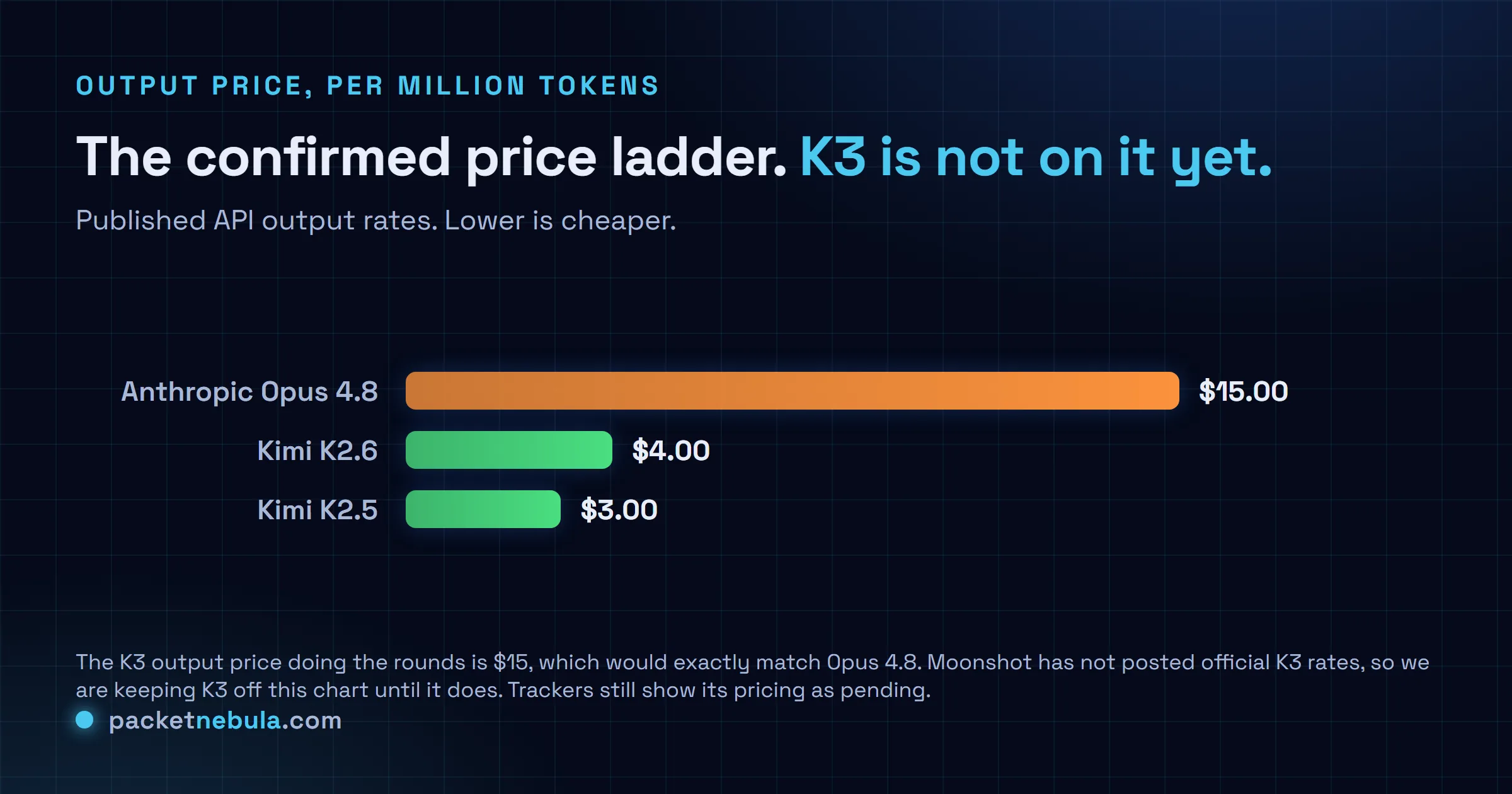
Moonshot’s whole recent playbook is undercutting the frontier labs on token price. The older models make that concrete: K2.6 runs $0.95 in and $4.00 out per million, K2.5 sits at $0.60 and $3.00. Against Anthropic’s Opus 4.8 list price of $3 in and $15 out, that’s roughly a third of the cost for the previous generation.
For K3 specifically? We don’t know. The figure being repeated is $3 in and $15 out, which would land K3 exactly on Opus 4.8’s price, not below it. That would be a real break from the cheap-challenger story. But Moonshot hasn’t posted official K3 rates, and the pricing trackers still show it as pending. So we left K3 off the chart above on purpose. Charting a number the vendor hasn’t published is how you end up quoting yourself three weeks later.
Why it matters before the model card lands
Zoom out and the release says something even with the specs half-confirmed.
For a couple of years the working assumption was that Chinese frontier models trailed the American labs by eight to twelve months. A model that ships into the app the same week it’s rumored, aiming at Opus 4.8 rather than last year’s target, dents that. Moonshot is reportedly raising at around a $31.5 billion valuation, chasing DeepSeek’s larger raise, and the open-weight strategy is the lever: give the weights away, sell the hosted tier and the goodwill.
If you already lean on open models, this matters directly. The same wall applies though. A 2.5-to-3T model is not something you run on a desk. It’s the same story we hit with Thinking Machines Inkling this week, where “open” meant eight big GPUs, not your laptop. If you want weights that run on hardware you own, a smaller model like Qwen 3.7 offline is still the honest answer.
The honest read
I’m genuinely interested in K3, and I’m not ready to repeat its scoreboard as fact. Both of those can be true.
What’s solid tonight is small but real: the model is live, you can use it, and the context window is a confirmed 1M. Everything with a decimal point in it, the parameter count, the benchmark rows, the price per token, is running ahead of Moonshot’s own paperwork. So do the boring thing. Log into the app, throw the prompts that actually matter to your work at K3 Max, and wait for the weights and the model card before you wire it into anything. The leaderboard is somebody else’s marketing. The prompts on your desk are the only test that pays your bills.
Sources: TechCrunch, PYMNTS, OfficeChai and BigGo Finance, July 2026. The 1M context and the July 16 app and API launch are attributed to Moonshot. Parameter counts, benchmark scores and API pricing are as circulating via reporting and user tests, are not from an official model card, and are not independently reproduced. Predecessor pricing and Opus 4.8 list pricing are as published by each vendor.
Update, 7 October 2026. Anthropic's pricing page lists Claude Opus 4.8 at $5 and $25 per million tokens, not the $3 and $15 quoted here.
Frequently asked questions
Is Kimi K3 released?
Yes, in the product. Moonshot put K3 live in the Kimi client and API on the evening of July 16, 2026, in two tiers labelled Max and Cluster Max. Reporting earlier that day still called it upcoming, and by the evening it was in the app. The open weights and a full technical model card are the parts still landing.
How big is Kimi K3?
The most-quoted figure is 2.8 trillion total parameters, which would make it the largest open-weight model out of China. That number comes from leaks and user tests, not an official model card, and other reports say 2.5T. Moonshot has confirmed a context window of up to 1M tokens. The active parameter count per token has not been reliably disclosed. K2 ran 1T total with 32B active for reference.
How much does Kimi K3 cost?
Officially, unknown as of July 16. Moonshot had not posted K3 API rates and trackers still show pricing as pending. A figure of $3 input and $15 output per million tokens is circulating, which would exactly match Anthropic Opus 4.8 list pricing. For context, confirmed rates on the older models are $0.95 in and $4.00 out for K2.6, and $0.60 in and $3.00 out for K2.5. Treat any K3 price as a rumor until Moonshot posts it.
Is Kimi K3 better than Claude Opus 4.8?
On the numbers Moonshot is showing, it edges Opus 4.8 on some benchmarks and trails Claude Fable 5 and GPT-5.6 Sol. One circulating score puts K3 at 1687 on GDPval-AA v2 against roughly 1600 for Opus 4.8 Max. None of that is independently reproduced yet, so we would not call it settled. Run your own prompts once the API stabilises.
Can I download the Kimi K3 weights?
Not yet. Moonshot positions K3 as open-weight and says the weights are coming soon, most likely under a modified MIT license as with earlier Kimi releases. Until they are on Hugging Face, the only access is the hosted Kimi app and API.


