
Two months. That is how long Nvidia's neocloud financing programme ran before the Wall Street Journal reported, on 27 August, that the company had stepped back from parts of it. The programme is the AI Compute Partnership, announced 1 July: Nvidia backstops a small cloud operator by promising to rent unused GPUs back at a fixed rate, which makes lenders comfortable, and in exchange takes a share of what the operator earns above a threshold. Nvidia's reply to the report was that the model is still in place and continues to evolve. So which is it? We went to the quarterly filing rather than the coverage, and the filing describes an arrangement that sits oddly next to the one cloud operators reportedly objected to.
The short answer
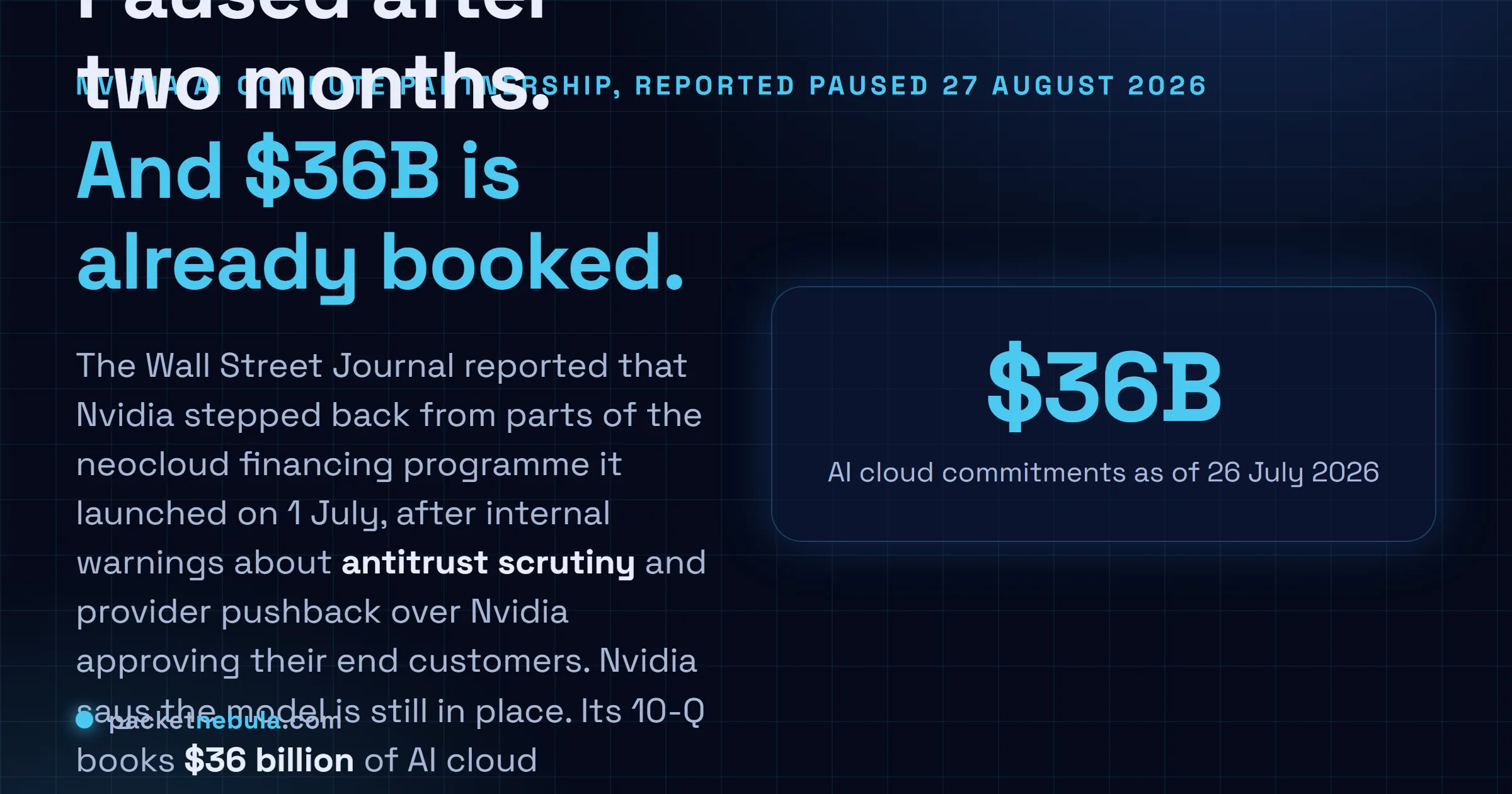
The Wall Street Journal reported on 27 August that Nvidia stepped back from deals in the AI Compute Partnership, the neocloud financing programme it launched on 1 July, after internal warnings about antitrust exposure and pushback from providers over Nvidia approving their end customers. Nvidia says the model is still in place. The quarterly filing, published the same week, puts $36 billion of AI cloud agreements on the books and describes terms that do not obviously match what providers were reportedly offered.
What the programme was
Colette Kress and Raj Mirpuri published it on 1 July. The pitch was aimed at operators who have demand and a site but cannot write a nine-figure cheque for accelerators, which describes most of the neocloud tier.
Nvidia’s part is a floor. It commits to cloud service agreements against the capacity, so if the provider cannot fill a hall, Nvidia rents it. A lender looking at that build now sees contracted revenue rather than a bet on a sales pipeline, and prices the debt accordingly. Nvidia gets hardware revenue plus a cut of what the provider earns from real customers on top. The Journal puts that cut at 50 percent of revenue above a threshold, a number Nvidia has never published.
Sharon AI, an Australian operator, signed for up to 40,000 GB300 GPUs on a six-year agreement. Firmus took the bigger side: a DSX campus in Batam, Indonesia, built to Nvidia’s SuperPOD reference architecture, scaling to 360 MW and as many as 170,000 GPUs. Call it 210,000 accelerators between them at launch.
It is a clean idea. Vendor finance is old, and using guaranteed offtake instead of a loan is a reasonable way to do it when the collateral is a depreciating machine nobody can price in eight years.
The number nobody printed
Every outlet that covered the pause quoted $36 billion. It comes from the 10-Q for the quarter ended 26 July, which was the first time Nvidia disclosed the size of this thing.
Almost nobody printed the rest of the table.
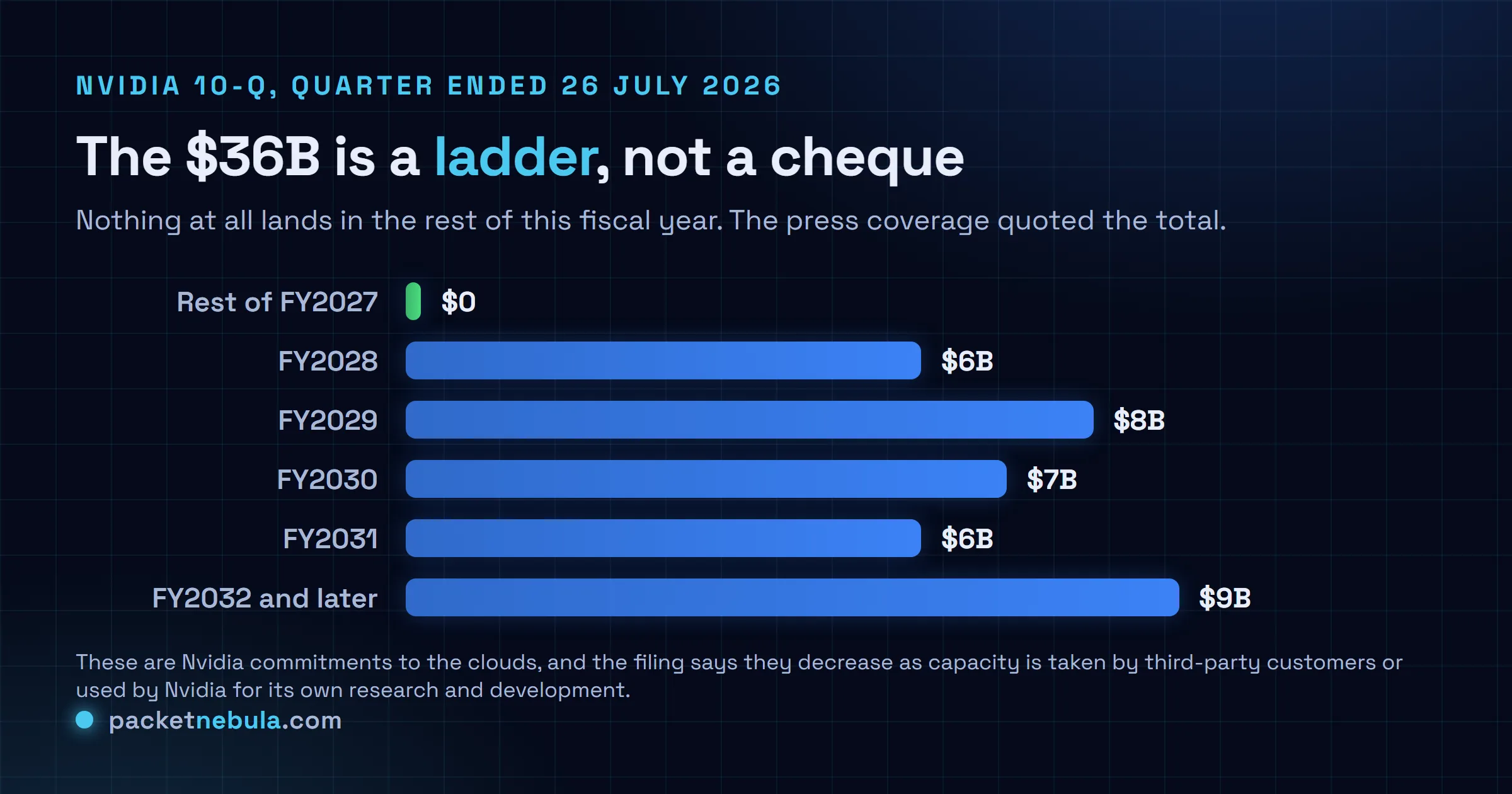
Nothing in the remainder of fiscal 2027. Then $6B, $8B, $7B, $6B, and $9B in fiscal 2032 and beyond. So the obligation everyone described as enormous does not start until Nvidia’s fiscal 2028, and it thins out across six years after that.
Two other lines sit near it and are worth knowing about. Nvidia separately carries $3.529 billion of notional land, power and shell guarantees for AI cloud partners, booked as credit derivatives, with partners having placed $712 million in escrow against Nvidia’s exposure and terms running five to seven years. And the SB Energy guaranties behind OpenAI’s Ohio leases, which we went through in detail when they were disclosed, add $105 billion to bring total maximum gross guarantee exposure to $108.5 billion.
The AI Compute Partnership is the smallest of Nvidia’s financing instruments by a wide margin. It is also the only one that got paused.
Where the filing and the reporting disagree
Here is the sentence from the 10-Q, and it is the reason we wrote this up at all:
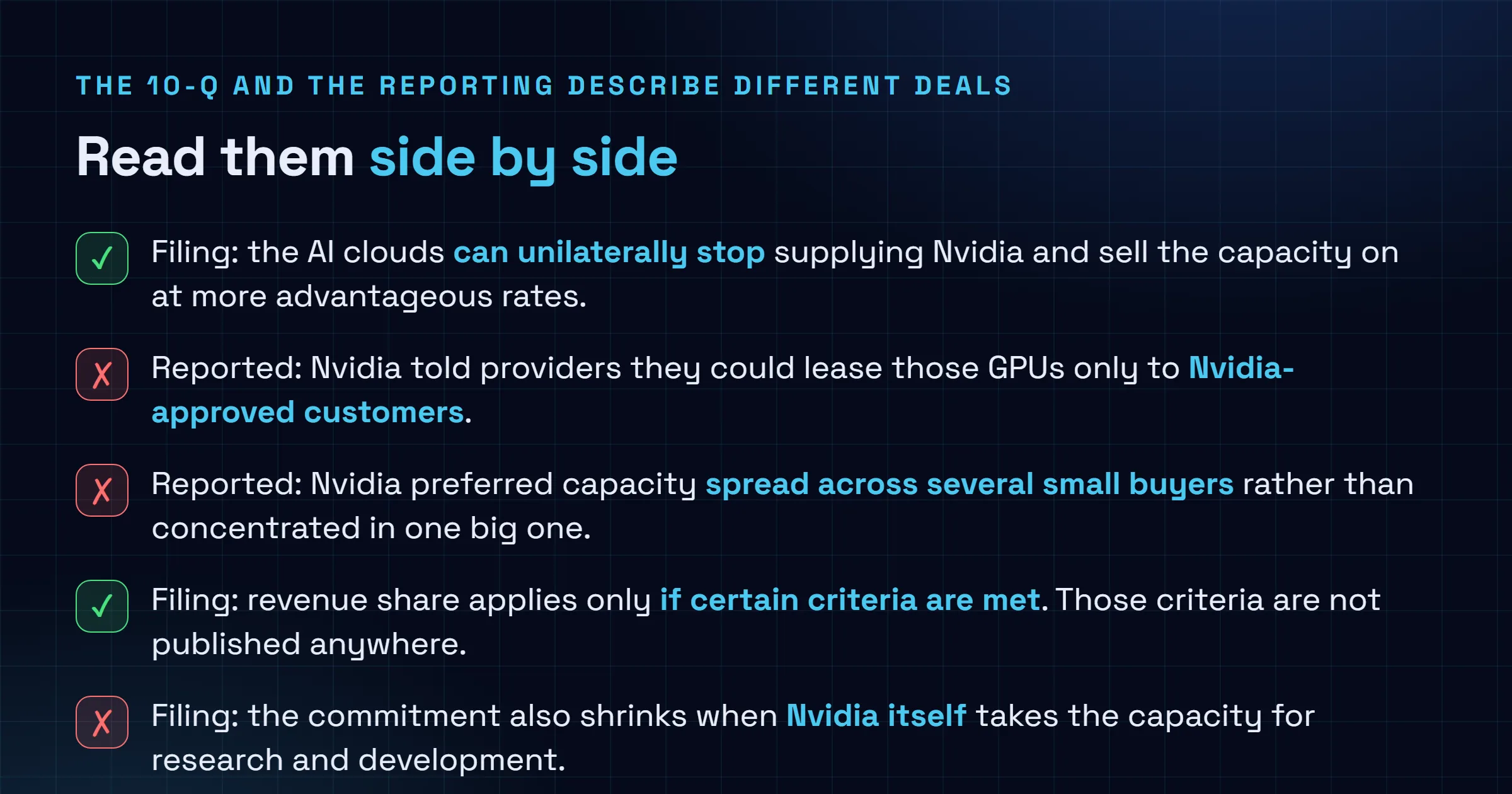
Under these agreements, AI clouds procure our data center infrastructure products and we commit to cloud service agreements, which the AI clouds can unilaterally stop providing to us and sell to third-party customers at more advantageous rates.
Unilaterally. The filing describes an arrangement where the operator holds the whip: it can pull capacity out from under Nvidia the moment a better-paying tenant appears, and Nvidia’s commitment shrinks as that happens.
Now set that beside what the Journal reported providers were actually told. That they could lease the backstopped GPUs only to customers Nvidia approved. That Nvidia would rather see a hall filled by several small AI companies than by one large one. Some operators pushed back, arguing they should decide who they sell to.
You can reconcile these if you squint. Freedom to sell capacity elsewhere is not the same as freedom to choose the tenant for capacity Nvidia is still backstopping, and a filing summarises where reporting describes a negotiation. Fine. But the gap is real, and it lines up exactly with the part that got paused.
Two smaller things in the same passage deserve a look. The filing says commitments decrease as capacity is used by third-party customers “or by us for our research and development efforts”, meaning Nvidia consuming its own backstopped GPUs drains the obligation the same way a paying customer does. And the revenue share is conditional: “if certain criteria are met, we will participate in revenue share”. Nobody has published the criteria.
About the denial
Nvidia’s line was that the business model introduced in July is still in place and continues to evolve due to high demand. Several outlets ran that as Nvidia denying the pause.
Read it again. It defends the model, not the individual deals, and the Journal’s claim was that specific deals were shelved while the programme could be revamped or folded into something else. Those two statements can both be accurate. I might be too generous here, but a company that had genuinely paused nothing usually says so in five words.
If you rent GPUs from a neocloud
Practically, nothing about your 2026 capacity changes. None of the $36 billion lands before fiscal 2028, and the accelerators in Batam and Australia are being installed regardless of how the financing gets restructured.
What is worth doing is asking two questions of any provider in this programme, before you sign rather than after. Does the contract carry an approval or vetting clause on who the tenant is? And what happens to your reservation if the backstop behind that hall is withdrawn?
The broader shape here is the one we have been tracking since the $500 billion financing platforms were announced on 10 August. Nvidia has three instruments running at once, and they differ mainly in how much say Nvidia gets over the customer’s business. The asset-manager platforms give it none. The Ohio guaranties give it none, with one tenant. The AI Compute Partnership reportedly gave it approval rights over end customers and a view on how capacity should be distributed.
That one is the one on hold. The money was never the problem.
Sources: the programme terms, partner names, GPU counts and the Batam campus figures come from the Nvidia blog post of 1 July 2026 by Colette Kress and Raj Mirpuri. The $36 billion commitment ladder, the quoted filing language, the $3.529 billion of land, power and shell guarantees, the $712 million escrow and the $108.5 billion total exposure come from Nvidia’s 10-Q for the quarter ended 26 July 2026. The pause, the 50 percent revenue share, the Nvidia-approved-customer condition, the capacity distribution preference, the internal antitrust concerns and the Nvidia statement were first reported by the Wall Street Journal on 27 August 2026 and are cited here via Reuters and TNW. Nvidia has not confirmed the reported deal terms.
Update, 7 October 2026. Nvidia's 10-Q, filed on 26 August, doesn't mention a pause. The pause is the Wall Street Journal's report of 27 August, and Nvidia's blog doesn't state a six-year term for Sharon AI. See the ledger row.
Frequently asked questions
What is Nvidia's AI Compute Partnership?
A financing model Nvidia announced on 1 July 2026 in a blog post by CFO Colette Kress and Raj Mirpuri. Smaller AI cloud providers, often called neoclouds, buy Nvidia data centre systems without funding the whole purchase upfront, because Nvidia commits to cloud service agreements that let it rent unused capacity back at a fixed rate. That guaranteed floor is what makes lenders willing to finance the build. In return Nvidia takes a share of the revenue the provider earns from third-party customers. The first two partners were Sharon AI, deploying up to 40,000 Grace Blackwell GB300 GPUs, and Firmus, building a 360 MW campus in Batam, Indonesia for up to 170,000 GPUs.
Did Nvidia actually pause the programme?
It depends who you ask, and both answers can be true at once. The Wall Street Journal reported on 27 August 2026 that Nvidia stepped back from deals in the programme the week before, and that it could still revamp the initiative or fold it into another effort. Nvidia told reporters that the new business model it introduced in July is still in place and continues to evolve due to high demand. That statement does not deny pausing individual deals. It defends the model. Several outlets read it as a denial anyway.
Why would this attract antitrust attention?
According to the Journal, some Nvidia employees raised the concern themselves with current and prospective customers, and the sensitivity was about how far Nvidia can dictate how its customers run their businesses. The specific terms reported are that providers could lease the backstopped GPUs only to customers Nvidia approved, and that Nvidia preferred capacity spread across several smaller AI firms rather than concentrated with one large buyer. Nvidia has not confirmed those terms. Whether they would breach any law is not something the reporting establishes, and no regulator has opened a public case on it.
What is the $36 billion figure?
It is the total of Nvidia's future AI cloud agreement commitments as disclosed in the 10-Q for the quarter ended 26 July 2026, and that filing was the first time the scale was public. It breaks down as nothing in the remainder of fiscal 2027, then $6B in fiscal 2028, $8B in fiscal 2029, $7B in fiscal 2030, $6B in fiscal 2031 and $9B in fiscal 2032 and beyond. The filing also says these commitments decrease as capacity is used by third-party customers or by Nvidia for its own research and development.
Should this change how I buy GPU capacity from a neocloud?
It changes the questions, not the plan. If you are pricing capacity at a provider in this programme, worth asking whether your contract carries any approval or vetting clause on who the tenant is, and what happens to your reservation if the backstop behind that hall is withdrawn or restructured. None of the $36 billion lands before fiscal 2028, so nothing about 2026 capacity moves on this news. The risk being repriced here is financing risk, and it sits with the provider rather than with you.


