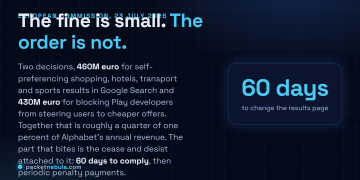





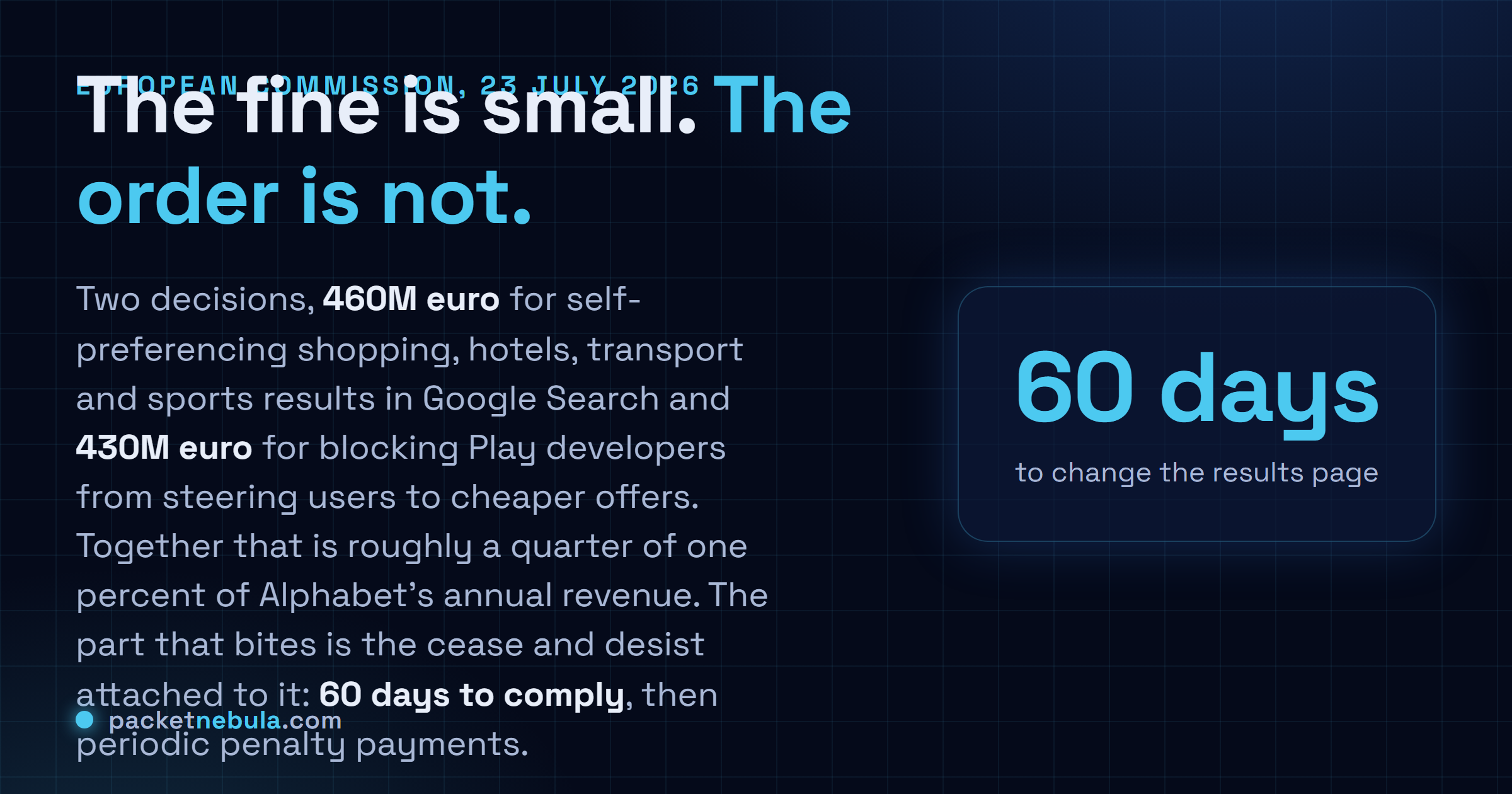
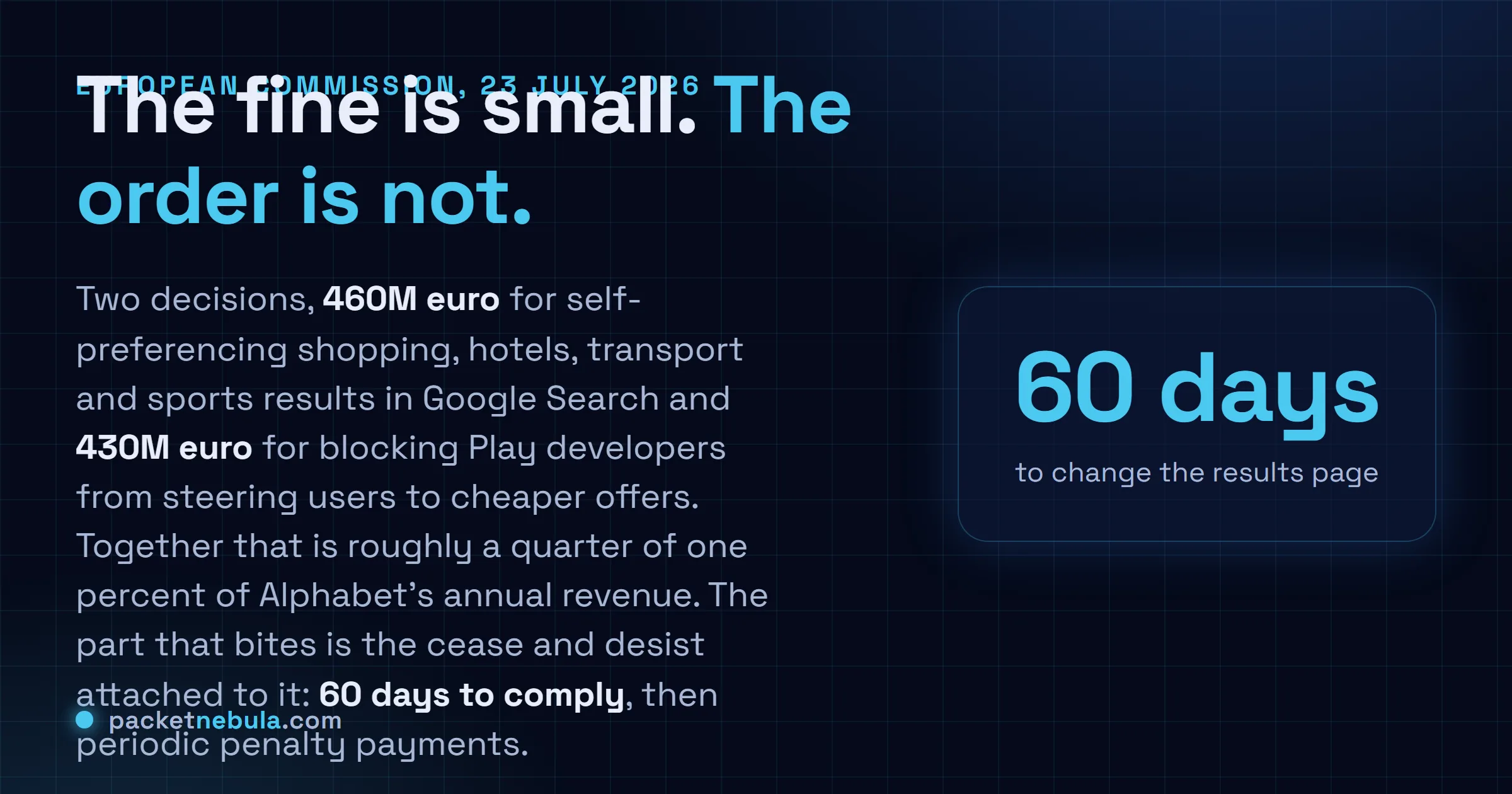
Check your EU rankings in October, not this week. On 23 July the European Commission fined Google 890 million euros across two decisions: 460 million for pushing its own shopping, hotel, transport and sports results above everyone else's in Search, and 430 million for stopping Google Play developers telling users where to buy cheaper. First time the Digital Markets Act has produced a fine against Google. We opened the press release assuming the number was the story. It isn't. At roughly a quarter of one percent of Alphabet's annual revenue, that fine is a line item somebody expenses. The cease and desist order bolted to it is the part with teeth, and it starts a 60-day clock on the results page you've been optimising for.
The short answer
The EU’s first DMA fines against Google: €460M for ranking its own shopping, hotel, transport and sports results above third parties, €430M for blocking Play developers from steering users to cheaper offers. Both come with an order to stop. If you run a comparison or aggregator site with EU traffic, or ship an Android app there, the money is irrelevant to you and the cease and desist is the thing to read.
The money isn’t the point
Honestly, the coverage got this backwards. Nearly every headline led with a billion dollars.
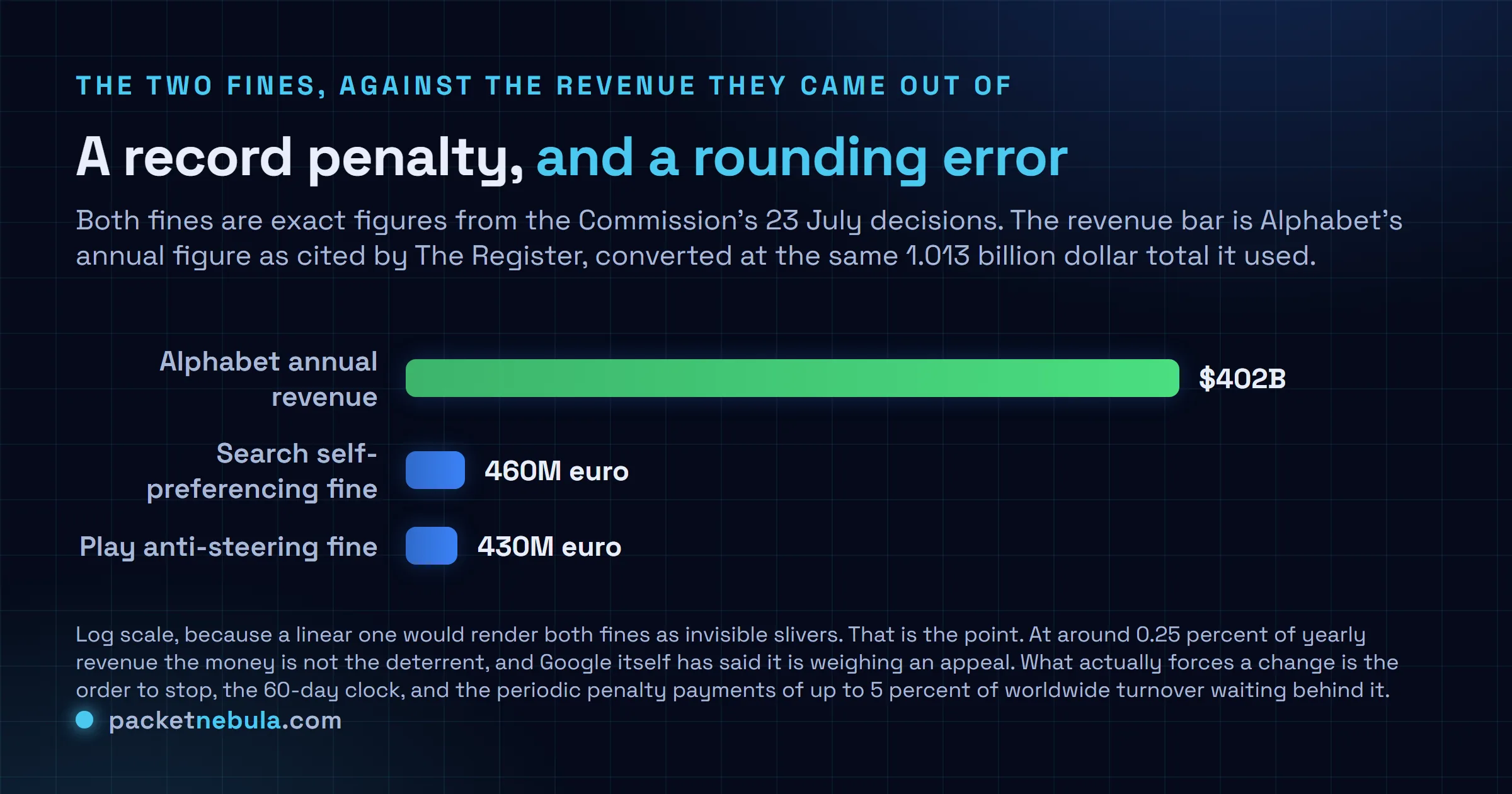
Here’s the arithmetic that kills that framing. The Register put the combined fines at about 1.013 billion dollars against Alphabet’s 402 billion dollars of annual revenue, so roughly a quarter of one percent. Yes, it’s a DMA record, and it beat the previous high set by Alibaba by around 340 million euros, four days after Alibaba set it. Records are still cheap when you earn that much.
The order is the expensive bit. Both decisions carry a cease and desist, and the Commission was specific about what Google has to do: treat third-party services appearing in its results “in a fair and non-discriminatory manner by reference to its own services”, and let Play developers “freely communicate, promote offers and conclude contracts with users not only within but also outside the Google Play app store”, both technically and contractually. Sixty days. Miss it and the Commission can start periodic penalty payments of up to 5 percent of worldwide turnover, which is the kind of number that does register.
Google says it’s reviewing the decisions and weighing an appeal. Worth knowing: lodging an appeal doesn’t suspend a Commission decision on its own. The clock keeps running.
What lands on your results page
This is the part worth planning around, and the honest answer is that nobody can draw you the new page yet.
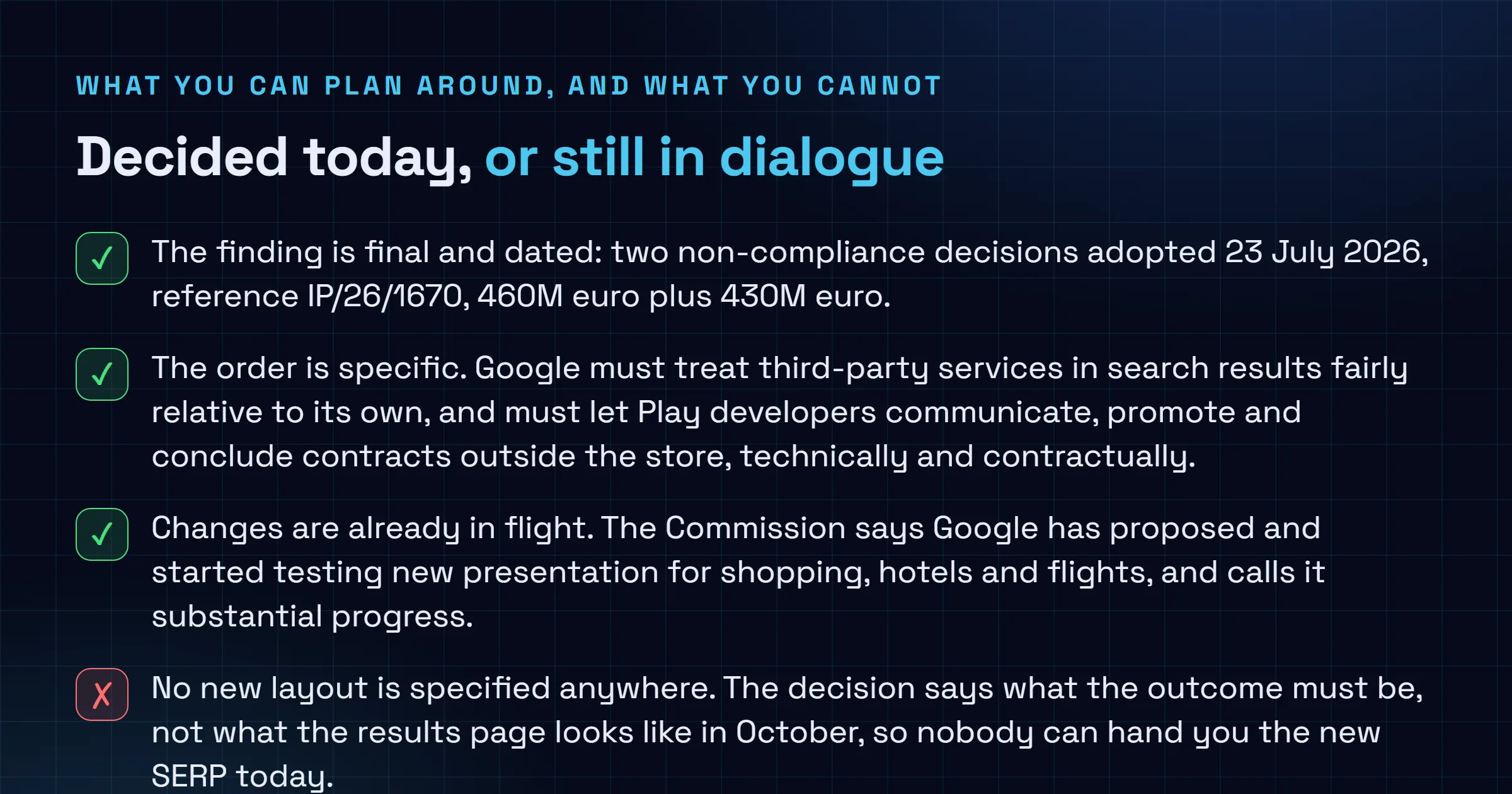
What the Commission found is narrow and concrete. Google gives its own shopping, hotels, transport and sports results preferential treatment, putting them at the top of the page or dressing them in enhanced visuals and filters that equivalent third-party services don’t get. The remedy is stated as an outcome, not a layout. So if you read a post this week confidently describing the September SERP, that person is guessing.
Some of it is already moving, though. The Commission notes that Google has proposed and started testing changes to how it presents its own free services for shopping, hotels and flights, plus changes to shopping ads and content related services such as sports, and it calls this substantial progress. Google’s own account of the same changes is much less cheerful. Kent Walker, its president of global affairs, wrote that to comply the company is “having to strip away real-time Search features Europeans love, like instant pricing and direct availability for hotels, flights, and restaurants”. Read those two descriptions side by side and you get a decent picture: the panels shrink or go, and the click has to land somewhere else.
If a meaningful slice of your traffic is EU users hitting comparison, travel or local-availability queries, the sane move isn’t to guess the layout. It’s to know your baseline before it shifts. Pull your EU impressions by query type now, segment the queries where a Google panel currently owns the top of the page, and sit on that snapshot. Whatever October looks like, you’ll be able to measure it. Most sites won’t have bothered.
Play developers get the link, not a free one
The second decision is cleaner, and it’s the one people are misreading in the other direction.
Yes, the block goes. Google prevented developers from communicating and promoting offers and concluding contracts in the channel of their choice, including rival app stores, and it has been ordered to stop, contractually as well as technically. That’s real. If you sell subscriptions through Play in the EU, you get to tell users your website is cheaper.
But the Commission didn’t outlaw the toll. It said plainly that Google can receive a fee for facilitating the initial acquisition of a new customer via Google Play, and that what went too far was the level of the steering-related fees and the length of the charging period. No compliant number was published. Coverage has pointed to a reworked 10 to 15 percent structure Google rolled out earlier this summer, which the Commission calls good progress and says it will assess against the new order rather than bless outright. Treat that percentage as reported, not settled. Model your web-checkout funnel on the assumption that steering costs something.
The paragraph everyone skipped
Near the end of the press release, one sentence: the Commission takes note of Google’s proposals on how it plans to apply the principles of the decision to AI Overviews and AI Mode, and dialogue will continue.
That’s it. No finding. No fine. No deadline.
I think that’s the most consequential line in the document, and I might be wrong about the timing, but not the logic. A Gemini-generated summary pinned above every third-party result on the page raises exactly the structural question the shopping carousel just lost on: Google’s own service, granted prominence third parties can’t buy or earn. The difference is that a shopping panel sends some clicks onward and an AI answer often sends none. Brussels has now written down, in a binding decision, the principle it would apply. It just hasn’t applied it there.
The wider pattern is familiar if you’ve watched the other big tech cases this year. Enforcement lands hard on the thing that was already old, while the thing actually reshaping your traffic stays in “constructive dialogue”. We saw the same shape when Anthropic’s $1.5B author settlement priced the piracy and left the fair-use question untouched, and when 25 companies signed the Open Weights letter while the bill with real teeth went in separately. The headline number is almost never where the change is.
Sources
The findings, fine amounts, cease and desist wording, the 60-day deadline and the AI Overviews paragraph are quoted from the European Commission press release IP/26/1670, Commission fines Google €890 million for breaches of the Digital Markets Act, 23 July 2026. The revenue comparison and the margin over Alibaba’s previous DMA record come from The Register. Kent Walker’s quote and the appeal status are as reported by PPC Land, with the marketer-side reading from Forbes and the AI Overviews context from Tech Policy Press. The 10 to 15 percent steering fee figure is reported, not stated in the decision.
Frequently asked questions
What exactly did the European Commission fine Google for on 23 July 2026?
Two separate non-compliance decisions under the Digital Markets Act, reference IP/26/1670. A 460 million euro fine for self-preferencing, because Google displays its own shopping, hotels, transport and sports results more prominently than equivalent third-party services in Google Search. And a 430 million euro fine for anti-steering, because Google prevented Play developers from freely communicating and promoting offers outside the store, and because the level and duration of its steering fees went beyond what the DMA allows.
Is €890 million a big fine for Google?
Not financially. The Register put the combined total at about 1.013 billion dollars, roughly a quarter of one percent of Alphabet's 402 billion dollar annual revenue. It is a record under the DMA, beating the previous high set by Alibaba four days earlier, but the deterrent here is the cease and desist order rather than the cheque. Google has 60 days to comply or it risks periodic penalty payments of up to 5 percent of worldwide turnover.
Will Google search results in the EU actually change?
Some already are. The Commission says Google has proposed and started testing changes to how it presents its own free services for shopping, hotels and flights, and calls that substantial progress towards compliance. What nobody can tell you is what the page looks like afterwards. The decision orders a fair and non-discriminatory outcome, it does not specify a layout, so any specific prediction of the new SERP is guesswork right now.
Can Android developers now link out to cheaper prices for free?
They can link out, but not necessarily for free. The Commission explicitly accepts that Google may charge a fee for facilitating the initial acquisition of a customer through Google Play. What it found non-compliant was the level of those steering fees and the length of the period Google charges them for, and it did not publish a number that would be compliant. So the contractual and technical block on steering has to go. The economics of steering are still being negotiated.
Does the decision cover AI Overviews and AI Mode?
No, and that is the most interesting gap in it. The Commission notes that Google has made proposals for how it plans to apply the principles of the search decision to AI Overviews and AI Mode, and says dialogue will continue in light of the decision. No finding, no fine, no deadline on that point yet. Given that an AI summary sits above every third-party link on the page, it is the same structural question the shopping carousel raised.
Is Google appealing, and does an appeal pause the deadline?
Google said it is reviewing the decisions and evaluating an appeal, and Kent Walker, its president of global affairs, argued publicly that this implementation of the DMA continues to break everyday products. Filing an appeal does not by itself suspend a Commission decision, so the 60-day compliance window and the fine both stand unless a court says otherwise.