

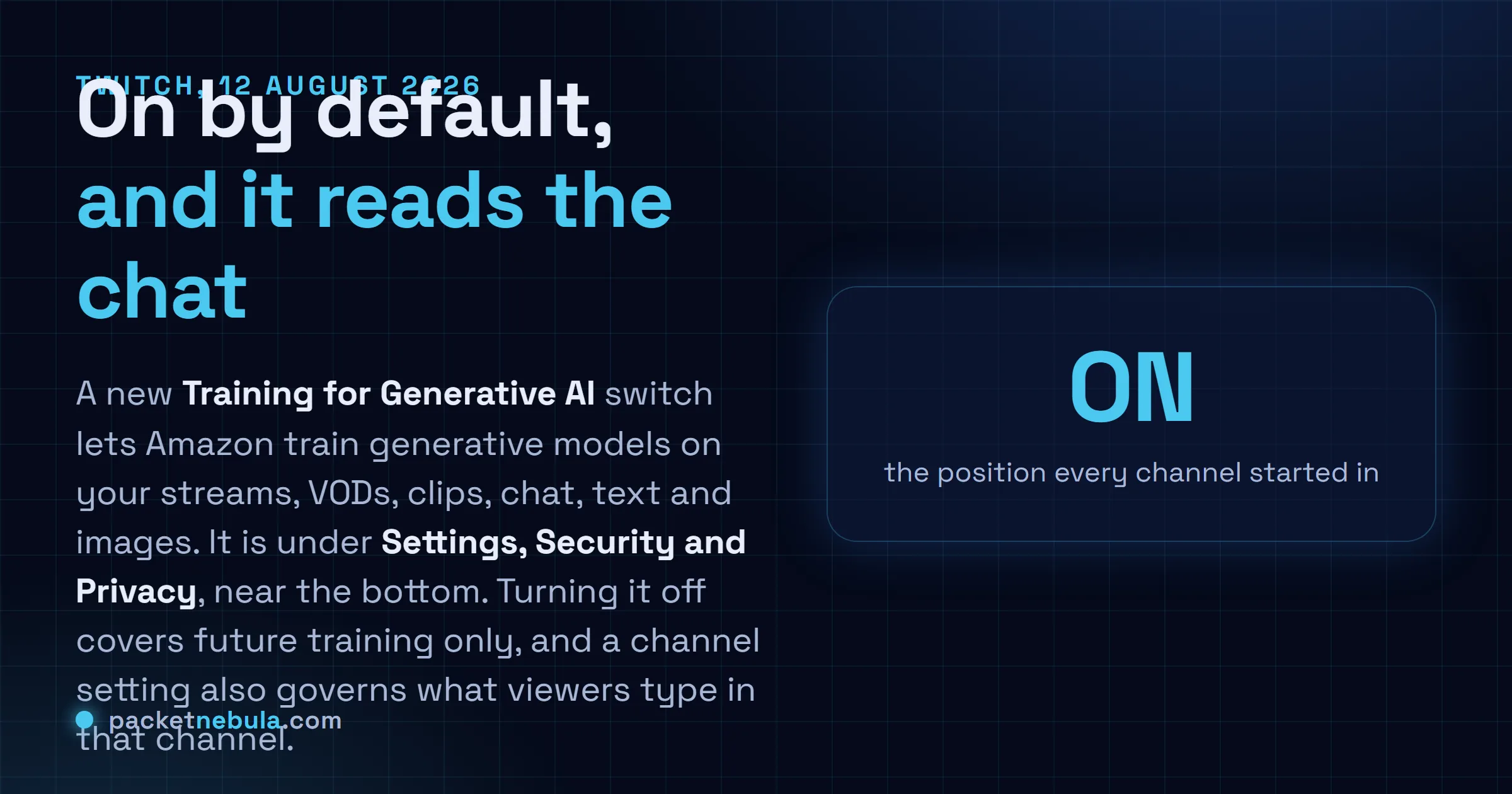
You went to bed a streamer and woke up a training set. On 12 August Twitch shipped a setting called Training for Generative AI, switched on for everybody, that lets Amazon train generative models on your streams, VODs, clips, chat and whatever text and images sit on your channel. It's in Settings, under Security and Privacy, near the bottom of the page. Flip it off and you're out, going forward. Then there's the part that got buried under the outrage cycle, which is that the switch is yours but the consent isn't only yours. Someone typing in your chat has no toggle of their own. Yours is the one that decides, for all of them.
The short answer
Twitch added a Training for Generative AI setting on 12 August 2026, enabled by default, letting Amazon train generative models on channel streams, VODs, clips, chat, text and images. It lives under Settings, Security and Privacy. Turning it off applies to future training only. It does not stop captions, recommendations, monetization tooling or AutoMod. And a channel’s setting governs what viewers type in that channel’s chat, because viewers get no setting at all.
Thirty seconds, if you know where to look
Avatar, top right. Settings. Security and Privacy. Scroll down, past the things you’d expect a security tab to hold, and there it is: Training for Generative AI. On mobile the path is Profile, then Settings, then the same tab.
The toggle is on. It was on before you read this, and it went on without you touching anything, which is the whole reason the story travelled. Switch it off and Amazon stops using your channel’s output to train generative models that produce text, audio, images or video.
The scope is broader than the word “streams” suggests. Live broadcasts and their VODs, sure. Also clips, highlights, chat logs, and the text and images sitting on your channel page. If it’s content and it’s yours, assume it’s in.
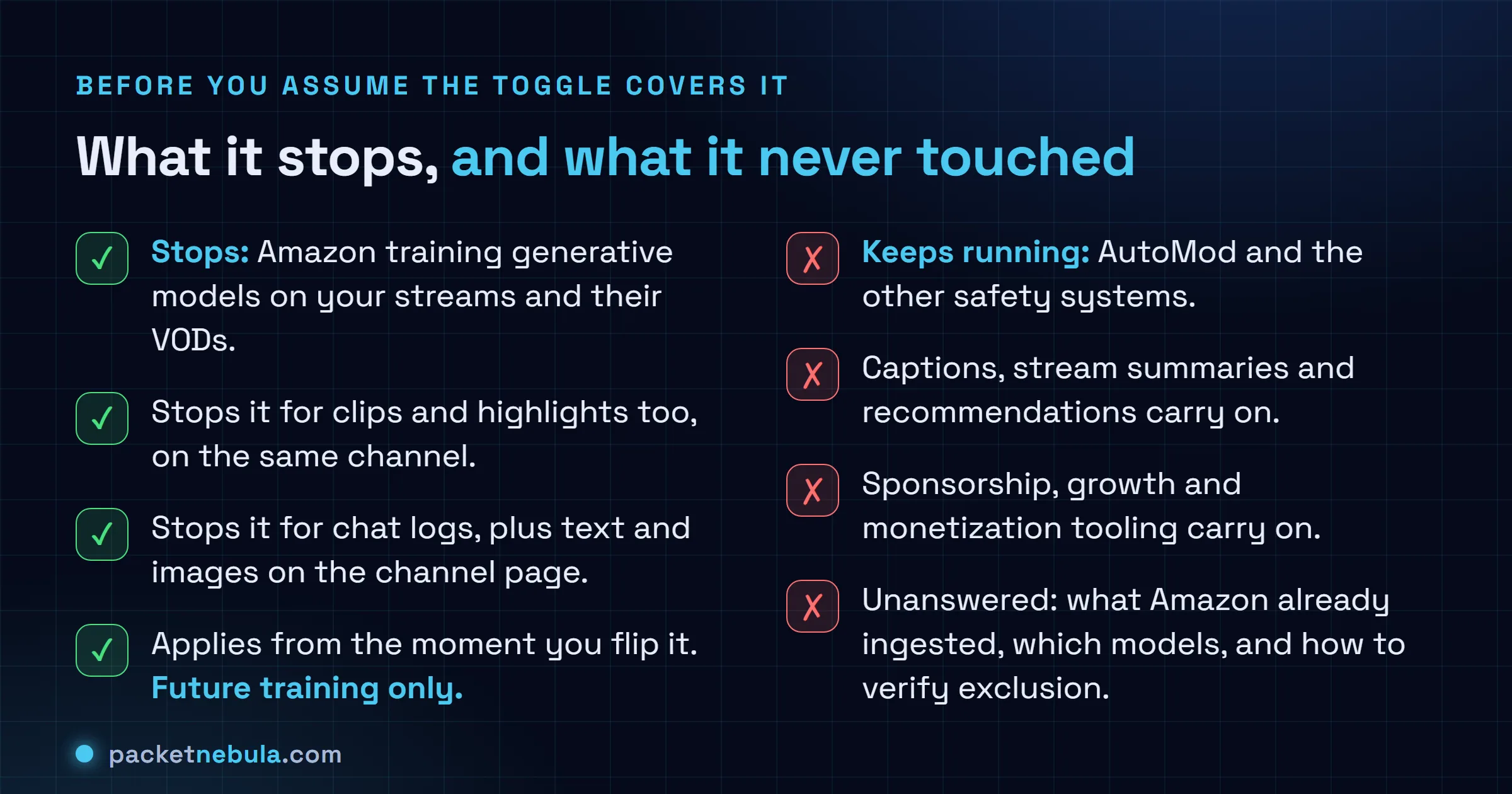
Going forward, anyway. Nothing in the wording reaches backwards.
Your switch, their words
This is the part we’d lead with, and almost nobody did.
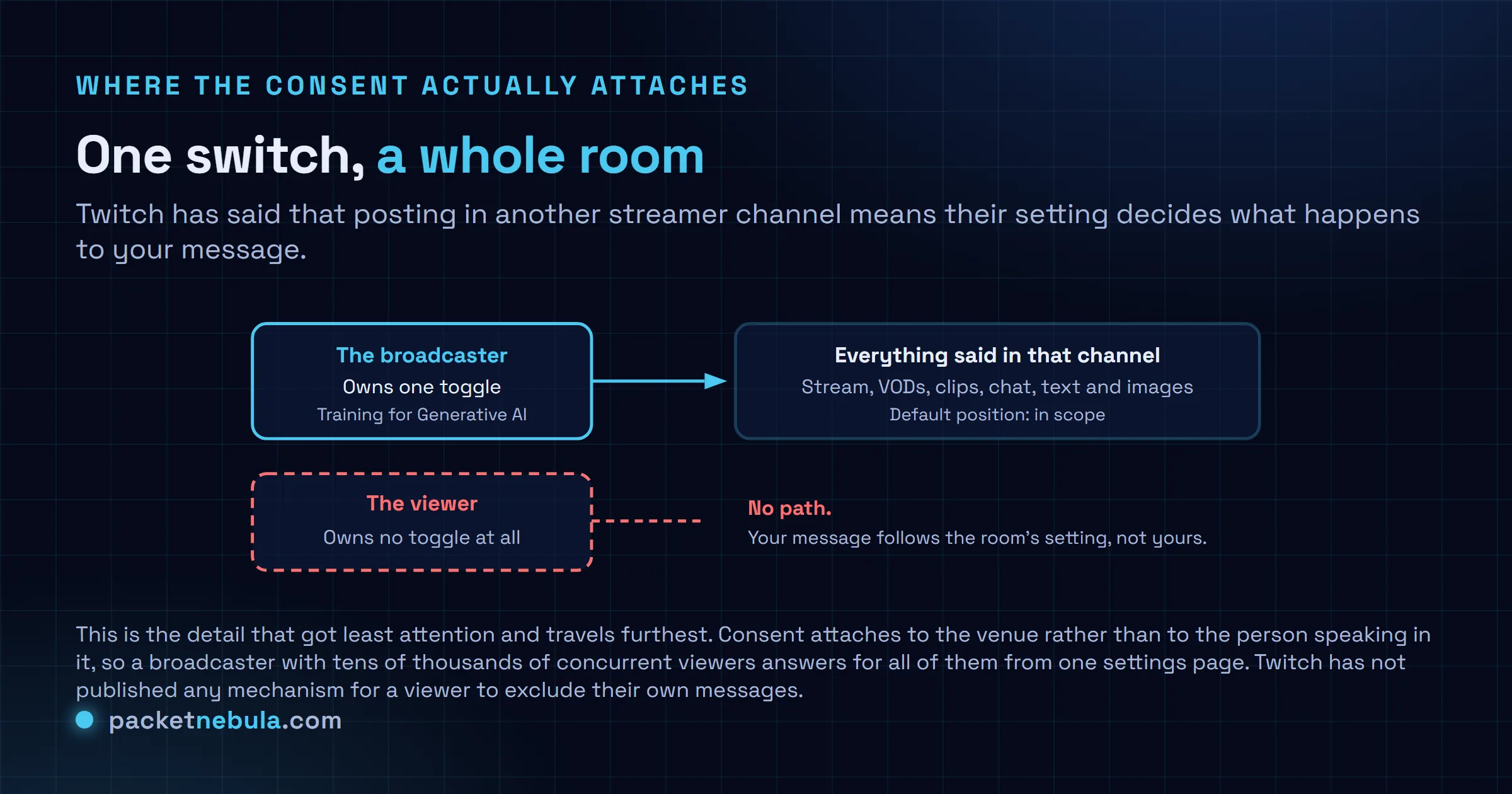
Twitch has been clear that if you post in someone else’s chat, their setting decides what happens to your message. Not yours. You can hold your own channel’s toggle off with both hands and still have every sentence you type in a friend’s stream go into the pile, because the consent attached to the room, not to the person speaking in it.
Think about what that means at scale. A channel with forty thousand concurrent viewers has one switch, held by one person, answering for forty thousand people who never saw it. A moderator who typed in that chat for three years never had a decision to make.
We’re not calling that illegitimate. Twitch owns the platform and the terms are the terms. But it is a consent model where the unit of consent is the venue rather than the speaker, and if you’ve ever built anything with user-generated content you know that distinction gets ugly the moment somebody asks for their data back.
”Nobody would opt in”
Chief product officer Mike Minton was asked why the thing ships on rather than off. His answer, to TechCrunch: “If this was opt-in, nobody would opt in. That’s the answer.”
Credit where it’s due. That’s a rare piece of on-record candour about default design, and it’s more useful than any policy page, because it tells you the product team already ran the numbers on consent and didn’t like them.
It also concedes the point. A default that only works because it’s a default is a default doing the arguing.
Minton was equally frank about the other half, saying he didn’t know whether Twitch video had already been used, because he didn’t know what Amazon had done. Two companies, one org chart, and the person who owns the product can’t tell you where the tapes went. That answer worries us more than the toggle does.
What flipping it off does not buy you
Read the label again. Training for Generative AI. Generative, and training, and that’s the boundary.
AutoMod keeps reading your chat. Captions keep running on your audio. Recommendations keep profiling your channel, and the sponsorship, growth and monetization machinery keeps chewing through the same content it always did. Twitch has said some of this can’t be turned off individually because it protects the whole community, which for AutoMod is a fair argument and for the monetization tooling is a different kind of argument.
So the toggle isn’t an AI opt-out. It’s an opt-out from one specific downstream use, the one where your voice ends up inside a model that generates new voices. Worth having. Not the same as the headline.
What’s still unconfirmed
There was no announcement post. The setting showed up and the docs were the record, which several outlets noted independently and which matches what we could find looking for one.
No model family is named. “Generative AI content models at Amazon” covers a lot of ground and commits to nothing. There’s no published retention or deletion path, no way for a broadcaster to verify exclusion after flipping the switch, and no statement either way on content ingested before 12 August. We’re marking all of that as unknown rather than guessing, because a guess here would be worth exactly nothing to you.
If you stream, go flip it. If you build on somebody else’s platform, the more durable lesson is the one Minton said out loud: the default is where the real policy lives, and it gets set by whoever owns the settings page. We’ve watched the same argument play out over the $1.5B Anthropic author settlement, and over what a privacy-first assistant actually keeps off the server. Different companies, same question about who decided.
Sources
Reported by TechCrunch on 12 August 2026, including the Minton quotes. Scope and viewer chat handling from Engadget, with the settings path and the list of AI features outside the opt-out in Engadget’s walkthrough. Community reaction and the default-on framing cross-checked against PC Gamer and Ars Technica. Twitch published no announcement post we could find, so the setting itself is the primary record.
Frequently asked questions
Where exactly is the Twitch AI training setting?
On the web, click your avatar in the top right, open Settings, choose the Security and Privacy tab, then scroll to Training for Generative AI near the bottom. On mobile it is Profile, then Settings, then Security and Privacy. The toggle is enabled by default, so leaving it alone means your channel content is in scope.
Does opting out remove content Amazon already trained on?
No. The wording covers future training only, and nothing published says anything about content already ingested. Asked directly whether Twitch videos had already been used, chief product officer Mike Minton told TechCrunch he did not know the answer because he did not know what Amazon had done. Nobody has offered a deletion path.
If I opt out, does that protect my viewers' chat messages?
Yes for your channel, and only for your channel. Twitch has said that if you post in another streamer's chat, that streamer's setting governs whether your message is used. Viewers have no control over their own messages. One broadcaster's toggle answers for every person who types in that room.
What does the opt-out NOT stop?
Plenty. The setting covers generative AI content models at Amazon, not machine learning across Twitch. Captions, recommendations, sponsorship and growth tooling, monetization features and safety systems such as AutoMod keep processing your content either way. Twitch has said some of these cannot be individually disabled because they protect the whole community.
Did Twitch announce this?
Not with a blog post. The setting appeared on 12 August and the documentation is the record, which is why the story broke through press coverage and community threads rather than an announcement. Twitch executives spoke about it afterwards, including on record about why the default is on.
Which Amazon models are being trained on this?
Unstated. The setting refers to generative AI content models at Amazon, covering text, audio, images and video, without naming a product or a model family. There is also no published way to verify that a channel with the toggle off has actually been excluded.


