

Cerebras published a bar chart with a 14x on it, and the bar beside it says 2.5x. That is the pitch for Ultrafast, the OpenAI API service tier previewed on 13 August: GPT-5.6 Sol running on Cerebras wafer scale hardware at up to 750 output tokens a second, up to fourteen times the Standard tier. Now scroll two images further down the same post. Cerebras also published its GDP-Val run, and there the gain is 5.6x end to end, because the part of the clock that is not the model, your tool calls plus your own code, went from 14.2 seconds to 14.9. It got very slightly slower. Credit where it is due, they published that chart themselves. It is a limited preview, for selected customers, and nobody has published a price.
The short answer
Ultrafast is a third service tier on the OpenAI API, running GPT-5.6 Sol on Cerebras wafer scale hardware. The headline is up to 14x the Standard tier. The measured end to end number on the vendor’s own benchmark is 5.6x, and the gap between those two numbers is the useful part. Limited preview, selected customers, nothing you can budget against yet.
What actually launched
Not a model. A lane.
Ultrafast is a service tier, sitting alongside Standard and Priority on the same OpenAI API, serving the same GPT-5.6 Sol you already call. Same weights, same interface, different silicon underneath: Cerebras wafer scale engines rather than GPUs, which is what the ten billion dollar partnership the two companies signed earlier this year was for. Cerebras keeps 44 GB of SRAM on the chip itself, so serving a token doesn’t mean hauling weights back and forth across a memory bus, and that single architectural fact is where the speed comes from.
 Image: Cerebras
Sol is the right model to put there, incidentally. It’s the slow one. The member of the GPT-5.6 family OpenAI points at legal briefs and engineering reports, the one that thinks for minutes, and if you’re going to spend money making inference fast then that’s where the seconds are.
The number under the number
Here’s the chart Cerebras published, and it’s more interesting than the one everybody quoted.
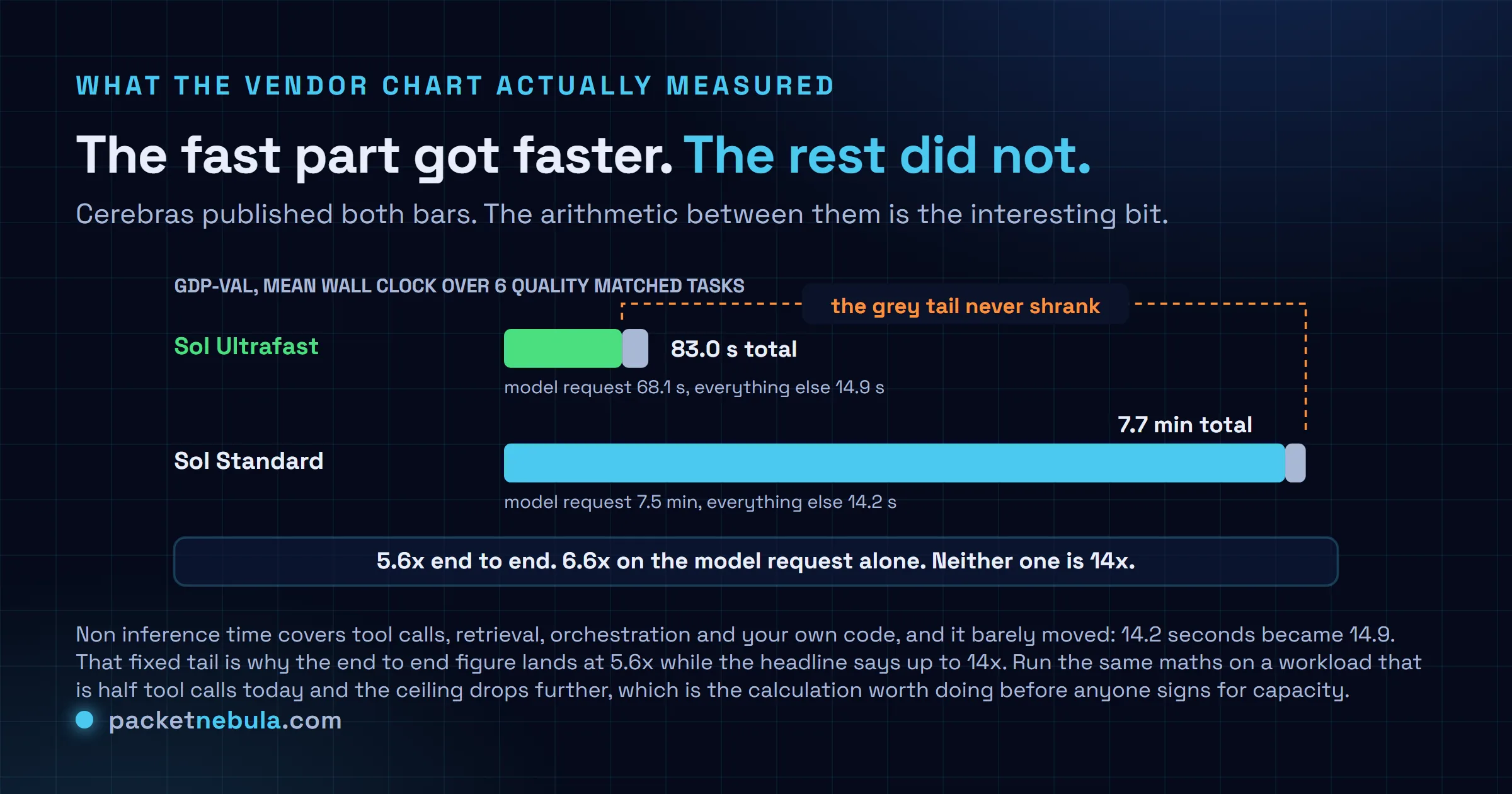
On six quality matched GDP-Val tasks, Standard spends 7.5 minutes on the model request and 14.2 seconds on everything else. Ultrafast spends 68.1 seconds on the model request and 14.9 seconds on everything else. So the model request got 6.6 times faster, the whole task got 5.6 times faster, and the non inference part got marginally worse.
That gap isn’t a Cerebras problem, it’s just Amdahl’s law showing up on a launch page. Fourteen times is the number you’d see if a request were nothing but token generation. Real agent work is loops, retrieval and code you wrote, and none of that runs on a wafer.
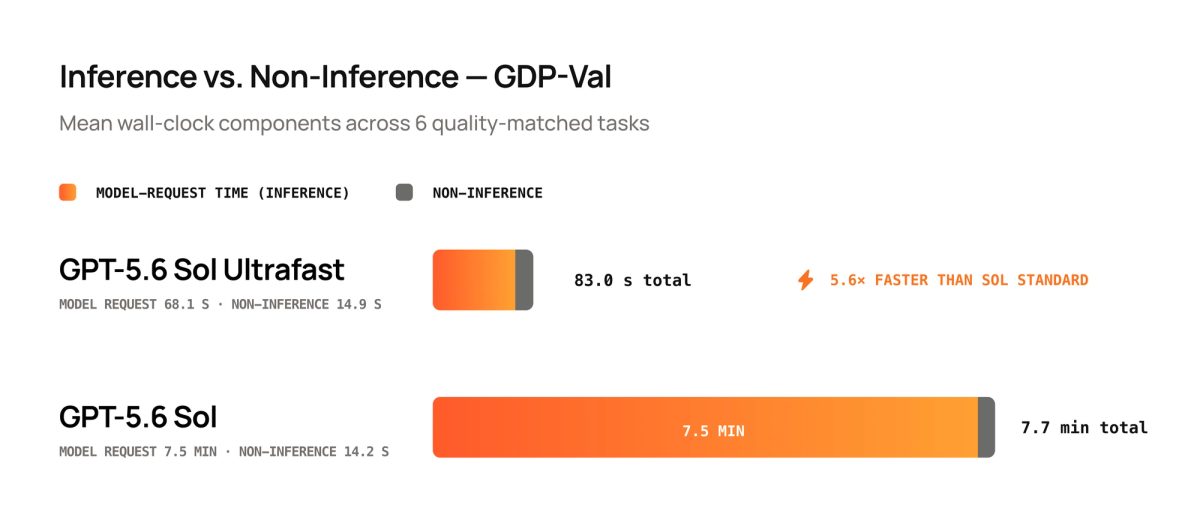 Image: Cerebras
The other measurement worth keeping is Humanity’s Last Exam, 2,500 questions, run in 11 hours 11 minutes against 78 hours 27 minutes for the comparison model. Roughly seven times. That one is a batch job, which is exactly the shape where a token generation win survives intact, and it’s a genuinely useful data point for anyone running large evaluation sweeps overnight.
All of these are Cerebras measuring hardware Cerebras sells, dated July 2026, with no independent re-run. We’d hold them loosely. The internal consistency is good though, and a vendor publishing the chart that undercuts its own headline number is not the usual behaviour.
Three rungs, two rate cards
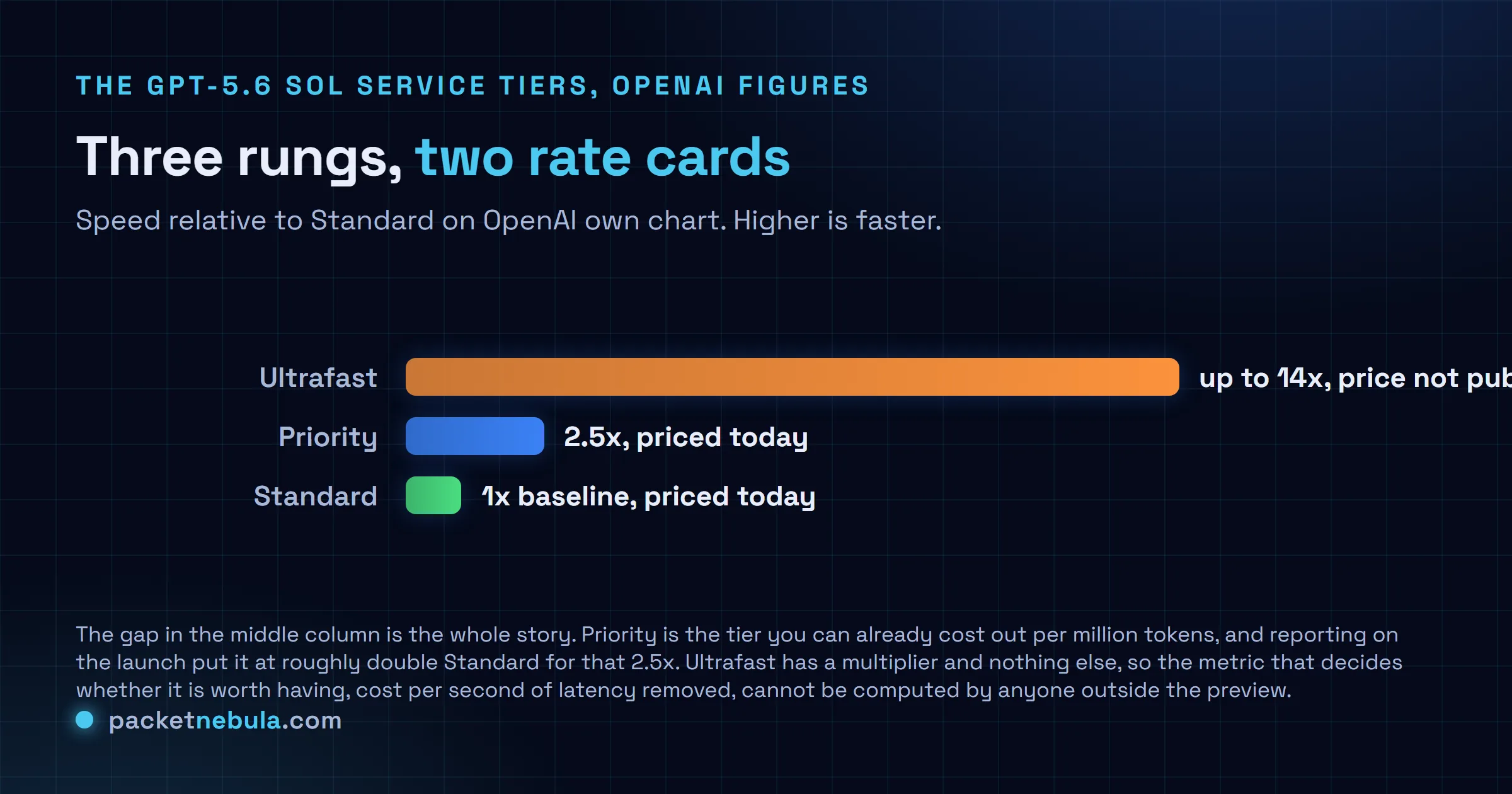
Standard is 1x and priced. Priority is 2.5x and priced, at roughly double Standard by most accounts of the launch. Ultrafast is up to 14x and priced at whatever you negotiate, because OpenAI published no rate, no quota, no region list and no latency term with the preview.
Which makes the only question that matters unanswerable from outside. Nobody is buying tokens here, they’re buying seconds off a wall clock, and the metric is cost per second removed. If Priority buys 2.5x for 2x the money, Ultrafast has a bar to clear, and the shape of that bar is entirely unknown until a rate card exists. I might be wrong, but a tier that launches to Jane Street with no public price usually means the price is high enough to want a conversation first.
Named early users are Jane Street, Podium, Basis and Rogo. Trading, sales tooling, accounting and finance research. Latency sensitive money, in other words, which fits.
Who should care today
If you run interactive work where a human is waiting, this is the first tier that changes what the product can be, and worth joining the queue for. Voice, live research, an agent someone is watching.
If you run overnight batch, the HLE result says the win is real for you too and it may be the easiest sell, since you can measure it directly against your current bill.
And if your agent spends half its wall clock in tool calls, do the arithmetic on your own traces before you get excited. Take your model request time, divide by six, add back everything else unchanged. That’s your realistic ceiling, and for a lot of pipelines it lands nearer 2x than 14x.
Nothing changes in your code either way, which is the quiet good news. Same API, same model ID, a tier flag. That’s a very different migration from the GPT-5.6 Sol retune that split ChatGPT from the API earlier this month.
Worth noting where this sits in the wider picture. OpenAI is now buying inference speed from Cerebras wafers while also building its own inference accelerator with Broadcom. Both bets are on the same conviction: the model is fast enough, the serving is not.
Sources
Cerebras, Accelerating GPT-5.6 Sol Ultrafast with OpenAI, 13 August 2026, for the 750 tokens per second figure, the GDP-Val wall clock chart, the Humanity’s Last Exam timings and the tier multipliers. OpenAI, Previewing Ultrafast mode, 13 August 2026. Unite.AI, Cerebras runs OpenAI’s GPT-5.6 Sol at 750 tokens per second, for the named early customers and the on chip SRAM detail. The Decoder, GPT-5.6 Sol goes 14x faster as OpenAI launches Ultrafast mode, for the Priority tier pricing comparison and the partnership figure. Both charts reproduced above are Cerebras’ own, from the announcement post.
Frequently asked questions
What is OpenAI Ultrafast?
A new service tier on the OpenAI API, previewed on 13 August 2026, that runs GPT-5.6 Sol on Cerebras wafer scale hardware instead of GPUs. OpenAI puts it at up to 14 times the speed of the Standard tier, and Cerebras measured up to 750 output tokens per second. It is a limited preview open to selected customers, expanding as capacity allows.
How much does Ultrafast cost?
No rate has been published. OpenAI's preview announcement carries speed figures and named customers but no price, no quota, no region list and no latency commitment. The neighbouring Priority tier is the one you can already cost out, and coverage of the launch put it at roughly double Standard for 2.5 times the speed.
Is Ultrafast really 14 times faster?
For token generation against the Standard tier, on OpenAI's own chart, up to. On a real workload it is less. Cerebras' GDP-Val figures give 6.6x on model request time and 5.6x once the rest of the task is counted, because non inference time went from 14.2 to 14.9 seconds. The more tool calling a workload does, the closer it sits to that floor.
Which models run on Ultrafast?
GPT-5.6 Sol at launch, the reasoning heavy member of the GPT-5.6 family that OpenAI positions for legal, financial and engineering work. Terra and Luna are not part of the preview. Cerebras describes the tier as serving Sol specifically, and OpenAI has not said which models follow.
Who can use Ultrafast today?
Selected customers only, through the OpenAI API. Jane Street, Podium, Basis and Rogo have been named as early users. There is a sign up form for everyone else, and OpenAI says access widens as Cerebras capacity grows. There is no published date for general availability.


