
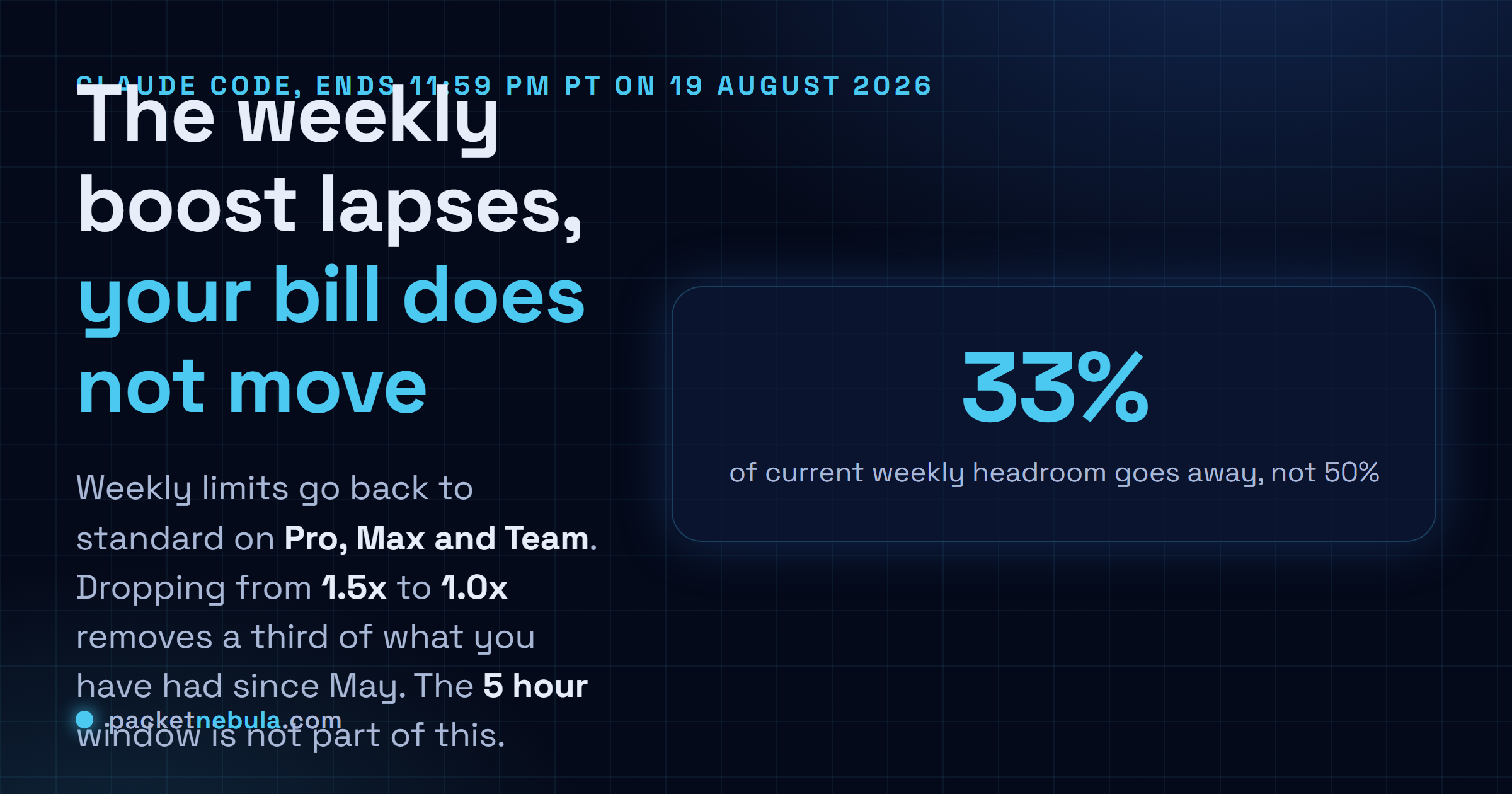
You will probably notice it on Thursday, mid refactor, when the weekly meter sits lower than it has all summer. Here is what happened: the promotion that has been handing Claude Code subscribers 50% extra weekly usage since May ends at 11:59 PM PT on 19 August, and limits go back to standard. Anthropic's support page is blunt about it. After 19 August, weekly usage limits in Claude Code return to their standard levels, with no change to your plan or billing. Pro, Max and Team are all in it, along with legacy seat based Enterprise seats. Free plans never were. The part worth getting right is the arithmetic, because losing a 50% boost does not cost you 50%.
The short answer
Since May, Pro, Max and Team subscribers have had 50% extra weekly usage in Claude Code. That promotion ends on 19 August and weekly limits return to standard. Your plan does not change, your bill does not change, and the 5 hour session window is untouched. What shrinks is the weekly pool, by a third of what you have been living on. If you have been finishing your week comfortably, you probably will not notice. If you have been running out on Sunday, you are about to run out on Friday.
The number everyone is getting wrong
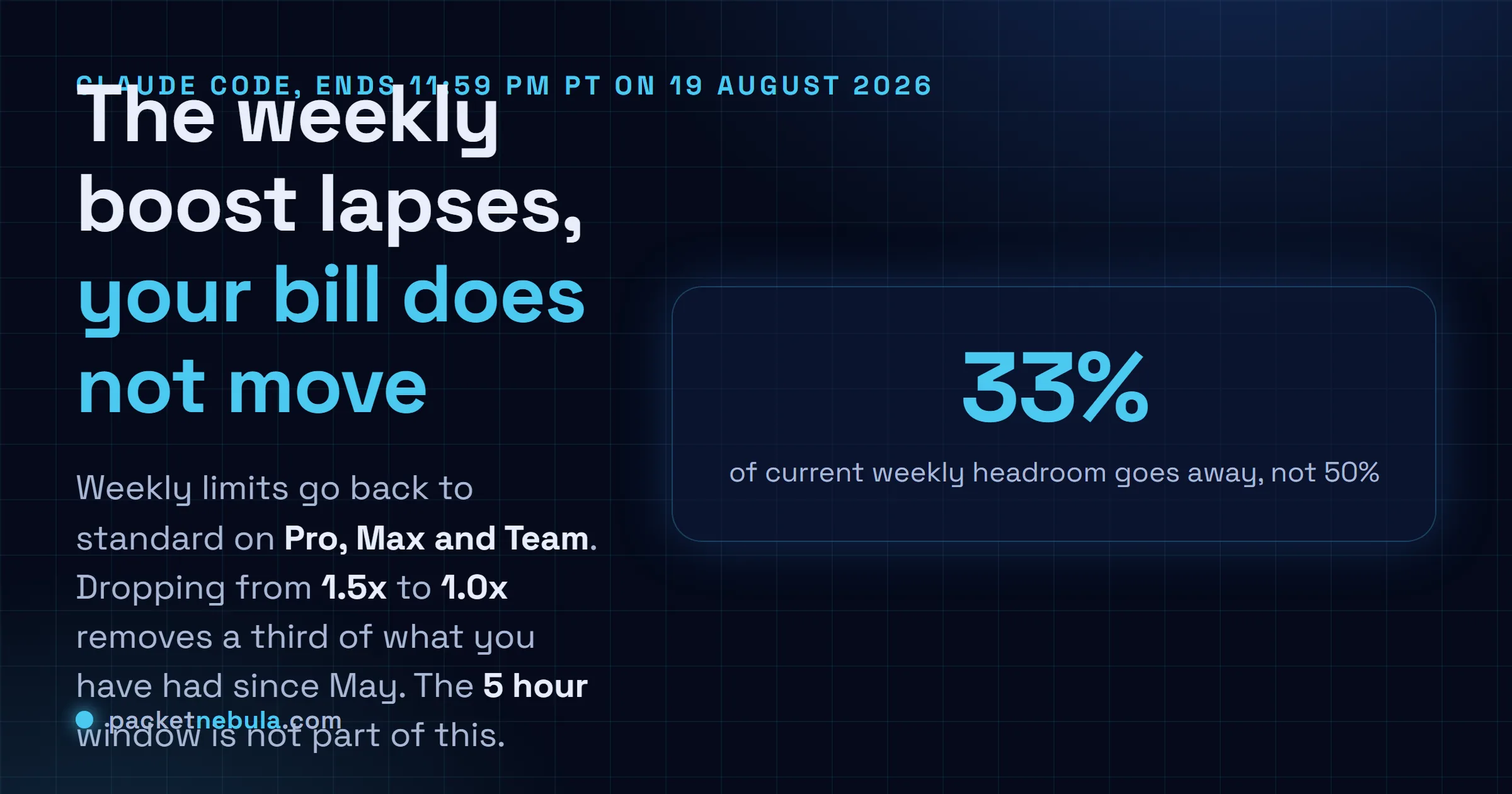
A 50% boost going away is not a 50% cut. It sounds like one. It is not.
Work it from your standard allowance. Call it 100. The promotion has been putting you at 150 since May. On Thursday you are back at 100, which means you lose 50 out of the 150 you have been using. That is a third. If you had actually lost half you would land at 75, and you would be worse off than before any of this started.
Small distinction, real consequences for planning. A third off a week that used to finish on Sunday afternoon puts you out somewhere around Friday. A half would have put you out on Wednesday. We have seen both figures quoted this week, and only one of them is right.
What is actually moving, and what is not
The promotion started in May and applied to weekly limits only, across the CLI, the IDE extensions, the desktop app and the web version. It got extended more than once. The July extension pushed it to 19 August, and Anthropic’s support article now carries that as the end date rather than another rollover.
Not moving: your plan, your price, your 5 hour rolling window. That last one matters more than it sounds, because the two limits went opposite ways this year. Timelines compiled from Anthropic’s announcements put a permanent doubling of the 5 hour limits back in May, with weekly caps unchanged at the time. So your ability to hammer through a long afternoon is fine. It is the seven day pool that tightens.
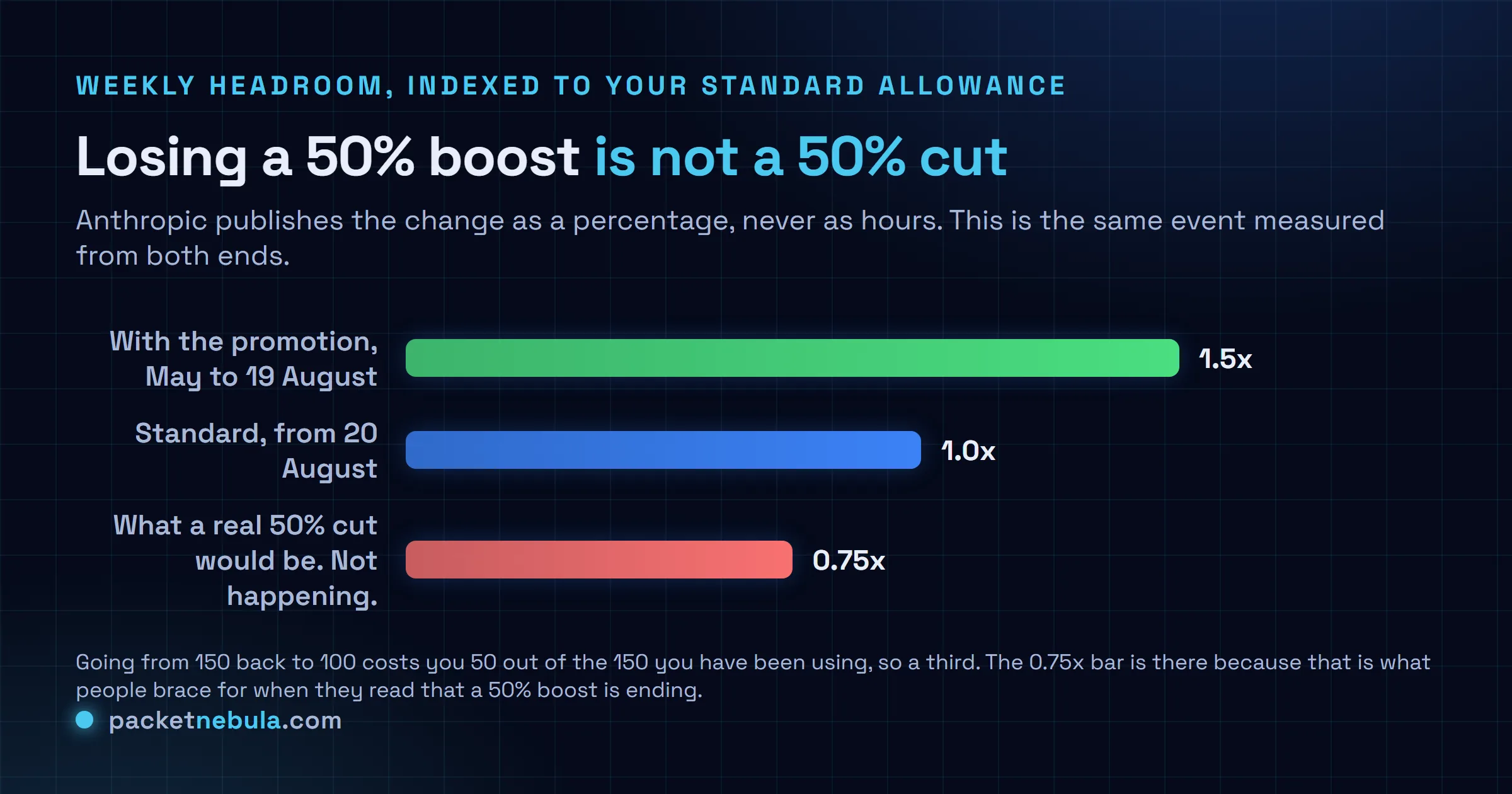
Also untouched: Claude Cowork and the other Claude apps. The boost never covered them. If most of your week happens outside Claude Code, Thursday is a non event for you.
Nobody can tell you your limit in hours
Here is the awkward part. Ask what your standard weekly limit actually is, as a number, and there is no current published answer.
Anthropic’s pricing page lists Pro at $20 a month billed monthly, $17 on the annual deal, and Max starting at $100. It says Claude Code is included. It does not say how much. The support article about the promotion talks in percentages rather than hours. And the hour ranges you will find in every guide right now, the 40 to 80 hours for Pro sort of thing, trace back to figures published in August 2025 that were quoted against Sonnet 4. That is a year and several model generations ago, and consumption per hour is not remotely the same thing today.
So the guides are not lying. They are just old. Run the /usage command and read your own meter, because it is the only figure that describes your account.
I find this genuinely annoying, for what it is worth. Capacity you cannot express as a number is capacity you cannot plan against, and “run the command and see” is a workable answer for one developer but a poor one for a team lead trying to size seats.
What to do before Thursday night
Not much. A couple of things are cheap now and irritating later, though.
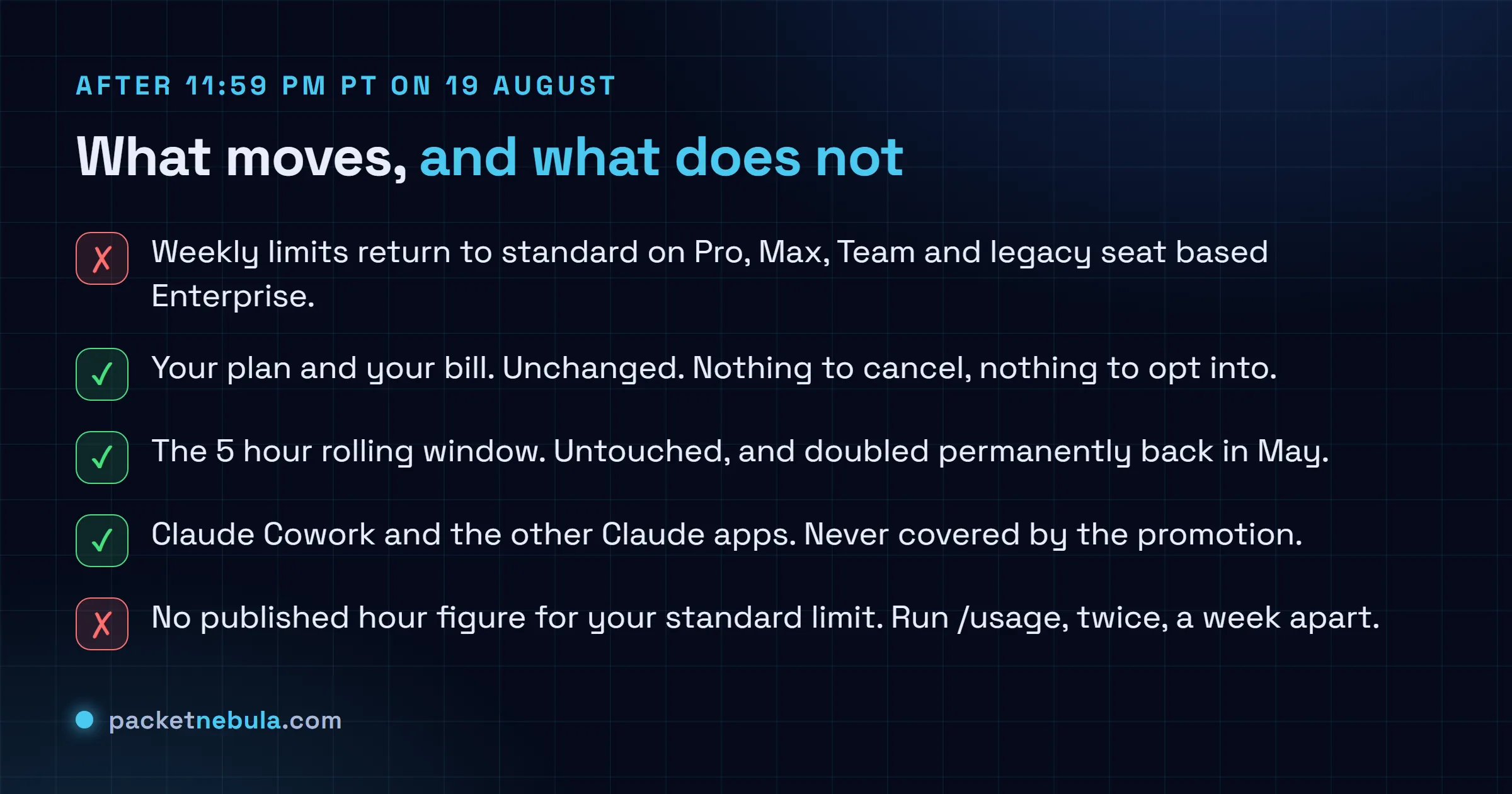
Check /usage today, while the boost is still on, and note where you sit in the week. Then check it again next Tuesday. Two readings a week apart tell you your real burn rate against the new ceiling, which beats any published range.
If you regularly run long agentic sessions, the lever with the biggest effect on consumption is not which plan you are on. It is how much thinking you ask for. Model choice and effort level drive token burn far more than session count does, which is the same reason effort levels change what a run costs more than most people expect. Dropping a routine cleanup pass from a heavy model to a light one buys back more week than any workflow tweak we know of.
Worth remembering that Pro, Max and Team stopped being billed for the auto mode classifier overhead earlier this month, which quietly went the other way on cost. We covered what changed when auto mode became the default and that part still stands.
If you enable usage credits, work past the included limit gets billed at standard API rates instead of stopping. That is a choice, not a default. Off unless you switch it on.
One last thing. The promotion ran four months and got extended at least twice, which is not the behaviour of a company that hates handing out capacity. I would not assume this is the last we see of it. I also would not build a sprint plan on that assumption.
Sources
Anthropic support, Claude Code May to August 2026 weekly limits promotion, read 18 August 2026. Help Net Security, Claude Code users keep 50% higher limits, 13 July 2026. Anthropic support, Using Claude Code with your Pro or Max plan, read 18 August 2026. Claude pricing, plan tiers and monthly prices, read 18 August 2026. explainX, Claude usage limits 2026, every change dated, read 18 August 2026, for the compiled timeline and the August 2025 hour ranges.
Update, 7 October 2026. The promotion ended on 13 September, not 19 August, and it left weekly limits 25 percent above their pre-promotion level. See the retirements calendar.
Frequently asked questions
What exactly happens at 11:59 PM PT on 19 August 2026?
The promotion that has been adding 50% to weekly Claude Code usage limits since May stops. Anthropic's support article says weekly usage limits return to their standard levels after 19 August, with no change to your plan or billing. Nothing is being taken away from the plan you pay for. A temporary top up that ran through four months and at least two extensions simply lapses. You do not have to do anything, and there is no opt in or opt out.
Is this a 50% cut to my weekly usage?
No, and that is the number most people are getting wrong. If your standard allowance is 100 and the promotion put you at 150, going back to 100 removes 33% of what you have had, not 50%. Same event, two very different figures depending on which end you measure from. Practically: budget roughly two thirds of the week you have been running since May, and expect to hit the wall around Friday instead of Sunday if you were already close.
Does this change the 5 hour session limit?
No. The promotion only ever touched the weekly cap. The 5 hour rolling window is separate and it is not part of this. Worth knowing that these two limits moved in opposite directions this year: the 5 hour limits were doubled permanently back in May, per timelines compiled from Anthropic's announcements, while the weekly boost was always flagged as promotional. So the short version is that your burst capacity stays where it is and your weekly pool shrinks.
Which plans are affected, and which are not?
Pro, Max and Team are in, plus legacy seat based Enterprise seats. Free plans were never eligible, and neither were consumption based Enterprise seats. The boost applied across the CLI, the IDE extensions, the desktop app and the web version of Claude Code. It did not cover the other Claude apps or Claude Cowork, so if your usage is mostly in those, nothing about your week changes on Thursday.
How do I find out what my standard weekly limit actually is?
Run the /usage command in Claude Code. That is the only answer we trust. Anthropic does not publish current weekly limits as a number on the pricing page, and the hour ranges that circulate in guides trace back to figures given in August 2025 that were quoted against Sonnet 4. Different models, different year, different consumption per hour. Treat those numbers as history rather than as your allowance, and read your own meter instead.


