
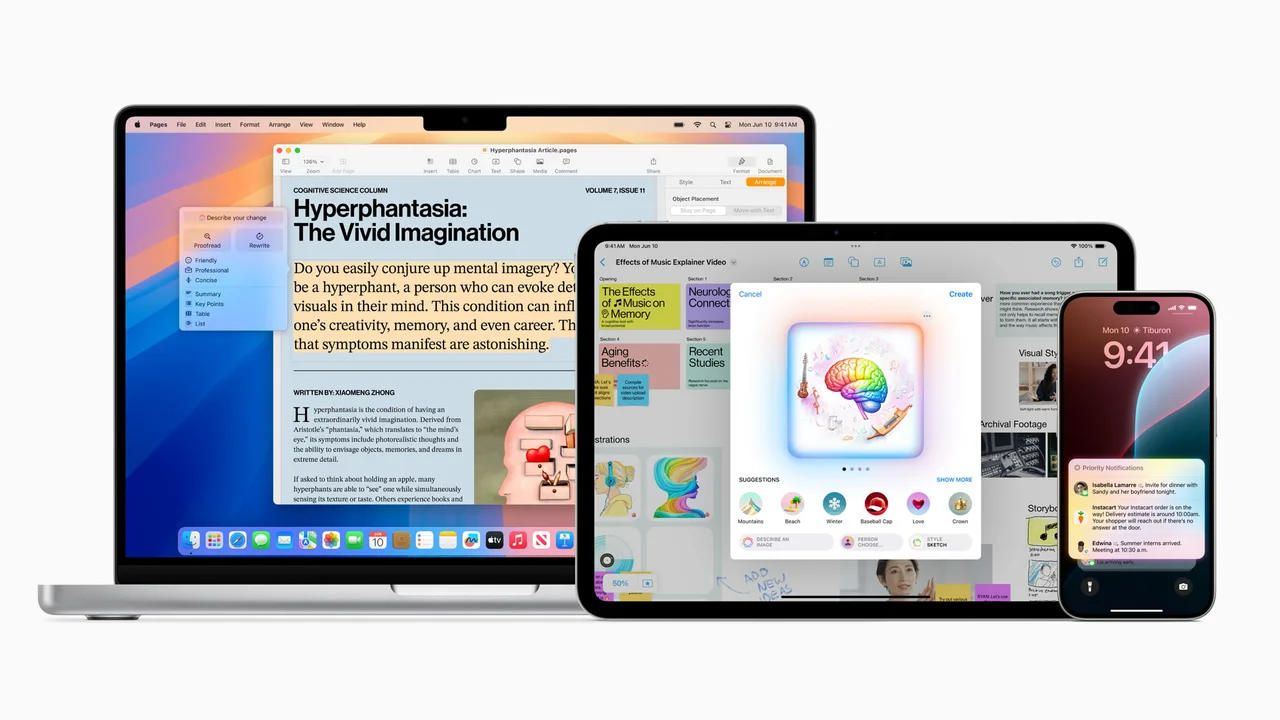
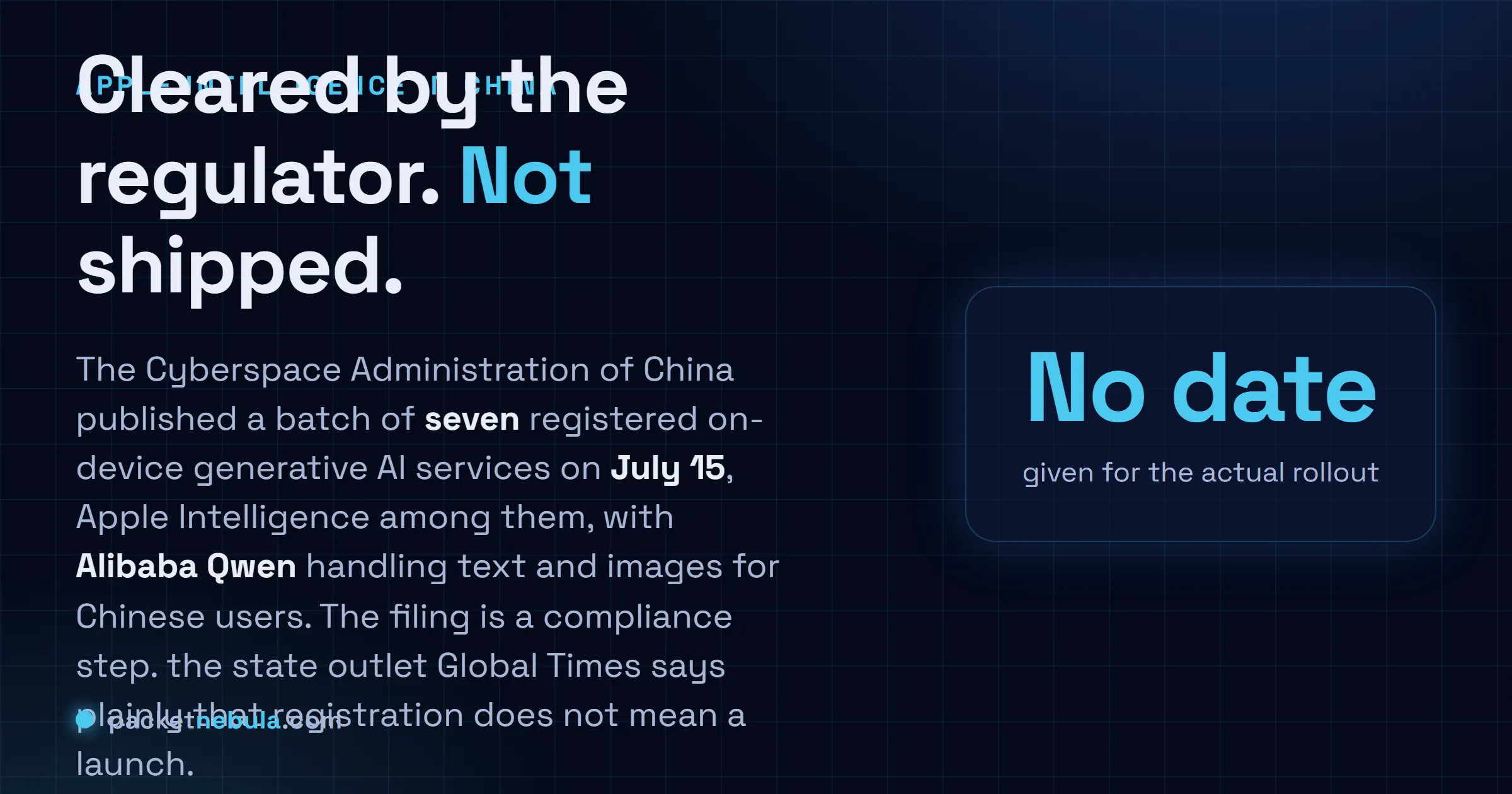
Twenty-two months. That is how long an iPhone bought in Shanghai has sat with the Apple Intelligence menu dark while the Huawei next to it happily rewrote its owner's emails. That wait now has an end in sight: China's Cyberspace Administration published a batch of registered on-device generative AI services on July 15, and Apple Intelligence is on it, with Alibaba's Qwen handling text and images for Chinese users. Before you file that as a launch, don't. The regulator's own state paper says flatly that registration isn't a rollout, and nobody has named a date. So we went digging into what the paperwork actually covers. It's more interesting than the headline.
The short answer
China’s regulator published Apple Intelligence in a batch of seven registered on-device AI services, with Alibaba’s Qwen doing text and images for Chinese users and Baidu confirmed on the visual side. It’s a compliance filing, not a rollout. Global Times says so outright. Nothing changes outside mainland China, and the real story is that Apple now ships a different model stack per region.
What actually happened
Paperwork cleared. On July 15 the Cyberspace Administration of China published registration information for seven newly added generative AI services running on mobile devices, and Apple Intelligence was among them. Reuters picked it up the same day. The filing sits under China’s Interim Measures for the Management of Generative AI Services, the regime that says a generative AI service offered to the Chinese public has to be registered before it can be offered at all.
One wrinkle worth flagging, because it tripped us up. Global Times reports the notice puts Apple Intelligence’s own registration date at July 8, while the batch itself surfaced publicly on the 15th. Small gap, and neither Apple nor the CAC has explained it. We’d treat the 15th as the date the world found out, not the date the stamp landed.
Apple has said nothing. Not a word, which for a company that has spent two years telling Chinese customers the feature was coming “subject to regulatory approval” is a little loud.
The bit everyone is getting wrong
You’ll see “Apple was the only foreign brand on the list” in a lot of coverage. It isn’t right. The reported seven are Apple Intelligence, Huawei’s Xiaoyi, OPPO’s AndesGPT, vivo’s Blue Heart on-device model, Xiaomi’s Surge AI, Samsung’s Galaxy AI, and Nubia’s Doubao Phone model. Samsung is on there. That’s two foreign brands.
I might be splitting hairs, but the framing matters. This wasn’t a special carve-out where Beijing let exactly one Western company through the door. It was the first proper batch under a licensing regime for on-device AI, and it happened to include the two foreign phone makers that sell in volume there. Less geopolitics, more filing cabinet.
Who actually answers the request
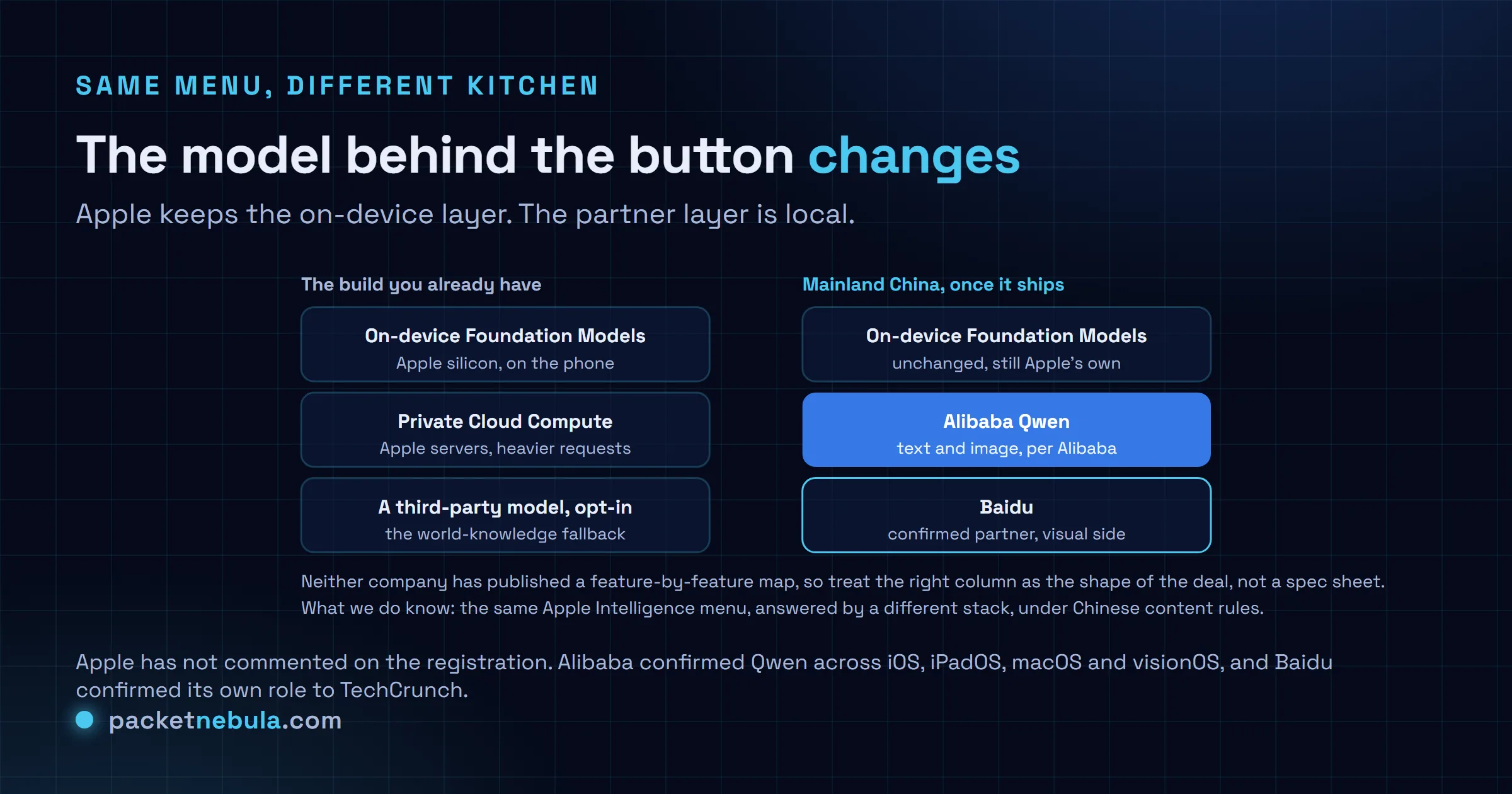
This is the part that should interest anyone building software. Alibaba confirmed to CNBC that Qwen will be integrated into Apple Intelligence experiences across iOS, iPadOS, macOS and visionOS for Chinese users, covering text and image understanding and generation. Baidu confirmed its own role to TechCrunch, and has been reported as taking the visual search side. TechCrunch also notes Apple has been sniffing around DeepSeek and ByteDance.
Apple keeps its on-device Foundation Models. Those run on the phone and don’t need anyone’s blessing. It’s the layer above, the one that handles the requests too big for the handset, where China gets a different answer than you do.
So the same button, in the same UI, wired to a different brain depending on where the SIM is. That’s genuinely new territory for Apple, and I don’t think the consequences are priced in yet. If you support an app with users in mainland China and you lean on system-level AI features, the output behaviour, the content filtering and the refusal patterns won’t match what you test at home. Test there, or don’t ship the feature there. If you want a sense of what Qwen is actually like to work with, we’ve written up running Qwen 3.7 locally and put it head to head with GLM 5.2.
Why Apple cared enough to wait two years
Money, mostly. Greater China brought Apple $20.5 billion in the last quarter, up 28% year over year, and Apple recently clawed back the number two spot in the Chinese smartphone market. Meanwhile Huawei and Xiaomi shipped on-device AI to their customers while the iPhone sat there with the feature switched off. Since September 2024. That’s a long time to sell a flagship with a hole in the spec sheet.
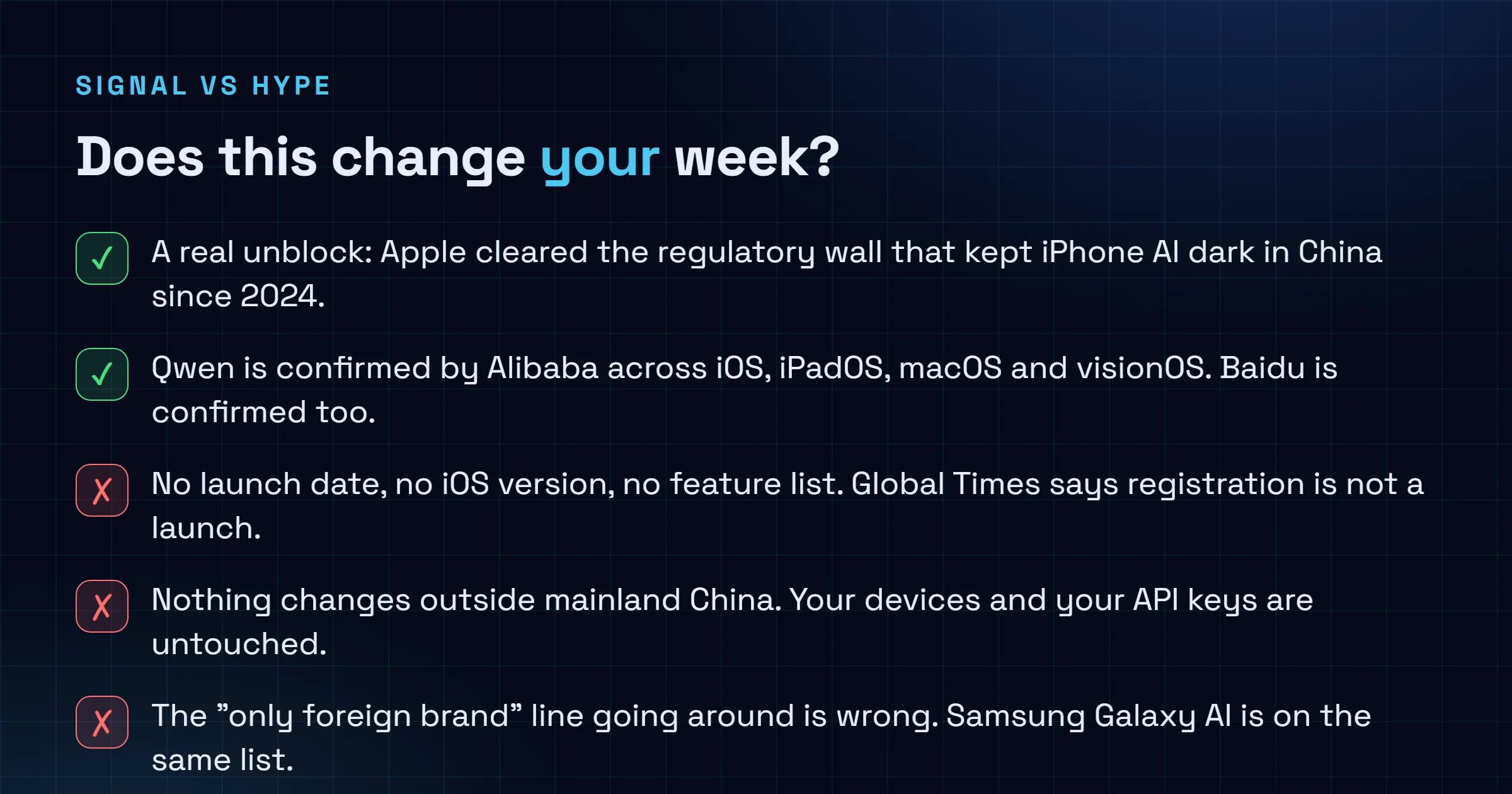

Image: Apple
What we’d actually do with this
Nothing, today. That’s the honest answer if you’re outside China.
If you are inside it, or you ship to it, the useful move is to stop treating “Apple Intelligence” as one product. It’s now a brand covering at least two different backends, and the Chinese one runs under content rules that Apple doesn’t set. AppleInsider raised the censorship question and it’s a fair one, because Apple has never had a partner model sitting in that position before.
The other thing to watch is whether this filing was the last hurdle or just the newest one. AppleInsider isn’t sure it’s the final step, and given that Apple previously had trouble adapting Baidu’s models for Chinese customers, a registration certificate and a shipping feature are not the same object. Watch for an iOS point release with a China-specific build note. That’s when it’s real.
Until then, this is a stamp on a form. An important stamp. Still a form.
If you’re tracking what Apple’s assistant does elsewhere, our write-up of the iOS 27 public beta and the rebuilt Siri covers the version Chinese users still can’t have.
Sources
Reporting and confirmations for this piece: TechCrunch on the approval and the Baidu confirmation, Global Times on the registration notice and the launch timing, AppleInsider on what may still be outstanding, and BigGo Finance on the full list of seven registered services.
Frequently asked questions
Is Apple Intelligence available in China now?
No. The Cyberspace Administration of China published Apple Intelligence in a batch of seven registered on-device generative AI services on July 15, 2026, which is a compliance filing rather than a launch. State outlet Global Times said directly that completing registration does not mean an immediate launch, and that the rollout timeline remains unknown. Apple has not commented, and no iOS version or feature list has been named.
Which AI model powers Apple Intelligence in China?
Alibaba confirmed that its Qwen models will be integrated into Apple Intelligence experiences across iOS, iPadOS, macOS and visionOS for users in China, covering text and image understanding and generation. Baidu is also a confirmed partner and has been reported as handling the visual search side. Apple keeps its own on-device Foundation Models. Neither company has published a feature-by-feature breakdown of who answers what.
Does this change anything outside mainland China?
Nothing at all, for now. The registration is a mainland China regulatory step under the Interim Measures for the Management of Generative AI Services. Your devices, your Apple Intelligence features and any API keys you hold are untouched. The one thing worth tracking is the precedent: Apple is shipping a regionally different model stack behind the same interface, which matters if you build or support apps used in China.
Was Apple the only foreign brand approved?
No, and that line has been circulating incorrectly. The reported list of seven services includes Samsung Galaxy AI alongside Apple Intelligence, Huawei Xiaoyi, OPPO AndesGPT, vivo Blue Heart, Xiaomi Surge AI and Nubia Doubao Phone. Two foreign brands, not one. Apple is the higher-profile case because its AI features had been blocked in China since 2024, not because it stood alone on the list.


