
You ran `pip install duckdb` this morning and nothing was different. Good, because that is the honest answer here: AWS signed a definitive agreement on 26 August to buy DuckLabs, the small Amsterdam company that writes DuckDB, and the database stays free under the MIT licence held by the independent DuckDB Foundation. The team becomes an AWS subsidiary in early September, still run by the two researchers who built the thing at CWI in 2018. Terms undisclosed. So far, so calm. Then we went and read the Foundation own page, and the number that stuck was three, because that is how many seats its board has, and two of them are about to be occupied by AWS employees.
The short answer
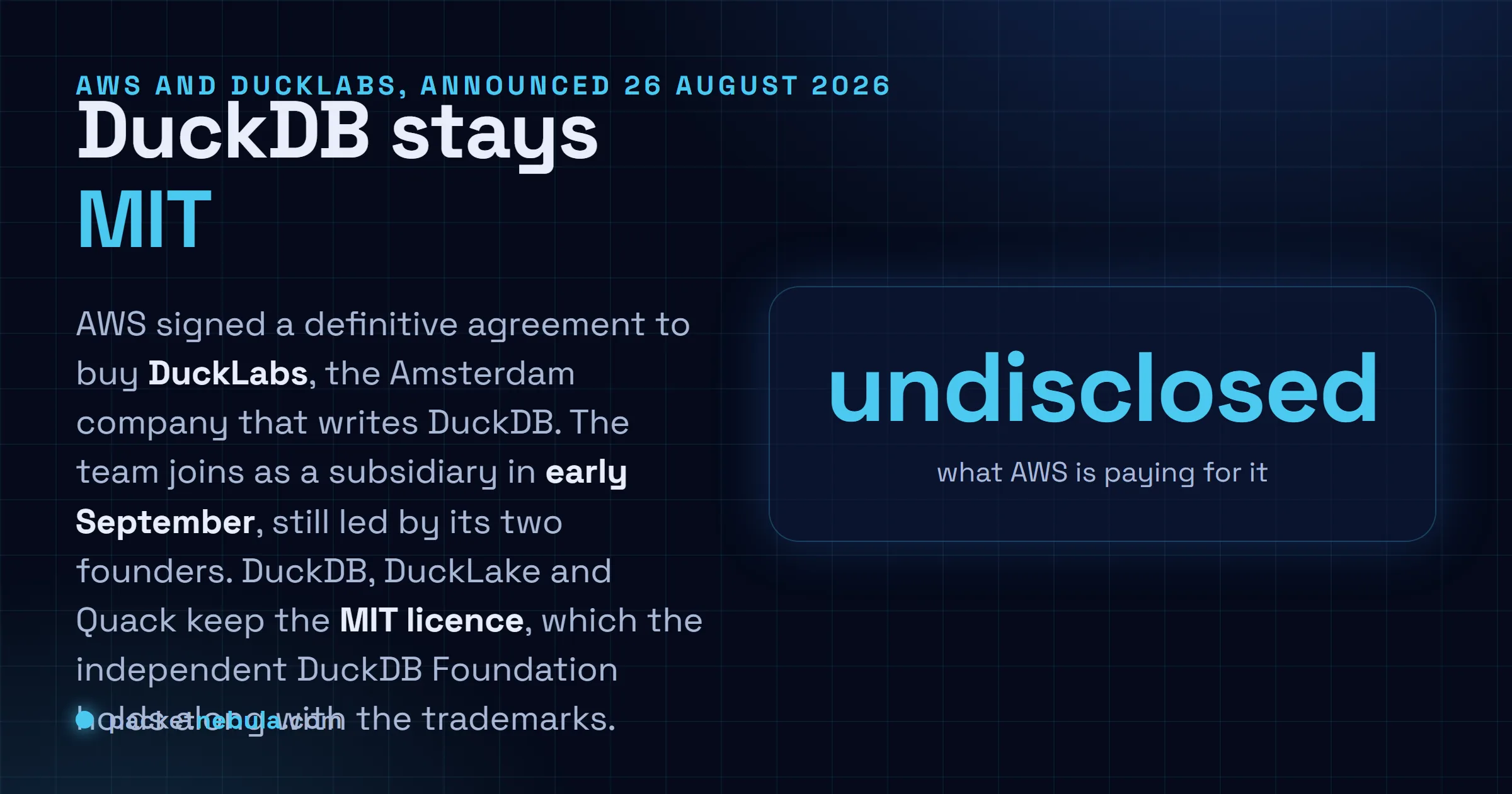
AWS is buying DuckLabs, the Amsterdam company behind DuckDB, and the team becomes a wholly owned subsidiary in early September 2026. Terms were not disclosed. DuckDB, DuckLake and Quack stay MIT under the independent DuckDB Foundation, which owns the IP and the trademarks. Nothing in your pipeline changes today. The part worth watching is who sets priorities, not who holds the copyright.
What AWS actually bought
Image: Amazon
DuckLabs is not DuckDB. That distinction carries the whole story, and most of the coverage flattened it.
DuckDB is an in-process analytical database. No server, no daemon, no port to open. You import it into Python or R or a Node script and it runs columnar OLAP queries inside your own process, against Parquet files or CSVs or S3 objects, whatever you point it at. It came out of CWI Amsterdam, the Dutch research institute responsible for a good share of the decent ideas in analytical databases, and it got popular because it deleted an entire tier of infrastructure for anyone whose data fits on one machine. Which, for most people, it does.
DuckLabs is the company Hannes Muhleisen and Mark Raasveldt built to develop it. Roughly: the people who write the commits. That is what AWS signed for on 26 August, with closing expected shortly and DuckLabs saying it becomes a wholly owned subsidiary in early September. Both founders keep leading the team and the technical direction from inside Amazon.
The Foundation, a separate Dutch non-profit, was not part of the deal at all.
The licence is genuinely fine. That is not the question
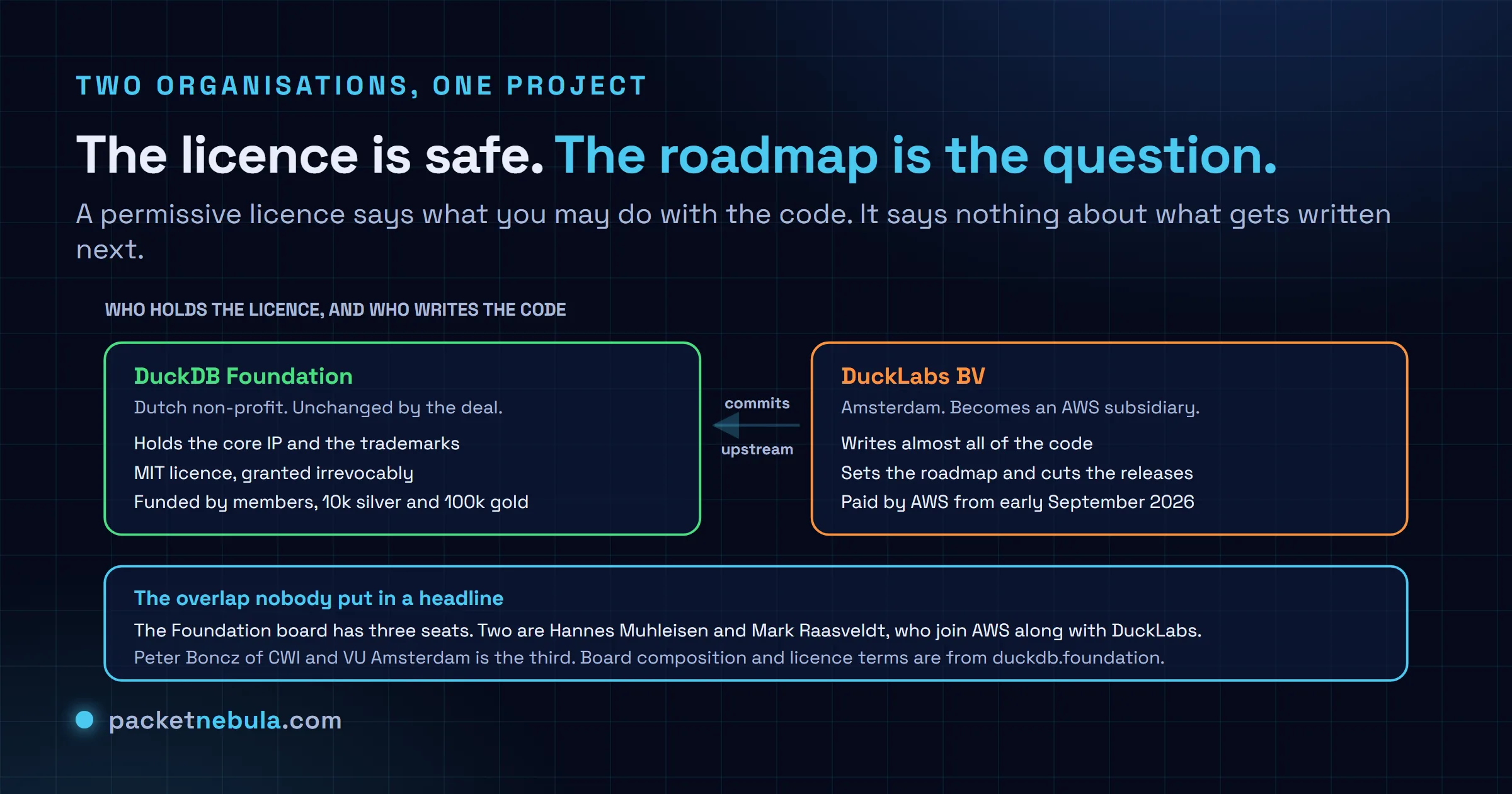
The Foundation page is unusually blunt for a governance page. It holds the core IP and the trademarks of DuckDB, DuckLake and Quack, and those projects are distributed under MIT irrevocably. DuckLabs repeated the commitment on announcement day, saying there are no changes to roadmap, licensing or governance model.
We believe them. Not out of charity: an irrevocable MIT grant on code that is already published cannot be walked back by anyone, new owner included. Fork rights survive an acquisition. So the “will they close it” panic that fills every thread like this one is aimed at the wrong risk.
The real one is quieter. Read the two boxes again. One organisation owns the licence, a different organisation writes the code, and only one of those two has a payroll. Nearly all contributions and strategic direction have come from DuckLabs, which makes the Foundation a strong legal shell around a project whose actual momentum sits somewhere else. And the shell has three board seats, two belonging to people who from September collect an Amazon salary.
None of which is sinister. Muhleisen has said openly that the Foundation role should expand, and that a Technical Advisory Board is coming so anyone betting on DuckDB gets a channel that stays independent. Correct instinct. It is also a quiet admission that today’s arrangement is thin.
I think the licence obsession in open source works as a comfort blanket. Licences protect what already exists. What gets built next is decided by whoever employs the committers, and that changed hands this week.
Why AWS wanted it
The strategic logic is not subtle, and AWS wrote it down itself. It wants to pair DuckDB, which it calls a superpower at everyday queries of a terabyte or less, with the exabyte scale of S3 and the existing analytics line of Redshift, Athena, EMR, Glue ETL and SageMaker. Read that as the long push to make S3 somewhere you compute rather than somewhere you park files.
There is precedent inside the building. AWS says Amazon Quick has been running on DuckDB since October 2025, has served over 2.5 billion queries on it, and saw average query latency fall by around 30 percent. Those are Amazon numbers and nobody has audited them, but they explain the purchase better than the press language does. They shipped it, it worked, they bought the team.
The ecosystem reaction has been calmer than you would expect. MotherDuck, which sells a managed DuckDB cloud and had the most to lose, called the move predictable and probably good for the project, while noting the familiar pattern of waiting for an open source project to get big and then launching it as a service. Its chief executive also allowed the take might age badly, comparing his own optimism to being relaxed about “inviting the wolves over for a dinner party”. The company has since started offering enterprise DuckDB support, something it deliberately avoided while DuckLabs was independent.
That last detail is the interesting one. A commercial support gap opened, and somebody filled it inside a week.
What we would actually do about it
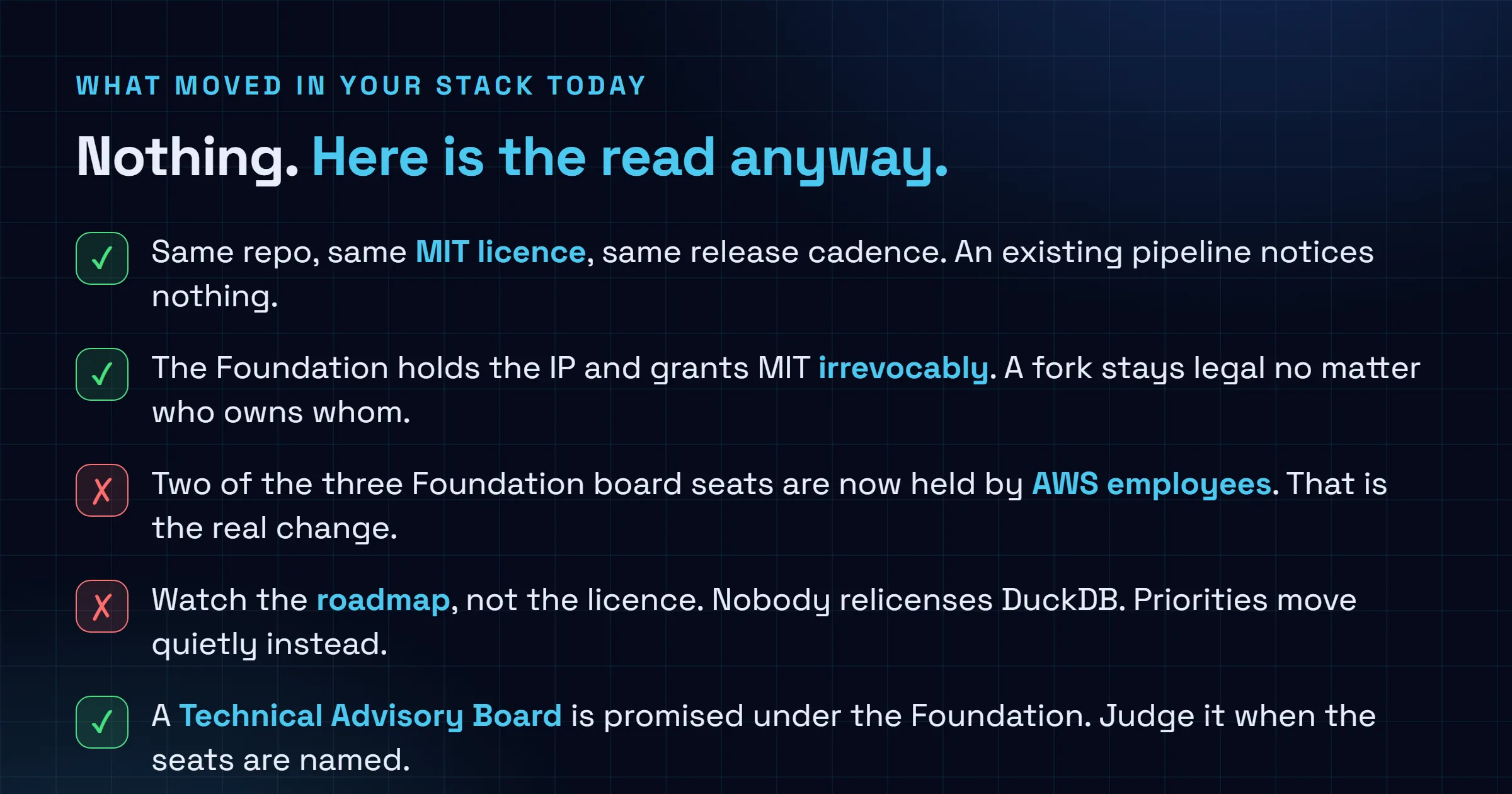
Nothing urgent, which is a boring answer and also the true one. Pin your DuckDB version the way you should have been doing anyway, pin the extension versions with it, and get on with your afternoon.
What we would actually watch over the next year is which extensions get love. DuckDB reads and writes Google Sheets and queries BigQuery through community extensions today, and its Parquet and Iceberg support treats every object store as equal. If two years from now the S3 paths are noticeably smoother than the rest, you have your answer about roadmap capture without anyone having touched the licence file.
For the wider shape of this, we wrote about what the reported Nvidia deal for Hugging Face changes in much the same terms: the neutral layer of the stack keeps getting bought, and the licence is rarely the part that moves. Same week and the same company, pointing the other way: Amazon is also closing Mechanical Turk on 30 September.
One prediction, and I might be wrong about it. A managed DuckDB service on AWS ships before the end of 2027, it will be good, and it will make that Foundation advisory board matter a great deal more than it does today.
Sources
AWS published the announcement on the AWS Big Data Blog on 26 August 2026, and the corporate note carrying the announcement graphic sits on About Amazon. DuckLabs published its own statement the same day, DuckLabs to Join AWS, Projects to Remain Open Source. Licence terms, IP ownership, membership tiers and the three board seats come from duckdb.foundation. The Register covered the contribution imbalance and the Muhleisen comments on expanding the Foundation in its report on the acquisition, and MotherDuck set out its own position in a post from its chief executive.
Frequently asked questions
Is DuckDB still open source after the AWS acquisition?
Yes. DuckDB, DuckLake, Quack and the extensions stay under the MIT licence, and that licence is not AWS to change: the non-profit DuckDB Foundation holds the core intellectual property and the trademarks, and grants MIT irrevocably. DuckLabs, the company being bought, is the team that writes the code, which is a different thing from the entity that owns it.
What exactly did AWS buy?
DuckLabs BV, the Amsterdam company founded by Hannes Muhleisen and Mark Raasveldt to develop DuckDB commercially. AWS announced a definitive agreement on 26 August 2026, and DuckLabs said it expects to become a wholly owned AWS subsidiary in early September. Financial terms were not disclosed by either side. The DuckDB Foundation was not part of the transaction.
Will DuckDB get relicensed or go closed source?
Almost certainly not, and it would be difficult even if someone wanted it. The Foundation holds the IP under an irrevocable MIT grant, so every version published so far stays MIT forever and anyone may fork it. The realistic risk is not licensing. It is that the roadmap starts favouring the workloads that matter to a cloud provider, which no licence prevents.
Does anything break in my existing DuckDB setup?
No. Nothing moved on 28 August 2026. Same repository, same release cadence, same MIT terms, same extension install path. If you pin versions you are already doing the only hygiene this deal calls for. There is no migration, no account to create and no deprecation notice attached to the announcement.
Who keeps AWS honest on the DuckDB roadmap now?
On paper, the Foundation board, which has three seats: Hannes Muhleisen as chair, Mark Raasveldt, and Peter Boncz of CWI and VU Amsterdam. The first two are joining AWS with DuckLabs, so Boncz is the one board member with no line into Amazon. DuckLabs has said it will add a Technical Advisory Board under the Foundation so heavy users and rival vendors get a formal channel into the roadmap. Worth judging once the seats are actually named.


