
• Latest
  • Trending
  • All
Google's official announcement image for the release, reading Introducing Gemini 3.8 Flash and 3.8 Flash Cyber in black type over a pale blue background with a blurred white chevron and the four colour Gemini spark below.

Gemini 3.8 Flash keeps the price and the 1 January cliff

3 September 2026
The official xAI announcement card for Grok 4.7, white type on a dark grey and navy gradient.

Grok 4.7 keeps $2 and $6, and its gains over 4.6 are xhigh versus high

22 September 2026
Answer card stating that Qwen-Image-2.1, released on 20 September 2026, ships open weights with a 7 billion parameter diffusion transformer, a Qwen3-VL 8B text encoder and an RGBA VAE totalling about 33 gigabytes in BF16, under the Qwen Research License that limits use to research or evaluation and requires a separate commercial licence, unlike the Apache 2.0 licence of Qwen-Image 1.0.

Qwen-Image-2.1 brings the weights back, but not the Apache licence

21 September 2026
Answer card stating that Ternary Bonsai 2 27B, released by PrismML on 17 September 2026 under Apache 2.0, packs Qwen3.8 27B into 5.95 gigabytes at 1.72 bits per weight, keeps 98.2 percent of the 14-benchmark average, about 75 percent on SWE-bench Verified and Terminal-Bench 2.1, and needs PrismML's llama.cpp fork to run.

Does Bonsai 2 27B really keep 98% of Qwen3.8 in 5.95 GB?

20 September 2026
Answer card stating that Jev 1.13 from TypeSafe AI is a decision model in early access since 15 September 2026 that returns typed probabilities instead of text, priced at 42 dollars per billion input tokens with output tokens free, answering in 70 to 500 milliseconds, with a 64K token request budget, text input only, and a documented list of things it does badly, including counting and dates.

Jev 1.13 bills $42 a billion tokens, and it can’t count

19 September 2026
Answer card stating that Qwen3.8-Omni-Flash launched on 17 September 2026 as an API only model on Alibaba Cloud Model Studio, taking text, images, audio and video in a 1M token context and returning text only, priced at 0.15 dollars per million input tokens for every modality and 0.47 dollars per million output tokens in the international regions, with no open weights published and the Qwen-Live Harness GitHub repository returning 404.

Qwen3.8-Omni-Flash bills audio at $0.15 and ships no weights

18 September 2026
Answer card stating that on 15 September 2026 AWS said it is unable to restore access to resources and data hosted exclusively in the Middle East Bahrain region me-south-1 and in the mec1-az2 zone of the UAE region, because the damage spanned multiple Availability Zones and exceeded what multi-AZ services are designed to withstand.

AWS can’t restore me-south-1, six months after the drone strikes

17 September 2026
Answer card stating that Google released Gemini 3.8 Live and Gemini 3.8 Live Extended Thinking on 15 September 2026 at 3 dollars per million audio input tokens and 12 dollars out, that the thinking model requires asynchronous tools, and that Artificial Analysis scores it 82.6 on its Speech to Speech Quality Index.

Gemini 3.8 Live Extended Thinking rejects any tool that blocks

16 September 2026
Answer card summarising the Atria Dawn Preview release: 744B GLM-5.2 base, MIT licence, 1.5 TB BF16 and 756 GB FP8 checkpoints, 256K context, top on five of sixteen benchmark rows and trailing on SWE-bench Pro.

Atria Dawn Preview is 744B under MIT, and the BF16 weighs 1.5 TB

15 September 2026
Answer card stating that OpenAI released the Agents API in public beta on 10 September 2026 with no separate fee, billed through model tokens, tool calls and hosted sandbox time, with a choice of OpenAI hosted, self hosted or partner sandboxes, US only data residency and no Zero Data Retention support.

OpenAI’s Agents API has no fee, no ZDR and a one hour sandbox clock

14 September 2026
Answer card: Sakana Fugu Max at $2 and $6 per million tokens, Fugu Ultra v2 unchanged at $5 and $30, and Sakana saying Ultra v2 scores without Fable 5 or GPT-6 Astra in its pool.

Fugu Max costs $2 and $6 while Fugu Ultra v2 runs without Fable 5

13 September 2026
Answer card stating that DeepSeek released DeepSeek-V4.1-Flash on 10 September 2026 as a 552 billion parameter mixture of experts model with a new causal encoder decoder architecture that activates 8 billion parameters on input and 16 billion on output, with native vision, a one million token context and MIT licensed weights, that the API model name is now deepseek-flash at 0.15 dollars per million input tokens and 0.60 dollars per million output tokens off peak, and that DeepSeek announced V4 Pro would be routed to V4.1-Flash from 14 September and reversed that on 11 September.

DeepSeek V4.1-Flash arrived, and the V4 Pro retirement lasted a day

12 September 2026
Answer card stating that Cognition released SWE-2 on 10 September 2026, a coding model post-trained from Kimi K3, scoring 50.0 percent on FrontierCode 1.1 Main against 50.9 percent for Claude Fable 5.1 and 27.3 percent on Terminal-Bench 4 against 55.8 percent, available only inside Devin.

SWE-2 trails Fable 5.1 by one point, and by 28 on Terminal-Bench 4

11 September 2026
  • About
  • Contact
  • Privacy
  • Legal
Tuesday, September 22, 2026
  • Login
Packet Nebula
  • Home
  • Articles
    • Security
    • Network
    • Dev
    • Sysadmin
    • SEO
    • Email & DNS
  • Tools
    • Network tools: free, fast, no signup
    • Security tools: free, fast, no signup
    • Developer tools: free, fast, no signup
    • Sysadmin tools: free, fast, no signup
    • SEO tools: free, fast, no signup
    • Email & DNS tools: free, fast, no signup
  • Download
  • About
No Result
View All Result
Packet Nebula
No Result
View All Result
Home Dev

Gemini 3.8 Flash keeps the price and the 1 January cliff

by stephane
3 September 2026
in Dev
0
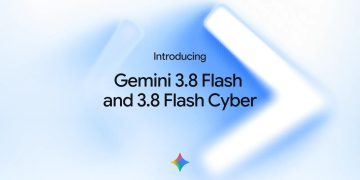
Google's official announcement image for the release, reading Introducing Gemini 3.8 Flash and 3.8 Flash Cyber in black type over a pale blue background with a blurred white chevron and the four colour Gemini spark below.
503
SHARES
1.4k
VIEWS
Share on FacebookShare on Twitter

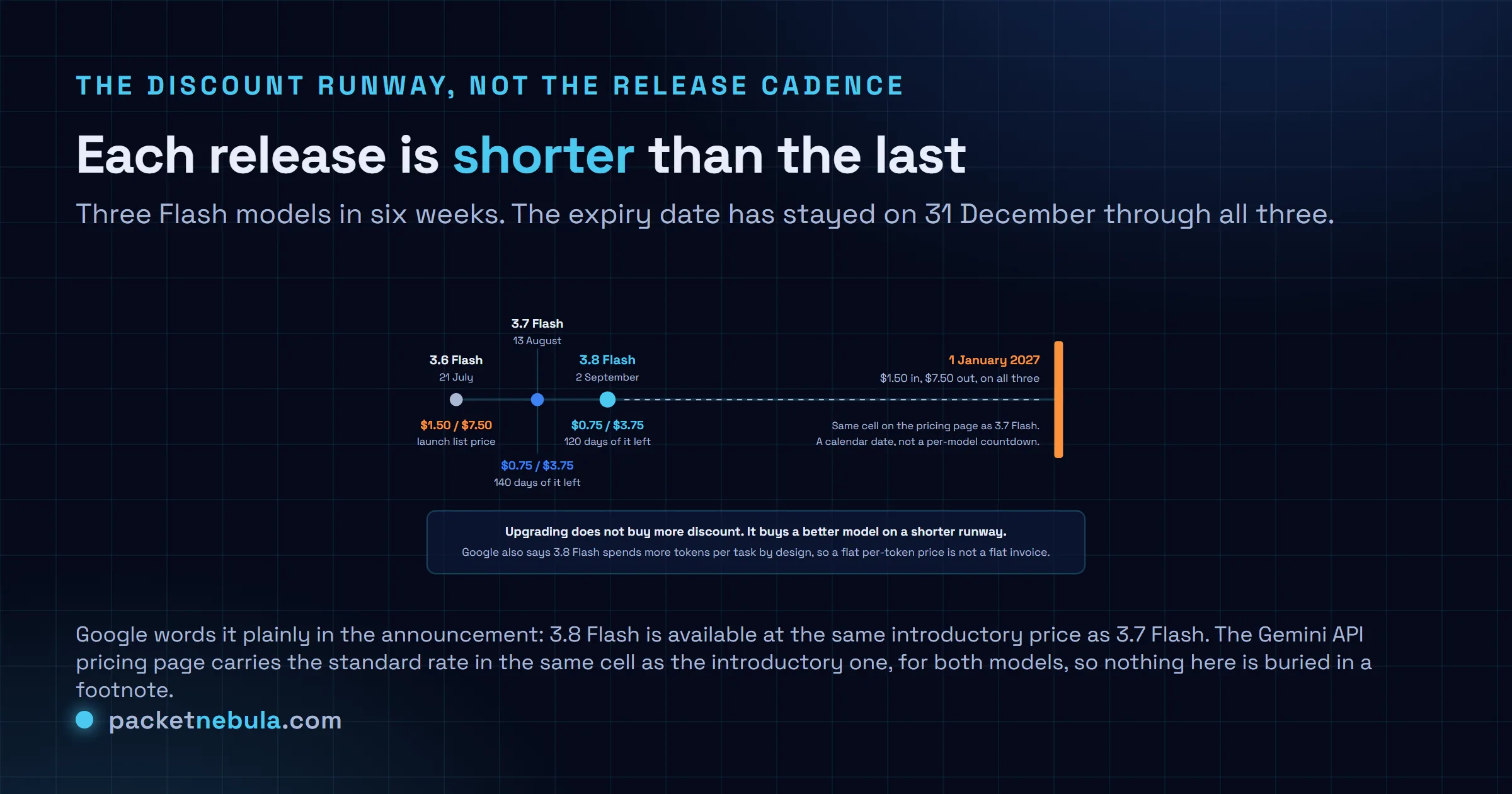
We opened the Gemini pricing page expecting a new row with a new date. The row is new. The date is not. Google shipped Gemini 3.8 Flash on 2 September 2026, three weeks after 3.7 Flash, at the same introductory $0.75 per million input tokens and $3.75 output, and the cell still says that rate runs out on 31 December 2026 before becoming $1.50 and $7.50 on 1 January. Google's own post calls this the third Flash release in six weeks. So the models keep improving while the discount runway keeps shrinking: 140 days when 3.7 landed in August, 120 now. Honestly, the line that interests us more sits further down the announcement, where Google says outright that 3.8 Flash burns more tokens on purpose.

The short answer

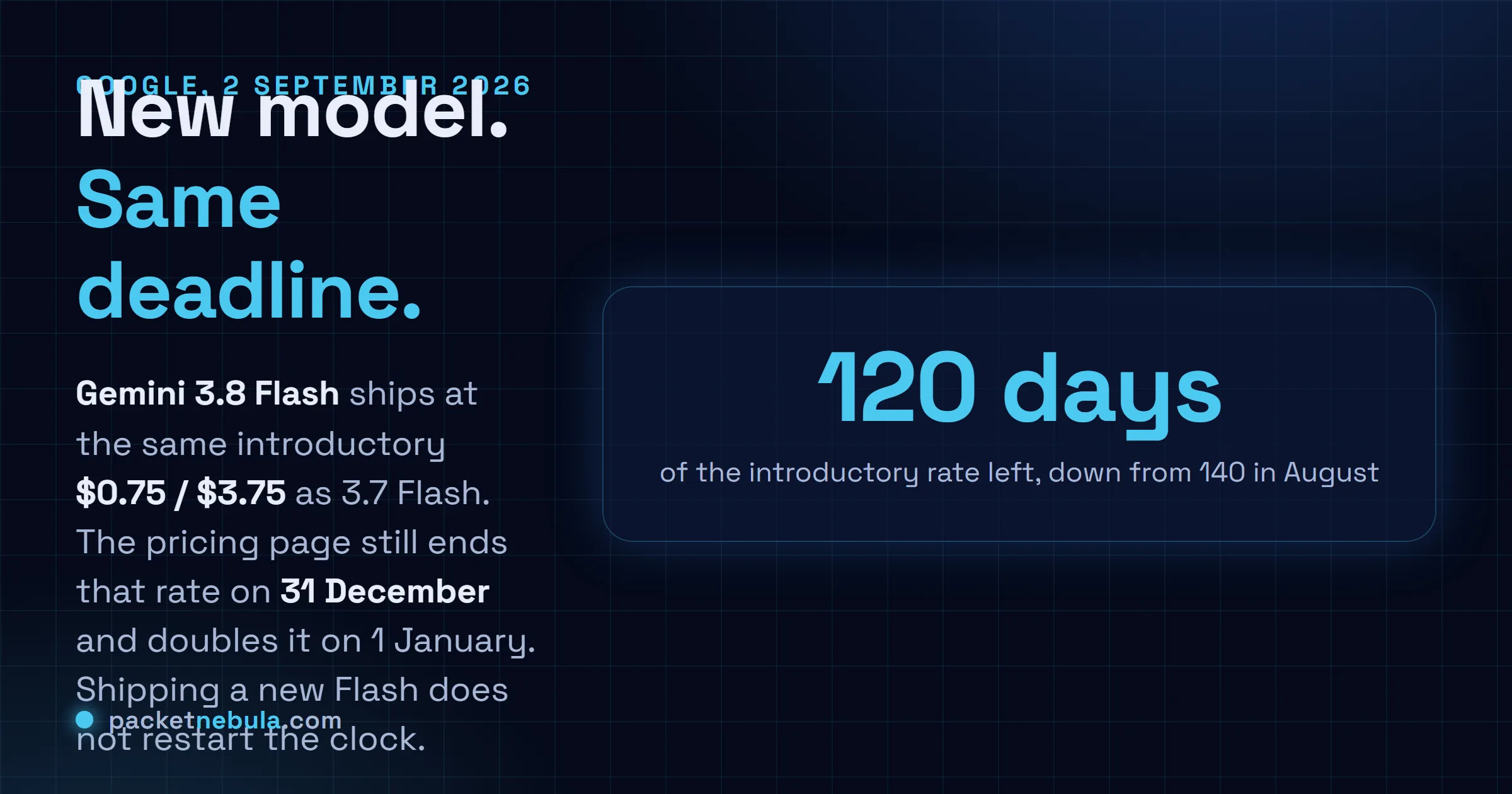
Gemini 3.8 Flash landed on 2 September, three weeks after 3.7 Flash, at the identical introductory price. The pricing page still ends that rate on 31 December and doubles it on 1 January, so a new model does not restart the clock. Google says the model deliberately spends more tokens. And the coding benchmark everyone will quote was published as a chart with no numbers on it.
$0.75 / $3.75per 1M, unchanged from 3.7 Flash
120 daysuntil the introductory rate expires
54.9%HLE-Verified, the one number in the post
Answer card stating that Google released Gemini 3.8 Flash on 2 September 2026, three weeks after Gemini 3.7 Flash and the third Flash release in six weeks, at the same introductory price of seventy five cents per million input tokens and three dollars seventy five per million output tokens, and that the Gemini application programming interface pricing page still ends that introductory rate on 31 December 2026 and raises it to one dollar fifty and seven dollars fifty on 1 January 2027 exactly as it does for Gemini 3.7 Flash, leaving one hundred and twenty days of the discounted rate.
One card. The model is new, the deadline is inherited.

The clock is a date, not a countdown

Here is the bit that nobody frames as news, because it looks like nothing happened. Google’s announcement says 3.8 Flash arrives “at the same introductory price as 3.7 Flash”, and it does. What that sentence hides is that the introductory price has a fixed end date attached to it, and that date has not moved once across three releases.

Back in July, 3.6 Flash launched at $1.50 and $7.50 with no discount at all. In August, 3.7 Flash halved that to $0.75 and $3.75, and we wrote up the expiry printed in the same cell: 31 December 2026, then back to $1.50 and $7.50. That gave 140 days of cheap tokens. Now 3.8 Flash inherits the same rate and the same wall, and there are 120 days left.

So if you have been holding off on standardising your agents on Flash while the versions churned, waiting cost you twenty days of runway and bought you a better model. That may well be a fair trade. It is just not a free one.
Google's official announcement image, reading Introducing Gemini 3.8 Flash and 3.8 Flash Cyber in black type over a pale blue background with a blurred white chevron shape and the four colour Gemini spark logo underneath.

Image: Google

Timeline diagram of three Gemini Flash releases against one fixed price expiry, showing Gemini 3.6 Flash on 21 July 2026 at a launch list price of one dollar fifty input and seven dollars fifty output per million tokens, Gemini 3.7 Flash on 13 August 2026 at the introductory seventy five cents and three dollars seventy five with one hundred and forty days of it remaining, and Gemini 3.8 Flash on 2 September 2026 at the same seventy five cents and three dollars seventy five with one hundred and twenty days remaining, all running into a wall on 1 January 2027 when the rate becomes one dollar fifty and seven dollars fifty for every one of them.
Three releases, six weeks, one unmoved deadline.

Google admits the model spends more

This is the paragraph in the announcement worth reading twice. Google writes that the gains “stem from a core design choice: 3.8 Flash works harder”, that on complex tasks it executes extra reasoning steps and calls tools iteratively, and that “at times, the model might use more tokens to maximize performance, especially at higher effort levels”.

Read that as a billing statement, because that is what it is. Your per token rate held flat. Your per task cost did not necessarily. An agent loop that used to close in four tool calls and now closes in seven is more accurate and more expensive at the same price sheet, and no launch post will tell you the ratio for your workload.

Google is unusually direct about the escape hatch, to its credit. Drop to a lower effort level, or stay on 3.7 Flash, which the docs say remains fully supported for efficiency-first workloads. That is a vendor telling you not to upgrade, which we do not see often. Take it at face value: if you are running high volume, cheap, shallow calls, 3.7 Flash is probably still your model.

The benchmark you cannot quote

Google’s headline claim is DeepSWE v1.1, a long horizon software engineering evaluation, where 3.8 Flash “outperforms most larger frontier models” at a fraction of their cost. We wanted the number. There isn’t one.

What Google published is a scatter plot of score against average cost per task, sourced to Datacurve AI, with a dozen models plotted and no axis labels on the points themselves. You can eyeball where 3.8 Flash sits relative to Claude Opus 5 and GPT-5.6 Sol, and it sits well, but eyeballing a chart is not a citation. Same story for Vals Finance Agent V2 and Harvey’s Legal Agent Benchmark, both charts, both figure-free. The only number written out in prose is 54.9% on HLE-Verified.

I might be wrong about the intent here, and a cost versus quality plot is genuinely the right shape for a “cheap model beats expensive models” argument. But when the one benchmark everybody will cite has no citable value, that is a choice someone made.
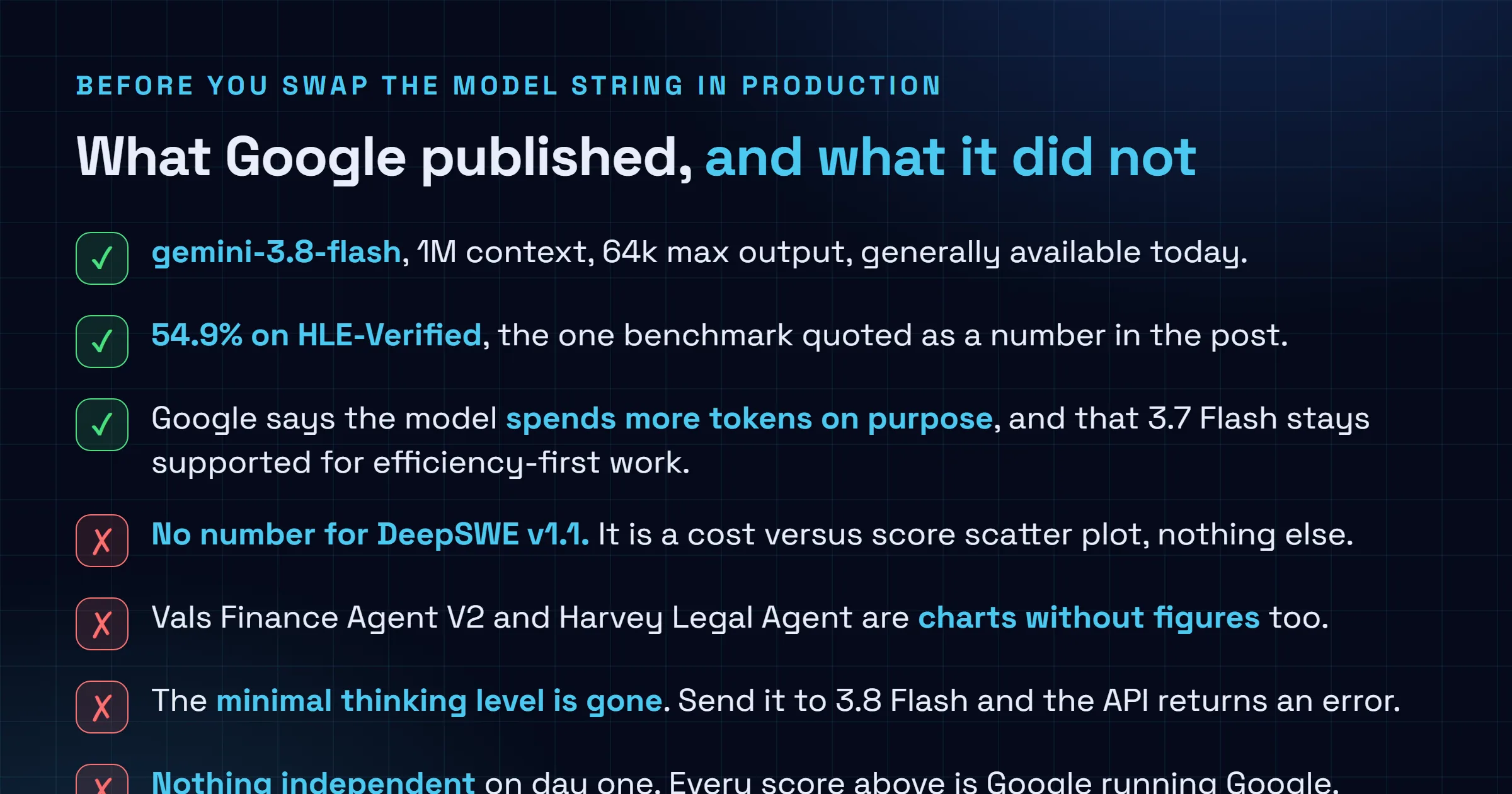
Checklist separating what Google published about Gemini 3.8 Flash from what it did not, confirming the model identifier gemini three point eight flash with a one million token context window and sixty four thousand maximum output tokens, general availability in the Gemini application programming interface and Google AI Studio and Android Studio and Antigravity and Stitch and Gemini Enterprise and for Google AI Pro and Ultra subscribers in the Gemini app and AI Mode in Search and Google Sheets, a score of fifty four point nine percent on HLE-Verified, the removal of the minimal thinking level which now returns an error, and Google saying the model spends more tokens by design, set against the absence of any published number for DeepSWE version one point one which appears only as a cost versus score scatter plot, the absence of published figures for Vals Finance Agent V2 and the Harvey Legal Agent Benchmark, and the absence of any independent third party evaluation on launch day.
Confirmed on the left of the ledger, missing on the right.

What actually breaks in your code

One real breaking change, and it is small but sharp. The minimal thinking level is gone on 3.8 Flash. Google’s guidance states plainly that minimal is not supported and that setting it explicitly returns an error, leaving low, medium (the default) and high.

If your service pins thinking_level to minimal for latency, swapping the model string will hand you a validation failure rather than a slower response. Worth catching in staging.

Otherwise it is the standard Gemini 3 migration surface you have already dealt with once. Strip temperature, top_p and top_k from your generation config, drop candidate_count, and use the thinking_level enum rather than the older thinking_budget integer. The model id is gemini-3.8-flash, with a 1M token context window and 64k maximum output.

The variant you probably cannot get

The second launch is Gemini 3.8 Flash Cyber, and it is worth two sentences even though most readers will never touch it. It is restricted to what Google calls trusted defenders via the new Fairwind Program, aimed at government authorities, critical infrastructure operators and software maintainers, and you apply for access rather than enabling it.

Google is explicit that it prioritised vulnerability fixing over exploitation, and that the defensive variant ships with looser mitigations precisely because access is gated. The numbers it does put in prose: 47.2% pass@1 on CWE-Bench against a leading frontier model at 47.8%, more than 70% success on an internal vulnerability discovery benchmark across 20 languages, and 2.6 times more correct Chrome patches than much larger commercial models per its own Chrome Security team.

Both variants run on the same core, which is the interesting technical claim underneath all of this. Google says the coding gains in the general model came partly from training hard on defensive security work. If that holds up, general purpose coding models get better by learning to read code adversarially, and that is a more useful idea than another point on a chart.

If you are still working out where Flash fits against the rest of the field, our write up of Gemini 3.6 Flash covers where this generation started, and Claude Opus 5 holding its price is the other side of the same chart, since Opus 5 is the model Google plotted itself against.

Sources

Google, Introducing Gemini 3.8 Flash and 3.8 Flash Cyber, 2 September 2026 (the announcement, the quoted lines, the Cyber figures and the image above). Google AI for Developers, Gemini API pricing (the $0.75 and $3.75 introductory rate, its 31 December 2026 end date and the $1.50 and $7.50 that follows, for both 3.7 and 3.8 Flash). Google AI for Developers, What’s new in Gemini 3.8 Flash (the model id, context window, thinking levels, the removal of minimal and the migration parameters). 9to5Google, Gemini 3.8 Flash rolling out three weeks after last release, 2 September 2026. MarkTechPost, Google DeepMind releases Gemini 3.8 Flash and Gemini 3.8 Flash Cyber, 2 September 2026.

Frequently asked questions

How much does Gemini 3.8 Flash cost?

Seventy five cents per million input tokens and $3.75 per million output, on the paid tier. That is an introductory rate, and the Gemini API pricing page states it applies through December 31, 2026, after which the price becomes $1.50 input and $7.50 output from January 1, 2027. Both numbers sit in the same cell. It is exactly the same pricing line Gemini 3.7 Flash carries.

Is Gemini 3.8 Flash cheaper than 3.7 Flash?

No. The two models list at the same per token price today and at the same price from 1 January. What Google does say is that 3.8 Flash works harder on complex tasks, executing extra reasoning steps and calling tools iteratively, and that it may use more tokens to maximise performance at higher effort levels. Same rate per token, potentially more tokens per task, so budget on your own traces rather than on the price sheet.

What broke when moving from 3.7 Flash to 3.8 Flash?

The minimal thinking level. Google's guidance for 3.8 Flash says minimal is not supported and that setting it returns an error, leaving low, medium (the default) and high. The wider Gemini 3 migration rules still apply too: drop temperature, top_p and top_k, drop candidate_count, and use the thinking_level enum instead of thinking_budget.

How good is Gemini 3.8 Flash at coding?

Google claims it outperforms most larger frontier models on DeepSWE v1.1, a long horizon software engineering benchmark, at a fraction of their cost. It also quotes 54.9% on HLE-Verified. Worth knowing before you quote a figure at anyone: the DeepSWE result is published as a cost versus score scatter plot with no numbers attached, so there is no official percentage to cite. Everything on launch day is Google evaluating Google.

Can I use Gemini 3.8 Flash Cyber?

Almost certainly not. It is restricted to what Google calls trusted defenders through the new Fairwind Program, which prioritises government authorities, critical infrastructure operators and software maintainers, and access is granted by application. The general 3.8 Flash model is what everyone else gets, and Google says both variants share the same underlying core.

Where can I use Gemini 3.8 Flash?

Through the Gemini API in Google AI Studio and Android Studio, plus Google Antigravity, Stitch and Gemini Enterprise. Google AI Pro and Ultra subscribers also get it in the Gemini app, in AI Mode in Google Search and in Gemini in Google Sheets. The model identifier is gemini-3.8-flash, with a one million token context window and 64k maximum output.

Tags: aigeminigooglellmnewspricing
Share201Tweet126
stephane

stephane

  • Trending
  • Comments
  • Latest
Answer card: Proton Lumo 2.0 is private by policy, not by locality. Saved history is locked so even Proton cannot read it, but the prompt is decrypted on a Proton EU server to answer it, then forgotten.

Proton Lumo 2.0 review: how private is it, really?

3 September 2026
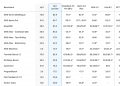
The Agentic Coding section of the official Hy4 preview benchmark appendix published by Tencent, a table comparing Hy3 and Hy4 preview against DeepSeek V4 Pro 0813, Qwen 3.8 Max, GLM 5.3, Kimi K3, GPT 5.6 Sol and Claude Opus 5 across SWE-bench Multilingual, SWE-bench Pro, DeepSWE, three SWE Atlas tasks, SWE-Marathon, Terminal-Bench 2.1, NL2Repo-Bench, CyberGym, ProgramBench, PostTrainBench and Harbor-Index.

Tencent’s 770B Hy4 tops one benchmark row in 46

3 September 2026
Answer card: Qwen 3.7 Max is API-only and cannot run locally yet; the open Qwen models (Qwen 3.6 27B, qwen3:8b to 32b) run offline via Ollama.

Qwen 3.7 local: what you can actually run offline

22 June 2026
Answer card: JWTs are not encrypted, anyone can read them; the signature proves who issued the token, not who may read it.

Are JWTs encrypted? No, and the difference will bite you

0
Answer card: a random 8 character password falls in under 2 hours offline, while 16 random characters hold for 1.4 trillion years at the same speed.

How long does it take to crack a password in 2026?

0
Answer card: three DNS records decide if your mail lands or bounces; SPF lists allowed senders, DKIM signs messages, DMARC sets the failure policy.

SPF, DKIM and DMARC explained: the records your email needs

0
The official xAI announcement card for Grok 4.7, white type on a dark grey and navy gradient.

Grok 4.7 keeps $2 and $6, and its gains over 4.6 are xhigh versus high

22 September 2026
Answer card stating that Qwen-Image-2.1, released on 20 September 2026, ships open weights with a 7 billion parameter diffusion transformer, a Qwen3-VL 8B text encoder and an RGBA VAE totalling about 33 gigabytes in BF16, under the Qwen Research License that limits use to research or evaluation and requires a separate commercial licence, unlike the Apache 2.0 licence of Qwen-Image 1.0.

Qwen-Image-2.1 brings the weights back, but not the Apache licence

21 September 2026
Answer card stating that Ternary Bonsai 2 27B, released by PrismML on 17 September 2026 under Apache 2.0, packs Qwen3.8 27B into 5.95 gigabytes at 1.72 bits per weight, keeps 98.2 percent of the 14-benchmark average, about 75 percent on SWE-bench Verified and Terminal-Bench 2.1, and needs PrismML's llama.cpp fork to run.

Does Bonsai 2 27B really keep 98% of Qwen3.8 in 5.95 GB?

20 September 2026
  • About
  • Contact
  • Privacy
  • Legal

Copyright © 2026 Stephane Cardon.

Welcome Back!

Login to your account below

Forgotten Password?

Retrieve your password

Please enter your username or email address to reset your password.

Log In
No Result
View All Result
  • Home
  • Articles
    • Security
    • Network
    • Dev
    • Sysadmin
    • SEO
    • Email & DNS
  • Tools
    • Network tools: free, fast, no signup
    • Security tools: free, fast, no signup
    • Developer tools: free, fast, no signup
    • Sysadmin tools: free, fast, no signup
    • SEO tools: free, fast, no signup
    • Email & DNS tools: free, fast, no signup
  • Download
  • About

Copyright © 2026 Stephane Cardon.