
• Latest
  • Trending
  • All
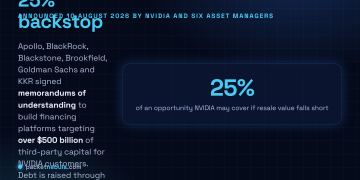
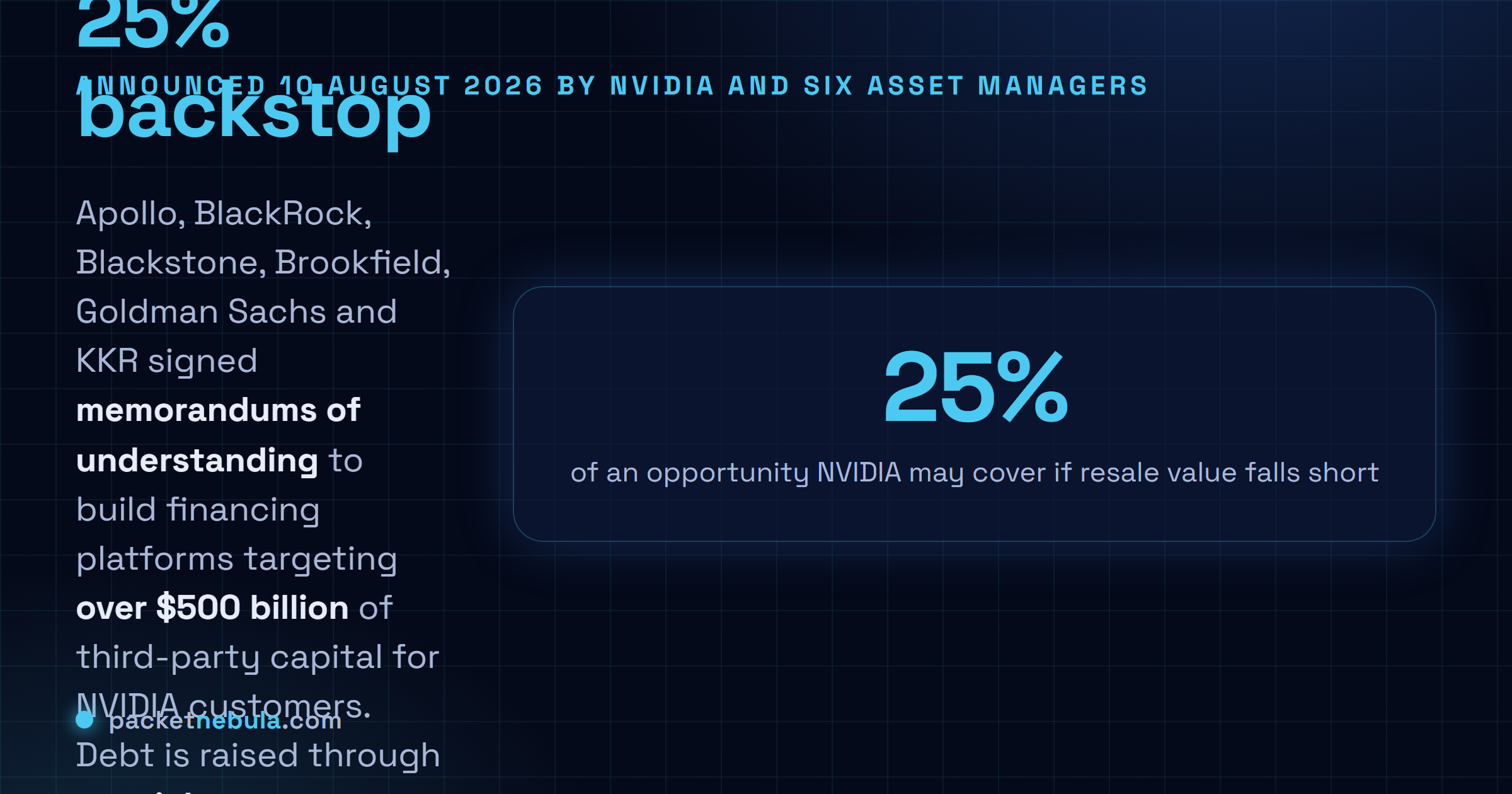
Answer card: on 10 August 2026 NVIDIA signed memorandums of understanding with Apollo, BlackRock, Blackstone, Brookfield, Goldman Sachs and KKR to establish AI compute financing platforms targeting over 500 billion dollars of third-party capital, raised through special purpose entities secured on the compute, with NVIDIA offering residual value support on up to 25 percent of an opportunity.

NVIDIA’s $500B compute financing and the 25% backstop

11 August 2026
Answer card stating that Qwen-Image-2.1, released on 20 September 2026, ships open weights with a 7 billion parameter diffusion transformer, a Qwen3-VL 8B text encoder and an RGBA VAE totalling about 33 gigabytes in BF16, under the Qwen Research License that limits use to research or evaluation and requires a separate commercial licence, unlike the Apache 2.0 licence of Qwen-Image 1.0.

Qwen-Image-2.1 brings the weights back, but not the Apache licence

21 September 2026
Answer card stating that Ternary Bonsai 2 27B, released by PrismML on 17 September 2026 under Apache 2.0, packs Qwen3.8 27B into 5.95 gigabytes at 1.72 bits per weight, keeps 98.2 percent of the 14-benchmark average, about 75 percent on SWE-bench Verified and Terminal-Bench 2.1, and needs PrismML's llama.cpp fork to run.

Does Bonsai 2 27B really keep 98% of Qwen3.8 in 5.95 GB?

20 September 2026
Answer card stating that Jev 1.13 from TypeSafe AI is a decision model in early access since 15 September 2026 that returns typed probabilities instead of text, priced at 42 dollars per billion input tokens with output tokens free, answering in 70 to 500 milliseconds, with a 64K token request budget, text input only, and a documented list of things it does badly, including counting and dates.

Jev 1.13 bills $42 a billion tokens, and it can’t count

19 September 2026
Answer card stating that Qwen3.8-Omni-Flash launched on 17 September 2026 as an API only model on Alibaba Cloud Model Studio, taking text, images, audio and video in a 1M token context and returning text only, priced at 0.15 dollars per million input tokens for every modality and 0.47 dollars per million output tokens in the international regions, with no open weights published and the Qwen-Live Harness GitHub repository returning 404.

Qwen3.8-Omni-Flash bills audio at $0.15 and ships no weights

18 September 2026
Answer card stating that on 15 September 2026 AWS said it is unable to restore access to resources and data hosted exclusively in the Middle East Bahrain region me-south-1 and in the mec1-az2 zone of the UAE region, because the damage spanned multiple Availability Zones and exceeded what multi-AZ services are designed to withstand.

AWS can’t restore me-south-1, six months after the drone strikes

17 September 2026
Answer card stating that Google released Gemini 3.8 Live and Gemini 3.8 Live Extended Thinking on 15 September 2026 at 3 dollars per million audio input tokens and 12 dollars out, that the thinking model requires asynchronous tools, and that Artificial Analysis scores it 82.6 on its Speech to Speech Quality Index.

Gemini 3.8 Live Extended Thinking rejects any tool that blocks

16 September 2026
Answer card summarising the Atria Dawn Preview release: 744B GLM-5.2 base, MIT licence, 1.5 TB BF16 and 756 GB FP8 checkpoints, 256K context, top on five of sixteen benchmark rows and trailing on SWE-bench Pro.

Atria Dawn Preview is 744B under MIT, and the BF16 weighs 1.5 TB

15 September 2026
Answer card stating that OpenAI released the Agents API in public beta on 10 September 2026 with no separate fee, billed through model tokens, tool calls and hosted sandbox time, with a choice of OpenAI hosted, self hosted or partner sandboxes, US only data residency and no Zero Data Retention support.

OpenAI’s Agents API has no fee, no ZDR and a one hour sandbox clock

14 September 2026
Answer card: Sakana Fugu Max at $2 and $6 per million tokens, Fugu Ultra v2 unchanged at $5 and $30, and Sakana saying Ultra v2 scores without Fable 5 or GPT-6 Astra in its pool.

Fugu Max costs $2 and $6 while Fugu Ultra v2 runs without Fable 5

13 September 2026
Answer card stating that DeepSeek released DeepSeek-V4.1-Flash on 10 September 2026 as a 552 billion parameter mixture of experts model with a new causal encoder decoder architecture that activates 8 billion parameters on input and 16 billion on output, with native vision, a one million token context and MIT licensed weights, that the API model name is now deepseek-flash at 0.15 dollars per million input tokens and 0.60 dollars per million output tokens off peak, and that DeepSeek announced V4 Pro would be routed to V4.1-Flash from 14 September and reversed that on 11 September.

DeepSeek V4.1-Flash arrived, and the V4 Pro retirement lasted a day

12 September 2026
Answer card stating that Cognition released SWE-2 on 10 September 2026, a coding model post-trained from Kimi K3, scoring 50.0 percent on FrontierCode 1.1 Main against 50.9 percent for Claude Fable 5.1 and 27.3 percent on Terminal-Bench 4 against 55.8 percent, available only inside Devin.

SWE-2 trails Fable 5.1 by one point, and by 28 on Terminal-Bench 4

11 September 2026
Answer card for Meta Muse, free to 100 million tokens a week then $20 a month, launched 8 September 2026 for United States adults only, running in a dedicated per user virtual machine.

Does Meta Muse do enough to earn your inbox and a card on file?

9 September 2026
  • About
  • Contact
  • Privacy
  • Legal
Monday, September 21, 2026
  • Login
Packet Nebula
  • Home
  • Articles
    • Security
    • Network
    • Dev
    • Sysadmin
    • SEO
    • Email & DNS
  • Tools
    • Network tools: free, fast, no signup
    • Security tools: free, fast, no signup
    • Developer tools: free, fast, no signup
    • Sysadmin tools: free, fast, no signup
    • SEO tools: free, fast, no signup
    • Email & DNS tools: free, fast, no signup
  • Download
  • About
No Result
View All Result
Packet Nebula
No Result
View All Result
Home Dev

NVIDIA’s $500B compute financing and the 25% backstop

by stephane
11 August 2026
in Dev
0
Answer card: on 10 August 2026 NVIDIA signed memorandums of understanding with Apollo, BlackRock, Blackstone, Brookfield, Goldman Sachs and KKR to establish AI compute financing platforms targeting over 500 billion dollars of third-party capital, raised through special purpose entities secured on the compute, with NVIDIA offering residual value support on up to 25 percent of an opportunity.
498
SHARES
1.4k
VIEWS
Share on FacebookShare on Twitter

Six phone calls, and nobody said no. That is roughly how Jensen Huang described it, and on 10 August NVIDIA announced memorandums of understanding with Apollo, BlackRock, Blackstone, Brookfield, Goldman Sachs and KKR to build financing platforms aimed at mobilizing more than $500 billion of third-party capital for AI compute. The pitch is that GPUs stop being a depreciating expense and start being collateral. Debt gets raised through special purpose entities secured on the machines, and NVIDIA customers borrow at rates they would never get on their own balance sheet. We have read a lot of enormous round numbers this year. This one has a much smaller number buried inside it that we think matters more, and it is 25%.

The short answer

On 10 August 2026 NVIDIA signed memorandums of understanding with Apollo, BlackRock, Blackstone, Brookfield, Goldman Sachs and KKR to create financing platforms for AI compute, targeting over $500 billion of third-party capital for NVIDIA customers. Debt is raised through special purpose entities with the compute itself as collateral. NVIDIA may provide residual value support on up to 25% of an opportunity. Nothing is executed yet, no rate or term has been published, and the useful life the whole model depends on is assumed rather than stated.
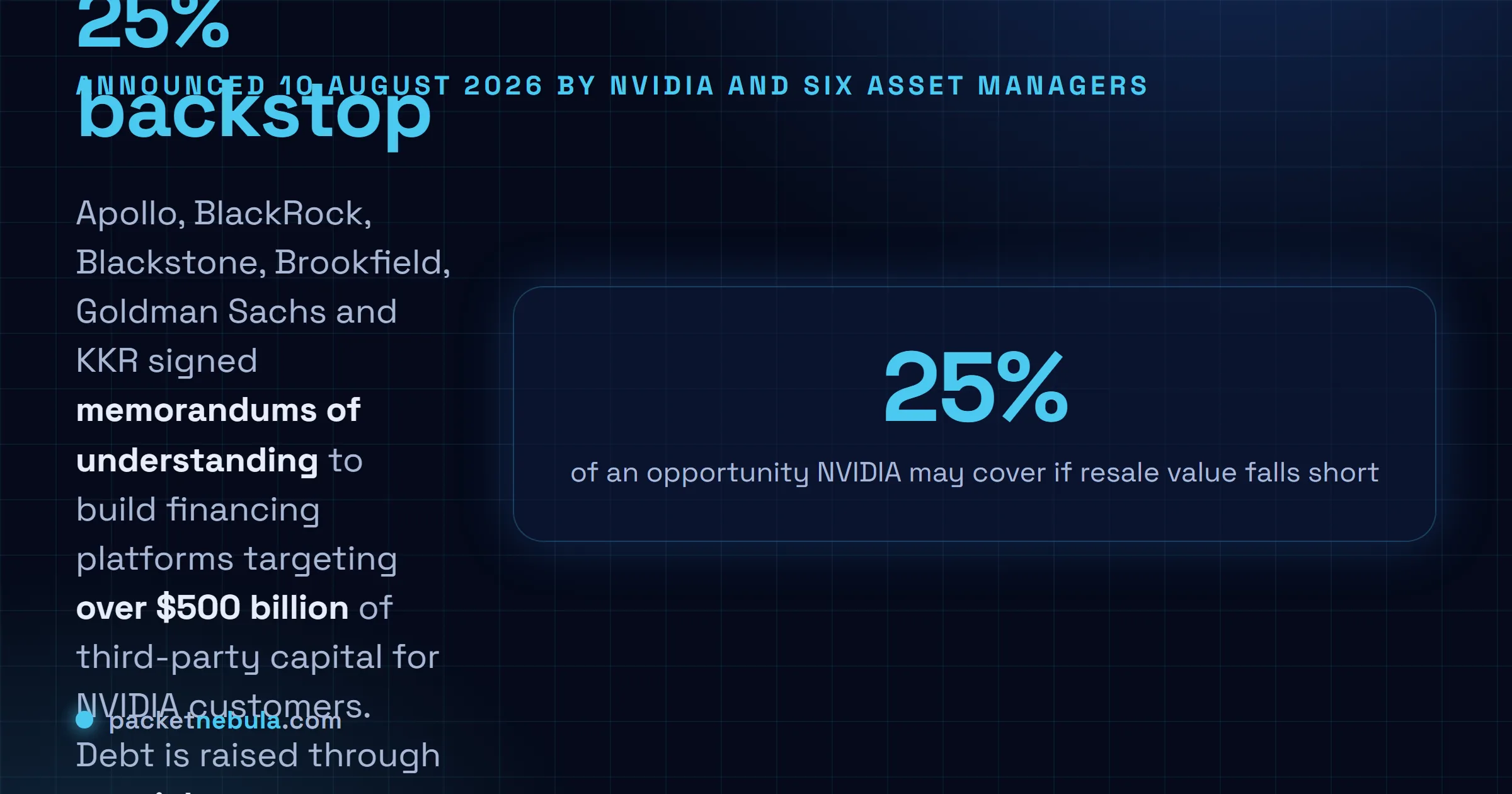
$500B+third-party capital the platforms target
25%of an opportunity NVIDIA may backstop on residual value
6asset managers signed, all of them on MOUs only
Answer card: on 10 August 2026 NVIDIA signed memorandums of understanding with Apollo, BlackRock, Blackstone, Brookfield, Goldman Sachs and KKR to establish AI compute financing platforms targeting over 500 billion dollars of third-party capital, raised through special purpose entities secured on the compute, with NVIDIA offering residual value support on up to 25 percent of an opportunity.
The headline number is the one everyone quoted. The one on the right is the one that decides whether this holds.

What was actually signed

Six firms, one instrument, no money yet.

Apollo, BlackRock, Blackstone, Brookfield and KKR come in as capital providers. Goldman Sachs is the only bank in the group, positioned as lead bookrunner on public debt deals while its asset management arm collects the returns. Together they signed MOUs to set up dedicated pools of capital that NVIDIA customers can borrow from at rates NVIDIA describes as attractive, covering frontier AI labs, enterprises and AI clouds.

The mechanics are ordinary infrastructure finance pointed at an unusual asset. Special purpose entities issue private offerings and bonds. The collateral is the compute. Larry Fink pitched it to investors as high credit quality with attractive yields in debt, which is exactly the sentence you say when you want an insurance company to buy the paper.

And that is the actual innovation here. Not the size. The reclassification.
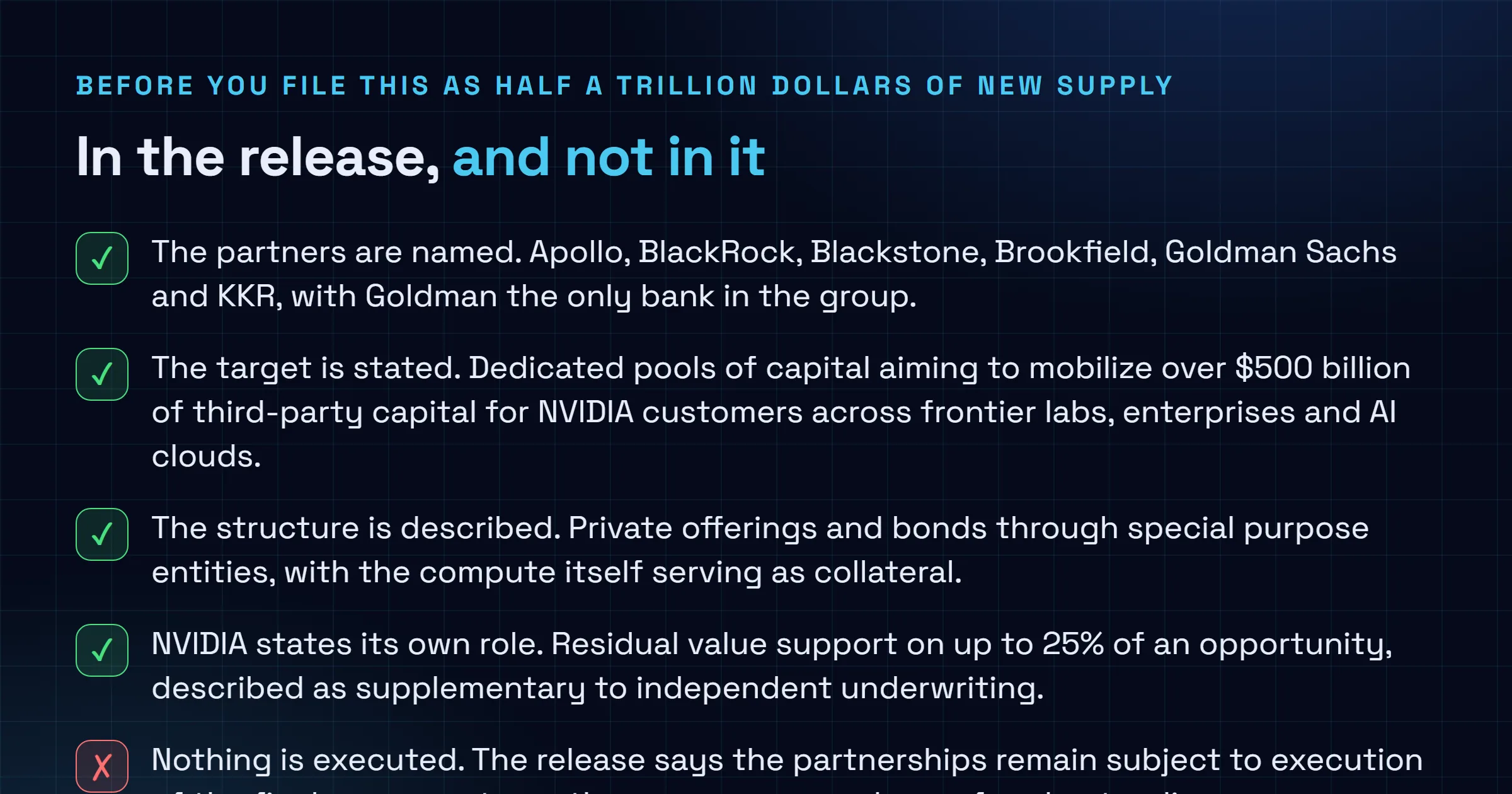
Checklist of what the NVIDIA compute financing announcement of 10 August 2026 confirms, namely the six named partners, the over 500 billion dollar third-party capital target, the special purpose entity structure with compute as collateral and residual value support of up to 25 percent of an opportunity, set against what it omits including any signed definitive agreement, any rate or term, any assumed useful life, any first loss allocation and any date for a first issue.
Read the bottom half first. Every missing line is a term that decides whether the top half works.

The 25% is the part worth arguing about

Huang said NVIDIA may provide residual value support on up to 25% of an opportunity, covering part of the gap if a chip’s resale or reuse value falls short at the end of a financing term. He was careful to frame it as supplementary, not as a guarantee underneath the whole thing.

Run the arithmetic anyway. A flat 25% across a $500 billion target lands near $125 billion of NVIDIA exposure. That is not the plan NVIDIA published, it is deal by deal, and we would not quote it as a commitment. But it is the right order of magnitude to hold in your head, because it tells you who is really taking the depreciation view.

Felix Wang at Hedgeye called it making NVIDIA’s product cheaper without really cutting GPU prices, and said it makes future demand more sensitive to credit conditions. Honestly, that is the cleanest summary anyone gave. A vendor that partially guarantees the residual value of its own hardware is doing vendor financing with extra steps, and the risk does not vanish because it moved into an SPE.

The unresolved question is useful life. Amazon shortened server useful life from six years to five effective 1 January 2025, citing the pace of AI development, and took roughly $1.4 billion of extra depreciation in that year. NVIDIA argues the other way, pointing at A100s from 2020 still under multi-year commitments and implying a life closer to a decade. Both cannot be the basis for pricing the same bond.
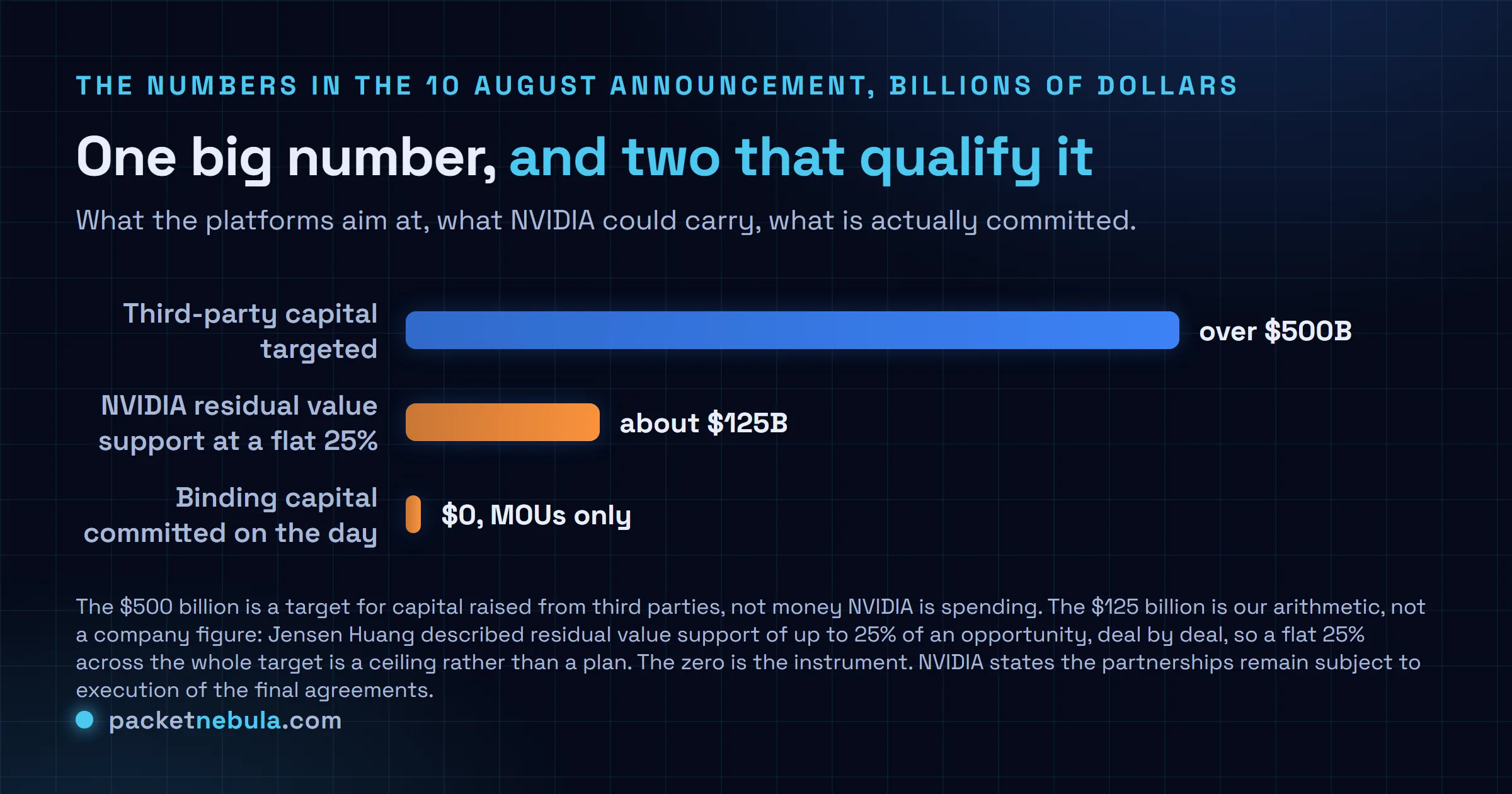
Bar chart of the three dollar figures in the NVIDIA compute financing announcement of 10 August 2026, showing over 500 billion dollars of third-party capital targeted, about 125 billion dollars of NVIDIA residual value support if applied at a flat 25 percent, and zero dollars of binding capital committed because the parties signed memorandums of understanding only.
The middle bar is our arithmetic, not NVIDIA's number. The bottom bar is the one that is verified.

This is the second $500 billion NVIDIA number in three weeks

They are not the same money, and the conflation is already happening.

On 24 July, SK Group and NVIDIA announced a partnership worth more than $500 billion on letters of intent, with a named 2GW AI factory attached. That number is a projected value of goods and services flowing between two companies. This one is a target for third-party capital that other people lend to NVIDIA’s customers. Same headline figure, completely different thing, and neither is a signed contract.

There is also a pattern forming across the industry that we flagged in June. The $35 billion private credit package behind Anthropic’s TPU vehicle came with Broadcom adding residual value guarantees, and the same lab has since gone further off balance sheet with a landlord platform owned by Macquarie and GIC. Chip vendors backstopping the resale value of their own silicon is quietly becoming the standard tool for getting these deals financed. NVIDIA just did it at a scale that makes it a market structure rather than a one-off.

Does it change what you pay

Not this quarter, and probably not this year.

No new fab capacity appears because a bond got issued. Nothing in the announcement adds a single accelerator to the supply that exists, and the lead times you are quoted today were set by packaging and memory, not by credit. If you are pricing a build for 2027, this changes nothing you can act on.

The second-order effect is real though, and it cuts both ways. Cheaper debt for neoclouds means more rentable capacity gets stood up, which over a couple of years should pull hourly rental prices down. It also means a meaningful slice of AI buildout demand now depends on credit markets staying friendly. When financing is the thing enabling the purchase, a spread widening does what a demand collapse would do, only faster.

I might be wrong about the timing, but the signal I would actually track is not the $500 billion. It is the first definitive agreement, and what useful life the underwriters put in it. That number, whenever somebody publishes it, is the entire trade.

Sources

  • NVIDIA newsroom, “NVIDIA Partners With Apollo, BlackRock, Blackstone, Brookfield, Goldman Sachs and KKR to Establish AI Compute Infrastructure Financing Platforms to Mobilize Over $500 Billion of Third-Party Capital”, 10 August 2026, the primary release, for the six partners, the over $500 billion third-party capital target, the dedicated pools of capital for frontier labs, enterprises and AI clouds, and the statement that the partnerships remain subject to execution of the final agreements.
  • Fortune, “Nvidia taps Wall Street for $500 billion funding commitment”, 11 August 2026, for Huang approaching only six firms with none turning him down, the special purpose entity structure with compute as collateral, Goldman as the only bank and lead bookrunner, the residual value support of up to 25% of an opportunity, and the Felix Wang comment from Hedgeye Risk Management.
  • Forbes, “Nvidia’s $500B Bet To Make AI Compute Wall Street’s Next Asset Class”, 10 August 2026, for the framing of residual value support as limited and supplementary, the undisclosed first loss allocation, Amazon’s move from six year to five year server useful life effective 1 January 2025 with roughly $1.4 billion of added depreciation, and NVIDIA’s counter-argument about 2020 A100s.
  • The National, “Nvidia turns to Wall Street giants to raise $500bn for AI infrastructure”, 11 August 2026, for independent confirmation of the six partners and the 25% figure, and for the quotes from Larry Fink and David Solomon.
  • CNBC, “Nvidia lines up $500 billion in financing as CEO Jensen Huang tells CNBC his chips are ‘investable asset’”, 10 August 2026, for Huang describing chips as an investable asset class and the assets as revenue-generating, productive, long-lived, fungible and flexible.

Frequently asked questions

What did NVIDIA announce on 10 August 2026?

Memorandums of understanding with Apollo, BlackRock, Blackstone, Brookfield, Goldman Sachs and KKR to establish AI compute infrastructure financing platforms. The stated goal is to mobilize over $500 billion of third-party capital and create dedicated pools of capital at attractive rates for NVIDIA customers, including frontier AI labs, enterprises and AI cloud providers. The release states plainly that the partnerships remain subject to execution of the final agreements.

Is NVIDIA spending $500 billion?

No. The $500 billion is a target for capital raised from third parties, not NVIDIA money. NVIDIA's own exposure is the residual value support Jensen Huang described, which he framed as up to 25% of an opportunity and supplementary to the underwriting the asset managers do themselves. At a flat 25% across the full target that arithmetic reaches roughly $125 billion, but that is a ceiling we calculated rather than a figure NVIDIA published.

What does using compute as collateral actually mean?

Debt is issued through special purpose entities, and the accelerators plus the revenue they earn secure that debt. If a borrower defaults, the lender takes machines that can be redeployed to a different customer rather than a warehouse of dead stock. That fungibility is the whole argument. Huang told CNBC that these are revenue-generating assets now, and that they are productive, long-lived, fungible and flexible.

Does this make GPUs cheaper?

Not directly, and that is the sharpest criticism of it. Felix Wang at Hedgeye Risk Management put it as making NVIDIA's product cheaper without really cutting GPU prices, while making future demand more sensitive to credit conditions. Cheaper financing lowers the total cost of getting compute deployed. The sticker price on the hardware does not move, and the new variable is what happens to that demand if credit tightens.

What should I watch next?

The first definitive agreement and the first actual issue, because everything today is an MOU. After that, the terms that decide whether this works: the assumed useful life of the accelerators, the tenor of the loans against the refresh cycle, and who takes the first loss if secondary value disappoints. None of those are in the announcement.

Tags: aibig-techgpuinfrastructurenewsnvidia
Share199Tweet125
stephane

stephane

  • Trending
  • Comments
  • Latest
Answer card: Proton Lumo 2.0 is private by policy, not by locality. Saved history is locked so even Proton cannot read it, but the prompt is decrypted on a Proton EU server to answer it, then forgotten.

Proton Lumo 2.0 review: how private is it, really?

3 September 2026
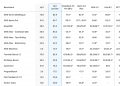
The Agentic Coding section of the official Hy4 preview benchmark appendix published by Tencent, a table comparing Hy3 and Hy4 preview against DeepSeek V4 Pro 0813, Qwen 3.8 Max, GLM 5.3, Kimi K3, GPT 5.6 Sol and Claude Opus 5 across SWE-bench Multilingual, SWE-bench Pro, DeepSWE, three SWE Atlas tasks, SWE-Marathon, Terminal-Bench 2.1, NL2Repo-Bench, CyberGym, ProgramBench, PostTrainBench and Harbor-Index.

Tencent’s 770B Hy4 tops one benchmark row in 46

3 September 2026
Answer card: Qwen 3.7 Max is API-only and cannot run locally yet; the open Qwen models (Qwen 3.6 27B, qwen3:8b to 32b) run offline via Ollama.

Qwen 3.7 local: what you can actually run offline

22 June 2026
Answer card: JWTs are not encrypted, anyone can read them; the signature proves who issued the token, not who may read it.

Are JWTs encrypted? No, and the difference will bite you

0
Answer card: a random 8 character password falls in under 2 hours offline, while 16 random characters hold for 1.4 trillion years at the same speed.

How long does it take to crack a password in 2026?

0
Answer card: three DNS records decide if your mail lands or bounces; SPF lists allowed senders, DKIM signs messages, DMARC sets the failure policy.

SPF, DKIM and DMARC explained: the records your email needs

0
Answer card stating that Qwen-Image-2.1, released on 20 September 2026, ships open weights with a 7 billion parameter diffusion transformer, a Qwen3-VL 8B text encoder and an RGBA VAE totalling about 33 gigabytes in BF16, under the Qwen Research License that limits use to research or evaluation and requires a separate commercial licence, unlike the Apache 2.0 licence of Qwen-Image 1.0.

Qwen-Image-2.1 brings the weights back, but not the Apache licence

21 September 2026
Answer card stating that Ternary Bonsai 2 27B, released by PrismML on 17 September 2026 under Apache 2.0, packs Qwen3.8 27B into 5.95 gigabytes at 1.72 bits per weight, keeps 98.2 percent of the 14-benchmark average, about 75 percent on SWE-bench Verified and Terminal-Bench 2.1, and needs PrismML's llama.cpp fork to run.

Does Bonsai 2 27B really keep 98% of Qwen3.8 in 5.95 GB?

20 September 2026
Answer card stating that Jev 1.13 from TypeSafe AI is a decision model in early access since 15 September 2026 that returns typed probabilities instead of text, priced at 42 dollars per billion input tokens with output tokens free, answering in 70 to 500 milliseconds, with a 64K token request budget, text input only, and a documented list of things it does badly, including counting and dates.

Jev 1.13 bills $42 a billion tokens, and it can’t count

19 September 2026
  • About
  • Contact
  • Privacy
  • Legal

Copyright © 2026 Stephane Cardon.

Welcome Back!

Login to your account below

Forgotten Password?

Retrieve your password

Please enter your username or email address to reset your password.

Log In
No Result
View All Result
  • Home
  • Articles
    • Security
    • Network
    • Dev
    • Sysadmin
    • SEO
    • Email & DNS
  • Tools
    • Network tools: free, fast, no signup
    • Security tools: free, fast, no signup
    • Developer tools: free, fast, no signup
    • Sysadmin tools: free, fast, no signup
    • SEO tools: free, fast, no signup
    • Email & DNS tools: free, fast, no signup
  • Download
  • About

Copyright © 2026 Stephane Cardon.