
• Latest
  • Trending
  • All
Answer card: Bloomberg reported on 8 August 2026 that Situational Awareness invested 400 million dollars into Source Foundry, 500 million in total, at a reported 5 billion dollar valuation, for a stealth startup building lithography tools aimed at the extreme ultraviolet market ASML dominates.

Source Foundry: $400M and a $5B bet against ASML

10 August 2026
Answer card stating that Ternary Bonsai 2 27B, released by PrismML on 17 September 2026 under Apache 2.0, packs Qwen3.8 27B into 5.95 gigabytes at 1.72 bits per weight, keeps 98.2 percent of the 14-benchmark average, about 75 percent on SWE-bench Verified and Terminal-Bench 2.1, and needs PrismML's llama.cpp fork to run.

Does Bonsai 2 27B really keep 98% of Qwen3.8 in 5.95 GB?

20 September 2026
Answer card stating that Jev 1.13 from TypeSafe AI is a decision model in early access since 15 September 2026 that returns typed probabilities instead of text, priced at 42 dollars per billion input tokens with output tokens free, answering in 70 to 500 milliseconds, with a 64K token request budget, text input only, and a documented list of things it does badly, including counting and dates.

Jev 1.13 bills $42 a billion tokens, and it can’t count

19 September 2026
Answer card stating that Qwen3.8-Omni-Flash launched on 17 September 2026 as an API only model on Alibaba Cloud Model Studio, taking text, images, audio and video in a 1M token context and returning text only, priced at 0.15 dollars per million input tokens for every modality and 0.47 dollars per million output tokens in the international regions, with no open weights published and the Qwen-Live Harness GitHub repository returning 404.

Qwen3.8-Omni-Flash bills audio at $0.15 and ships no weights

18 September 2026
Answer card stating that on 15 September 2026 AWS said it is unable to restore access to resources and data hosted exclusively in the Middle East Bahrain region me-south-1 and in the mec1-az2 zone of the UAE region, because the damage spanned multiple Availability Zones and exceeded what multi-AZ services are designed to withstand.

AWS can’t restore me-south-1, six months after the drone strikes

17 September 2026
Answer card stating that Google released Gemini 3.8 Live and Gemini 3.8 Live Extended Thinking on 15 September 2026 at 3 dollars per million audio input tokens and 12 dollars out, that the thinking model requires asynchronous tools, and that Artificial Analysis scores it 82.6 on its Speech to Speech Quality Index.

Gemini 3.8 Live Extended Thinking rejects any tool that blocks

16 September 2026
Answer card summarising the Atria Dawn Preview release: 744B GLM-5.2 base, MIT licence, 1.5 TB BF16 and 756 GB FP8 checkpoints, 256K context, top on five of sixteen benchmark rows and trailing on SWE-bench Pro.

Atria Dawn Preview is 744B under MIT, and the BF16 weighs 1.5 TB

15 September 2026
Answer card stating that OpenAI released the Agents API in public beta on 10 September 2026 with no separate fee, billed through model tokens, tool calls and hosted sandbox time, with a choice of OpenAI hosted, self hosted or partner sandboxes, US only data residency and no Zero Data Retention support.

OpenAI’s Agents API has no fee, no ZDR and a one hour sandbox clock

14 September 2026
Answer card: Sakana Fugu Max at $2 and $6 per million tokens, Fugu Ultra v2 unchanged at $5 and $30, and Sakana saying Ultra v2 scores without Fable 5 or GPT-6 Astra in its pool.

Fugu Max costs $2 and $6 while Fugu Ultra v2 runs without Fable 5

13 September 2026
Answer card stating that DeepSeek released DeepSeek-V4.1-Flash on 10 September 2026 as a 552 billion parameter mixture of experts model with a new causal encoder decoder architecture that activates 8 billion parameters on input and 16 billion on output, with native vision, a one million token context and MIT licensed weights, that the API model name is now deepseek-flash at 0.15 dollars per million input tokens and 0.60 dollars per million output tokens off peak, and that DeepSeek announced V4 Pro would be routed to V4.1-Flash from 14 September and reversed that on 11 September.

DeepSeek V4.1-Flash arrived, and the V4 Pro retirement lasted a day

12 September 2026
Answer card stating that Cognition released SWE-2 on 10 September 2026, a coding model post-trained from Kimi K3, scoring 50.0 percent on FrontierCode 1.1 Main against 50.9 percent for Claude Fable 5.1 and 27.3 percent on Terminal-Bench 4 against 55.8 percent, available only inside Devin.

SWE-2 trails Fable 5.1 by one point, and by 28 on Terminal-Bench 4

11 September 2026
Answer card for Meta Muse, free to 100 million tokens a week then $20 a month, launched 8 September 2026 for United States adults only, running in a dedicated per user virtual machine.

Does Meta Muse do enough to earn your inbox and a card on file?

9 September 2026
Answer card stating that the public download pages for the VMware Virtual Disk Development Kit on developer.broadcom.com began returning 404 errors on 25 August 2026 with no announcement or deprecation notice, that Broadcom support tells customers the kit is no longer available for use or download, and that release lines 7.0.3.1, 8.x and 9.x are all affected.

Broadcom pulled VDDK 8.0 and 9.0, and the 404 is the only notice

8 September 2026
  • About
  • Contact
  • Privacy
  • Legal
Monday, September 21, 2026
  • Login
Packet Nebula
  • Home
  • Articles
    • Security
    • Network
    • Dev
    • Sysadmin
    • SEO
    • Email & DNS
  • Tools
    • Network tools: free, fast, no signup
    • Security tools: free, fast, no signup
    • Developer tools: free, fast, no signup
    • Sysadmin tools: free, fast, no signup
    • SEO tools: free, fast, no signup
    • Email & DNS tools: free, fast, no signup
  • Download
  • About
No Result
View All Result
Packet Nebula
No Result
View All Result
Home Dev

Source Foundry: $400M and a $5B bet against ASML

by stephane
10 August 2026
in Dev
0
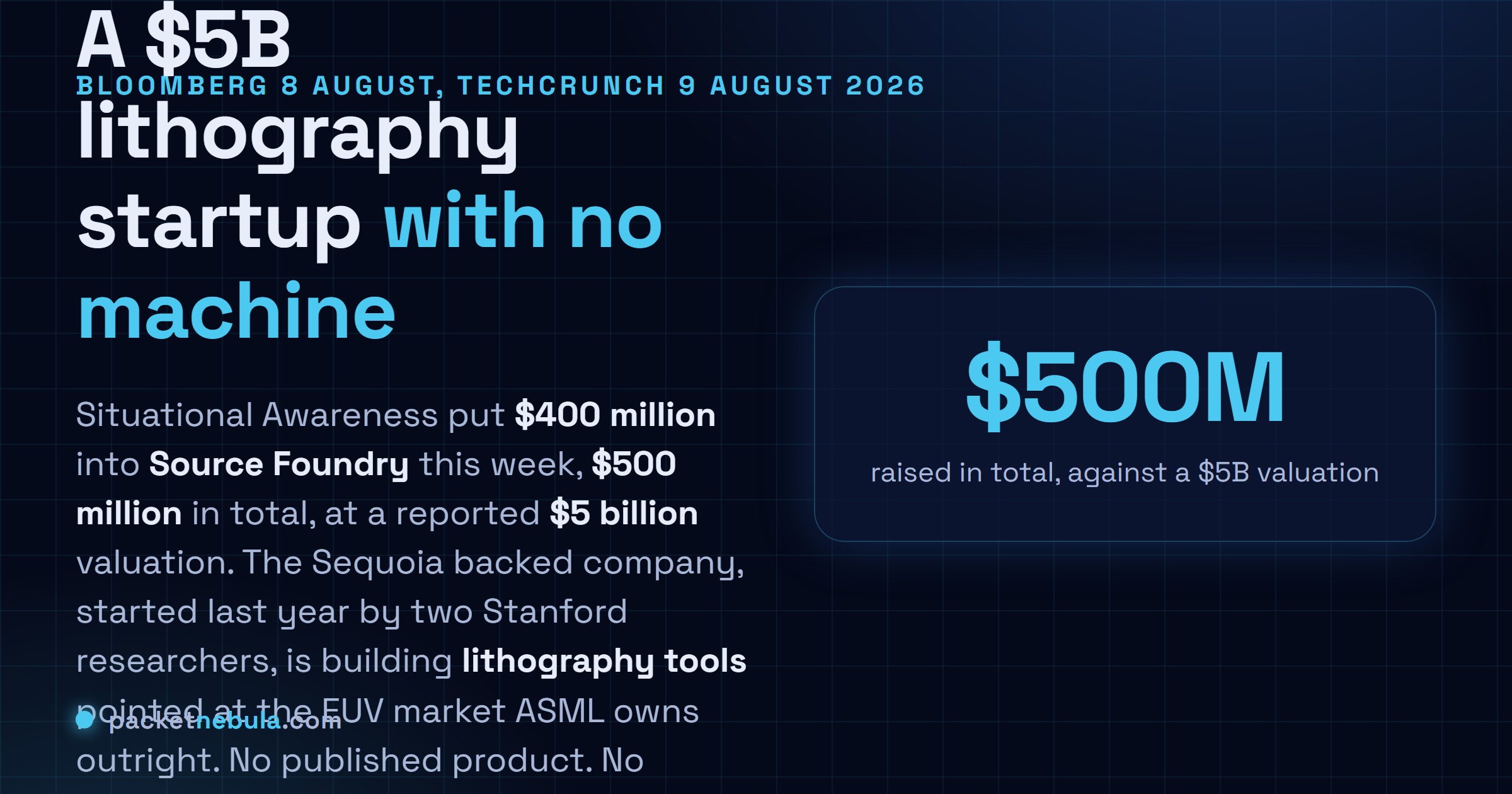
Answer card: Bloomberg reported on 8 August 2026 that Situational Awareness invested 400 million dollars into Source Foundry, 500 million in total, at a reported 5 billion dollar valuation, for a stealth startup building lithography tools aimed at the extreme ultraviolet market ASML dominates.
493
SHARES
1.4k
VIEWS
Share on FacebookShare on Twitter

A hedge fund that lost roughly two thirds of its value in July just wrote a $400 million cheque for a company nobody has seen a product from. Bloomberg named the recipient on 8 August: Source Foundry, a stealth startup founded last year by two Stanford researchers, now valued at $5 billion, building tools for lithography. The pitch is the biggest one in hardware, which is that ASML should not be the only company on Earth capable of printing a leading edge chip. We think the bet is defensible and most of the coverage is not. Because $500 million, the total Situational Awareness has now put in, is roughly what a single High-NA EUV scanner costs to install. So this is a research programme with a valuation stapled to it. Worth watching anyway, and not for the reason the headlines suggest.

The short answer

Situational Awareness put $400 million into Source Foundry, taking its total to $500 million at a reported $5 billion valuation. The company was founded last year by Stanford researchers Abdulmalik Obaid and Joe Burg, it is backed by Sequoia, and it is building lithography tools aimed at the EUV market ASML owns. No product, wavelength or timeline has been published. The money is roughly the price of one machine from the incumbent, so read it as a research budget rather than a competitive threat.
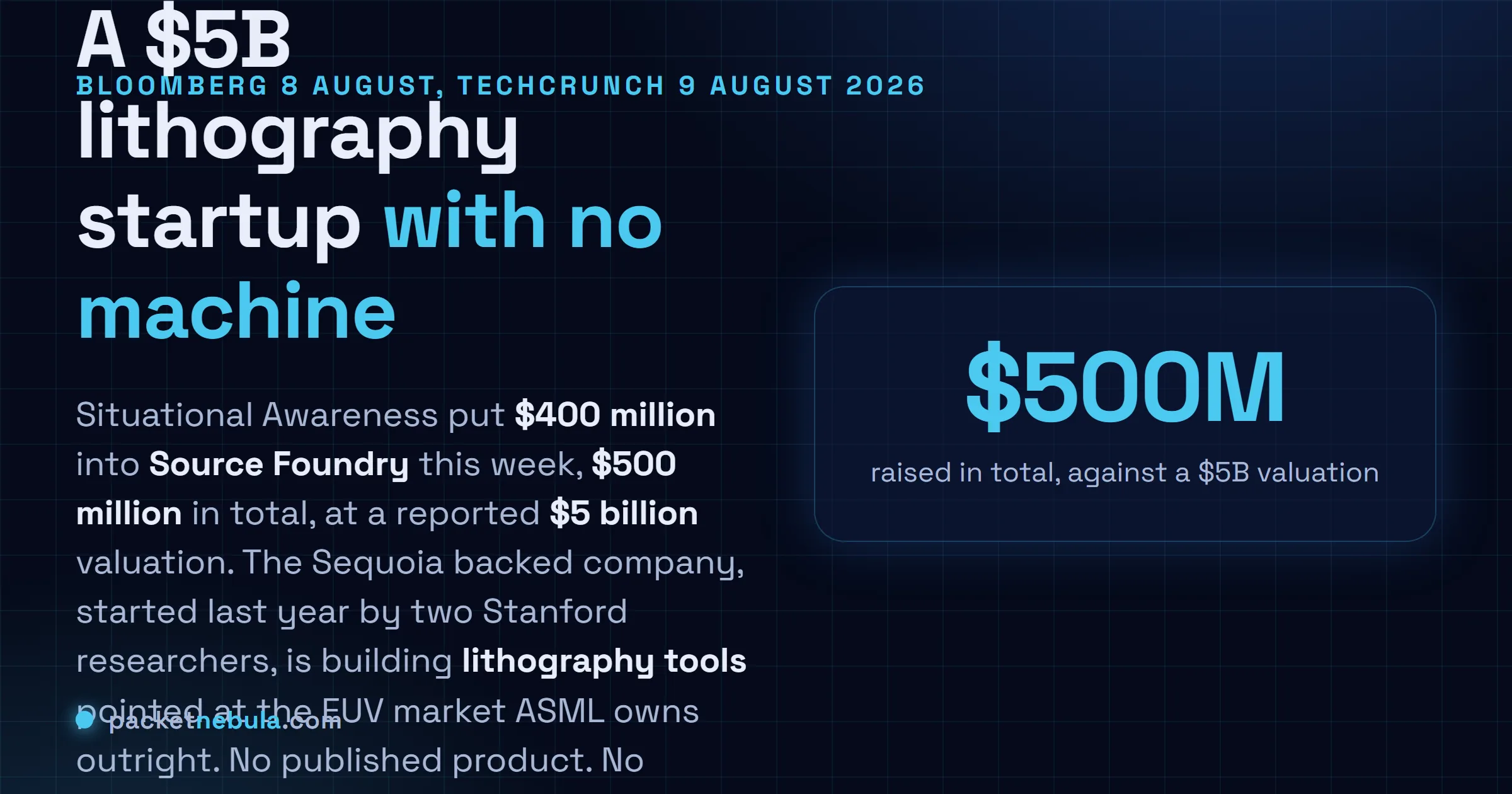
$500Mraised in total, $400M of it this week
$5Breported valuation, company still in stealth
~$400Minstalled price of one ASML High-NA scanner
Answer card: Bloomberg reported on 8 August 2026 that Situational Awareness invested 400 million dollars into Source Foundry, 500 million in total, at a reported 5 billion dollar valuation, for a stealth startup founded last year by two Stanford researchers that is building lithography tools aimed at the extreme ultraviolet market ASML dominates, with no product and no timeline published.
Two real numbers and a valuation. Everything technical is still sealed.

What actually got reported

Bloomberg broke the identification on 8 August. Situational Awareness had made a large private investment that it had not named, and the recipient turned out to be Source Foundry. TechCrunch followed on 9 August with Wall Street Journal sourcing putting the new money at $400 million, and the fund’s cumulative position at $500 million.

Source Foundry started last year. The founders are Abdulmalik Obaid and Joe Burg, both out of Stanford, and Sequoia was already on the cap table. The latest round values the company at $5 billion. Sequoia’s Stephanie Zhan frames the work as attacking a bottleneck in semiconductor manufacturing by developing tools for lithography, and every write-up then points that at extreme ultraviolet, because that is the bottleneck everybody means.

That’s the whole confirmed story. No wavelength. No light source approach. Nothing about whether they are chasing a full scanner or one subsystem inside somebody else’s.
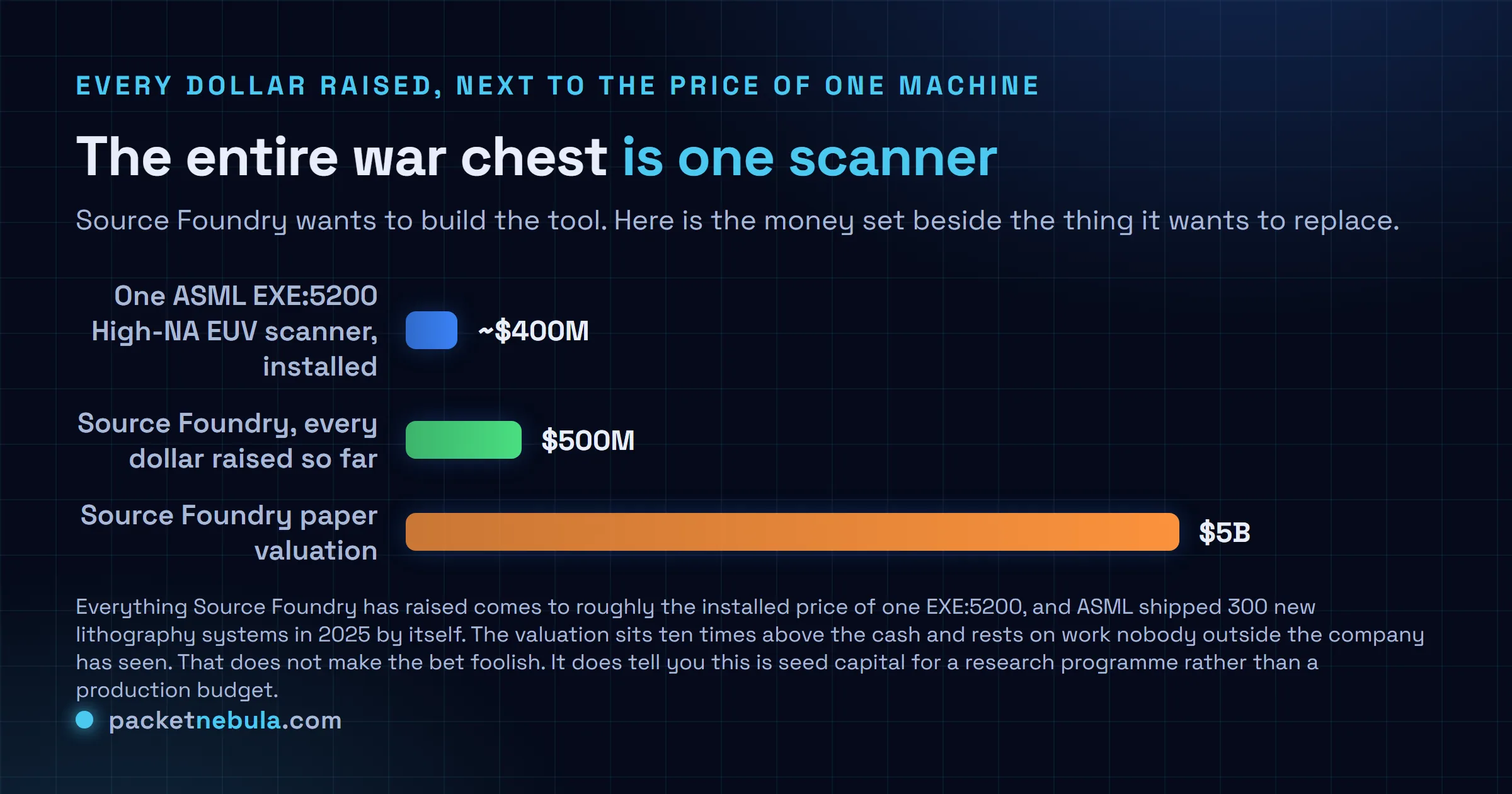
Logarithmic bar chart comparing the roughly 400 million dollar installed cost of one ASML EXE:5200 High-NA extreme ultraviolet scanner, the 500 million dollars Source Foundry has raised in total, and the startup's reported 5 billion dollar valuation.
The company has raised about the price of one machine from the company it wants to displace.

Five hundred million dollars is one machine

Here’s the comparison that reframes the story. A single ASML EXE:5200 High-NA scanner runs somewhere around $400 million installed, and fewer than a dozen exist anywhere. Source Foundry’s entire funding to date, across every investor, is $500 million.

So the war chest buys one of the things it intends to replace, with change left for a lease.

Run it against the incumbent’s operating rhythm and it gets starker. ASML reported €32.7 billion in net sales for 2025 and €9.6 billion of net income. It shipped 300 new lithography systems that year plus 27 used ones. Its own guidance puts R&D at roughly €1.2 billion for the first quarter of 2026, so Source Foundry’s total raise is about five weeks of ASML research spending. That is not a knock on the founders. It’s just what the gap looks like when you write it down.

The hard part was never the money

EUV is not one clever machine. It’s a stack of separately absurd engineering problems, and ASML’s advantage is that it either owns or has spent decades welding together the suppliers who solved them.

The light comes from firing a high power laser at droplets of molten tin tens of thousands of times a second, turning them into plasma that radiates at 13.5 nanometres. Nothing focuses that wavelength by refraction, because everything absorbs it, so the optics are multilayer mirrors polished to a flatness that has become the standard cliché of the industry. Then the whole thing has to hold that precision, in vacuum, on a stage moving wafers at production speed, for years.

Any one of those is a company. Buying your way through all of them at once, on $500 million, is not a plan anyone credible would pitch. Which is why I suspect the actual bet is narrower than the ASML challenger framing implies. Maybe a metrology tool, maybe a source, maybe something upstream that makes existing scanners cheaper to run. A component win would be a good outcome, and it would still not read as a headline.

Worth remembering that the last serious attempt to build an alternative EUV path folded into ASML rather than beating it.
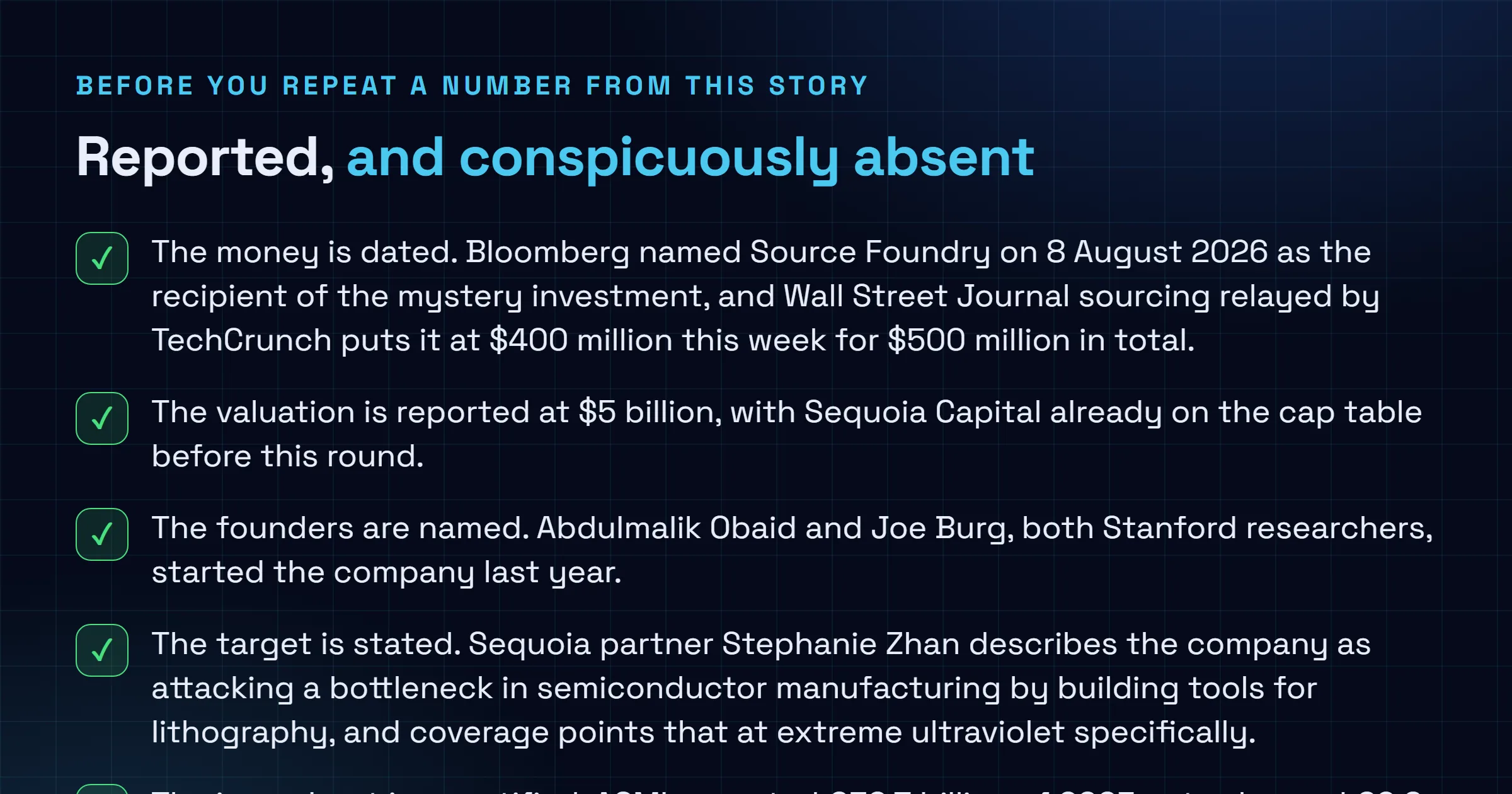
Checklist of what is on the record about the Source Foundry investment reported on 8 and 9 August 2026, including the amounts, valuation, named founders, stated lithography target and ASML's published 2025 results, set against what is absent including any product description, wavelength, prototype timeline, named customer or independent technical validation.
Five things with reporting behind them. Five things nobody has published.

Who is writing the cheque, and why that matters

Situational Awareness is not a normal semiconductor investor. Leopold Aschenbrenner started it in 2024 after leaving OpenAI, ran a concentrated long book on AI infrastructure, and had a very bad July. Reporting describes a drawdown near 67% and a forced sale of most of the public portfolio to Citadel. Mike Novogratz called it the most catastrophic hedge fund blowup of his career.

The numbers wobble depending on where you read. TechCrunch puts the fund at $20 billion before and about $10 billion after. CNBC’s coverage of the fire sale worked from a $45 billion peak. Either way the fund kept its private holdings, including a large Anthropic stake, and it is evidently still deploying into private AI infrastructure at scale.

So the $400 million is conviction from someone with an unusually specific thesis about compute scarcity. It is not diligence you can borrow. A fund that just took that kind of loss on AI hardware writing a nine figure private cheque is, if anything, a reason to look harder at the technical claims rather than less.

Does this change anything for you

No. Not this year, probably not this decade.

Wafer capacity does not move because a stealth company raised money, and scanner lead times are set by ASML’s build rate rather than by anybody’s cap table. If you buy accelerators, your prices are still governed by packaging capacity and memory, which is the same squeeze that has been pushing consumer hardware prices up all year.

The interesting read is directional. Every serious AI operator has spent this year trying to own more of its own supply, whether that means standing up a fab of your own or quietly staffing a custom silicon team. Funding the machines that make the chips is the logical end of that anxiety. It’s also the hardest version of it.

What we’d watch for is boring and specific: a named evaluation partner. Lithography tools become real when a fab or a research institute agrees to put one on the floor and says so publicly. Until that happens, Source Foundry is a $5 billion valuation attached to a research programme, and the most honest thing anybody can say about the technology is that we don’t know what it is.

Sources

  • TechCrunch, “Embattled hedge fund Situational Awareness invests $400M in chip startup Source Foundry”, 9 August 2026, for the $400 million this week, the $500 million cumulative figure from the Wall Street Journal, the Stanford founders, the Citadel sale and the retained Anthropic stake.
  • Bloomberg, “Situational Awareness’s Mystery Investment Was to Source Foundry”, 8 August 2026, for the original identification of the recipient.
  • Yahoo Finance, 9 August 2026, for the $5 billion valuation, the founder names Abdulmalik Obaid and Joe Burg, the Sequoia backing, the Stephanie Zhan description of the lithography target and the Novogratz quote.
  • ASML, “ASML reports €32.7 billion total net sales and €9.6 billion net income in 2025”, 28 January 2026, for the 2025 results, the 300 new and 27 used lithography systems shipped, and the Q1 2026 R&D guidance of around €1.2 billion.
  • Tom’s Hardware and TrendForce, 19 March 2026, for the High-NA EXE:5200 price of roughly $380 million to $400 million installed and the small number of units deployed worldwide.
  • CNBC, 31 July 2026, for the July drawdown, the peak assets figure and the sale of the public portfolio to Citadel.

Frequently asked questions

What is Source Foundry actually building?

Tools for lithography, which is the step where circuit patterns get printed onto a silicon wafer. Sequoia partner Stephanie Zhan describes the company as going after a bottleneck in semiconductor manufacturing, and coverage points that at extreme ultraviolet, the wavelength ASML alone can sell into production today. Beyond that the company is in stealth. There is no published wavelength, no light source approach, no resolution target and no prototype. Anyone telling you how Source Foundry's machine works is guessing.

How much did Situational Awareness invest and when?

Wall Street Journal sourcing relayed by TechCrunch on 9 August 2026 puts it at $400 million this week, taking the fund's total in Source Foundry to $500 million. Bloomberg had identified the recipient of the fund's previously unnamed investment a day earlier, on 8 August. The round values Source Foundry at a reported $5 billion, and Sequoia Capital was already an investor before this money arrived.

Can a startup really compete with ASML?

Not soon, and the numbers say why. ASML booked €32.7 billion of net sales in 2025 with €9.6 billion of net income, shipped 300 new lithography systems that year, and guides around €1.2 billion of R&D for the first quarter of 2026 by itself. So Source Foundry's entire $500 million is about five weeks of the incumbent's research spending. EUV is also not one machine, it is a supply chain covering the tin plasma light source, the mirror optics and the high power lasers that drive it. Honestly, the more realistic outcome is a component or a niche tool rather than a full scanner.

Why is a hedge fund leading a chip equipment round?

Because that fund is unusual. Situational Awareness was started in 2024 by Leopold Aschenbrenner, a former OpenAI researcher who is now 24, and it ran a concentrated long book on AI infrastructure. July 2026 went badly, with reporting describing a roughly 67% drawdown and a forced sale of the public portfolio to Ken Griffin's Citadel. The fund kept its private positions, notably its Anthropic stake, and is clearly still deploying into private AI infrastructure. Take the size of the cheque as conviction, not as validation of the technology.

Does this change chip supply or GPU prices?

No, and not for years. Nothing about a stealth company raising money alters wafer capacity, scanner lead times or what an accelerator costs you this quarter. The only near term effect is on ASML's narrative, since a credible funded challenger changes how people talk about a monopoly long before it changes what anybody can buy. If you want a real signal, watch for a named evaluation partner at a fab or a research institute.

Tags: asmlchipsfundinghardwarelithographynews
Share197Tweet123
stephane

stephane

  • Trending
  • Comments
  • Latest
Answer card: Proton Lumo 2.0 is private by policy, not by locality. Saved history is locked so even Proton cannot read it, but the prompt is decrypted on a Proton EU server to answer it, then forgotten.

Proton Lumo 2.0 review: how private is it, really?

3 September 2026
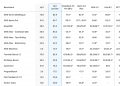
The Agentic Coding section of the official Hy4 preview benchmark appendix published by Tencent, a table comparing Hy3 and Hy4 preview against DeepSeek V4 Pro 0813, Qwen 3.8 Max, GLM 5.3, Kimi K3, GPT 5.6 Sol and Claude Opus 5 across SWE-bench Multilingual, SWE-bench Pro, DeepSWE, three SWE Atlas tasks, SWE-Marathon, Terminal-Bench 2.1, NL2Repo-Bench, CyberGym, ProgramBench, PostTrainBench and Harbor-Index.

Tencent’s 770B Hy4 tops one benchmark row in 46

3 September 2026
Answer card: Qwen 3.7 Max is API-only and cannot run locally yet; the open Qwen models (Qwen 3.6 27B, qwen3:8b to 32b) run offline via Ollama.

Qwen 3.7 local: what you can actually run offline

22 June 2026
Answer card: JWTs are not encrypted, anyone can read them; the signature proves who issued the token, not who may read it.

Are JWTs encrypted? No, and the difference will bite you

0
Answer card: a random 8 character password falls in under 2 hours offline, while 16 random characters hold for 1.4 trillion years at the same speed.

How long does it take to crack a password in 2026?

0
Answer card: three DNS records decide if your mail lands or bounces; SPF lists allowed senders, DKIM signs messages, DMARC sets the failure policy.

SPF, DKIM and DMARC explained: the records your email needs

0
Answer card stating that Ternary Bonsai 2 27B, released by PrismML on 17 September 2026 under Apache 2.0, packs Qwen3.8 27B into 5.95 gigabytes at 1.72 bits per weight, keeps 98.2 percent of the 14-benchmark average, about 75 percent on SWE-bench Verified and Terminal-Bench 2.1, and needs PrismML's llama.cpp fork to run.

Does Bonsai 2 27B really keep 98% of Qwen3.8 in 5.95 GB?

20 September 2026
Answer card stating that Jev 1.13 from TypeSafe AI is a decision model in early access since 15 September 2026 that returns typed probabilities instead of text, priced at 42 dollars per billion input tokens with output tokens free, answering in 70 to 500 milliseconds, with a 64K token request budget, text input only, and a documented list of things it does badly, including counting and dates.

Jev 1.13 bills $42 a billion tokens, and it can’t count

19 September 2026
Answer card stating that Qwen3.8-Omni-Flash launched on 17 September 2026 as an API only model on Alibaba Cloud Model Studio, taking text, images, audio and video in a 1M token context and returning text only, priced at 0.15 dollars per million input tokens for every modality and 0.47 dollars per million output tokens in the international regions, with no open weights published and the Qwen-Live Harness GitHub repository returning 404.

Qwen3.8-Omni-Flash bills audio at $0.15 and ships no weights

18 September 2026
  • About
  • Contact
  • Privacy
  • Legal

Copyright © 2026 Stephane Cardon.

Welcome Back!

Login to your account below

Forgotten Password?

Retrieve your password

Please enter your username or email address to reset your password.

Log In
No Result
View All Result
  • Home
  • Articles
    • Security
    • Network
    • Dev
    • Sysadmin
    • SEO
    • Email & DNS
  • Tools
    • Network tools: free, fast, no signup
    • Security tools: free, fast, no signup
    • Developer tools: free, fast, no signup
    • Sysadmin tools: free, fast, no signup
    • SEO tools: free, fast, no signup
    • Email & DNS tools: free, fast, no signup
  • Download
  • About

Copyright © 2026 Stephane Cardon.