
• Latest
  • Trending
  • All
Answer card explaining that a Los Angeles County Superior Court judge granted Santa Monica a preliminary injunction on 27 July 2026 barring Waymo from operating its charging facilities at 1222 and 1310 Broadway between 11pm and 6am, on a public nuisance claim, with a status conference set for 23 October 2026.

A judge shut Waymo’s Santa Monica depot from 11pm to 6am

3 September 2026
Answer card stating that on 15 September 2026 AWS said it is unable to restore access to resources and data hosted exclusively in the Middle East Bahrain region me-south-1 and in the mec1-az2 zone of the UAE region, because the damage spanned multiple Availability Zones and exceeded what multi-AZ services are designed to withstand.

AWS can’t restore me-south-1, six months after the drone strikes

17 September 2026
Answer card stating that Google released Gemini 3.8 Live and Gemini 3.8 Live Extended Thinking on 15 September 2026 at 3 dollars per million audio input tokens and 12 dollars out, that the thinking model requires asynchronous tools, and that Artificial Analysis scores it 82.6 on its Speech to Speech Quality Index.

Gemini 3.8 Live Extended Thinking rejects any tool that blocks

16 September 2026
Answer card summarising the Atria Dawn Preview release: 744B GLM-5.2 base, MIT licence, 1.5 TB BF16 and 756 GB FP8 checkpoints, 256K context, top on five of sixteen benchmark rows and trailing on SWE-bench Pro.

Atria Dawn Preview is 744B under MIT, and the BF16 weighs 1.5 TB

15 September 2026
Answer card stating that OpenAI released the Agents API in public beta on 10 September 2026 with no separate fee, billed through model tokens, tool calls and hosted sandbox time, with a choice of OpenAI hosted, self hosted or partner sandboxes, US only data residency and no Zero Data Retention support.

OpenAI’s Agents API has no fee, no ZDR and a one hour sandbox clock

14 September 2026
Answer card: Sakana Fugu Max at $2 and $6 per million tokens, Fugu Ultra v2 unchanged at $5 and $30, and Sakana saying Ultra v2 scores without Fable 5 or GPT-6 Astra in its pool.

Fugu Max costs $2 and $6 while Fugu Ultra v2 runs without Fable 5

13 September 2026
Answer card stating that DeepSeek released DeepSeek-V4.1-Flash on 10 September 2026 as a 552 billion parameter mixture of experts model with a new causal encoder decoder architecture that activates 8 billion parameters on input and 16 billion on output, with native vision, a one million token context and MIT licensed weights, that the API model name is now deepseek-flash at 0.15 dollars per million input tokens and 0.60 dollars per million output tokens off peak, and that DeepSeek announced V4 Pro would be routed to V4.1-Flash from 14 September and reversed that on 11 September.

DeepSeek V4.1-Flash arrived, and the V4 Pro retirement lasted a day

12 September 2026
Answer card stating that Cognition released SWE-2 on 10 September 2026, a coding model post-trained from Kimi K3, scoring 50.0 percent on FrontierCode 1.1 Main against 50.9 percent for Claude Fable 5.1 and 27.3 percent on Terminal-Bench 4 against 55.8 percent, available only inside Devin.

SWE-2 trails Fable 5.1 by one point, and by 28 on Terminal-Bench 4

11 September 2026
Answer card for Meta Muse, free to 100 million tokens a week then $20 a month, launched 8 September 2026 for United States adults only, running in a dedicated per user virtual machine.

Does Meta Muse do enough to earn your inbox and a card on file?

9 September 2026
Answer card stating that the public download pages for the VMware Virtual Disk Development Kit on developer.broadcom.com began returning 404 errors on 25 August 2026 with no announcement or deprecation notice, that Broadcom support tells customers the kit is no longer available for use or download, and that release lines 7.0.3.1, 8.x and 9.x are all affected.

Broadcom pulled VDDK 8.0 and 9.0, and the 404 is the only notice

8 September 2026
Answer card stating that OpenAI published its research acceleration measurements on 6 September 2026, that as of mid August 2026 its research organisation logged 3.1 agent workdays of coding agent runtime for every workday of human labour normalised to a standard eight hour day, and that OpenAI states this should not be read as a 3.1 times productivity gain because it measures runtime rather than delivered output.

OpenAI’s 3.1 agent-workdays per human day is not a 3.1x gain

7 September 2026
Answer card stating that Mullvad announced on 3 September 2026 that it is shutting down its public encrypted domain name system servers on 2 November 2026 and sponsoring the Quad9 Foundation instead, with 194.242.2.2 and its five sibling addresses all going away, and virtual private network customers unaffected.

Mullvad’s DNS servers go dark on 2 November, and Quad9 blocks no ads

5 September 2026
OpenAI announcement image for GPT-6 Astra, a spiral galaxy of white, blue and amber points of light curling around a bright core on a near black star field.

GPT-6 Astra lists at $10 and $50, 2.5x what GPT-5.6 Sol costs

6 September 2026
  • About
  • Contact
  • Privacy
  • Legal
Thursday, September 17, 2026
  • Login
Packet Nebula
  • Home
  • Articles
    • Security
    • Network
    • Dev
    • Sysadmin
    • SEO
    • Email & DNS
  • Tools
    • Network tools: free, fast, no signup
    • Security tools: free, fast, no signup
    • Developer tools: free, fast, no signup
    • Sysadmin tools: free, fast, no signup
    • SEO tools: free, fast, no signup
    • Email & DNS tools: free, fast, no signup
  • Download
  • About
No Result
View All Result
Packet Nebula
No Result
View All Result
Home Dev

A judge shut Waymo’s Santa Monica depot from 11pm to 6am

by stephane
3 September 2026
in Dev
0
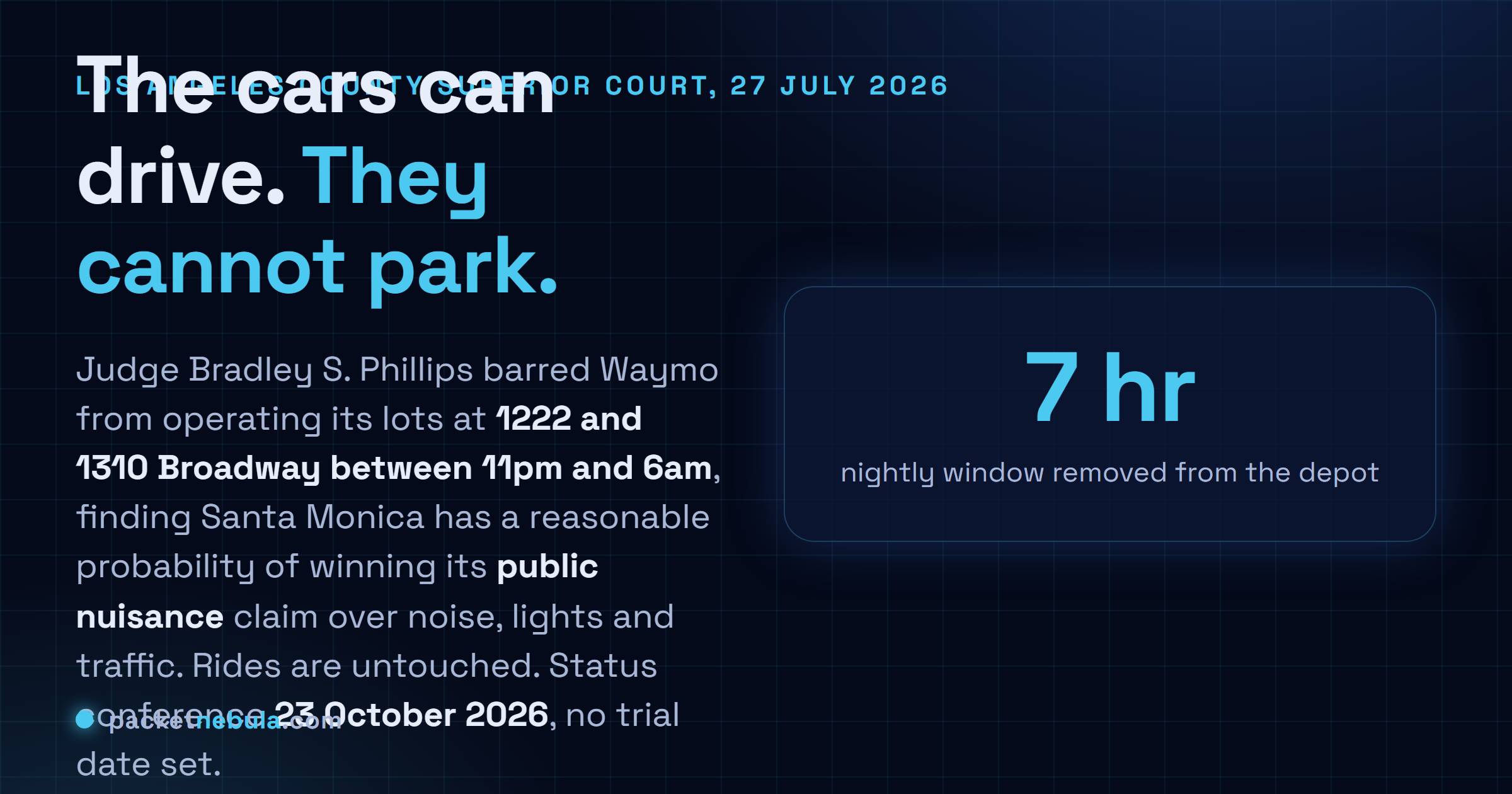
Answer card explaining that a Los Angeles County Superior Court judge granted Santa Monica a preliminary injunction on 27 July 2026 barring Waymo from operating its charging facilities at 1222 and 1310 Broadway between 11pm and 6am, on a public nuisance claim, with a status conference set for 23 October 2026.
492
SHARES
1.4k
VIEWS
Share on FacebookShare on Twitter

Eleven at night on Broadway in Santa Monica, and the cars come home. Not to a garage, to two open lots, where they beep and reverse into the chargers and the sound bounces off the alley walls. On 27 July a Los Angeles County Superior Court judge told Waymo to stop doing that between 11pm and 6am, a preliminary injunction that holds until trial. Rides are untouched. You can still hail a Waymo in Santa Monica at 2am. What the company lost is the right to charge and service its fleet at the two Broadway lots overnight, which sounds like a small thing until you remember that overnight is precisely when a robotaxi fleet is supposed to be plugged in.

The short answer

A Los Angeles County Superior Court judge granted Santa Monica a preliminary injunction on 27 July 2026, barring Waymo from operating its charging and servicing lots at 1222 and 1310 Broadway between 11pm and 6am until trial. The claim is public nuisance, brought over noise, lights and traffic. Rides carry on. What the fleet loses is the cheap, idle hours it was built around, and the lever that did it is older than the car.
11pmlots must go dark
7 hrwindow removed, nightly
23 Octnext hearing
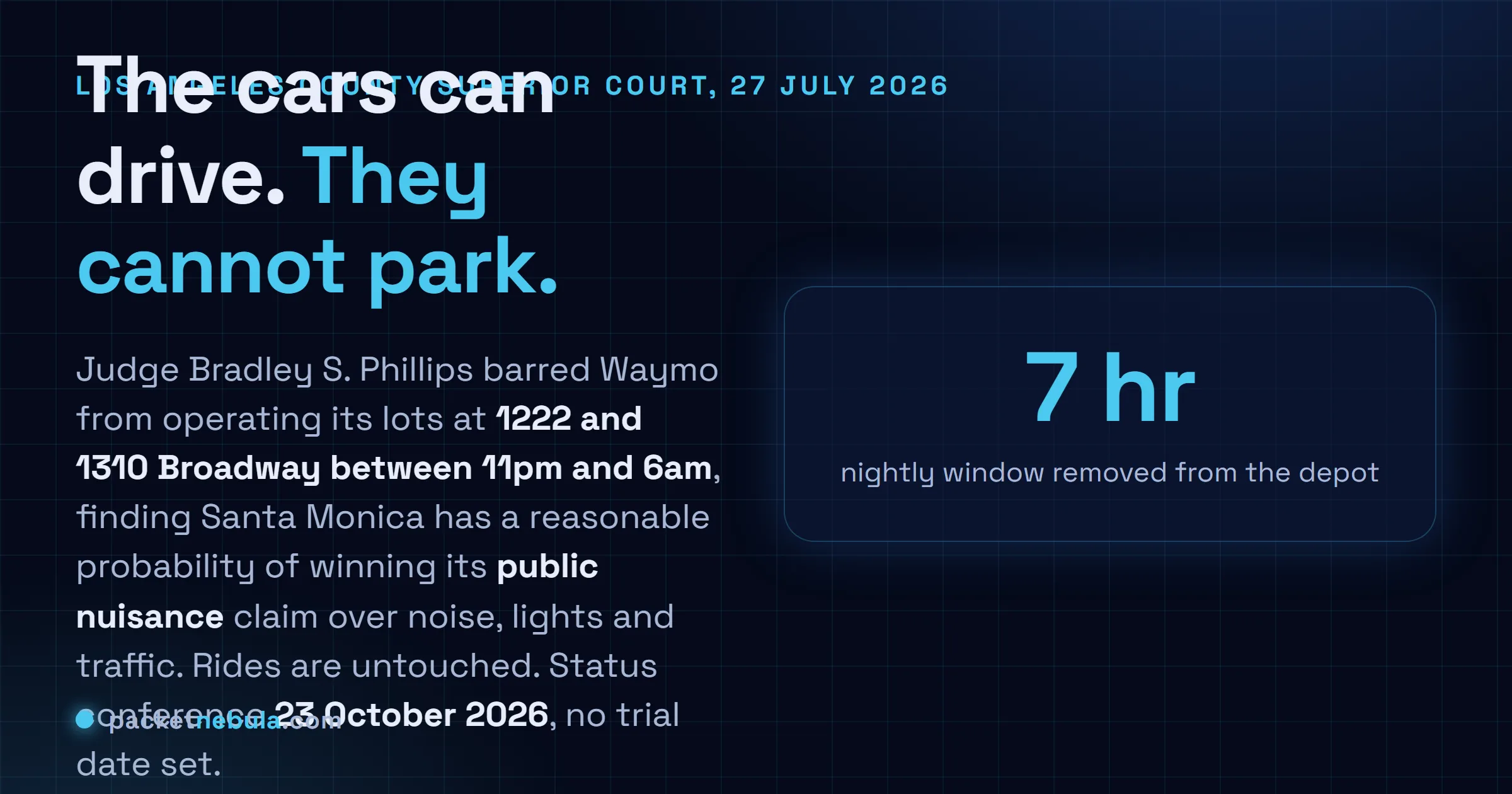
Answer card stating that on 27 July 2026 a Los Angeles County Superior Court judge granted the City of Santa Monica a preliminary injunction barring Waymo from operating its charging facilities at 1222 and 1310 Broadway between 11pm and 6am, on a public nuisance claim over noise, lighting and traffic, pending trial.
The order in one card. Note what it does not touch: the rides.

What the order does, and what it leaves alone

Judge Bradley S. Phillips granted the injunction on 27 July. Two addresses, 1222 and 1310 Broadway. No operations between 11pm and 6am, in force until the public nuisance case reaches trial. The City announced it the following day.

A preliminary injunction isn’t a verdict. Santa Monica had to show a reasonable probability of winning at trial and a balance of harms tipping its way, and the court found both. Waymo’s defence was that its mitigations had already fixed the problem: extra staff, software updates to lower noise levels and frequencies, light and noise barriers, modified vehicle behaviours. The judge’s response is the sentence to keep. The company had not shown those efforts were “sufficiently successful to eliminate the public nuisance that is created.”

Rides are untouched. A car charged and wiped down at noon can work all night, and Waymo hasn’t announced any change to Santa Monica availability. The company said it was disappointed, and that the order “may restrict our ability to provide visitors and residents with a safer, more accessible transportation option during some of the most dangerous hours of the day for road users.” Mayor Caroline Torosis gave the other side just as flatly: “Our residents’ ability to sleep peacefully in their own homes is not negotiable.”

Neither statement is wrong. That’s what makes this worth reading if you never go near Santa Monica.

Nobody models the depot

Here’s the thing about a driverless fleet. The car doesn’t sleep, but it does eat.

An electric vehicle in commercial service needs charging, cleaning, sensor calibration and the whole dull logistics tail that used to happen at somebody’s house. Human rideshare externalises all of it for free. Your driver charges at home, vacuums the back seat in their own driveway, and the platform never books a square foot of real estate for any of it. Delete the driver and every one of those minutes moves onto land the operator has to lease, inside the city it serves, close enough that deadhead miles don’t eat the margin.

So you take the cheapest urban land that fits. Which is a surface lot. Which, in a dense coastal city, is next to housing.

Then you schedule the work at night, because that’s when the cars aren’t earning and the power is cheapest.

That’s not a mistake in the plan. That is the plan. And the injunction removes exactly those hours.
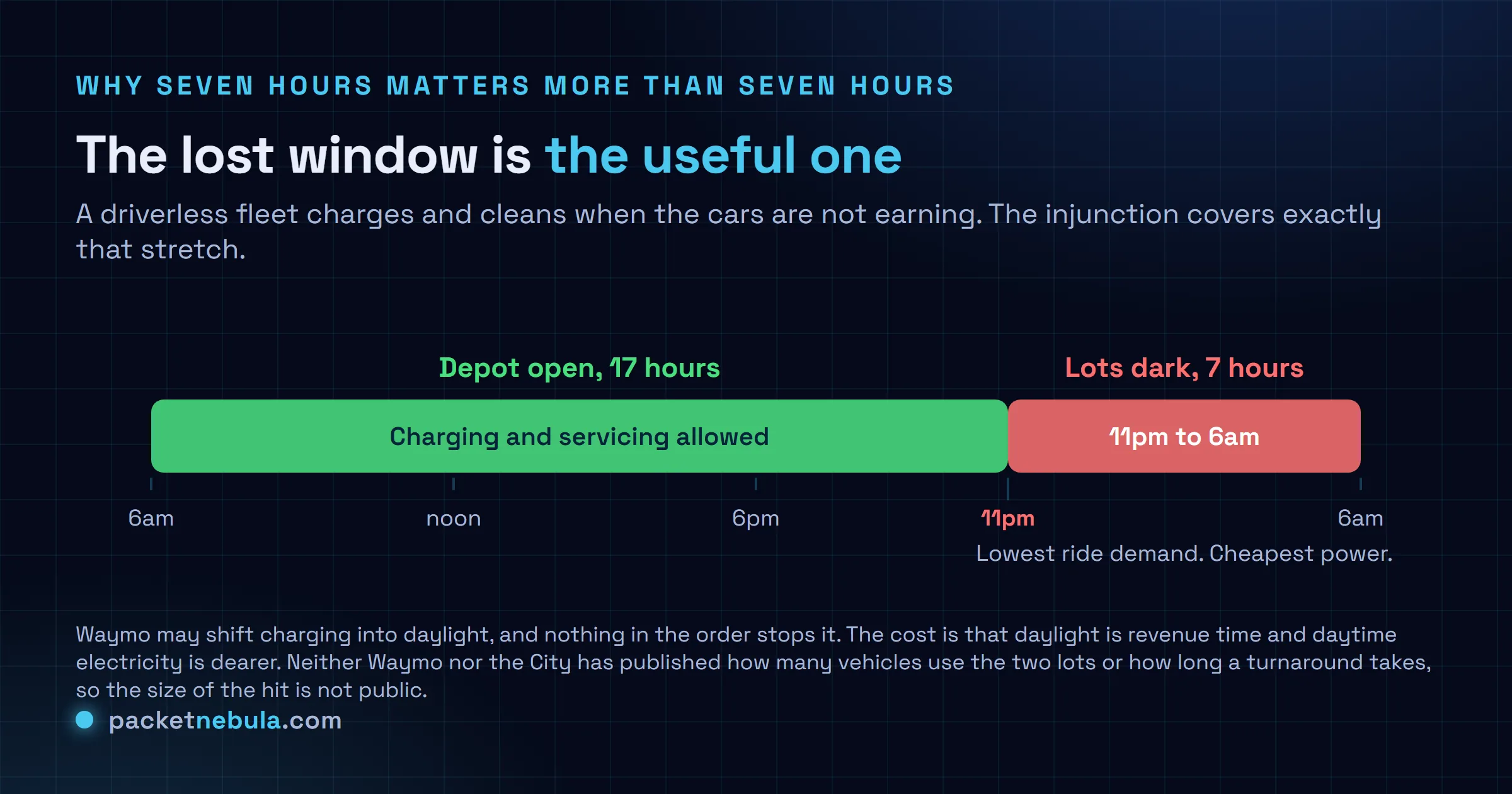
Diagram of a 24-hour day showing the Waymo Santa Monica depot open for charging and servicing from 6am to 11pm and closed under the injunction from 11pm to 6am, with the closed window marked as the seven hours of lowest ride demand and cheapest electricity.
The seven hours the court removed are the seven the fleet actually wanted.

Waymo can move charging into daylight. Nothing stops it. But daylight is when a robotaxi should have a passenger in it, so every kilowatt-hour shifted forward is a car parked during revenue hours, drawing power at a worse rate, in a business where the effective fleet size is however many vehicles you can turn around per day. That isn’t a rounding error in the unit economics. It’s most of them.

I might be wrong about the size of the hit, and honestly nobody outside Waymo can size it, because the company has never published how many vehicles use those two lots or how long a turnaround takes. But the direction isn’t ambiguous.

The lever wasn’t an AV rule

Look at which law did this.

Not the DMV, and not the CPUC, the body that licenses paid autonomous rides in California. NHTSA handles the vehicle itself, and last week it handed Zoox a federal exemption to sell rides in a car with no steering wheel. Every one of those regulators has said yes to driverless operation in some form.

What closed the lots at midnight is public nuisance, a doctrine that predates the internal combustion engine, brought by a city on behalf of people who can’t sleep. One neighbour told a local broadcaster the motors echo down the alleys “like a canyon”. Another described a five year old woken two to four nights a week. There is no decibel figure in any of the coverage we could find, and no vehicle count either, which is a real gap in the public record. The court didn’t need one.

The industry spent a decade fighting the patchwork of state and local autonomous vehicle rules, and mostly won at the vehicle level. This case walks around that fight. Santa Monica is not regulating an autonomous vehicle. It’s regulating what happens on a parking lot at 2am, which it has always been entitled to do, and which no preemption argument reaches.

The shape is the same one we saw when the FCC used equipment authorisation to block foreign-produced robots: the decisive instrument is rarely the one the sector is watching.
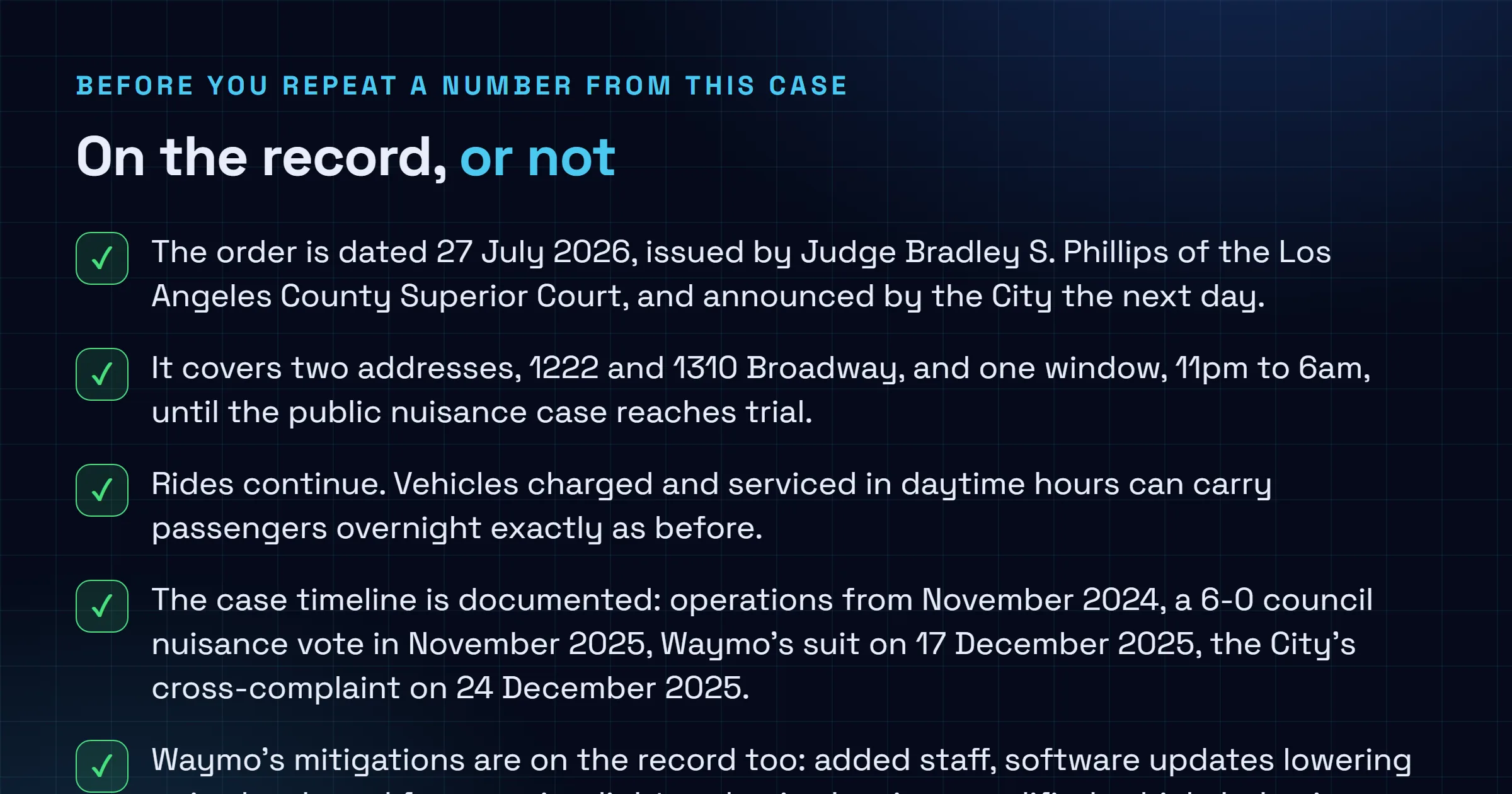
Checklist separating what is on the record in the Waymo Santa Monica injunction, including the order date, the two addresses, the banned hours, the case timeline and the October status conference, from what has not been published, including decibel measurements, vehicle counts, a trial date and any appeal.
Documented on the left. Everything people are guessing at on the right.

If you plan infrastructure for anything

The transferable lesson has nothing to do with cars.

Any system that removes a human operator tends to move that human’s invisible, unpriced overhead onto a balance sheet, usually as real estate, usually in the exact place where it annoys somebody. Self-driving fleets moved home charging into a neighbourhood lot. Cloud regions did it with power and water. Same move, different decade.

Which means the constraint that eventually bites is a local one, arriving through a body nobody in the sector reads: a council vote, a nuisance suit, a noise ordinance written in 1974. If you’re siting anything that runs at night near people, treat the neighbours as a hard technical constraint at the lease stage rather than a PR problem afterwards. Waymo did the mitigation work, and by the court’s reading it did quite a lot of it. It just did it after the complaints, against a standard that asks whether the nuisance is gone, not whether you tried.

Status conference on 23 October. No trial date yet.

Sources: the ruling date, the two Broadway addresses, the 11pm to 6am window, the public nuisance finding, the Torosis quote and the 23 October status conference come from the City’s own announcement, Court grants City’s request for preliminary injunction (28 July 2026). The judge’s name and his line about mitigation not eliminating the nuisance, plus the resident accounts, are reported by FOX 11 Los Angeles and Patch Santa Monica. The case timeline, the 6-0 council vote of November 2025 and Waymo’s list of mitigations are in the Santa Monica Daily Press and Westside Current. Waymo’s statement is quoted in both Patch and the Daily Press. No decibel measurements, vehicle counts or trial date have been published by any party.

Frequently asked questions

What exactly did the judge order Waymo to stop doing?

Judge Bradley S. Phillips issued a preliminary injunction on 27 July 2026 barring Waymo from operating its two charging and servicing facilities, at 1222 and 1310 Broadway in Santa Monica, between 11pm and 6am. It holds while the City's public nuisance case proceeds toward trial. It covers those two lots only.

Can you still get a Waymo ride in Santa Monica at night?

Yes. The order restricts operations at the two Broadway lots, not the service. Vehicles charged and serviced during daytime hours can carry passengers overnight as before. Waymo has not announced any change to its Santa Monica ride availability.

Why did the City win when Waymo says it already reduced the noise?

The standard for a preliminary injunction is a reasonable probability of success at trial plus a balance of harms, not a final verdict. Waymo told the court it had hired staff, pushed software updates to lower noise levels and frequencies, installed light and noise barriers and modified vehicle behaviours. The judge accepted that mitigation happened but found the company had not shown those efforts were, in his words, sufficiently successful to eliminate the public nuisance that is created.

How did this case start?

Charging operations at the Broadway lots began in November 2024. Residents complained for more than a year about noise, lighting and traffic. In November 2025 the City Council voted 6-0 to declare the facilities a public nuisance. Waymo sued the City on 17 December 2025, and the City filed a cross-complaint on 24 December 2025.

What happens next, and when?

A status conference is set for 23 October 2026 to review remediation measures. No trial date has been scheduled. The injunction stays in force in the meantime, and an appeal has not been announced.

Tags: autonomous-vehiclesgoogleinfrastructurenewsregulationrobotics
Share197Tweet123
stephane

stephane

  • Trending
  • Comments
  • Latest
Answer card: Proton Lumo 2.0 is private by policy, not by locality. Saved history is locked so even Proton cannot read it, but the prompt is decrypted on a Proton EU server to answer it, then forgotten.

Proton Lumo 2.0 review: how private is it, really?

3 September 2026
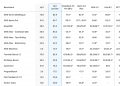
The Agentic Coding section of the official Hy4 preview benchmark appendix published by Tencent, a table comparing Hy3 and Hy4 preview against DeepSeek V4 Pro 0813, Qwen 3.8 Max, GLM 5.3, Kimi K3, GPT 5.6 Sol and Claude Opus 5 across SWE-bench Multilingual, SWE-bench Pro, DeepSWE, three SWE Atlas tasks, SWE-Marathon, Terminal-Bench 2.1, NL2Repo-Bench, CyberGym, ProgramBench, PostTrainBench and Harbor-Index.

Tencent’s 770B Hy4 tops one benchmark row in 46

3 September 2026
Answer card: Qwen 3.7 Max is API-only and cannot run locally yet; the open Qwen models (Qwen 3.6 27B, qwen3:8b to 32b) run offline via Ollama.

Qwen 3.7 local: what you can actually run offline

22 June 2026
Answer card: JWTs are not encrypted, anyone can read them; the signature proves who issued the token, not who may read it.

Are JWTs encrypted? No, and the difference will bite you

0
Answer card: a random 8 character password falls in under 2 hours offline, while 16 random characters hold for 1.4 trillion years at the same speed.

How long does it take to crack a password in 2026?

0
Answer card: three DNS records decide if your mail lands or bounces; SPF lists allowed senders, DKIM signs messages, DMARC sets the failure policy.

SPF, DKIM and DMARC explained: the records your email needs

0
Answer card stating that on 15 September 2026 AWS said it is unable to restore access to resources and data hosted exclusively in the Middle East Bahrain region me-south-1 and in the mec1-az2 zone of the UAE region, because the damage spanned multiple Availability Zones and exceeded what multi-AZ services are designed to withstand.

AWS can’t restore me-south-1, six months after the drone strikes

17 September 2026
Answer card stating that Google released Gemini 3.8 Live and Gemini 3.8 Live Extended Thinking on 15 September 2026 at 3 dollars per million audio input tokens and 12 dollars out, that the thinking model requires asynchronous tools, and that Artificial Analysis scores it 82.6 on its Speech to Speech Quality Index.

Gemini 3.8 Live Extended Thinking rejects any tool that blocks

16 September 2026
Answer card summarising the Atria Dawn Preview release: 744B GLM-5.2 base, MIT licence, 1.5 TB BF16 and 756 GB FP8 checkpoints, 256K context, top on five of sixteen benchmark rows and trailing on SWE-bench Pro.

Atria Dawn Preview is 744B under MIT, and the BF16 weighs 1.5 TB

15 September 2026
  • About
  • Contact
  • Privacy
  • Legal

Copyright © 2026 Stephane Cardon.

Welcome Back!

Login to your account below

Forgotten Password?

Retrieve your password

Please enter your username or email address to reset your password.

Log In
No Result
View All Result
  • Home
  • Articles
    • Security
    • Network
    • Dev
    • Sysadmin
    • SEO
    • Email & DNS
  • Tools
    • Network tools: free, fast, no signup
    • Security tools: free, fast, no signup
    • Developer tools: free, fast, no signup
    • Sysadmin tools: free, fast, no signup
    • SEO tools: free, fast, no signup
    • Email & DNS tools: free, fast, no signup
  • Download
  • About

Copyright © 2026 Stephane Cardon.