
• Latest
  • Trending
  • All
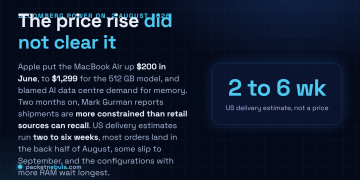
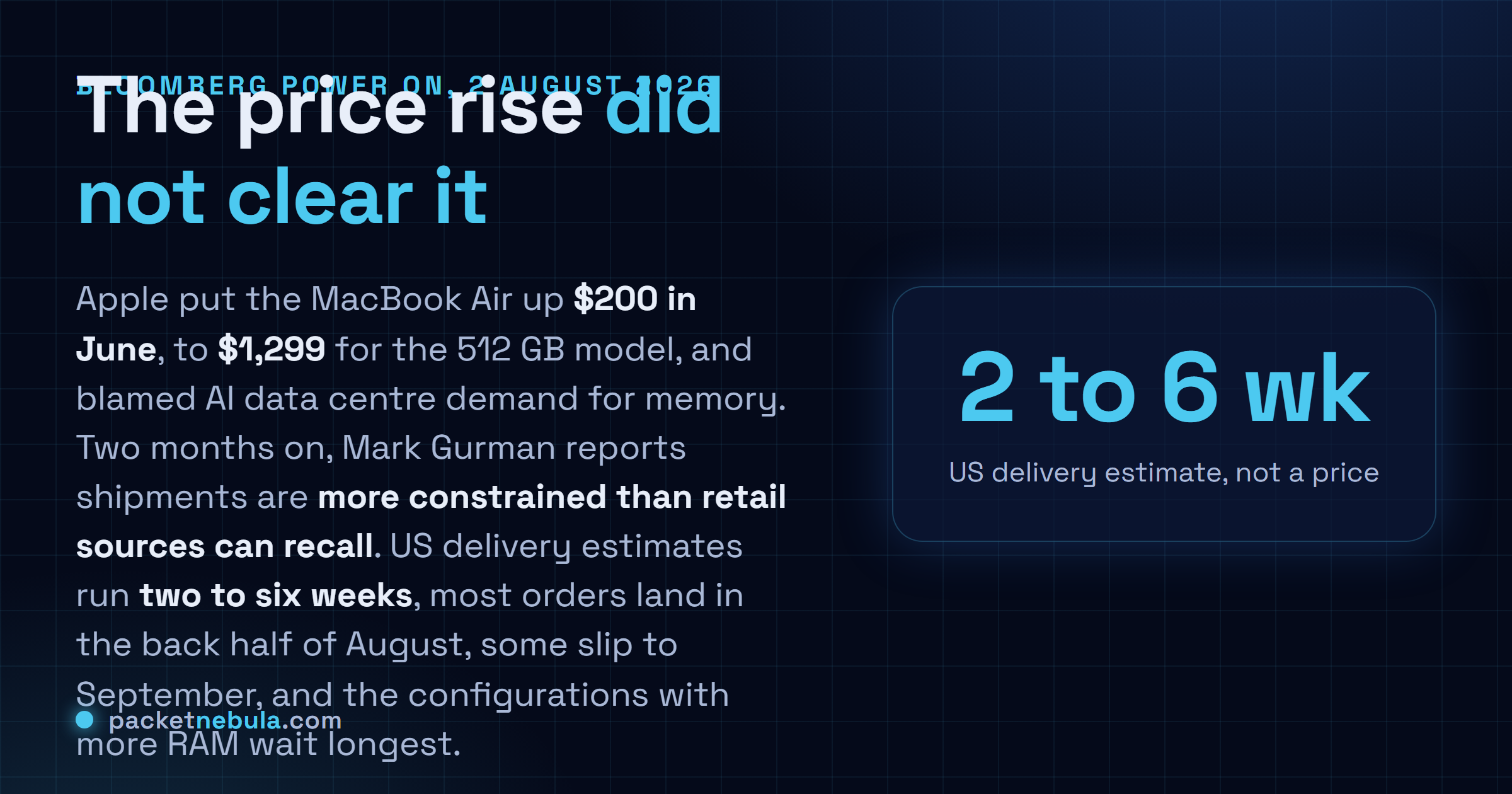
Answer card: Bloomberg reported on 2 August 2026 that the M5 MacBook Air is in major shortage two months after Apple raised its price to $1,299, with US delivery estimates of two to six weeks and the higher memory configurations waiting longest.

MacBook Air M5 shortage: $1,299 and a six week wait

3 August 2026
Answer card stating that Qwen3.8-Omni-Flash launched on 17 September 2026 as an API only model on Alibaba Cloud Model Studio, taking text, images, audio and video in a 1M token context and returning text only, priced at 0.15 dollars per million input tokens for every modality and 0.47 dollars per million output tokens in the international regions, with no open weights published and the Qwen-Live Harness GitHub repository returning 404.

Qwen3.8-Omni-Flash bills audio at $0.15 and ships no weights

18 September 2026
Answer card stating that on 15 September 2026 AWS said it is unable to restore access to resources and data hosted exclusively in the Middle East Bahrain region me-south-1 and in the mec1-az2 zone of the UAE region, because the damage spanned multiple Availability Zones and exceeded what multi-AZ services are designed to withstand.

AWS can’t restore me-south-1, six months after the drone strikes

17 September 2026
Answer card stating that Google released Gemini 3.8 Live and Gemini 3.8 Live Extended Thinking on 15 September 2026 at 3 dollars per million audio input tokens and 12 dollars out, that the thinking model requires asynchronous tools, and that Artificial Analysis scores it 82.6 on its Speech to Speech Quality Index.

Gemini 3.8 Live Extended Thinking rejects any tool that blocks

16 September 2026
Answer card summarising the Atria Dawn Preview release: 744B GLM-5.2 base, MIT licence, 1.5 TB BF16 and 756 GB FP8 checkpoints, 256K context, top on five of sixteen benchmark rows and trailing on SWE-bench Pro.

Atria Dawn Preview is 744B under MIT, and the BF16 weighs 1.5 TB

15 September 2026
Answer card stating that OpenAI released the Agents API in public beta on 10 September 2026 with no separate fee, billed through model tokens, tool calls and hosted sandbox time, with a choice of OpenAI hosted, self hosted or partner sandboxes, US only data residency and no Zero Data Retention support.

OpenAI’s Agents API has no fee, no ZDR and a one hour sandbox clock

14 September 2026
Answer card: Sakana Fugu Max at $2 and $6 per million tokens, Fugu Ultra v2 unchanged at $5 and $30, and Sakana saying Ultra v2 scores without Fable 5 or GPT-6 Astra in its pool.

Fugu Max costs $2 and $6 while Fugu Ultra v2 runs without Fable 5

13 September 2026
Answer card stating that DeepSeek released DeepSeek-V4.1-Flash on 10 September 2026 as a 552 billion parameter mixture of experts model with a new causal encoder decoder architecture that activates 8 billion parameters on input and 16 billion on output, with native vision, a one million token context and MIT licensed weights, that the API model name is now deepseek-flash at 0.15 dollars per million input tokens and 0.60 dollars per million output tokens off peak, and that DeepSeek announced V4 Pro would be routed to V4.1-Flash from 14 September and reversed that on 11 September.

DeepSeek V4.1-Flash arrived, and the V4 Pro retirement lasted a day

12 September 2026
Answer card stating that Cognition released SWE-2 on 10 September 2026, a coding model post-trained from Kimi K3, scoring 50.0 percent on FrontierCode 1.1 Main against 50.9 percent for Claude Fable 5.1 and 27.3 percent on Terminal-Bench 4 against 55.8 percent, available only inside Devin.

SWE-2 trails Fable 5.1 by one point, and by 28 on Terminal-Bench 4

11 September 2026
Answer card for Meta Muse, free to 100 million tokens a week then $20 a month, launched 8 September 2026 for United States adults only, running in a dedicated per user virtual machine.

Does Meta Muse do enough to earn your inbox and a card on file?

9 September 2026
Answer card stating that the public download pages for the VMware Virtual Disk Development Kit on developer.broadcom.com began returning 404 errors on 25 August 2026 with no announcement or deprecation notice, that Broadcom support tells customers the kit is no longer available for use or download, and that release lines 7.0.3.1, 8.x and 9.x are all affected.

Broadcom pulled VDDK 8.0 and 9.0, and the 404 is the only notice

8 September 2026
Answer card stating that OpenAI published its research acceleration measurements on 6 September 2026, that as of mid August 2026 its research organisation logged 3.1 agent workdays of coding agent runtime for every workday of human labour normalised to a standard eight hour day, and that OpenAI states this should not be read as a 3.1 times productivity gain because it measures runtime rather than delivered output.

OpenAI’s 3.1 agent-workdays per human day is not a 3.1x gain

7 September 2026
Answer card stating that Mullvad announced on 3 September 2026 that it is shutting down its public encrypted domain name system servers on 2 November 2026 and sponsoring the Quad9 Foundation instead, with 194.242.2.2 and its five sibling addresses all going away, and virtual private network customers unaffected.

Mullvad’s DNS servers go dark on 2 November, and Quad9 blocks no ads

5 September 2026
  • About
  • Contact
  • Privacy
  • Legal
Friday, September 18, 2026
  • Login
Packet Nebula
  • Home
  • Articles
    • Security
    • Network
    • Dev
    • Sysadmin
    • SEO
    • Email & DNS
  • Tools
    • Network tools: free, fast, no signup
    • Security tools: free, fast, no signup
    • Developer tools: free, fast, no signup
    • Sysadmin tools: free, fast, no signup
    • SEO tools: free, fast, no signup
    • Email & DNS tools: free, fast, no signup
  • Download
  • About
No Result
View All Result
Packet Nebula
No Result
View All Result
Home Dev

MacBook Air M5 shortage: $1,299 and a six week wait

by stephane
3 August 2026
in Dev
0
Answer card: Bloomberg reported on 2 August 2026 that the M5 MacBook Air is in major shortage two months after Apple raised its price to $1,299, with US delivery estimates of two to six weeks and the higher memory configurations waiting longest.
492
SHARES
1.4k
VIEWS
Share on FacebookShare on Twitter

You go to order six Airs for the new starters, and the checkout says late September. That's roughly where this is: Apple put the MacBook Air up $200 in June, to $1,299 for the 512 GB model, and two months on it still can't keep the laptop in stock. Bloomberg's Mark Gurman reported on 2 August that shipments are more constrained than retail sources can recall, with US delivery estimates running two to six weeks. The configurations carrying more memory wait longest. That last detail is the one worth holding onto, because it says the shortage isn't being cleared by price. It's being rationed by lead time.

The short answer

Apple raised Mac prices in late June and blamed AI demand for memory. Two months later the MacBook Air is in short supply anyway, with US delivery estimates of two to six weeks and the higher memory configurations waiting longest. The useful signal isn’t the price. It’s that a $200 increase didn’t buy availability, which tells you where consumer devices now sit in the queue for DRAM.
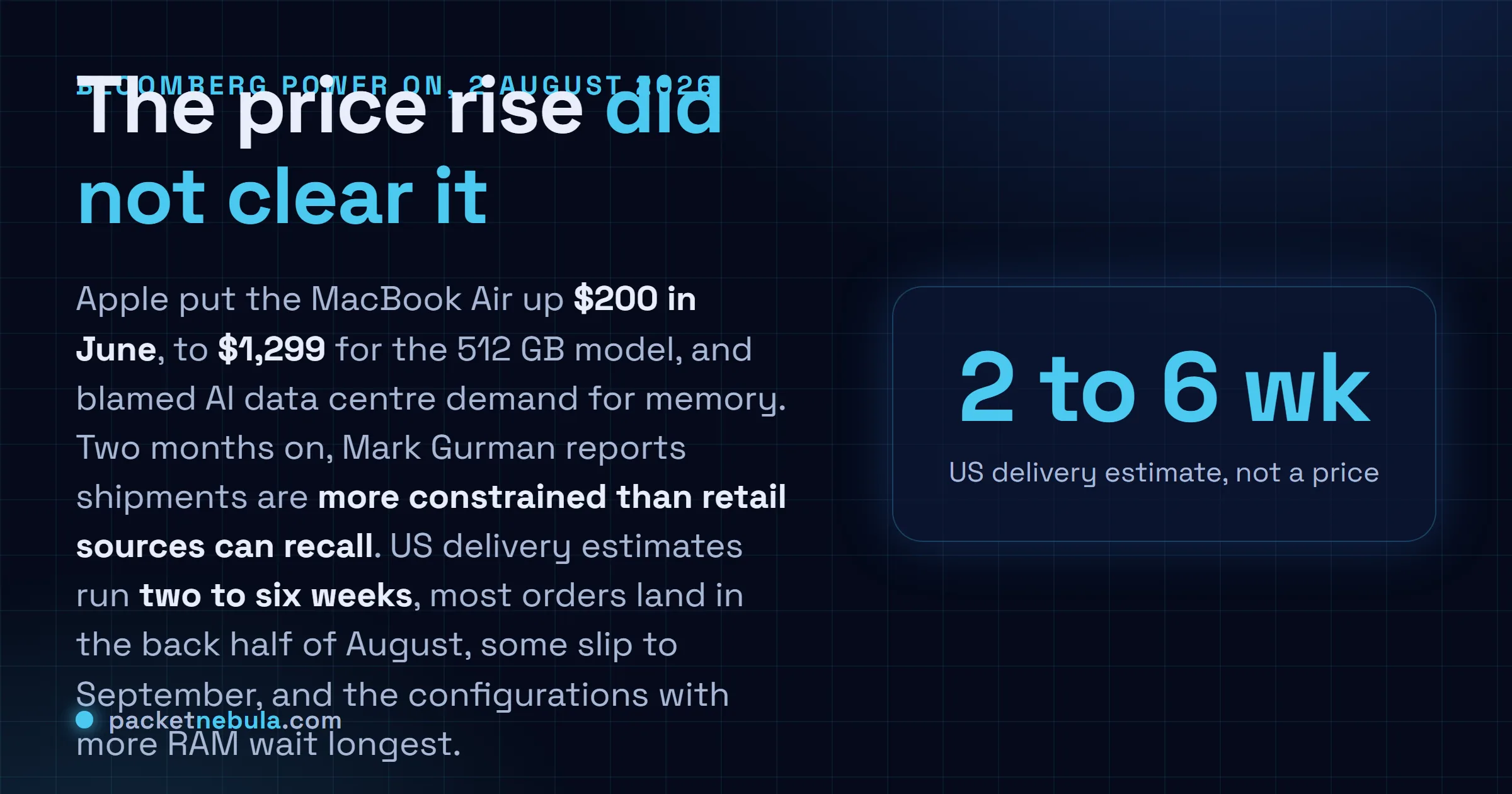
$1,299Air entry price after June
2 to 6 wkUS delivery estimate
+30%entry price across 2026
Answer card: Bloomberg reported on 2 August 2026 that the M5 MacBook Air is in major shortage two months after Apple raised its price to $1,299, with US delivery estimates of two to six weeks and the higher memory configurations waiting longest.
A price rise in June, a stock problem in August. Both from the same cause.

What was actually reported

Gurman’s Power On newsletter on 2 August is the source, and the line everyone picked up came from Apple retail: shipments of new units are more constrained than store sources can ever recall. MacRumors, 9to5Mac and TechCrunch all ran it the same day, and none of them added a unit number, because there isn’t one.

What you can check yourself is the store. Delivery estimates on Apple’s US site ran two to six weeks, most orders landing in the back half of August, a few pushed into September. TechCrunch also noted the marketing tell: Apple has been steering front-page attention toward the base MacBook Pro, with the Air marked subject to availability. The back to school promotion slipped from June too.

Gurman reports Apple is sourcing memory from Chinese suppliers to cover the gap. Which, for a company that has spent a decade de-risking its supply chain in the other direction, is a reasonable measure of how tight this is.

The bit that isn’t in the headline

Look at the sequence rather than the shortage.

Apple raised prices in late June and said why, on the record: the rapid expansion of AI data centres created an extraordinary surge in demand for memory and storage, and it had never seen a component price increase this much this quickly. The 512 GB Air went to $1,299 from $1,099. The 1 TB MacBook Pro went to $1,999 from $1,699. Then the Air sold out anyway.
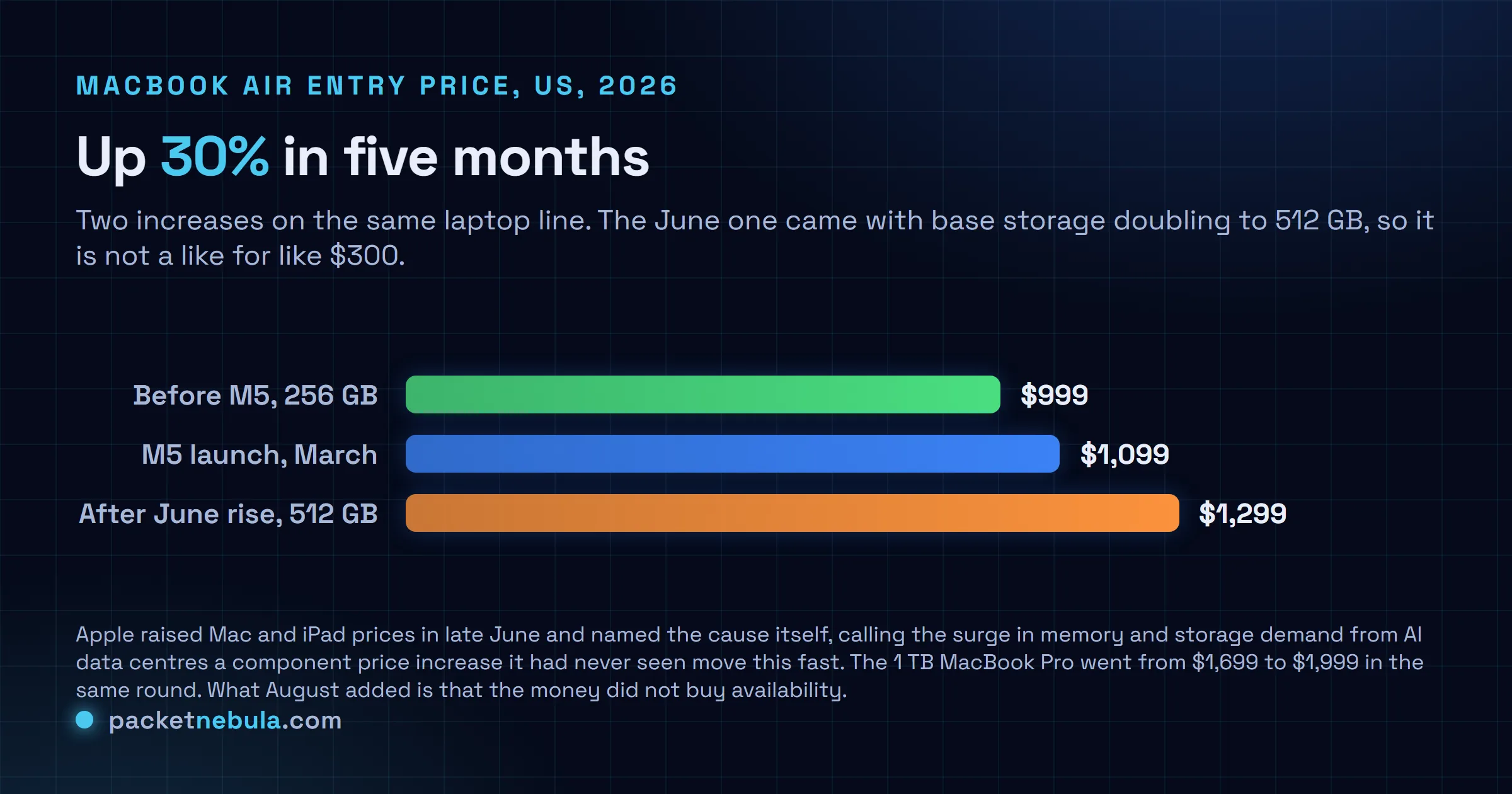
Comparison chart of MacBook Air entry price through 2026: $999 before the M5, $1,099 at the M5 launch in March, and $1,299 after the June increase that also moved base storage to 512 GB.
Two increases on one laptop line in five months. The second came with double the storage.

Normally a $200 increase does some of the rationing for you. Demand softens, the queue shortens, everyone grumbles and moves on. That didn’t happen here, and the reason is that Apple isn’t really competing with its own customers for these parts. It’s competing with hyperscalers, and they’re not price-sensitive in any way a laptop buyer would recognise. When an accelerator’s HBM stack earns more per wafer than the LPDDR in a MacBook, consumer devices get whatever’s left.

Honestly, I think that’s the whole story, and it generalises well past Apple. The consumer price rises we’ve been covering all year were the polite phase of this shortage. Rationing by lead time is the impolite one.

Why the RAM tier matters more than usual

Here’s the practical bit, and it’s the detail most of the coverage buried.

The delivery estimate isn’t attached to the model. It’s attached to the configuration, and higher memory configurations carry the longest dates. So the spec decision and the schedule decision have collapsed into the same decision. Order the 16 GB base and you might see August. Order 24 or 32 with a storage bump and you’re reading September, on a machine you priced in July.

Anyone who buys laptops in batches knows why that’s annoying. You don’t spec a fleet machine and then find out when it ships. You promise a start date to a manager, and the machine has to be on the desk for it.
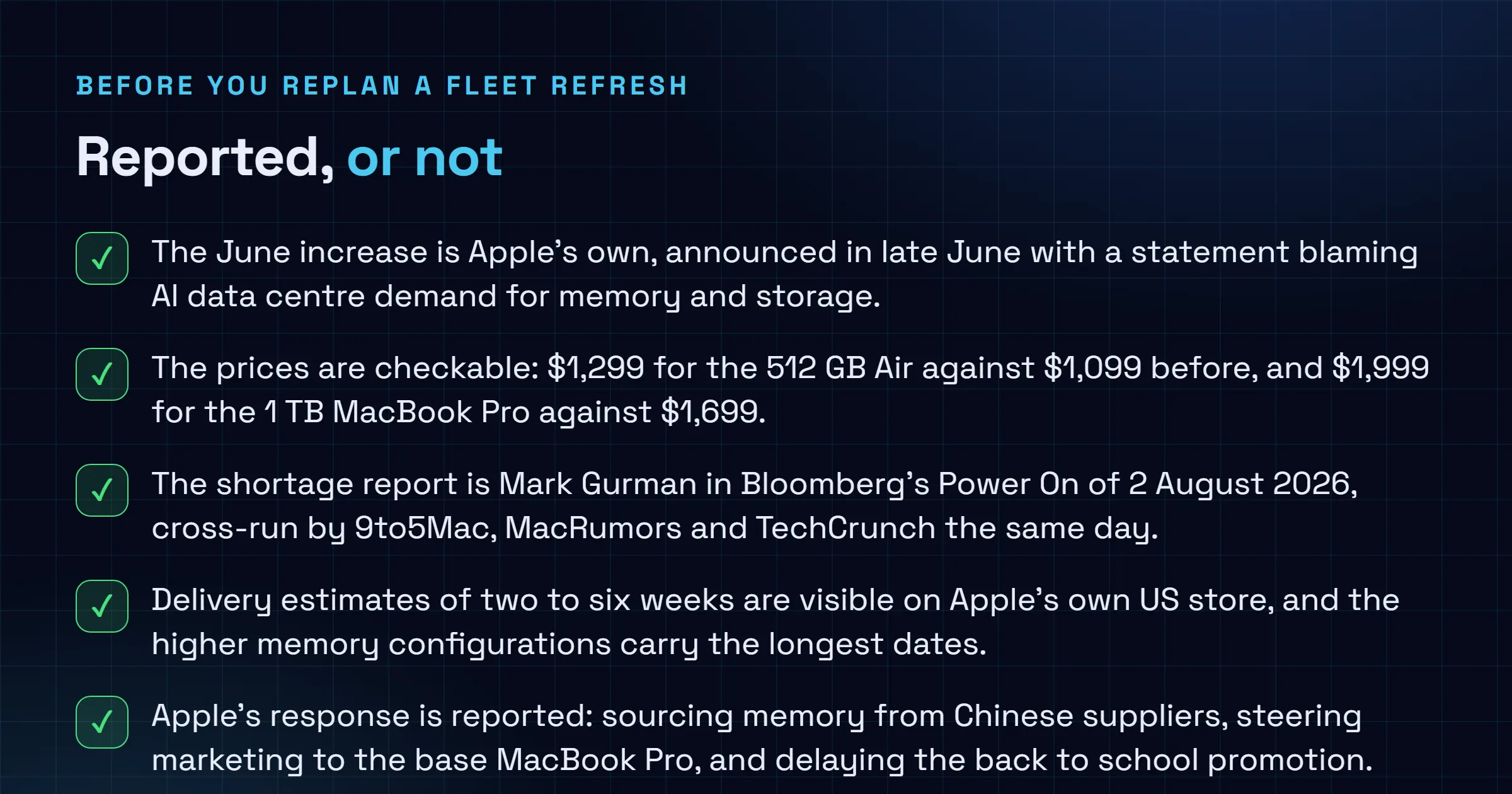
Checklist separating what is reported and attributable about the MacBook Air shortage, including the June price increase, the checkable prices, the Bloomberg report and the Apple store delivery estimates, from what nobody has published, including unit numbers, an end date and any further price rise.
Five things on the record. Three that nobody has published.

What we’d do with a Q3 laptop budget

Order the spec you actually need, now, and stop treating the RAM tier as a nice to have you can revisit. It’s the line item that decides your delivery date, and it’s also the one that ages a machine fastest if you under-buy. Under-specifying to dodge a wait means paying the wait again in two years.

Ask the reseller for committed dates rather than the store estimate. Apple’s own window is a range, and a range is what a supply team says when it doesn’t know. Business channels often hold allocation that the consumer store doesn’t show, which is worth ten minutes on the phone before you accept September.

And keep the causal chain straight when the variance lands on someone’s desk. This is the same shortage behind the Pixel 11 price increase Google confirmed and behind Qualcomm’s double-digit chip rise starting 1 September. Three vendors, three different ways of passing the same problem on. Apple is simply the only one that shows you the constraint as a date on a checkout page.

One last thought, and I might be wrong about this. Apple absorbed years of component swings without moving list prices, and it burned that credibility in a single June. If memory contract prices keep climbing into 2027, the interesting question isn’t whether the Air goes up again. It’s whether the base configuration quietly gets worse instead, which is the move nobody has to announce.

Sources

The shortage report is Mark Gurman’s Bloomberg Power On newsletter of 2 August 2026, as covered by MacRumors, 9to5Mac and TechCrunch, all published the same day. The June price increase and Apple’s statement about AI data centre demand are reported by the Associated Press via US News and TechRepublic. The Q3 DRAM forecast is TrendForce’s press release of 3 July 2026. We have not seen any published unit volumes for MacBook Air production, and we’d treat any that appear without a source with suspicion.

Frequently asked questions

Why is the MacBook Air out of stock in August 2026?

Memory. Apple said in late June that the rapid expansion of AI data centres created an extraordinary surge in demand for memory and storage, and that it had never seen a component price rise this much this quickly. The same shortage hit the Mac mini and Mac Studio first. Bloomberg's Mark Gurman reported on 2 August 2026 that MacBook Air shipments are now more constrained than retail store sources can recall.

How long is the wait for a MacBook Air right now?

Apple's US online store showed two to six week delivery estimates when the report ran on 2 August 2026. Most configurations land in the back half of August and some slip into September. The estimate is per configuration, not per model, so the number you see depends on which memory and storage tier you pick.

How much has the MacBook Air gone up in 2026?

The entry price went from $999 to $1,099 when the M5 model arrived in March 2026, then to $1,299 in the late June increase, which also moved base storage from 256 GB to 512 GB. So it is up about 30 percent across the year, though the June step is not a like for like $200 because you get twice the storage. The 1 TB MacBook Pro moved from $1,699 to $1,999 in the same round.

Should I order a high-RAM MacBook Air now or wait?

Order it now if the spend is approved and the machine has a job waiting. Higher memory configurations carry the longest dates, so the wait grows with the spec rather than shrinking. Nobody credible is forecasting memory prices falling in 2026, and TrendForce still had conventional DRAM rising another 13 to 18 percent in Q3 in its 3 July release. Waiting risks paying more for the same wait.

Is this only an Apple problem?

No. Google confirmed Pixel 11 price rises for the same reason, and Qualcomm is raising chip prices on products shipping after 1 September 2026. Apple is just the visible case because it publishes per-configuration delivery dates on a public store, so you can watch the constraint instead of inferring it from a press release.

Tags: applehardwarememorynewspricing
Share197Tweet123
stephane

stephane

  • Trending
  • Comments
  • Latest
Answer card: Proton Lumo 2.0 is private by policy, not by locality. Saved history is locked so even Proton cannot read it, but the prompt is decrypted on a Proton EU server to answer it, then forgotten.

Proton Lumo 2.0 review: how private is it, really?

3 September 2026
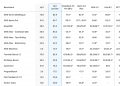
The Agentic Coding section of the official Hy4 preview benchmark appendix published by Tencent, a table comparing Hy3 and Hy4 preview against DeepSeek V4 Pro 0813, Qwen 3.8 Max, GLM 5.3, Kimi K3, GPT 5.6 Sol and Claude Opus 5 across SWE-bench Multilingual, SWE-bench Pro, DeepSWE, three SWE Atlas tasks, SWE-Marathon, Terminal-Bench 2.1, NL2Repo-Bench, CyberGym, ProgramBench, PostTrainBench and Harbor-Index.

Tencent’s 770B Hy4 tops one benchmark row in 46

3 September 2026
Answer card: Qwen 3.7 Max is API-only and cannot run locally yet; the open Qwen models (Qwen 3.6 27B, qwen3:8b to 32b) run offline via Ollama.

Qwen 3.7 local: what you can actually run offline

22 June 2026
Answer card: JWTs are not encrypted, anyone can read them; the signature proves who issued the token, not who may read it.

Are JWTs encrypted? No, and the difference will bite you

0
Answer card: a random 8 character password falls in under 2 hours offline, while 16 random characters hold for 1.4 trillion years at the same speed.

How long does it take to crack a password in 2026?

0
Answer card: three DNS records decide if your mail lands or bounces; SPF lists allowed senders, DKIM signs messages, DMARC sets the failure policy.

SPF, DKIM and DMARC explained: the records your email needs

0
Answer card stating that Qwen3.8-Omni-Flash launched on 17 September 2026 as an API only model on Alibaba Cloud Model Studio, taking text, images, audio and video in a 1M token context and returning text only, priced at 0.15 dollars per million input tokens for every modality and 0.47 dollars per million output tokens in the international regions, with no open weights published and the Qwen-Live Harness GitHub repository returning 404.

Qwen3.8-Omni-Flash bills audio at $0.15 and ships no weights

18 September 2026
Answer card stating that on 15 September 2026 AWS said it is unable to restore access to resources and data hosted exclusively in the Middle East Bahrain region me-south-1 and in the mec1-az2 zone of the UAE region, because the damage spanned multiple Availability Zones and exceeded what multi-AZ services are designed to withstand.

AWS can’t restore me-south-1, six months after the drone strikes

17 September 2026
Answer card stating that Google released Gemini 3.8 Live and Gemini 3.8 Live Extended Thinking on 15 September 2026 at 3 dollars per million audio input tokens and 12 dollars out, that the thinking model requires asynchronous tools, and that Artificial Analysis scores it 82.6 on its Speech to Speech Quality Index.

Gemini 3.8 Live Extended Thinking rejects any tool that blocks

16 September 2026
  • About
  • Contact
  • Privacy
  • Legal

Copyright © 2026 Stephane Cardon.

Welcome Back!

Login to your account below

Forgotten Password?

Retrieve your password

Please enter your username or email address to reset your password.

Log In
No Result
View All Result
  • Home
  • Articles
    • Security
    • Network
    • Dev
    • Sysadmin
    • SEO
    • Email & DNS
  • Tools
    • Network tools: free, fast, no signup
    • Security tools: free, fast, no signup
    • Developer tools: free, fast, no signup
    • Sysadmin tools: free, fast, no signup
    • SEO tools: free, fast, no signup
    • Email & DNS tools: free, fast, no signup
  • Download
  • About

Copyright © 2026 Stephane Cardon.