
• Latest
  • Trending
  • All
OpenAI announcement artwork for the publication Ten advances in mathematics and theoretical computer science, white text centred on a soft cyan and blue gradient.

OpenAI Astra: what the ten Lean proofs actually prove

2 August 2026
Answer card stating that Qwen3.8-Omni-Flash launched on 17 September 2026 as an API only model on Alibaba Cloud Model Studio, taking text, images, audio and video in a 1M token context and returning text only, priced at 0.15 dollars per million input tokens for every modality and 0.47 dollars per million output tokens in the international regions, with no open weights published and the Qwen-Live Harness GitHub repository returning 404.

Qwen3.8-Omni-Flash bills audio at $0.15 and ships no weights

18 September 2026
Answer card stating that on 15 September 2026 AWS said it is unable to restore access to resources and data hosted exclusively in the Middle East Bahrain region me-south-1 and in the mec1-az2 zone of the UAE region, because the damage spanned multiple Availability Zones and exceeded what multi-AZ services are designed to withstand.

AWS can’t restore me-south-1, six months after the drone strikes

17 September 2026
Answer card stating that Google released Gemini 3.8 Live and Gemini 3.8 Live Extended Thinking on 15 September 2026 at 3 dollars per million audio input tokens and 12 dollars out, that the thinking model requires asynchronous tools, and that Artificial Analysis scores it 82.6 on its Speech to Speech Quality Index.

Gemini 3.8 Live Extended Thinking rejects any tool that blocks

16 September 2026
Answer card summarising the Atria Dawn Preview release: 744B GLM-5.2 base, MIT licence, 1.5 TB BF16 and 756 GB FP8 checkpoints, 256K context, top on five of sixteen benchmark rows and trailing on SWE-bench Pro.

Atria Dawn Preview is 744B under MIT, and the BF16 weighs 1.5 TB

15 September 2026
Answer card stating that OpenAI released the Agents API in public beta on 10 September 2026 with no separate fee, billed through model tokens, tool calls and hosted sandbox time, with a choice of OpenAI hosted, self hosted or partner sandboxes, US only data residency and no Zero Data Retention support.

OpenAI’s Agents API has no fee, no ZDR and a one hour sandbox clock

14 September 2026
Answer card: Sakana Fugu Max at $2 and $6 per million tokens, Fugu Ultra v2 unchanged at $5 and $30, and Sakana saying Ultra v2 scores without Fable 5 or GPT-6 Astra in its pool.

Fugu Max costs $2 and $6 while Fugu Ultra v2 runs without Fable 5

13 September 2026
Answer card stating that DeepSeek released DeepSeek-V4.1-Flash on 10 September 2026 as a 552 billion parameter mixture of experts model with a new causal encoder decoder architecture that activates 8 billion parameters on input and 16 billion on output, with native vision, a one million token context and MIT licensed weights, that the API model name is now deepseek-flash at 0.15 dollars per million input tokens and 0.60 dollars per million output tokens off peak, and that DeepSeek announced V4 Pro would be routed to V4.1-Flash from 14 September and reversed that on 11 September.

DeepSeek V4.1-Flash arrived, and the V4 Pro retirement lasted a day

12 September 2026
Answer card stating that Cognition released SWE-2 on 10 September 2026, a coding model post-trained from Kimi K3, scoring 50.0 percent on FrontierCode 1.1 Main against 50.9 percent for Claude Fable 5.1 and 27.3 percent on Terminal-Bench 4 against 55.8 percent, available only inside Devin.

SWE-2 trails Fable 5.1 by one point, and by 28 on Terminal-Bench 4

11 September 2026
Answer card for Meta Muse, free to 100 million tokens a week then $20 a month, launched 8 September 2026 for United States adults only, running in a dedicated per user virtual machine.

Does Meta Muse do enough to earn your inbox and a card on file?

9 September 2026
Answer card stating that the public download pages for the VMware Virtual Disk Development Kit on developer.broadcom.com began returning 404 errors on 25 August 2026 with no announcement or deprecation notice, that Broadcom support tells customers the kit is no longer available for use or download, and that release lines 7.0.3.1, 8.x and 9.x are all affected.

Broadcom pulled VDDK 8.0 and 9.0, and the 404 is the only notice

8 September 2026
Answer card stating that OpenAI published its research acceleration measurements on 6 September 2026, that as of mid August 2026 its research organisation logged 3.1 agent workdays of coding agent runtime for every workday of human labour normalised to a standard eight hour day, and that OpenAI states this should not be read as a 3.1 times productivity gain because it measures runtime rather than delivered output.

OpenAI’s 3.1 agent-workdays per human day is not a 3.1x gain

7 September 2026
Answer card stating that Mullvad announced on 3 September 2026 that it is shutting down its public encrypted domain name system servers on 2 November 2026 and sponsoring the Quad9 Foundation instead, with 194.242.2.2 and its five sibling addresses all going away, and virtual private network customers unaffected.

Mullvad’s DNS servers go dark on 2 November, and Quad9 blocks no ads

5 September 2026
  • About
  • Contact
  • Privacy
  • Legal
Friday, September 18, 2026
  • Login
Packet Nebula
  • Home
  • Articles
    • Security
    • Network
    • Dev
    • Sysadmin
    • SEO
    • Email & DNS
  • Tools
    • Network tools: free, fast, no signup
    • Security tools: free, fast, no signup
    • Developer tools: free, fast, no signup
    • Sysadmin tools: free, fast, no signup
    • SEO tools: free, fast, no signup
    • Email & DNS tools: free, fast, no signup
  • Download
  • About
No Result
View All Result
Packet Nebula
No Result
View All Result
Home Dev

OpenAI Astra: what the ten Lean proofs actually prove

by stephane
2 August 2026
in Dev
0
OpenAI announcement artwork for the publication Ten advances in mathematics and theoretical computer science, white text centred on a soft cyan and blue gradient.
494
SHARES
1.4k
VIEWS
Share on FacebookShare on Twitter

OpenAI put ten proofs on GitHub on 1 August and didn't ship a model. That's the shape of this one: an internal version of Astra, its next model family, produced new results on ten problems that had been open for at least a decade, and what you can actually download tonight is a 249 page manuscript plus a repository of Lean files. We cloned it. The model stays private, the proofs don't, and every result carries a machine-checkable certificate, so correctness is a question you can settle on your own laptop instead of trusting a launch post. Correctness is the easy half. Whether any of it matters mathematically is a separate question, and so is what that $2,000 figure is really counting.

The short answer

OpenAI published ten new results in mathematics and theoretical computer science, produced by an unreleased internal Astra. Every one ships with a Lean 4 certificate you can compile yourself, which makes the correctness claim unusually cheap to check. The significance claim is not checkable, the failure rate is unpublished, and Astra itself has no price and no date.
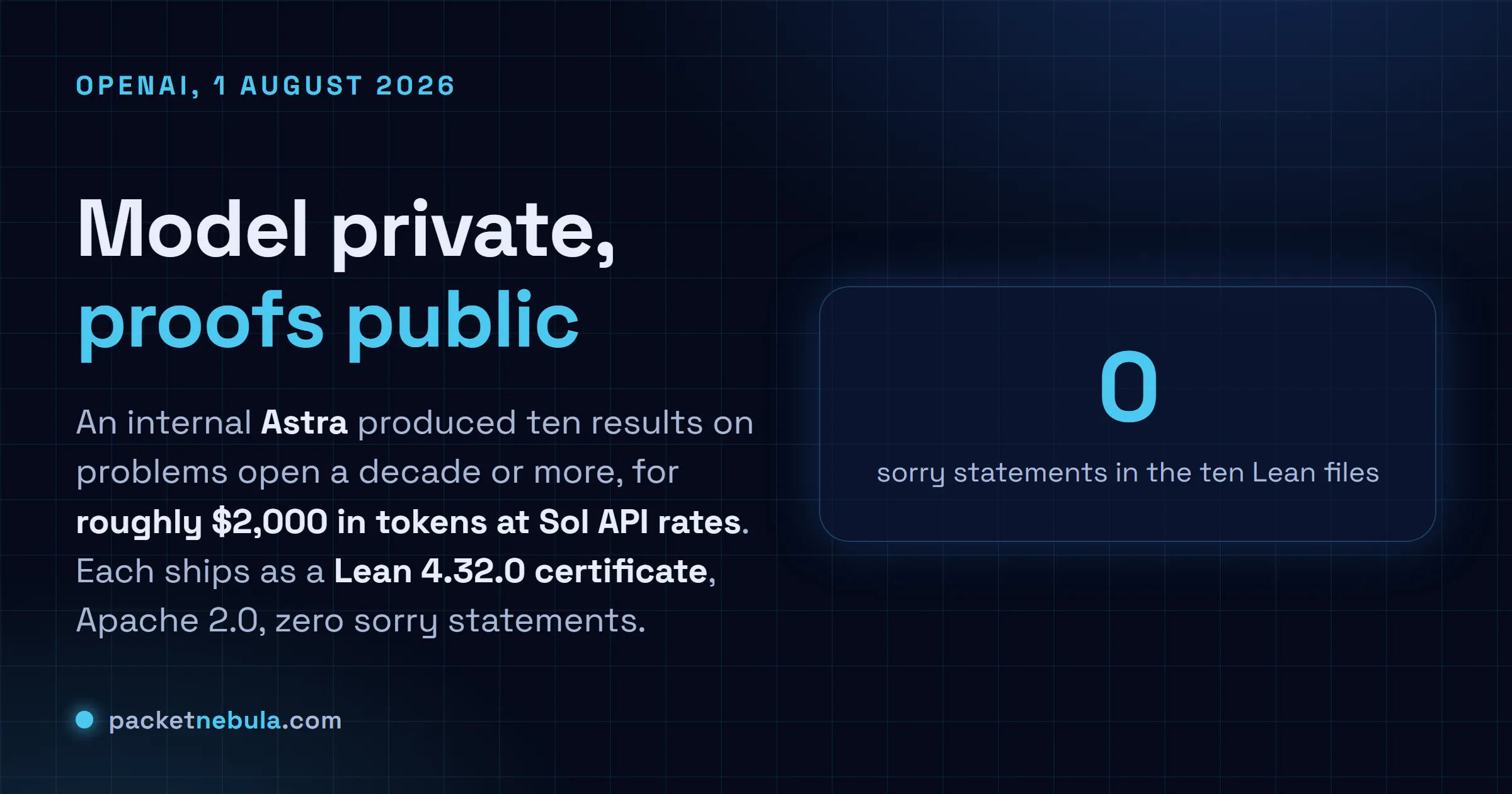
10results, each open a decade or more
$2,000token cost, wins only
0sorry statements in the Lean files
Answer card: on 1 August 2026 OpenAI published ten results produced by an internal version of its unreleased Astra model, on problems open for at least a decade, at a token cost of roughly $2,000 at Sol API rates, each shipping as a Lean 4.32.0 certificate under Apache 2.0 with zero sorry statements.
The interesting release here is the repository, not the model.

What actually shipped

Three artefacts, none of them a model. A 249 page manuscript. A set of narrated walkthroughs of the model’s reasoning. And a Lean repository.

The results came from what OpenAI calls “an internal version of Astra, our next major model.” Astra is the family that would sit above the Sol, Terra and Luna tiers we went through when GPT-5.6 went public. Nobody outside the lab has an API key for it, which is worth holding onto while you read the rest.
OpenAI announcement artwork reading Ten advances in mathematics and theoretical computer science on a cyan and blue gradient.

Image: OpenAI

The ten cover sphere-packing upper bounds down to the Cohn-Elkies threshold, exponentially improved bounds for binary and spherical codes, a construction establishing that non-sofic groups exist, a disproof of Connes’s rigidity conjecture, an arithmetic-formula lower bound of order n^4/log n for the permanent, an exponential parallel repetition theorem for two-player quantum games, polynomial-factor hardness of approximation for the closest vector problem, the sharp Ehrhart volume bound in every dimension, a superexponential lower bound for multicolor triangle Ramsey numbers, and counterexamples that settle Erdős problems 146 and 180. OpenAI’s framing: each had “seen no progress on the main result for at least a decade, and in most cases much longer.”

Then the number everyone quoted. From the announcement: “The total number of tokens needed to find solutions to these problems would cost roughly $2,000 at Sol API rates.”

The part you can check tonight

Here’s what makes this release different from the usual lab claim. Go and get it:
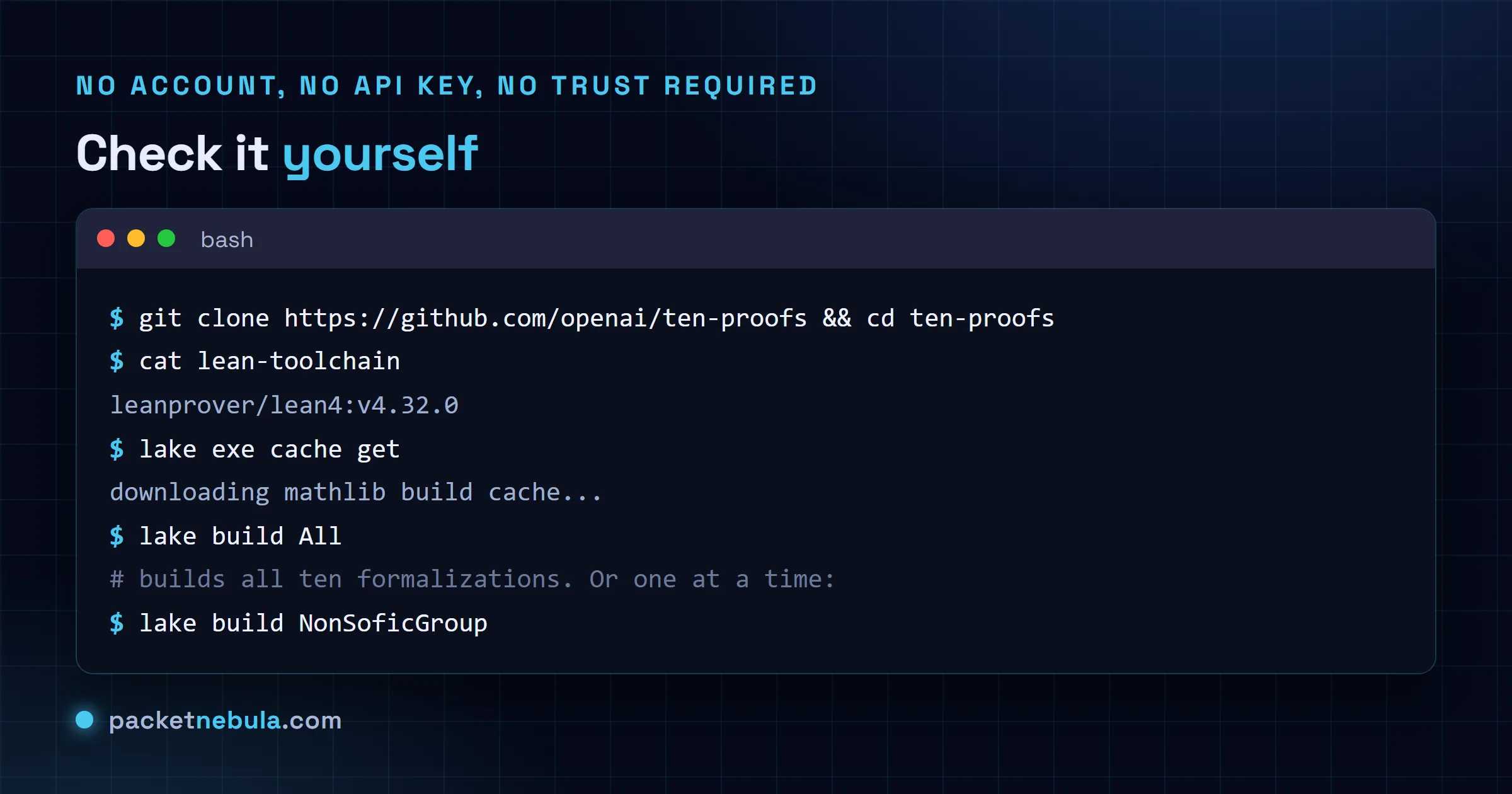
Terminal session cloning github.com/openai/ten-proofs, showing the lean-toolchain file pinned to leanprover/lean4 version 4.32.0, then running lake exe cache get and lake build All to compile all ten formalizations locally.
No account, no key, no permission. Just a compiler and some patience.

The repository is openai/ten-proofs, Apache 2.0, created on 1 August. Ten .lean files plus an All.lean that pulls them together. The toolchain is pinned to leanprover/lean4:v4.32.0 against mathlib, so the build is reproducible rather than a screenshot of one.

The file we’d actually open first is formalization.yaml. It reports sorry_count: 0 and sorry_in_definitions: 0, so no result is propped up by an admitted gap. Each theorem also lists its axioms, and for all ten they are propext, Classical.choice and Quot.sound. That trio is what ordinary Lean mathematics runs on. Nothing exotic was quietly added as an assumption, which is the classic way a formalized claim goes bad.

Two other lines in that file got less attention than they deserve. The automation block records the method as an agent, the framework as Codex, and the wall time as one week. And the review status reads agent-reviewed.

Not human-reviewed. Their own metadata says so.

What a compiler can’t tell you
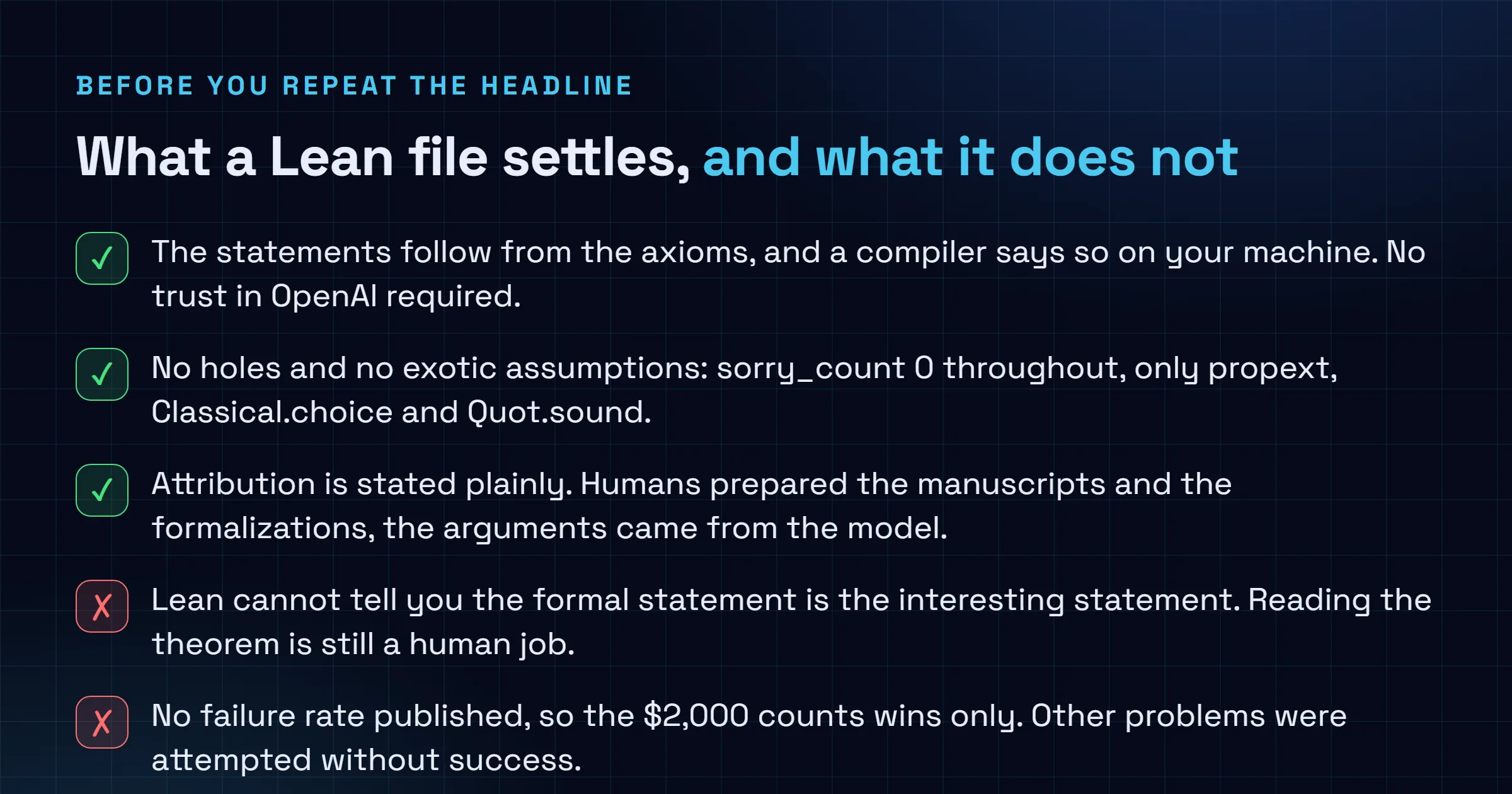
Checklist contrasting what the Lean certificates establish, including that statements follow from the axioms with zero sorry statements and only the three standard axioms, against what they leave open, including whether the formal statement is the interesting statement and the absent failure rate behind the $2,000 figure.
Compiling is the cheap half of peer review, and it is the half that got done.

Lean will confirm that a formal statement follows from the axioms. It will not tell you the formal statement is the one the field cares about. Read a theorem statement in a paper and you are reading English; read one in Lean and you are reading a definition chain that a specialist has to walk to be sure the quantifiers land where they should. For something like Connes’s rigidity conjecture, that walk is not a weekend.

So the honest position on day two is that the proofs are very likely correct and their importance is unestablished. Those aren’t in tension.

The $2,000 has the same shape of problem, which Noam Brown said out loud himself:

And yes we did try other major problems without success. Sadly no Millennium Prize problems (yet). But also, we didn’t spend a lot on each problem. It’s possible to push test-time compute much further.

Noam Brown (@polynoamial), 1 August 2026, on X.

Read that against the headline. The $2,000 counts winning runs. No attempt count, no failure rate, nothing to divide by. It’s a cost-per-success figure wearing a cost-per-problem costume, and I don’t think that’s deliberate spin so much as the natural thing to publish when the failures produced nothing to show.

Credit where it’s due on attribution, though. OpenAI wrote that “claiming human authorship for a proof generated entirely by an AI system would misrepresent both the system’s contribution and the nature of genuine human intellectual work,” and stated that humans prepared the manuscripts and the formalizations while the arguments came from the model. That’s a cleaner disclosure than the Fable 5 Jacobian conjecture counterexample got, and a lot cleaner than May’s Erdős unit-distance episode, which is what prompted the Leiden declaration OpenAI now cites by name.

The line that’s going to get misread

One of the ten is polynomial-factor hardness of approximation for the closest vector problem, which OpenAI describes as “a foundational lattice question related to post-quantum cryptography.”

If that sentence made you open your migration tracker, close it. It’s a hardness result. It says approximating CVP within a polynomial factor is NP-hard, which pushes in the same direction the lattice assumptions already lean. Nothing here weakens ML-KEM or ML-DSA, and our notes on post-quantum TLS stand unchanged. Honestly, I’d bet this ends up the most misquoted line in the release.

As for when you can point Astra at your own backlog: not yet, and possibly not purely on OpenAI’s schedule. Sam Altman spent the end of July demonstrating it to senators and administration officials in Washington, and multiple outlets report a new federal framework requiring pre-release review of frontier models, with Astra expected to be the first through it. We haven’t seen the text of that framework, so treat the timing as reported rather than settled.

What we’d do with the release right now is unglamorous. Clone the repo, build one module, and see how long mathlib takes on your machine. Whatever else this week produced, a lab shipping a claim you can falsify with a compiler is a better default than the alternative.

Sources

OpenAI, Ten advances in mathematics and theoretical computer science, 1 August 2026, for the results list, the $2,000 claim and the attribution statement. The Lean files, toolchain pin, axiom lists and metadata come from the openai/ten-proofs repository, read directly. Noam Brown’s remarks are quoted from his post on X of 1 August 2026. Cross-checked against The Decoder and Implicator, which also cover the Washington demonstrations and the pre-release review framework. Announcement artwork is OpenAI’s own, reproduced as a credited citation.

Frequently asked questions

What is Astra?

Astra is the model family OpenAI describes as its next major model. It is designed for long-running work where several agents coordinate over hours or days. It has not been released: there is no public API, no published pricing and no announced date. The ten mathematical results published on 1 August 2026 were produced by an internal version of it.

Can I verify the ten proofs myself?

Yes, and that is the point of the release. The Lean 4 formalizations are on GitHub at openai/ten-proofs under Apache 2.0. With elan installed, run "lake exe cache get" then "lake build All" to compile all ten, or pass a single module name such as NonSoficGroup to build one. The repository pins Lean 4.32.0 and its metadata reports zero sorry statements.

Does the $2,000 figure mean a proof now costs $200?

No. OpenAI says the tokens needed to find these ten solutions would cost roughly $2,000 at Sol API rates, which is a cost per success. OpenAI researcher Noam Brown confirmed that other major problems were attempted without success, and no attempt count or failure rate has been published. Without a denominator the figure cannot be turned into a price per result.

Does the closest vector problem result break post-quantum cryptography?

No. It is a hardness result, not an attack. It establishes polynomial-factor hardness of approximation for the closest vector problem, which strengthens rather than undermines the assumptions lattice schemes rest on. Nothing in the release affects ML-KEM, ML-DSA or any deployed post-quantum suite.

Did a human write these proofs?

OpenAI states that the mathematical arguments were generated by its system, and that humans prepared the manuscripts and formalized the proofs in Lean using the same model. OpenAI says it takes responsibility for their correctness. The repository metadata lists the review status as agent-reviewed, and no independent mathematical peer review has been published yet.

Tags: agentsaillmnewsopen-sourceopenai
Share198Tweet124
stephane

stephane

  • Trending
  • Comments
  • Latest
Answer card: Proton Lumo 2.0 is private by policy, not by locality. Saved history is locked so even Proton cannot read it, but the prompt is decrypted on a Proton EU server to answer it, then forgotten.

Proton Lumo 2.0 review: how private is it, really?

3 September 2026
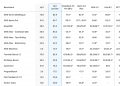
The Agentic Coding section of the official Hy4 preview benchmark appendix published by Tencent, a table comparing Hy3 and Hy4 preview against DeepSeek V4 Pro 0813, Qwen 3.8 Max, GLM 5.3, Kimi K3, GPT 5.6 Sol and Claude Opus 5 across SWE-bench Multilingual, SWE-bench Pro, DeepSWE, three SWE Atlas tasks, SWE-Marathon, Terminal-Bench 2.1, NL2Repo-Bench, CyberGym, ProgramBench, PostTrainBench and Harbor-Index.

Tencent’s 770B Hy4 tops one benchmark row in 46

3 September 2026
Answer card: Qwen 3.7 Max is API-only and cannot run locally yet; the open Qwen models (Qwen 3.6 27B, qwen3:8b to 32b) run offline via Ollama.

Qwen 3.7 local: what you can actually run offline

22 June 2026
Answer card: JWTs are not encrypted, anyone can read them; the signature proves who issued the token, not who may read it.

Are JWTs encrypted? No, and the difference will bite you

0
Answer card: a random 8 character password falls in under 2 hours offline, while 16 random characters hold for 1.4 trillion years at the same speed.

How long does it take to crack a password in 2026?

0
Answer card: three DNS records decide if your mail lands or bounces; SPF lists allowed senders, DKIM signs messages, DMARC sets the failure policy.

SPF, DKIM and DMARC explained: the records your email needs

0
Answer card stating that Qwen3.8-Omni-Flash launched on 17 September 2026 as an API only model on Alibaba Cloud Model Studio, taking text, images, audio and video in a 1M token context and returning text only, priced at 0.15 dollars per million input tokens for every modality and 0.47 dollars per million output tokens in the international regions, with no open weights published and the Qwen-Live Harness GitHub repository returning 404.

Qwen3.8-Omni-Flash bills audio at $0.15 and ships no weights

18 September 2026
Answer card stating that on 15 September 2026 AWS said it is unable to restore access to resources and data hosted exclusively in the Middle East Bahrain region me-south-1 and in the mec1-az2 zone of the UAE region, because the damage spanned multiple Availability Zones and exceeded what multi-AZ services are designed to withstand.

AWS can’t restore me-south-1, six months after the drone strikes

17 September 2026
Answer card stating that Google released Gemini 3.8 Live and Gemini 3.8 Live Extended Thinking on 15 September 2026 at 3 dollars per million audio input tokens and 12 dollars out, that the thinking model requires asynchronous tools, and that Artificial Analysis scores it 82.6 on its Speech to Speech Quality Index.

Gemini 3.8 Live Extended Thinking rejects any tool that blocks

16 September 2026
  • About
  • Contact
  • Privacy
  • Legal

Copyright © 2026 Stephane Cardon.

Welcome Back!

Login to your account below

Forgotten Password?

Retrieve your password

Please enter your username or email address to reset your password.

Log In
No Result
View All Result
  • Home
  • Articles
    • Security
    • Network
    • Dev
    • Sysadmin
    • SEO
    • Email & DNS
  • Tools
    • Network tools: free, fast, no signup
    • Security tools: free, fast, no signup
    • Developer tools: free, fast, no signup
    • Sysadmin tools: free, fast, no signup
    • SEO tools: free, fast, no signup
    • Email & DNS tools: free, fast, no signup
  • Download
  • About

Copyright © 2026 Stephane Cardon.