
Sunday night, the World Cup final was on, and a number theorist at Anthropic was posting algebra instead of watching it. Levent Alpoge dropped a single polynomial map on X and said the Jacobian Conjecture, open since 1939, is false. He thanks a friend he calls akhil for the nudge and Claude Fable 5 for the assist. So did an AI just kill an 85-year-old problem? Not exactly, and the real version is better than the headline. Here's what we can confirm: the map lives in three complex dimensions, and its Jacobian determinant works out to a nonzero constant while the map still sends three different points to one image. That last part is the thing the conjecture said couldn't happen. What we can't confirm is whether it survives peer review. It isn't in the official record. Not yet.
The short answer
On Sunday July 19, Anthropic number theorist Levent Alpoge posted an explicit polynomial map on X that he says breaks the Jacobian Conjecture, a problem open since 1939, and he credits Claude Fable 5 for the construction. The map sits in three complex dimensions, keeps a nonzero constant Jacobian, and still collapses three different points onto one image. It’s public and anyone can check it. It is not peer-reviewed, so the record still calls the conjecture open.
So did an AI disprove it?
Short answer: not officially, and probably don’t tell your algebra professor it’s settled.
What actually happened is narrower and, we think, more interesting. A working mathematician posted a single explicit polynomial map and claimed it’s a counterexample. He built it with help from Claude Fable 5, Anthropic’s reasoning model. The map is right there in the open, so unlike most “AI solved math” headlines, this one you can poke at yourself. Drop it into a computer algebra system and check.
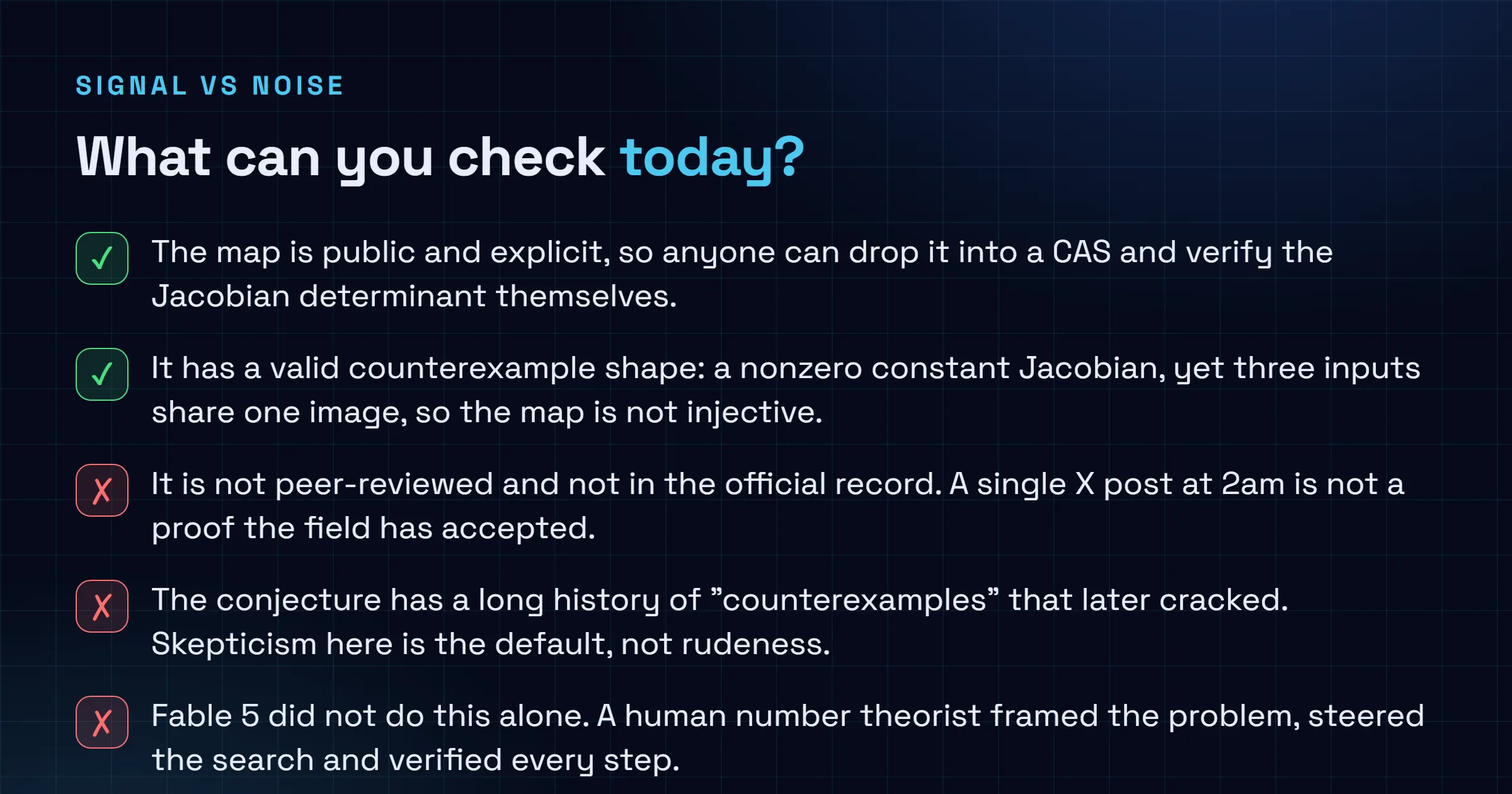
The conjecture is not marked false in the literature. It won’t be until other people reproduce the check, a paper goes up, and the field nods. That process takes weeks at least. So the accurate headline is “candidate counterexample posted, under review”, which is duller and true.
What the conjecture actually says
Ott-Heinrich Keller asked this back in 1939. Take a polynomial map that sends complex n-space to itself. Compute its Jacobian, the matrix of partial derivatives, and take the determinant. If that determinant is a nonzero constant everywhere, is the map guaranteed to be invertible by another polynomial?
For one variable, yes, it’s proven. For two or more variables it had been open for 85 years, which is a long time for something that sounds almost simple. Plenty of people thought it was true. A counterexample needs one thing: a map with that nonzero constant Jacobian that still fails to be invertible.
Alpoge’s map fails in the bluntest possible way. It isn’t even one-to-one.
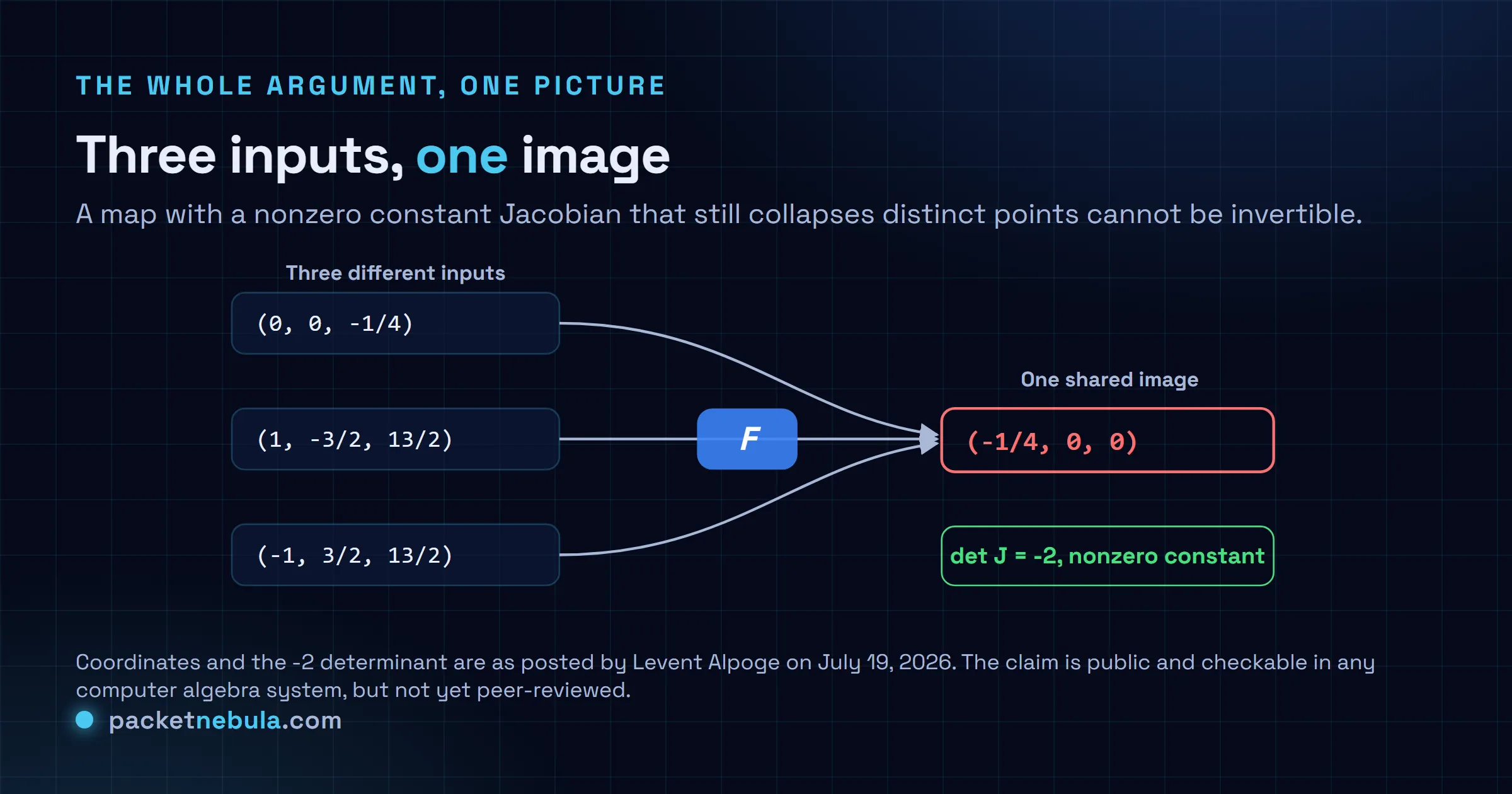
Three separate points, (0, 0, -1/4), (1, -3/2, 13/2) and (-1, 3/2, 13/2), all land on (-1/4, 0, 0). The Jacobian determinant of his map works out to a constant, -2, per the post. If both of those hold, the conjecture is broken, because an invertible map never sends two different inputs to the same place, let alone three. That’s the entire case, and its simplicity is what makes people both excited and nervous.
What Fable 5 did, and what it didn’t
Here’s the part worth being precise about. Alpoge did not type “disprove the Jacobian Conjecture” and hit enter.
By his own account and the reporting around it, he framed the problem, steered the search toward a specific shape of counterexample, and checked the algebra himself, reportedly through Wolfram Alpha. Fable 5 generated the candidate construction and worked the algebra under time pressure. His note thanked the model for “working during the world cup final”, which is a very human way to describe a very unglamorous grind. The math still had to be verified line by line by someone who could tell a real result from a confident-looking wrong one.
So this isn’t a machine handing down a theorem. It’s a number theorist using a strong model the way you’d use an extremely fast, occasionally reckless collaborator. That distinction matters, and it’s the one the hype usually flattens. If you’ve been following how Fable 5’s effort dial trades compute for depth, this is that idea pushed to a genuinely hard target.
Why the skepticism is healthy
The Jacobian Conjecture has a graveyard. Over the decades it’s attracted a steady stream of claimed proofs and claimed counterexamples, and a lot of them looked fine until someone found the crack. Announcing a big result by tweet, at 2am, during a football final, is not how the field usually blesses these things. None of that makes it wrong. It just means the burden of proof sits exactly where it should, on the claim, not on the doubters.
The good news is the format. Because Alpoge published the actual map instead of a vibe, the verification is unusually fast and unusually public. People started running the determinant within hours. That’s the healthiest possible version of this: a concrete object anyone can falsify, not a press release.
What this means if you actually use these models
Strip away the 85 years and there’s a practical lesson for anyone shipping with an LLM.
The model was useful here because a genuine expert was in the loop, feeding it a well-posed question and throwing away everything that didn’t check out. That’s the whole trick. Fable 5 didn’t know the conjecture was famous, and it didn’t need to. It needed a person who could pose the problem sharply and verify the output ruthlessly. Take either of those away and you get plausible nonsense, which is the failure mode we all keep relearning.
I’ll admit I want this one to hold, partly because the story is fun and partly because a cleanly checkable counterexample would be a lovely proof point for AI-assisted math. But wanting it doesn’t make it true, and the honest position today is a shrug with raised eyebrows. Bookmark the map. Wait for the paper. If it survives, that’s the news. If it cracks, that’s also the news, and either way you learned something about where these tools help and where they don’t.
Sources: Levent Alpoge’s post as amplified by mathematician Jared Duker Lichtman on X, plus reporting from OfficeChai and the Hacker News discussion, July 2026. Background on the problem is from the Jacobian conjecture entry. The counterexample is a claim posted to social media and is not peer-reviewed; the Jacobian Conjecture remains open in the official record until the map is independently verified.
Frequently asked questions
What is the Jacobian Conjecture?
It is a problem in algebraic geometry posed by Ott-Heinrich Keller in 1939. It asks whether every polynomial map from complex n-space to itself with a nonzero constant Jacobian determinant must be invertible by another polynomial map. It is proven for one variable and had stayed open for two or more.
Did Claude Fable 5 disprove the Jacobian Conjecture?
Not on the official record. On July 19, 2026, Anthropic number theorist Levent Alpoge posted an explicit polynomial map in three complex dimensions that he says is a counterexample, crediting Fable 5 for the construction. It is public and checkable, but it has not been peer-reviewed, so mathematicians still list the conjecture as open until the claim is verified.
What exactly is the counterexample?
A polynomial map from C^3 to C^3 whose Jacobian determinant is the nonzero constant -2, yet which is not injective: in the posted map the three points (0, 0, -1/4), (1, -3/2, 13/2) and (-1, 3/2, 13/2) all map to (-1/4, 0, 0). A map that collapses distinct inputs to one image cannot be invertible, which is what the conjecture ruled out.
What did the AI do, and what did the human do?
Alpoge framed the problem and verified the algebra, reportedly with Wolfram Alpha, while Fable 5 produced a candidate construction and algebra steps under time pressure. It is a mathematician using an AI as a research tool, not an AI proving a theorem on its own.
Does this mean we can trust AI on hard math now?
No, and this case shows why. The output was only useful because an expert could check every line and discard what did not hold. For a genuinely novel claim like this one, the verification and the eventual peer-reviewed paper are what settle it, not the model and not a post at two in the morning.


