
• Latest
  • Trending
  • All
NVIDIA Spectrum-X Ethernet switch hardware for AI factories, the platform that the Spectrum-6 102.4 Tb/s switch silicon plugs into, shown in NVIDIA corporate branding.

NVIDIA Spectrum-6: what 102.4 Tb/s Ethernet changes

23 July 2026
Answer card stating that OpenAI published its research acceleration measurements on 6 September 2026, that as of mid August 2026 its research organisation logged 3.1 agent workdays of coding agent runtime for every workday of human labour normalised to a standard eight hour day, and that OpenAI states this should not be read as a 3.1 times productivity gain because it measures runtime rather than delivered output.

OpenAI’s 3.1 agent-workdays per human day is not a 3.1x gain

7 September 2026
Answer card stating that Mullvad announced on 3 September 2026 that it is shutting down its public encrypted domain name system servers on 2 November 2026 and sponsoring the Quad9 Foundation instead, with 194.242.2.2 and its five sibling addresses all going away, and virtual private network customers unaffected.

Mullvad’s DNS servers go dark on 2 November, and Quad9 blocks no ads

5 September 2026
OpenAI announcement image for GPT-6 Astra, a spiral galaxy of white, blue and amber points of light curling around a bright core on a near black star field.

GPT-6 Astra lists at $10 and $50, 2.5x what GPT-5.6 Sol costs

6 September 2026
Google's official announcement image for the release, reading Introducing Gemini 3.8 Flash and 3.8 Flash Cyber in black type over a pale blue background with a blurred white chevron and the four colour Gemini spark below.

Gemini 3.8 Flash keeps the price and the 1 January cliff

3 September 2026
Answer card stating that Anthropic announced Enterprise Frontier Safeguards on 1 September 2026, that activity data used for misuse monitoring moves into cloud storage the customer controls under the customer own encryption keys, that Anthropic charges nothing for the feature while the cloud provider bills storage and egress, and that the phased rollout starts later in autumn 2026 with interim zero data retention on Fable 5 and Fable 5.1 for eligible customers.

Anthropic moves retention into your own cloud, for 30 days

3 September 2026
Official Google diagram of a client connection in three numbered steps: a DNS lookup with a query and an address, a TLS ClientHello and ServerHello, then a content exchange with a website. A callout on the DNS step reads 25% of global web traffic is now protected by encrypted DNS, and a callout beside an Android phone on the ClientHello step reads Android 17 supports ECH GREASE by default.

Android 17 hides the SNI, not your DNS or destination

3 September 2026
Still frame from the Claude Fable 5.1 launch video showing model-designed protein binders in orange docked against twelve grey target proteins, rendered as ESMFold2 structure predictions.

Claude Fable 5.1 breaks forced tool use, cuts cache 75%

1 September 2026
Answer card stating that on 31 August 2026 the European Commission designated ChatGPT a Very Large Online Search Engine under the Digital Services Act, the first conversational AI service classified that way, because it answers user prompts and queries including by searching the web, with OpenAI having declared roughly 159.1 million average monthly users in the European Union for ChatGPT search.

The EU now calls ChatGPT a very large search engine

3 September 2026
Answer card stating that on 31 August 2026 the Department of War added OpenAI ChatGPT Mil and Starshield AI Grok for Government to the GenAI.mil portal alongside Google Gemini, all three accredited at Impact Level 5 for Controlled Unclassified Information, with 1.7 million unique users onboarded out of roughly 3 million eligible personnel, and ChatGPT Mil currently serving GPT-5.4 Terra with GPT-5.6 Terra said to be rolling out.

ChatGPT Mil and Grok reached IL5 on GenAI.mil

3 September 2026
Answer card stating that Anthropic opened a research preview of the Model Hardware Standard on 27 August 2026, standardising the driver layer between an operating system and a laboratory instrument with read and write primitives plus discovery and safety limits, reachable through MCP as well as a command line and code files, with no public specification published.

Anthropic’s Model Hardware Standard is gated, and sits under MCP

3 September 2026
Official Cohere key art for the Parse 5 launch: the Cohere mark and the wordmark Parse with a superscript 5 in white, centred on a soft out of focus gradient of deep blue, violet and amber curves.

Cohere Parse 5 is $1.50 per 1,000 pages, on three of five dimensions

3 September 2026
Title card from the OpenAI announcement video: a man sits on a blue sofa in a loft with tall windows and potted plants, a laptop open on the coffee table in front of him, with the words WebMCP in ChatGPT in large white type across the lower left.

WebMCP in ChatGPT needs GPT-5.6 Sol or Terra

3 September 2026
  • About
  • Contact
  • Privacy
  • Legal
Tuesday, September 8, 2026
  • Login
Packet Nebula
  • Home
  • Articles
    • Security
    • Network
    • Dev
    • Sysadmin
    • SEO
    • Email & DNS
  • Tools
    • Network tools: free, fast, no signup
    • Security tools: free, fast, no signup
    • Developer tools: free, fast, no signup
    • Sysadmin tools: free, fast, no signup
    • SEO tools: free, fast, no signup
    • Email & DNS tools: free, fast, no signup
  • Download
  • About
No Result
View All Result
Packet Nebula
No Result
View All Result
Home Network

NVIDIA Spectrum-6: what 102.4 Tb/s Ethernet changes

by stephane
23 July 2026
in Network
0
NVIDIA Spectrum-X Ethernet switch hardware for AI factories, the platform that the Spectrum-6 102.4 Tb/s switch silicon plugs into, shown in NVIDIA corporate branding.
493
SHARES
1.4k
VIEWS
Share on FacebookShare on Twitter

So NVIDIA put a 102.4-terabit-per-second Ethernet switch on stage on July 21, and the number is doing a lot of heavy lifting. Here's the short answer: Spectrum-6 roughly doubles the per-chip bandwidth of the last generation, it's built for the Vera Rubin AI-factory platform, and its real headline isn't the terabits, it's co-packaged optics finally landing in a mainstream Ethernet switch. We went through NVIDIA's own numbers and the trade coverage, because a switch aimed at 100,000-GPU fabrics is not a switch for your rack, and the efficiency claims all carry quiet qualifiers. Worth pulling apart before anyone repeats the 102.4 on a slide.

The short answer

NVIDIA launched Spectrum-6 on July 21, a 102.4 Tb/s per-chip Ethernet switch for the Vera Rubin platform. It’s double the previous generation’s per-chip bandwidth, and the flagship SN6800 does 512 ports of 800G. The number everyone will quote is the terabits. The thing that actually matters is co-packaged optics arriving in a mainstream switch. Here’s how to read it without swallowing the marketing.
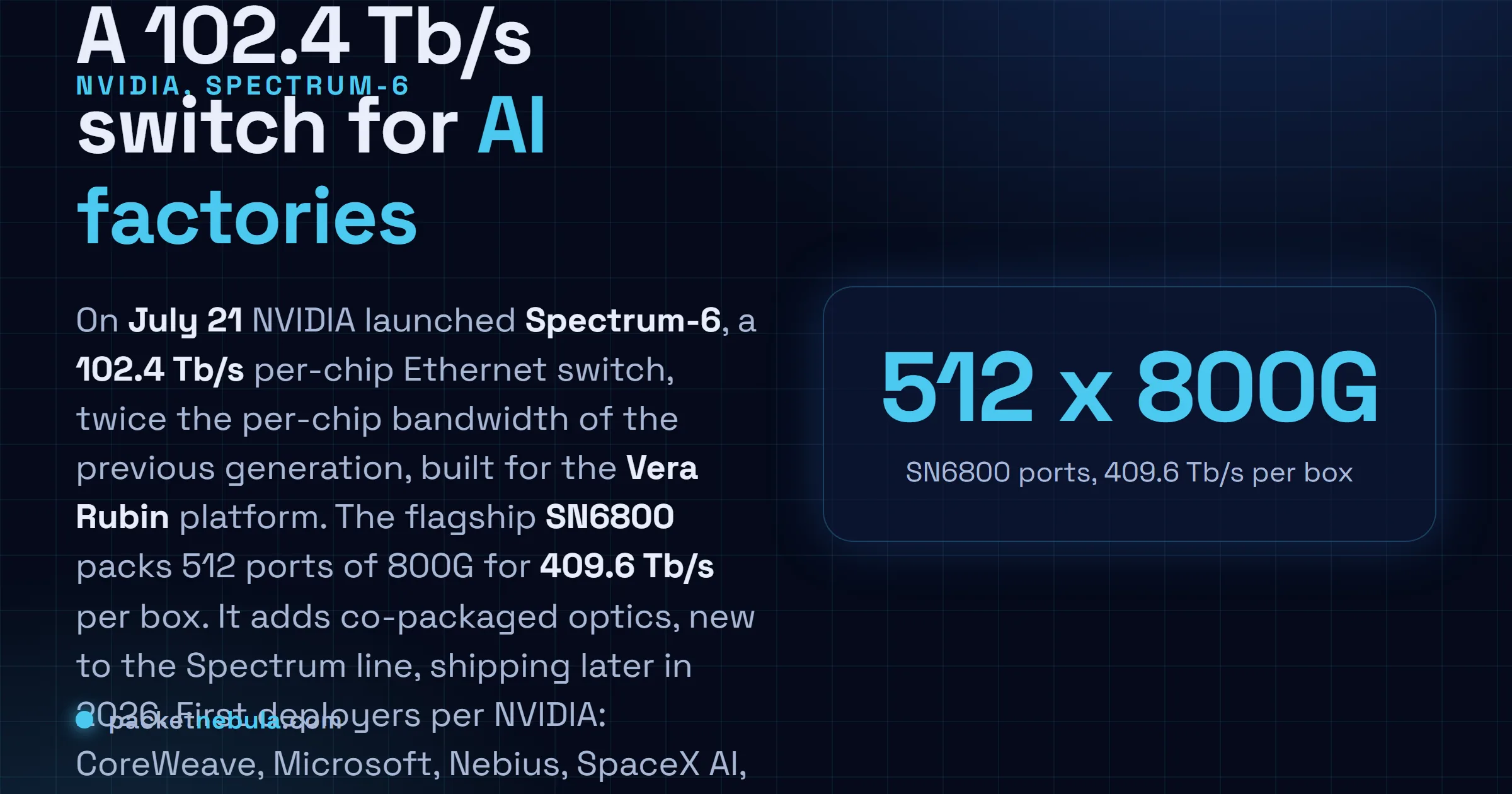
102.4 Tb/sper switch chip, 2x prior gen
512 x 800GSN6800 box, 409.6 Tb/s
CPOco-packaged optics, new here
Answer card: on July 21 2026 NVIDIA launched Spectrum-6, a 102.4 Tb/s per-chip Ethernet switch for the Vera Rubin platform, twice the previous generation, with the SN6800 doing 512 ports of 800G for 409.6 Tb/s per box, adding co-packaged optics that ship later in 2026, first deployers CoreWeave Microsoft Nebius SpaceX AI and Tesla.
The one-card version. A real switch, a real bandwidth jump, and a lot of qualifiers under the efficiency numbers.

What NVIDIA actually announced

A switch got twice as fast. That’s the honest one-liner.

On July 21, NVIDIA introduced Spectrum-6, the next generation of its Spectrum-X Ethernet switching. The one number it leads with: 102.4 Tb/s per switch chip, which NVIDIA describes as twice the capacity of the previous generation. It gets there with 200G PAM4 SerDes, the electrical signaling that lets each lane run faster. The flagship box, the SN6800, lines up 512 ports of 800G for 409.6 Tb/s of switching in a single chassis. There’s a smaller sibling too, the SN6810, at 128 ports of 800G.
NVIDIA Spectrum-X Ethernet networking hardware for AI factories, the platform family that the Spectrum-6 102.4 Tb/s switch silicon belongs to.
Image: NVIDIA (Spectrum-X Ethernet, the platform Spectrum-6 slots into)

This is the networking half of Vera Rubin, NVIDIA’s post-Blackwell platform. We wrote about what Vera Rubin actually is when Bristol Myers Squibb committed to a cluster, and the shape is the same here: the compute got the headlines, and the switch fabric that stitches those GPUs into one machine tends to get skipped. Spectrum-6 is that fabric.

The 102.4, read honestly

Here’s where people trip. 102.4 Tb/s is the aggregate of a single switch ASIC, not a port speed.

Per port, you’re getting 800G. The 102.4 is what one chip can move across all its ports at once. And the 409.6 Tb/s figure you’ll also see quoted is a different unit again: that’s a whole SN6800 box, multiple switch chips behind 512 ports. So if you line up “102.4” and “409.6” in the same sentence, you’re mixing per-chip and per-box. Not wrong, just two scales.
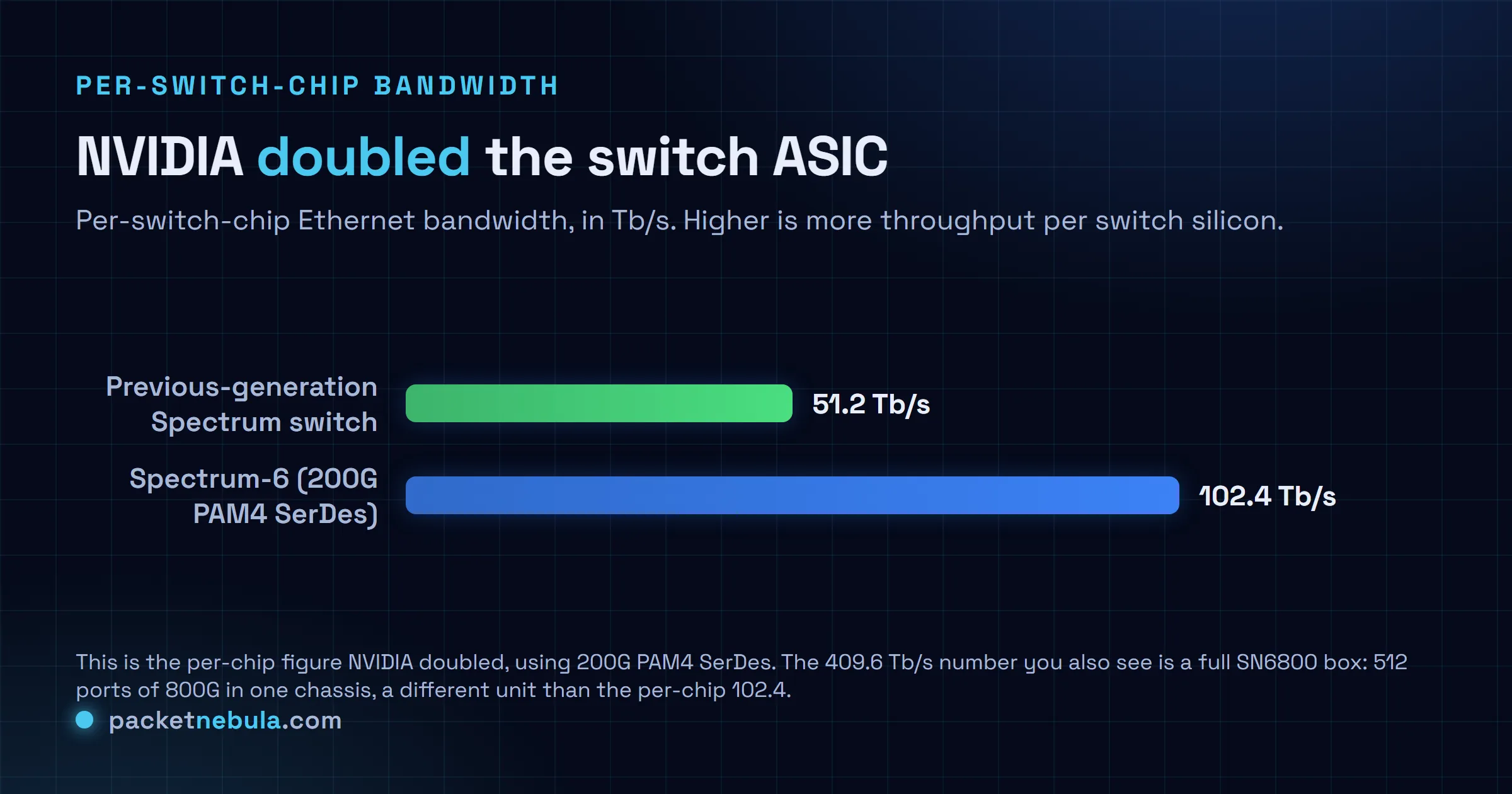
Bar comparison of per-switch-chip Ethernet bandwidth: previous-generation Spectrum switch at 51.2 Tb/s versus Spectrum-6 at 102.4 Tb/s using 200G PAM4 SerDes, a clean doubling.
The per-chip doubling, which is the honest apples-to-apples comparison. Box-level numbers are a separate scale.

The doubling itself is real and it’s the boring, solid part of the announcement. Two generations of SerDes plus a bigger switch die genuinely gets you there. What I’d push back on is treating “2x bandwidth” as “2x anything you care about.” Fabric bandwidth is a ceiling, not a throughput guarantee. Whether your training run goes faster depends on collective patterns, congestion control, and about ten things that aren’t the switch.

The part that’s actually new: co-packaged optics

Strip the terabits away and here’s the real story. Spectrum-6 brings co-packaged optics, CPO, into NVIDIA’s mainstream Ethernet line.

Normally the bit that turns electrical signals into light lives in pluggable transceivers, the little modules you slot into the front of a switch. At gigascale, a fabric has hundreds of thousands of those, and every one is a part that can die, draw power, and generate heat. CPO moves the optics into the switch package itself. Fewer discrete pluggables, fewer failure points, less power per bit moved.

NVIDIA puts hard multipliers on this: up to 5x higher power efficiency, and 10x improvement in mean time between incidents by cutting the number of optical components that can fail. Those are believable in direction. They’re also NVIDIA’s own numbers, measured against “previous architectures,” and they attach to the photonics variant specifically, not the plain pluggable version. So take the shape of the claim, hold the exact multiplier at arm’s length.

Who this is for (probably not you)

Let’s be blunt about scale. The 95% network efficiency figure NVIDIA quotes is at deployments “exceeding 100,000 GPUs.”

That’s the tell. This is spine and super-spine switching for AI factories, the kind of build where the power budget itself is the constraint, not the enterprise top-of-rack most of us actually touch. The named first deployers make it obvious: CoreWeave, Microsoft, Nebius, SpaceX AI, Tesla. Those are hyperscale and neocloud operators wiring up GPU counts with a lot of zeros. If you run a normal data center, Spectrum-6 is beautifully overkill.

So what’s the takeaway for the rest of us? The direction, not the SKU. Co-packaged optics moving from demos into shipping switch products is the signal worth filing. It’s the kind of change that shows up in your world two or three years later, quietly, as the transceiver failures you used to babysit stop happening. For now, though, this is a switch for people building million-GPU machines. Read the CPO trend. Skip the purchase order.
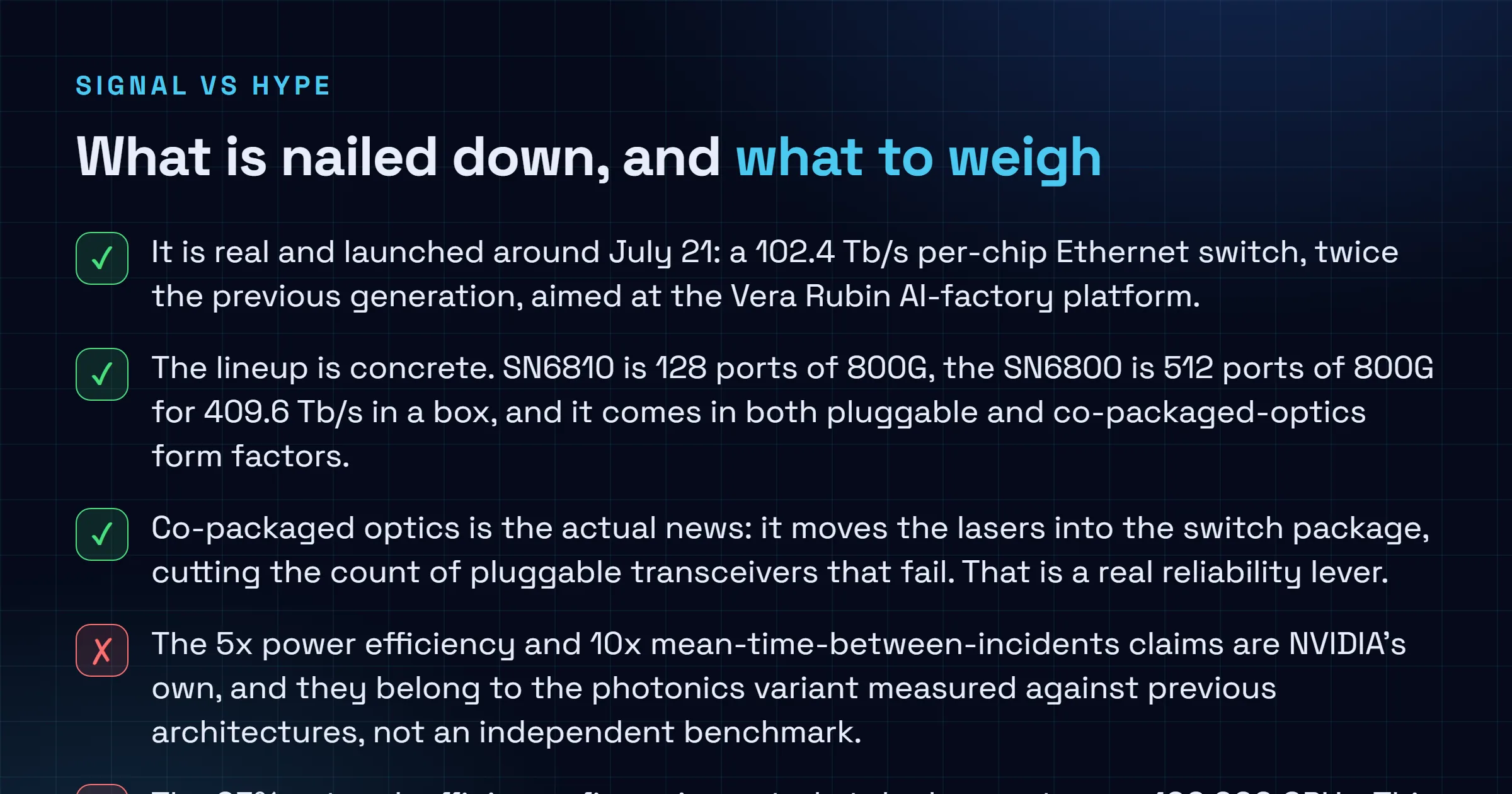
Checklist for reading the Spectrum-6 launch: it is real and 102.4 Tb/s per chip is confirmed, the SN6810 and SN6800 port counts are concrete, co-packaged optics is the genuine news, but the 5x power and 10x reliability figures are NVIDIA's own photonics numbers, the 95% efficiency is at 100000-plus GPUs, and the named deployers are intent not proof.
How to parse the Spectrum-6 announcement before you repeat the 102.4 on a slide.

Sources: NVIDIA Blog, NVIDIA Technical Blog (Spectrum-X Photonics) and SDxCentral, July 2026. The 102.4 Tb/s per-chip bandwidth, the 200G PAM4 SerDes, the SN6810 (128x800G) and SN6800 (512x800G, 409.6 Tb/s) port counts, the co-packaged and pluggable optics form factors, and the up-to-5x power efficiency, 10x mean-time-between-incidents and 95%-at-100,000-GPU figures are attributed to NVIDIA and are vendor claims, not independently benchmarked. The named first deployers (CoreWeave, Microsoft, Nebius, SpaceX AI, Tesla) are as listed by NVIDIA.

Frequently asked questions

What is NVIDIA Spectrum-6?

It is NVIDIA's new Ethernet switch generation, announced July 21, 2026. Each switch chip pushes 102.4 Tb/s, about double the previous generation, using 200G PAM4 SerDes. It is the switching layer for the Vera Rubin AI-factory platform and part of the Spectrum-X line. The flagship SN6800 box carries 512 ports of 800G, for 409.6 Tb/s in one chassis.

What does the 102.4 Tb/s number actually mean?

It is the aggregate bandwidth of a single switch ASIC, not a per-port speed. Per-port you get 800G (or 200G with more ports). So 102.4 Tb/s is the total a chip can move across all its ports at once. The 409.6 Tb/s you also see is a full SN6800 box with four of those switch chips' worth of capacity behind 512 ports. Two different units, easy to conflate.

What are co-packaged optics and why do they matter?

Normally the optics that turn electrical signals into light sit in pluggable transceivers you slot into the front of the switch. Co-packaged optics, or CPO, move that conversion into the switch package itself. Fewer separate pluggables means fewer parts that can fail and less power burned per bit. NVIDIA says it is worth up to 5x power efficiency and 10x mean time between incidents, though those are its own figures for the photonics variant.

Is Spectrum-6 something I would buy for my data center?

Almost certainly not, unless you run a very large GPU cluster. This is spine and super-spine switching designed for AI factories in the tens of thousands of GPUs and up, where the 95% efficiency claim is quoted at over 100,000 GPUs. For a normal enterprise rack it is wildly oversized. The useful takeaway is the technology direction, CPO going mainstream, not a purchase order.

When does Spectrum-6 ship?

NVIDIA has named CoreWeave, Microsoft, Nebius, SpaceX AI and Tesla as among the first to deploy it. The co-packaged-optics versions are expected to ship later in 2026, with pluggable versions reaching early customers first. So it is real hardware with named takers, but broad availability is still ramping rather than something you can order today.

Tags: datacenterethernetnetworkingnewsnvidiaspectrum-x
Share197Tweet123
stephane

stephane

  • Trending
  • Comments
  • Latest
The Agentic Coding section of the official Hy4 preview benchmark appendix published by Tencent, a table comparing Hy3 and Hy4 preview against DeepSeek V4 Pro 0813, Qwen 3.8 Max, GLM 5.3, Kimi K3, GPT 5.6 Sol and Claude Opus 5 across SWE-bench Multilingual, SWE-bench Pro, DeepSWE, three SWE Atlas tasks, SWE-Marathon, Terminal-Bench 2.1, NL2Repo-Bench, CyberGym, ProgramBench, PostTrainBench and Harbor-Index.

Tencent’s 770B Hy4 tops one benchmark row in 46

3 September 2026
Answer card: Proton Lumo 2.0 is private by policy, not by locality. Saved history is locked so even Proton cannot read it, but the prompt is decrypted on a Proton EU server to answer it, then forgotten.

Proton Lumo 2.0 review: how private is it, really?

3 September 2026
Answer card: Apple released iOS 26.6 and iPadOS 26.6 on 27 July 2026 with a release note covering bug fixes, security updates and an optimized Spotlight index to prepare for iOS 27, the index the rebuilt Siri reads for personal context.

iOS 26.6 is out: the Spotlight index it quietly builds

27 July 2026
Answer card: JWTs are not encrypted, anyone can read them; the signature proves who issued the token, not who may read it.

Are JWTs encrypted? No, and the difference will bite you

0
Answer card: a random 8 character password falls in under 2 hours offline, while 16 random characters hold for 1.4 trillion years at the same speed.

How long does it take to crack a password in 2026?

0
Answer card: three DNS records decide if your mail lands or bounces; SPF lists allowed senders, DKIM signs messages, DMARC sets the failure policy.

SPF, DKIM and DMARC explained: the records your email needs

0
Answer card stating that OpenAI published its research acceleration measurements on 6 September 2026, that as of mid August 2026 its research organisation logged 3.1 agent workdays of coding agent runtime for every workday of human labour normalised to a standard eight hour day, and that OpenAI states this should not be read as a 3.1 times productivity gain because it measures runtime rather than delivered output.

OpenAI’s 3.1 agent-workdays per human day is not a 3.1x gain

7 September 2026
Answer card stating that Mullvad announced on 3 September 2026 that it is shutting down its public encrypted domain name system servers on 2 November 2026 and sponsoring the Quad9 Foundation instead, with 194.242.2.2 and its five sibling addresses all going away, and virtual private network customers unaffected.

Mullvad’s DNS servers go dark on 2 November, and Quad9 blocks no ads

5 September 2026
OpenAI announcement image for GPT-6 Astra, a spiral galaxy of white, blue and amber points of light curling around a bright core on a near black star field.

GPT-6 Astra lists at $10 and $50, 2.5x what GPT-5.6 Sol costs

6 September 2026
  • About
  • Contact
  • Privacy
  • Legal

Copyright © 2026 Stephane Cardon.

Welcome Back!

Login to your account below

Forgotten Password?

Retrieve your password

Please enter your username or email address to reset your password.

Log In
No Result
View All Result
  • Home
  • Articles
    • Security
    • Network
    • Dev
    • Sysadmin
    • SEO
    • Email & DNS
  • Tools
    • Network tools: free, fast, no signup
    • Security tools: free, fast, no signup
    • Developer tools: free, fast, no signup
    • Sysadmin tools: free, fast, no signup
    • SEO tools: free, fast, no signup
    • Email & DNS tools: free, fast, no signup
  • Download
  • About

Copyright © 2026 Stephane Cardon.