
• Latest
  • Trending
  • All
Answer card: the Cyberspace Administration of China published seven registered on-device generative AI services on July 15 2026, Apple Intelligence among them with Alibaba Qwen handling text and images, but no launch date was given.

Apple Intelligence China: approved, not shipped

17 July 2026
Answer card stating that Qwen-Image-2.1, released on 20 September 2026, ships open weights with a 7 billion parameter diffusion transformer, a Qwen3-VL 8B text encoder and an RGBA VAE totalling about 33 gigabytes in BF16, under the Qwen Research License that limits use to research or evaluation and requires a separate commercial licence, unlike the Apache 2.0 licence of Qwen-Image 1.0.

Qwen-Image-2.1 brings the weights back, but not the Apache licence

21 September 2026
Answer card stating that Ternary Bonsai 2 27B, released by PrismML on 17 September 2026 under Apache 2.0, packs Qwen3.8 27B into 5.95 gigabytes at 1.72 bits per weight, keeps 98.2 percent of the 14-benchmark average, about 75 percent on SWE-bench Verified and Terminal-Bench 2.1, and needs PrismML's llama.cpp fork to run.

Does Bonsai 2 27B really keep 98% of Qwen3.8 in 5.95 GB?

20 September 2026
Answer card stating that Jev 1.13 from TypeSafe AI is a decision model in early access since 15 September 2026 that returns typed probabilities instead of text, priced at 42 dollars per billion input tokens with output tokens free, answering in 70 to 500 milliseconds, with a 64K token request budget, text input only, and a documented list of things it does badly, including counting and dates.

Jev 1.13 bills $42 a billion tokens, and it can’t count

19 September 2026
Answer card stating that Qwen3.8-Omni-Flash launched on 17 September 2026 as an API only model on Alibaba Cloud Model Studio, taking text, images, audio and video in a 1M token context and returning text only, priced at 0.15 dollars per million input tokens for every modality and 0.47 dollars per million output tokens in the international regions, with no open weights published and the Qwen-Live Harness GitHub repository returning 404.

Qwen3.8-Omni-Flash bills audio at $0.15 and ships no weights

18 September 2026
Answer card stating that on 15 September 2026 AWS said it is unable to restore access to resources and data hosted exclusively in the Middle East Bahrain region me-south-1 and in the mec1-az2 zone of the UAE region, because the damage spanned multiple Availability Zones and exceeded what multi-AZ services are designed to withstand.

AWS can’t restore me-south-1, six months after the drone strikes

17 September 2026
Answer card stating that Google released Gemini 3.8 Live and Gemini 3.8 Live Extended Thinking on 15 September 2026 at 3 dollars per million audio input tokens and 12 dollars out, that the thinking model requires asynchronous tools, and that Artificial Analysis scores it 82.6 on its Speech to Speech Quality Index.

Gemini 3.8 Live Extended Thinking rejects any tool that blocks

16 September 2026
Answer card summarising the Atria Dawn Preview release: 744B GLM-5.2 base, MIT licence, 1.5 TB BF16 and 756 GB FP8 checkpoints, 256K context, top on five of sixteen benchmark rows and trailing on SWE-bench Pro.

Atria Dawn Preview is 744B under MIT, and the BF16 weighs 1.5 TB

15 September 2026
Answer card stating that OpenAI released the Agents API in public beta on 10 September 2026 with no separate fee, billed through model tokens, tool calls and hosted sandbox time, with a choice of OpenAI hosted, self hosted or partner sandboxes, US only data residency and no Zero Data Retention support.

OpenAI’s Agents API has no fee, no ZDR and a one hour sandbox clock

14 September 2026
Answer card: Sakana Fugu Max at $2 and $6 per million tokens, Fugu Ultra v2 unchanged at $5 and $30, and Sakana saying Ultra v2 scores without Fable 5 or GPT-6 Astra in its pool.

Fugu Max costs $2 and $6 while Fugu Ultra v2 runs without Fable 5

13 September 2026
Answer card stating that DeepSeek released DeepSeek-V4.1-Flash on 10 September 2026 as a 552 billion parameter mixture of experts model with a new causal encoder decoder architecture that activates 8 billion parameters on input and 16 billion on output, with native vision, a one million token context and MIT licensed weights, that the API model name is now deepseek-flash at 0.15 dollars per million input tokens and 0.60 dollars per million output tokens off peak, and that DeepSeek announced V4 Pro would be routed to V4.1-Flash from 14 September and reversed that on 11 September.

DeepSeek V4.1-Flash arrived, and the V4 Pro retirement lasted a day

12 September 2026
Answer card stating that Cognition released SWE-2 on 10 September 2026, a coding model post-trained from Kimi K3, scoring 50.0 percent on FrontierCode 1.1 Main against 50.9 percent for Claude Fable 5.1 and 27.3 percent on Terminal-Bench 4 against 55.8 percent, available only inside Devin.

SWE-2 trails Fable 5.1 by one point, and by 28 on Terminal-Bench 4

11 September 2026
Answer card for Meta Muse, free to 100 million tokens a week then $20 a month, launched 8 September 2026 for United States adults only, running in a dedicated per user virtual machine.

Does Meta Muse do enough to earn your inbox and a card on file?

9 September 2026
  • About
  • Contact
  • Privacy
  • Legal
Monday, September 21, 2026
  • Login
Packet Nebula
  • Home
  • Articles
    • Security
    • Network
    • Dev
    • Sysadmin
    • SEO
    • Email & DNS
  • Tools
    • Network tools: free, fast, no signup
    • Security tools: free, fast, no signup
    • Developer tools: free, fast, no signup
    • Sysadmin tools: free, fast, no signup
    • SEO tools: free, fast, no signup
    • Email & DNS tools: free, fast, no signup
  • Download
  • About
No Result
View All Result
Packet Nebula
No Result
View All Result
Home Dev

Apple Intelligence China: approved, not shipped

by stephane
17 July 2026
in Dev
0
Answer card: the Cyberspace Administration of China published seven registered on-device generative AI services on July 15 2026, Apple Intelligence among them with Alibaba Qwen handling text and images, but no launch date was given.
493
SHARES
1.4k
VIEWS
Share on FacebookShare on Twitter

Twenty-two months. That is how long an iPhone bought in Shanghai has sat with the Apple Intelligence menu dark while the Huawei next to it happily rewrote its owner's emails. That wait now has an end in sight: China's Cyberspace Administration published a batch of registered on-device generative AI services on July 15, and Apple Intelligence is on it, with Alibaba's Qwen handling text and images for Chinese users. Before you file that as a launch, don't. The regulator's own state paper says flatly that registration isn't a rollout, and nobody has named a date. So we went digging into what the paperwork actually covers. Honestly, it's more interesting than the headline.

The short answer

China’s regulator published Apple Intelligence in a batch of seven registered on-device AI services, with Alibaba’s Qwen doing text and images for Chinese users and Baidu confirmed on the visual side. It’s a compliance filing, not a rollout. Global Times says so outright. Nothing changes outside mainland China, and the real story is that Apple now ships a different model stack per region.
July 15CAC batch published
7services registered
No dategiven for launch
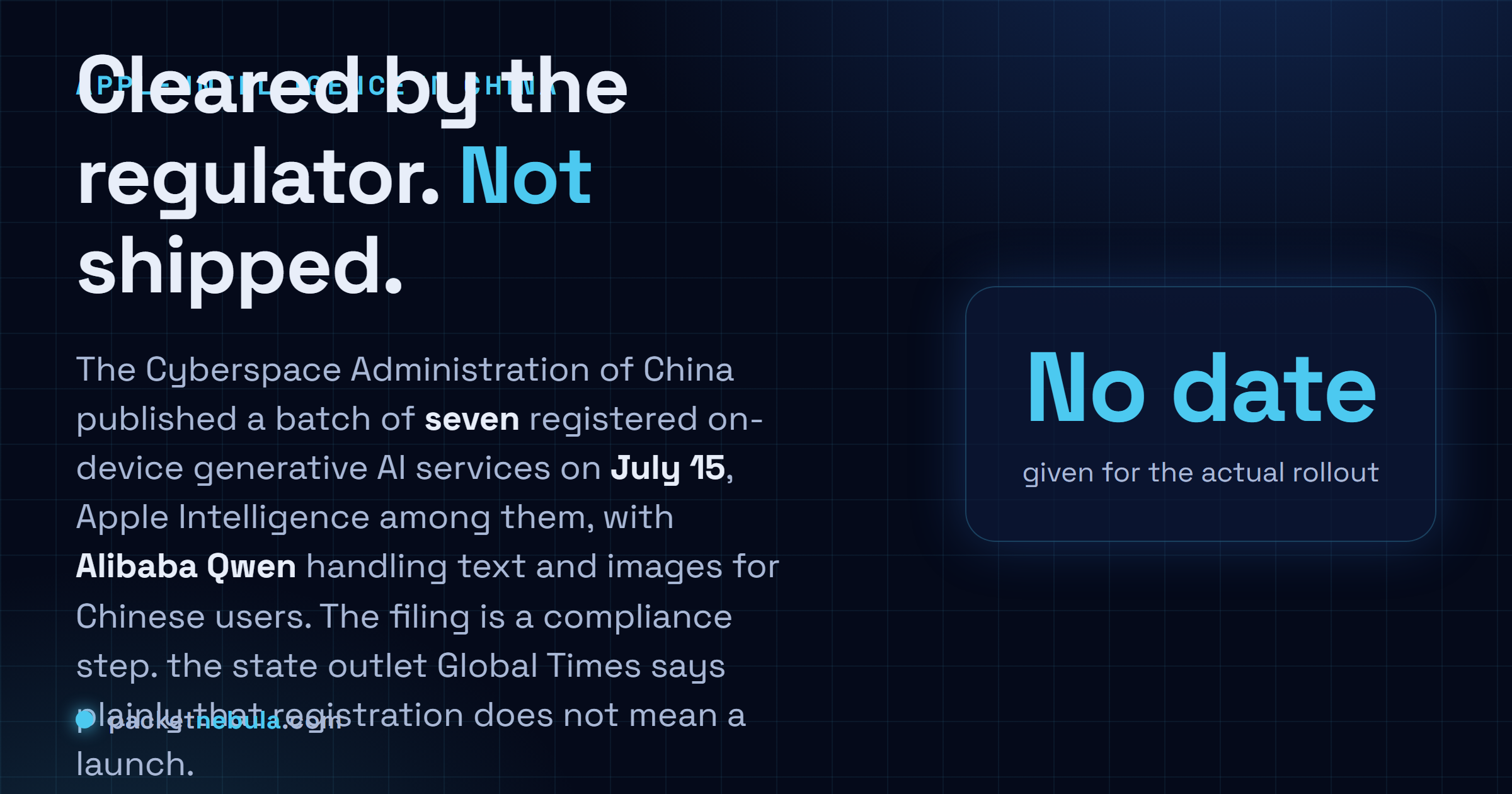
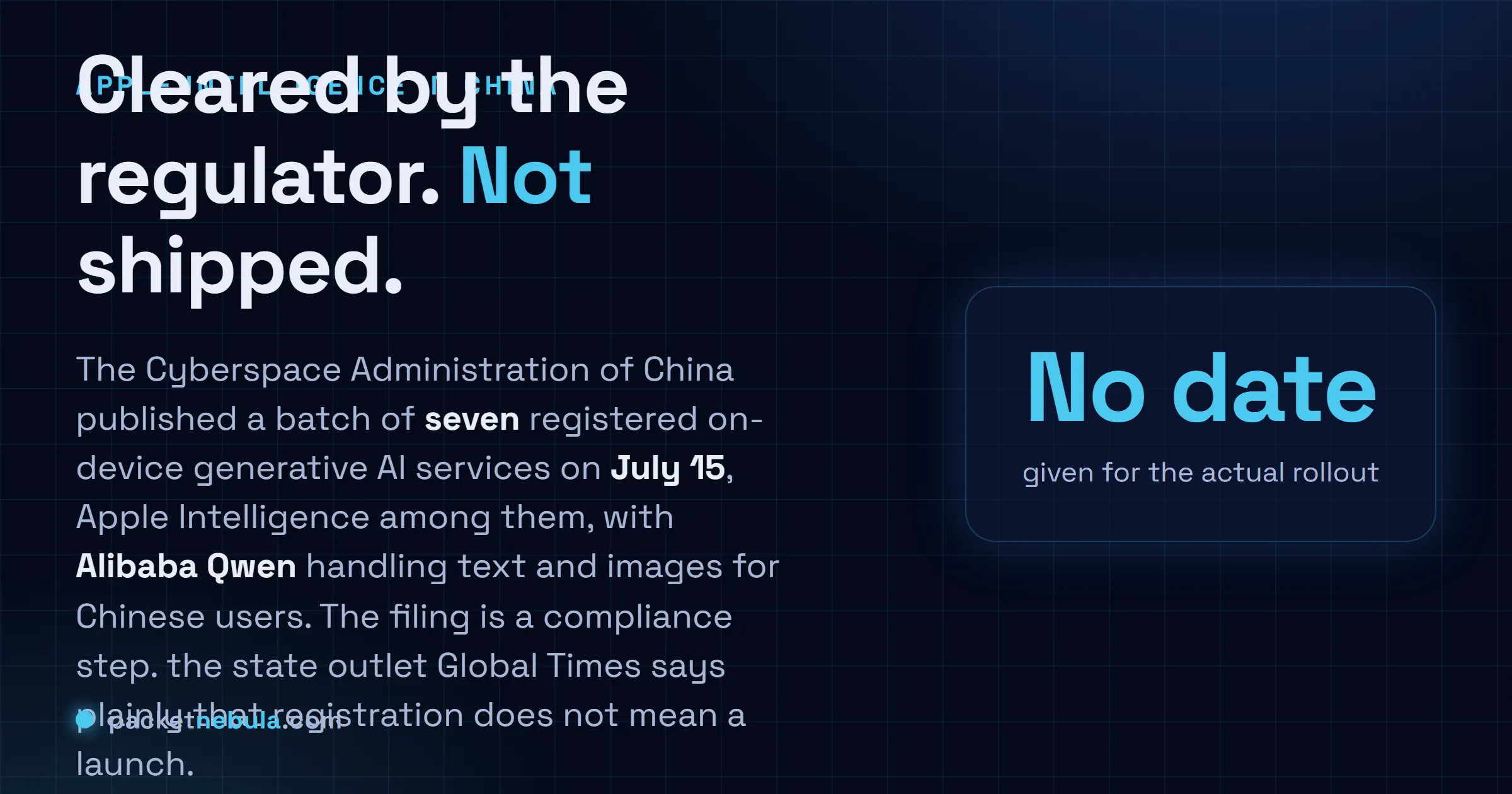
Answer card: the Cyberspace Administration of China published seven registered on-device generative AI services on July 15, Apple Intelligence among them with Alibaba Qwen handling text and images, but no launch date was given.
The one-card version. A real unblock, wrapped in real vagueness.

What actually happened

Paperwork cleared. On July 15 the Cyberspace Administration of China published registration information for seven newly added generative AI services running on mobile devices, and Apple Intelligence was among them. Reuters picked it up the same day. The filing sits under China’s Interim Measures for the Management of Generative AI Services, the regime that says a generative AI service offered to the Chinese public has to be registered before it can be offered at all.

One wrinkle worth flagging, because it tripped us up. Global Times reports the notice puts Apple Intelligence’s own registration date at July 8, while the batch itself surfaced publicly on the 15th. Small gap, and neither Apple nor the CAC has explained it. We’d treat the 15th as the date the world found out, not the date the stamp landed.

Apple has said nothing. Not a word, which for a company that has spent two years telling Chinese customers the feature was coming “subject to regulatory approval” is a little loud.

The bit everyone is getting wrong

You’ll see “Apple was the only foreign brand on the list” in a lot of coverage. It isn’t right. The reported seven are Apple Intelligence, Huawei’s Xiaoyi, OPPO’s AndesGPT, vivo’s Blue Heart on-device model, Xiaomi’s Surge AI, Samsung’s Galaxy AI, and Nubia’s Doubao Phone model. Samsung is on there. That’s two foreign brands.

I might be splitting hairs, but the framing matters. This wasn’t a special carve-out where Beijing let exactly one Western company through the door. It was the first proper batch under a licensing regime for on-device AI, and it happened to include the two foreign phone makers that sell in volume there. Less geopolitics, more filing cabinet.
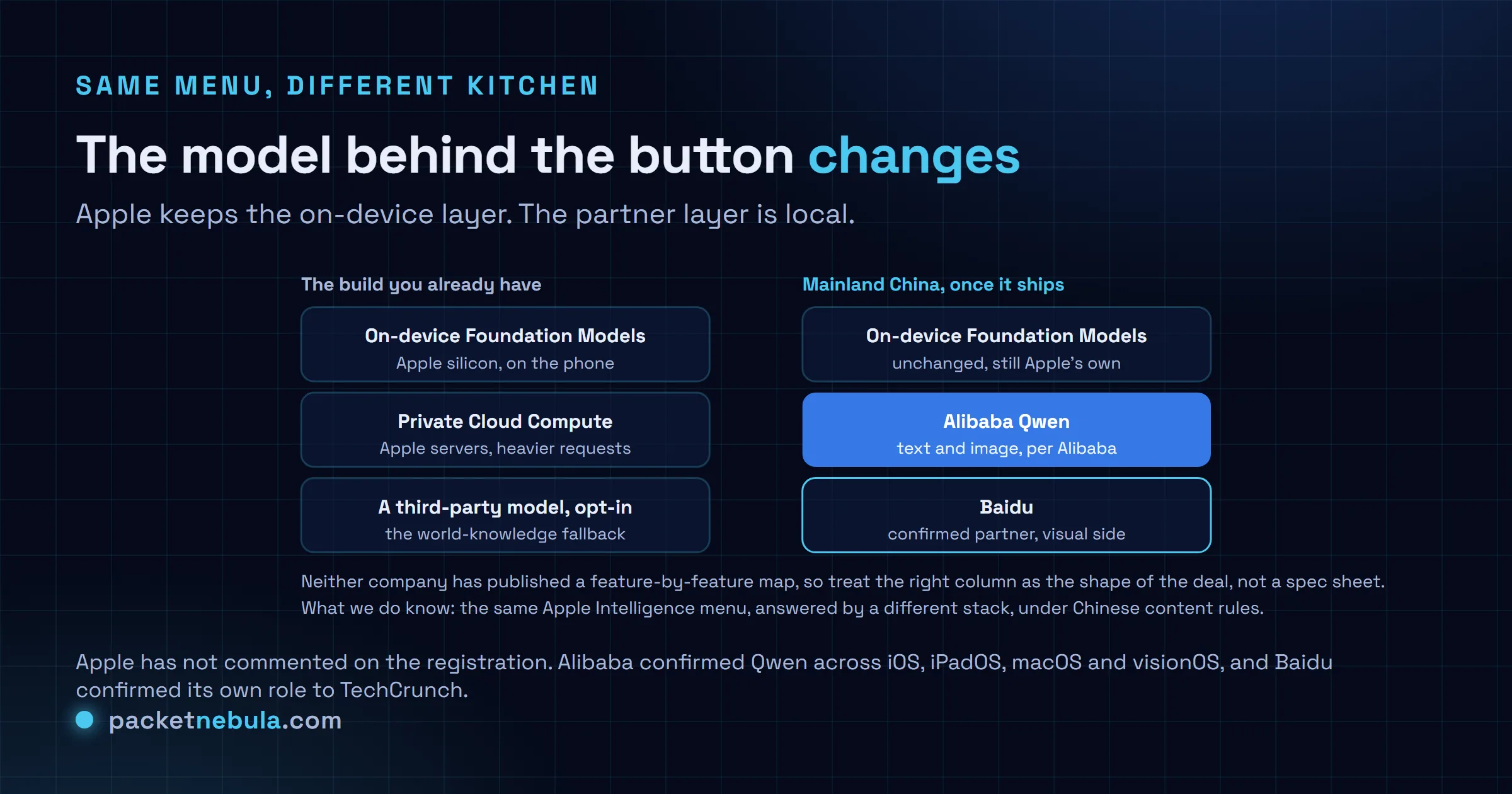
Diagram comparing the Apple Intelligence stack outside China (on-device Foundation Models, Private Cloud Compute, an opt-in third-party model) with the mainland China build (on-device Foundation Models unchanged, Alibaba Qwen for text and image, Baidu on the visual side).
Same menu, different kitchen. Apple keeps the on-device layer and hands the partner layer to local models.

Who actually answers the request

This is the part that should interest anyone building software. Alibaba confirmed to CNBC that Qwen will be integrated into Apple Intelligence experiences across iOS, iPadOS, macOS and visionOS for Chinese users, covering text and image understanding and generation. Baidu confirmed its own role to TechCrunch, and has been reported as taking the visual search side. TechCrunch also notes Apple has been sniffing around DeepSeek and ByteDance.

Apple keeps its on-device Foundation Models. Those run on the phone and don’t need anyone’s blessing. It’s the layer above, the one that handles the requests too big for the handset, where China gets a different answer than you do.

So the same button, in the same UI, wired to a different brain depending on where the SIM is. That’s genuinely new territory for Apple, and I don’t think the consequences are priced in yet. If you support an app with users in mainland China and you lean on system-level AI features, the output behaviour, the content filtering and the refusal patterns won’t match what you test at home. Test there, or don’t ship the feature there. If you want a sense of what Qwen is actually like to work with, we’ve written up running Qwen 3.7 locally and put it head to head with GLM 5.2.

Why Apple cared enough to wait two years

Money, mostly. Greater China brought Apple $20.5 billion in the last quarter, up 28% year over year, and Apple recently clawed back the number two spot in the Chinese smartphone market. Meanwhile Huawei and Xiaomi shipped on-device AI to their customers while the iPhone sat there with the feature switched off. Since September 2024. That’s a long time to sell a flagship with a hole in the spec sheet.
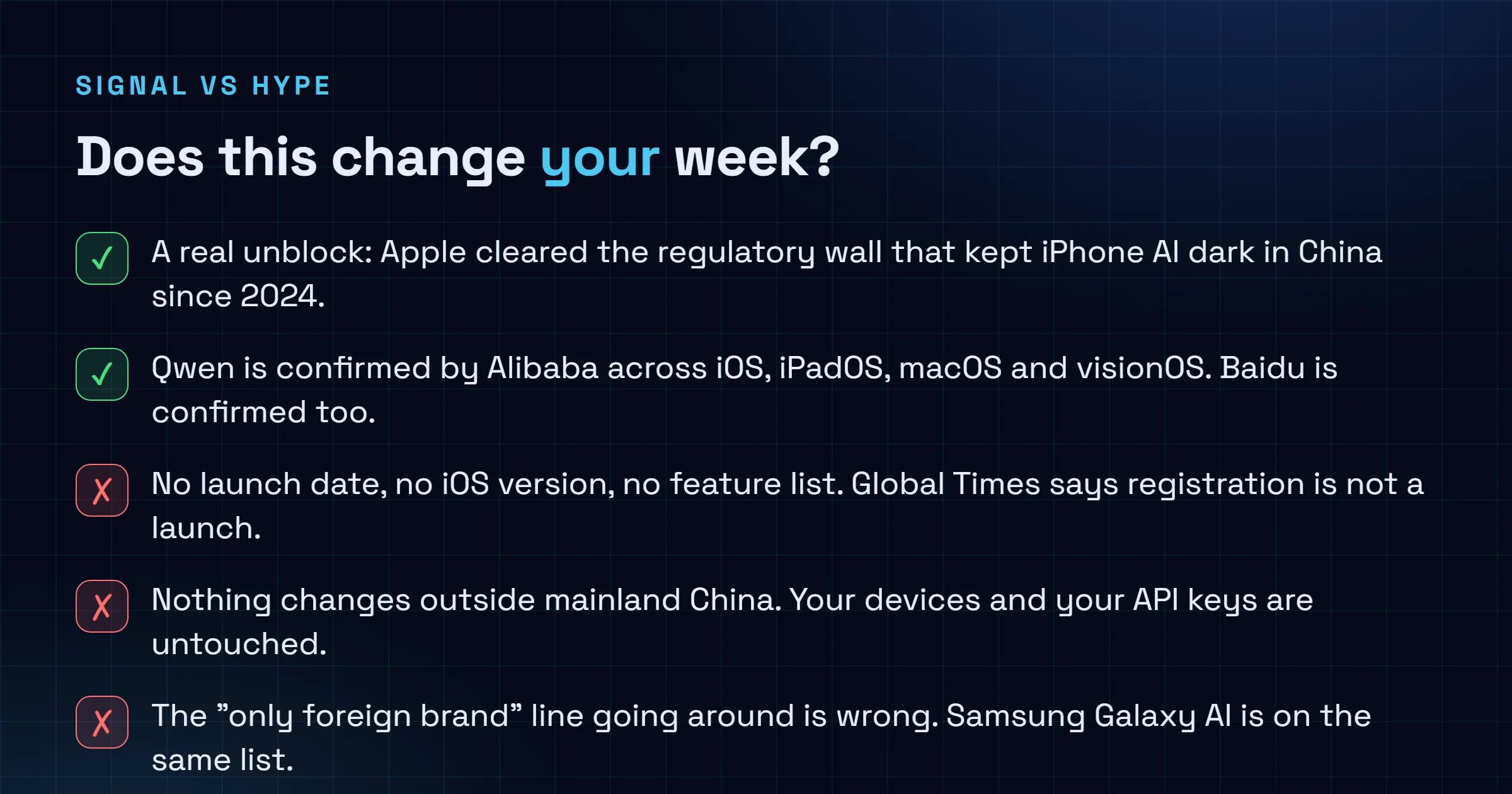
Checklist of what the China approval changes: a real regulatory unblock and confirmed Qwen and Baidu partnerships, versus no launch date, no change outside mainland China, and the incorrect only-foreign-brand claim.
Our read on signal versus noise here.

The official Apple Intelligence mark, a looping ring in muted gradient colours on a light background.
Image: Apple

What we’d actually do with this

Nothing, today. That’s the honest answer if you’re outside China.

If you are inside it, or you ship to it, the useful move is to stop treating “Apple Intelligence” as one product. It’s now a brand covering at least two different backends, and the Chinese one runs under content rules that Apple doesn’t set. AppleInsider raised the censorship question and it’s a fair one, because Apple has never had a partner model sitting in that position before.

The other thing to watch is whether this filing was the last hurdle or just the newest one. AppleInsider isn’t sure it’s the final step, and given that Apple previously had trouble adapting Baidu’s models for Chinese customers, a registration certificate and a shipping feature are not the same object. Watch for an iOS point release with a China-specific build note. That’s when it’s real.

Until then, this is a stamp on a form. An important stamp. Still a form.

If you’re tracking what Apple’s assistant does elsewhere, our write-up of the iOS 27 public beta and the rebuilt Siri covers the version Chinese users still can’t have.

Sources

Reporting and confirmations for this piece: TechCrunch on the approval and the Baidu confirmation, Global Times on the registration notice and the launch timing, AppleInsider on what may still be outstanding, and BigGo Finance on the full list of seven registered services.

Frequently asked questions

Is Apple Intelligence available in China now?

No. The Cyberspace Administration of China published Apple Intelligence in a batch of seven registered on-device generative AI services on July 15, 2026, which is a compliance filing rather than a launch. State outlet Global Times said directly that completing registration does not mean an immediate launch, and that the rollout timeline remains unknown. Apple has not commented, and no iOS version or feature list has been named.

Which AI model powers Apple Intelligence in China?

Alibaba confirmed that its Qwen models will be integrated into Apple Intelligence experiences across iOS, iPadOS, macOS and visionOS for users in China, covering text and image understanding and generation. Baidu is also a confirmed partner and has been reported as handling the visual search side. Apple keeps its own on-device Foundation Models. Neither company has published a feature-by-feature breakdown of who answers what.

Does this change anything outside mainland China?

Nothing at all, for now. The registration is a mainland China regulatory step under the Interim Measures for the Management of Generative AI Services. Your devices, your Apple Intelligence features and any API keys you hold are untouched. The one thing worth tracking is the precedent: Apple is shipping a regionally different model stack behind the same interface, which matters if you build or support apps used in China.

Was Apple the only foreign brand approved?

No, and that line has been circulating incorrectly. The reported list of seven services includes Samsung Galaxy AI alongside Apple Intelligence, Huawei Xiaoyi, OPPO AndesGPT, vivo Blue Heart, Xiaomi Surge AI and Nubia Doubao Phone. Two foreign brands, not one. Apple is the higher-profile case because its AI features had been blocked in China since 2024, not because it stood alone on the list.

Tags: aiappleapple-intelligencechinanewsqwen
Share197Tweet123
stephane

stephane

  • Trending
  • Comments
  • Latest
Answer card: Proton Lumo 2.0 is private by policy, not by locality. Saved history is locked so even Proton cannot read it, but the prompt is decrypted on a Proton EU server to answer it, then forgotten.

Proton Lumo 2.0 review: how private is it, really?

3 September 2026
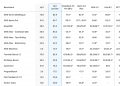
The Agentic Coding section of the official Hy4 preview benchmark appendix published by Tencent, a table comparing Hy3 and Hy4 preview against DeepSeek V4 Pro 0813, Qwen 3.8 Max, GLM 5.3, Kimi K3, GPT 5.6 Sol and Claude Opus 5 across SWE-bench Multilingual, SWE-bench Pro, DeepSWE, three SWE Atlas tasks, SWE-Marathon, Terminal-Bench 2.1, NL2Repo-Bench, CyberGym, ProgramBench, PostTrainBench and Harbor-Index.

Tencent’s 770B Hy4 tops one benchmark row in 46

3 September 2026
Answer card: Qwen 3.7 Max is API-only and cannot run locally yet; the open Qwen models (Qwen 3.6 27B, qwen3:8b to 32b) run offline via Ollama.

Qwen 3.7 local: what you can actually run offline

22 June 2026
Answer card: JWTs are not encrypted, anyone can read them; the signature proves who issued the token, not who may read it.

Are JWTs encrypted? No, and the difference will bite you

0
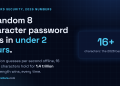
Answer card: a random 8 character password falls in under 2 hours offline, while 16 random characters hold for 1.4 trillion years at the same speed.

How long does it take to crack a password in 2026?

0
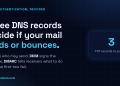
Answer card: three DNS records decide if your mail lands or bounces; SPF lists allowed senders, DKIM signs messages, DMARC sets the failure policy.

SPF, DKIM and DMARC explained: the records your email needs

0
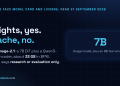
Answer card stating that Qwen-Image-2.1, released on 20 September 2026, ships open weights with a 7 billion parameter diffusion transformer, a Qwen3-VL 8B text encoder and an RGBA VAE totalling about 33 gigabytes in BF16, under the Qwen Research License that limits use to research or evaluation and requires a separate commercial licence, unlike the Apache 2.0 licence of Qwen-Image 1.0.

Qwen-Image-2.1 brings the weights back, but not the Apache licence

21 September 2026
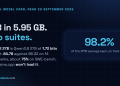
Answer card stating that Ternary Bonsai 2 27B, released by PrismML on 17 September 2026 under Apache 2.0, packs Qwen3.8 27B into 5.95 gigabytes at 1.72 bits per weight, keeps 98.2 percent of the 14-benchmark average, about 75 percent on SWE-bench Verified and Terminal-Bench 2.1, and needs PrismML's llama.cpp fork to run.

Does Bonsai 2 27B really keep 98% of Qwen3.8 in 5.95 GB?

20 September 2026
Answer card stating that Jev 1.13 from TypeSafe AI is a decision model in early access since 15 September 2026 that returns typed probabilities instead of text, priced at 42 dollars per billion input tokens with output tokens free, answering in 70 to 500 milliseconds, with a 64K token request budget, text input only, and a documented list of things it does badly, including counting and dates.

Jev 1.13 bills $42 a billion tokens, and it can’t count

19 September 2026
  • About
  • Contact
  • Privacy
  • Legal

Copyright © 2026 Stephane Cardon.

Welcome Back!

Login to your account below

Forgotten Password?

Retrieve your password

Please enter your username or email address to reset your password.

Log In
No Result
View All Result
  • Home
  • Articles
    • Security
    • Network
    • Dev
    • Sysadmin
    • SEO
    • Email & DNS
  • Tools
    • Network tools: free, fast, no signup
    • Security tools: free, fast, no signup
    • Developer tools: free, fast, no signup
    • Sysadmin tools: free, fast, no signup
    • SEO tools: free, fast, no signup
    • Email & DNS tools: free, fast, no signup
  • Download
  • About

Copyright © 2026 Stephane Cardon.